
Martin Scorsese is something of an enigma, which is certainly a new way to look at an artist who has come to be seen as one of the definitive voices in the history of cinema. He has somehow managed to both perfect certain genres, which have often come to be his most distinctive, as well as being intrepid enough to venture out of his comfort zone and do something entirely different. He may be celebrated for the former, but it’s the latter that truly proves Scorsese is a master of his craft. One of his most beloved experiments is in his adaptation of Edith Wharton’s seminal work of Romanticism, The Age of Innocence. Held up by many to be amongst his finest work, while still be regularly eclipsed by his more canonical classics, this adaptation is often quite divisive, with the perception that it is a masterful work of period drama often conflicting with the idea that Scorsese was perhaps slightly too much out of his depth – I tend to agree more with the first group, but the arguments held by the second are not without some merit, since the director was doing something profoundly different, which he had yet to explore at the time, but which he’s subsequently proved to be well within his wheelhouse. If anything, The Age of Innocence should be celebrated purely on the basis that it hails from a director outright refusing to rest on his laurels (which had grown to a truly intimidating size by the time this film went into production, based on the acclaim that already defined him as perhaps the preeminent American master currently working in the medium), and instead creating a work that sees him taking a slight sojourn from the more hardened, cynical nature of the majority of his previous films, and instead working in the realm of something more optimistic, but no less compelling than anything he had done before.
The Age of Innocence is a marvel, since it initially seems too detached from everything Scorsese was known for, but once you’re fully immersed in this story, all the traits that defined his career are there, just in a very different form. Essentially, Wharton’s story is about a wayward individual who is having a crisis of identity – he wants to stay true to himself and retain his strong principles, but also yearns to climb the ladder of success, gradually growing in reputation through interacting with those he admires, and hopes to eventually overtake. Along the way, there are various obstacles that come into his way, but he circumvents them through his clever wit and ability to work through any situation, regardless of how challenging it may be. This is quintessentially the premise of many Scorsese films, and the only difference that stands between The Age of Innocence and his more distinct work is the form this story takes. His passion is exceptionally clear here, but seems to be derived less from the self-assured hand of a seasoned veteran, but rather one who is intent on exploring something new. Adapting the novel was doubtlessly something of a risk, but in Scorsese’s capable hands, it was never going to fail. He is a director who frequently shows himself to be capable of adapting his own style to fit certain material, but what is most striking is how, even when stepping away from what is most familiar, his quirks aren’t ever fully abandoned – the intricate understanding of the human condition in contrast to the world around it, the smallest character-driven details that comment on broader issues, and a keen curiosity of the aspects of our existence that don’t always manifest in discernible ways, are all present here, and are precisely what makes The Age of Innocence such an enthralling piece of cinema.
Not only does this film do the source material justice, it explores some of the aspects that are sometimes missing in the more traditional period dramas – this isn’t simply a lush romance about a man caught between two women, one who is reliable and another who incites a fiery passion, but a metaphysical odyssey that delves deep into the psychology of its complex protagonist, as well as exploring the various idiosyncrasies of 19th-century high society, demonstrating their various machinations in exceptional detail. Striking the perfect balance between a bold period epic and a more intimate, character-driven drama, The Age of Innocence is beautifully-calibrated to both the sensibilities of its versatile director, and for audiences, who are doubtlessly searching for something elegant but not prosaic. One can criticize this adaptation in various ways, but one area in which it can’t quite be dismissed is in how it handles the stiffer side of the genre in which it was made. Period dramas are divisive, since those who are fascinated by this form of storytelling are frequently beguiled by the gorgeous gowns and antique furniture that populate the frames, while those who are more agnostic to it are more likely to stand at arm’s length. Scorsese works around this problem by employing the best of both worlds – beautifully sophisticated and never too revolutionary, The Age of Innocence avoids being stuffy by employing a more direct approach to its ideas. Scorsese ensures that everything flows exceptionally well – Joanne Woodward narrates the film, giving it a fluidity that aids it significantly in staying interesting (since it bridges the gap between the novel and the adaptation by allowing many of the details to be known more directly, rather than occurring in unnecessary exposition, or being elided entirely), and even at its most lavish, The Age of Innocence never appears to be overwrought or melodramatic, flourishing in its distinct but restrained style.
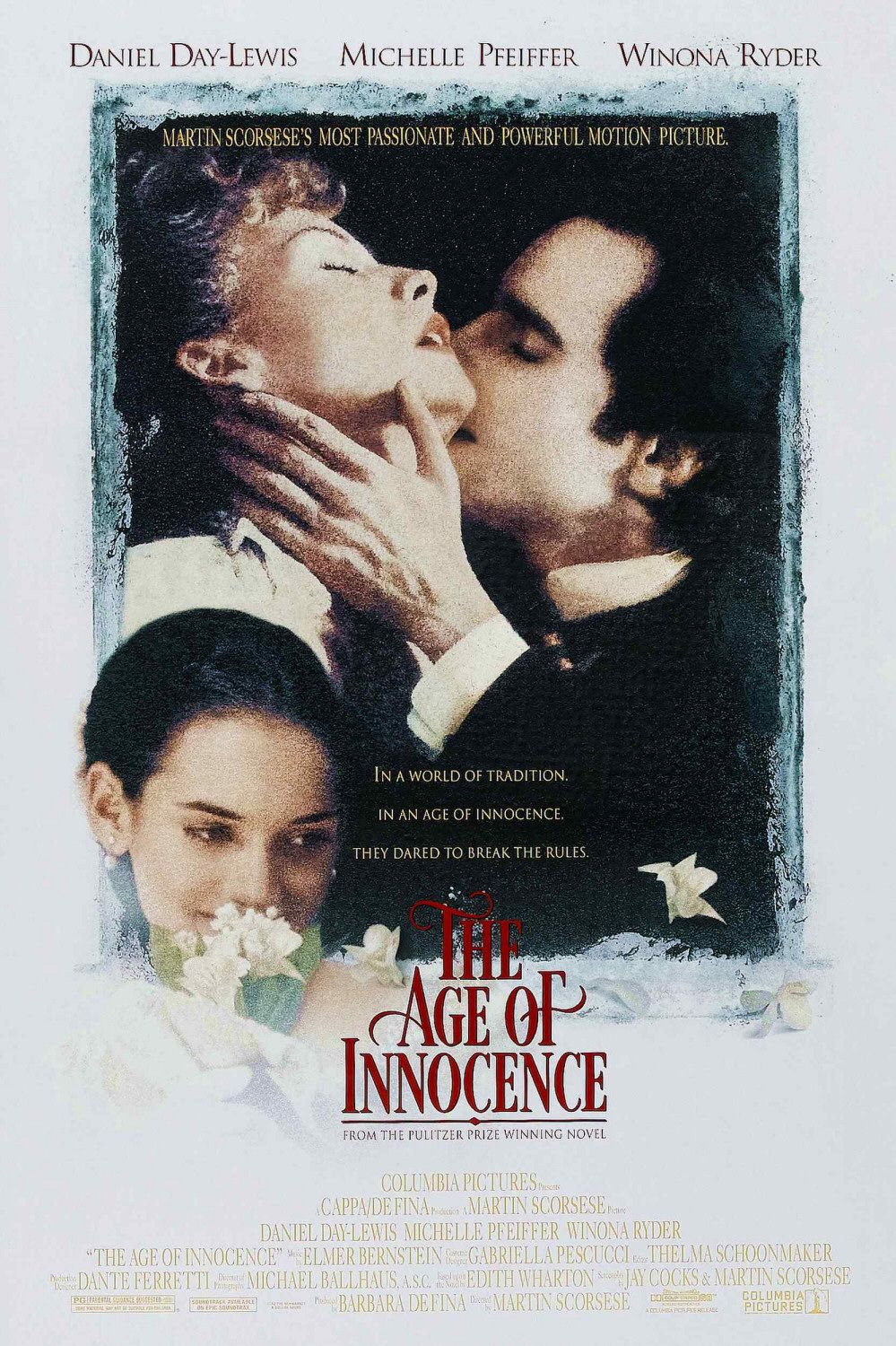
Also equally complicit in the success of The Age of Innocence are the performances given by the cast. The film is lead by Daniel Day-Lewis, who was at the peak of his career here, the dashing leading man who was almost fatally committed to his craft. In the part of Newland Archer, Day-Lewis is giving another recognizable period performance, one that fits into the socio-cultural milieu without being all that revolutionary, which was something he remedied in the following decades, where his sporadic film appearances were accompanied by much broader character work. He’s absolutely adequate, and with the exception of the final few scenes (where his character truly leaves an impression), blends well into the film without being entirely memorable – while it seems like a criticism, it’s more of an observation to the actor’s more stoic style being prominent, and working better in the context of this particular film. Undeniably, The Age of Innocence belongs to the women in the cast – Michelle Pfeiffer is the epitome of elegance as Countess Olenska, a woman caught between worlds, American by nature, European by upbringing and social refinement, and instead of enjoying both cultures, she feels isolated wherever she goes. Winona Ryder is wonderfully charming as the pixie-like May, an innocent young woman who has yet to be corrupted by the society that seems intent on both celebrating what she represents, and revoking it should she step out of place. Miriam Margoyles is also a scene-stealer as the eccentric Mason Mingott, a high-society empress who presides over the trials and tribulations of New York’s social scene with both an iron-fist and witty retort, which makes her both an intimidating figure and a wonderfully buoyant presence. Scorsese extracts some memorable performances from his cast, all of which are doing exceptional work in realizing the sometimes complex character work established by Wharton.
Despite being a gorgeous work (the cinematography by Michael Ballhaus, and the costumes by Gabriella Pescucci are absolutely stunning and are worth the price of admission alone), The Age of Innocence doesn’t only thrive on how Scorsese composes pure visual poetry from the source material. It’s a work of distinct beauty that also doesn’t dare neglect the more human side of the story, feeling oddly authentic, which isn’t something normally used to describe period dramas of this calibre. Scorsese and co-screenwriter Jay Cocks approach Wharton’s novel not as an impenetrable, sacred text that should be adapted directly, but rather as one that should be carefully curated, and tinkered with to the point where they could put their own artistic spin on a more archaic text without changing too much. Adaptations are supposed to be invigorating and earnest, rather than simmer with the sensation of merely being a decent translation from page to screen. The Age of Innocence manages to stand on its own merits, and gradually grows into quite a fascinating work, one that feels entirely authentic without needing to abandon the gorgeous details that make the original so wonderful – realistic dialogue that doesn’t feel stilted, earnest development of its characters and the effort to actually work beyond the confines of the genre are all aspects that make The Age of Innocence so extraordinarily compelling. This is what a literary adaptation should look like, at least in terms of those that attempt to directly work from the distinct source material – it needs to pay appropriate tribute, but not without giving its own unique insights into the underlying message. Scorsese and Cocks adapt it extremely well, and its ability to work in conjunction with some very talented individuals behind the scenes only bolsters the impactful brilliance that this film perpetually demonstrates and often even celebrates. The Age of Innocence is a stunning work that has some marvellous performances, wonderful design and an even more meaningful approach to familiar material, and while it may not reach the heights of some of his other works, this is a brief foray into the realm of the unknown for Scorsese, who proves that, even when doing something different, he’s always absolutely in control of his craft, which often leads to staggering works such as this film.
 The Postmodern Pelican
Every word you have written is absolutely accurate. What remains inexplicable is that if this praise is correct, why is the film such an overwhelming bore?