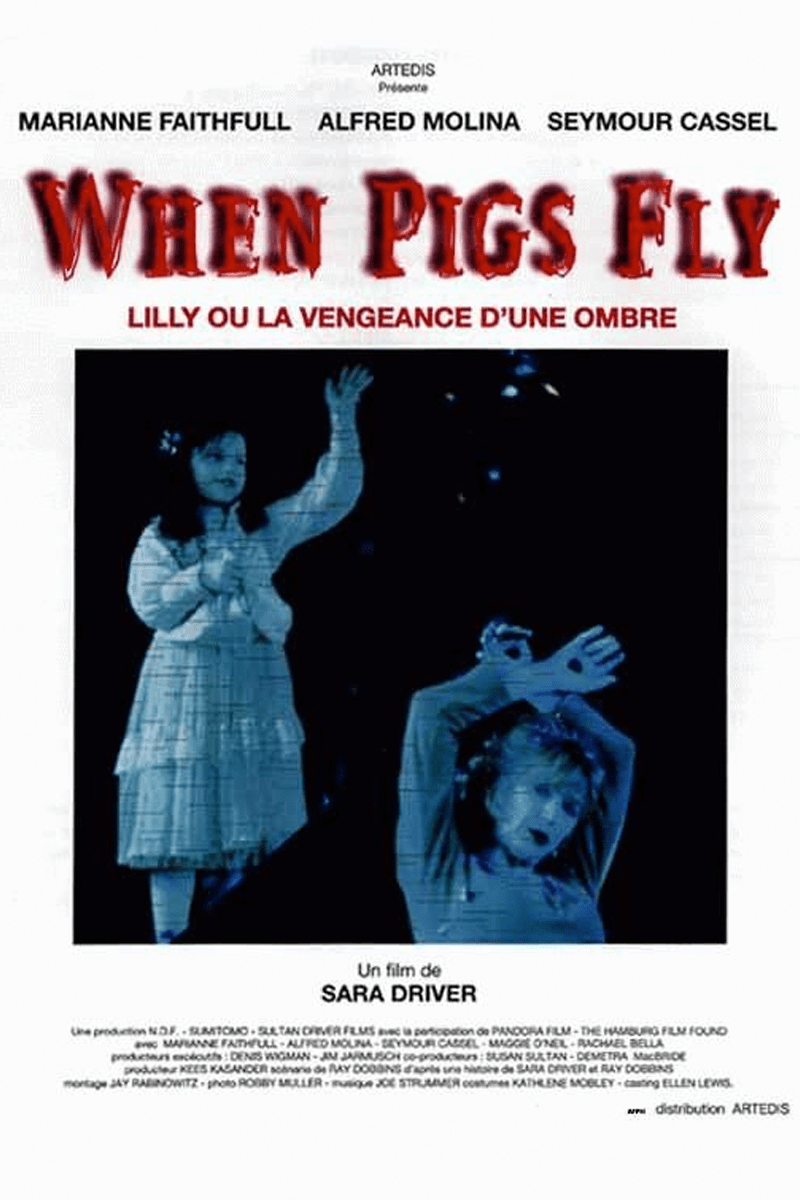
 Set in an indeterminate location somewhere in a seaside region of America, we’re introduced to Marty (Alfred Molina), a former jazz musician who has now lost his way, and has ended up wasting the best years of his life soaked in alcohol and teaching children how to play the piano. However, despite his sad existence, there are moments where he temporarily regains the passion he had before, but which are normally restricted to his dreams or the flights of fancy he takes when conducting lessons, the realization being that he is never going to be able to achieve the same level of accomplishment as he did in his peak. He inadvertently comes into possession of an old rocking chair when his tenant Sheila (Maggie O’Neill) leaves it on his doorstep. What neither of them realizes is that the chair comes with a pair of companions, namely Lily (Marianne Faithfull) and Ruthie (Rachael Bella), two ghosts who are bound to the chair, and have to follow it wherever it goes. They soon manifest to Marty, who believes he is stuck in some lucid dream until he realizes how real they are. The two new visitors to his home are far from the terrifying spectres he imagined – they’re playful, lovable rogues who enjoy using their afterlife privileges to make Marty’s life more difficult, in an attempt to pull him out of the slump he’s become nestled comfortably in. He comes to know the two ghosts and subsequently realizes there is more to their story than he expected, slowly uncovering a sinister set of secrets that have been quietly concealed in the town, and which Marty and ??? work laboriously to help resolve, not only because it is the right thing to do, but also to give the ghosts the eternal rest and closure they’ve been seeking for decades.
At first, it seemed bewildering that When Pigs Fly isn’t a better-known film – after all, its the sophomore film of independent cinema sensation Sara Driver, bears the name of her romantic and creative partner Jim Jarmusch as one of the producers, counts the likes of Joe Strummer (as the film’s composer) and Robby Müller (lending his gifted photographic talents to the film) amongst its crew, and existing in that ambigious space between Ghost and The Sixth Sense, where subversive dramas about the living interacting with the departed being quite vogue. However, once you see the film, it’s not all that difficult to understand – by no means a bad film, and far from a failure, When Pigs Fly is the kind of overly-ambitious independent drama that tries to do too much, without taking the time to develop on its promising ideas all that regularly. I am extremely fond of this film and count it as one of the more interesting experiments during this wave of independent arthouse films, but it falls just short of acquiring the status of a masterpiece, being a fascinating piece of filmmaking, but not anything that stands out more than another of the other equally-ambitious works of experimental comedy produced during this time. However, there are moments where it seems like Driver has made a true gem of a film, a metaphysical dark comedy about identity and embracing the unknown that stands as a profoundly moving work, even if it can be slightly derivative at times, which it easily overcomes by combining gorgeous visuals with a wonderfully buoyant story that carries a lot more weight than we’d expect at the outset.
When Pigs Fly is mostly a vehicle for Alfred Molina, who had been a consistent part of many great films on both sides of the Atlantic, finding relative success as a wonderful supporting presence in a variety of notable films, normally occupying supporting roles. Driver casts him in the kind of role that many character actors yearn for – a complex protagonist who is both endearing but not derivative and giving them the opportunity to extend their gifts far beyond the confines of what had been previously afforded to them. Independent cinema, if anything, gives more obscure actors the chance to show off their talents, and while we may appreciate Molina far more today, his earlier career was defined by an imbalance between the size of the role and the popularity of the film. Needless to say, When Pigs Fly is not something that put the actor on the map, but rather demonstrated his incredible ability to morph into any kind of character. Playing the sad-sack former jazz wunderkind who has regressed into pitiful alcoholism and languid depression, Molina shows what a chameleon he is – charming but grounded very much within reality, he gives such a compelling performance that often feels as if it is bursting at the seams, raring to be a part of a more focused film, but still bolstering it to the point where it works entirely on the strength of his performance. Marianne Faithfull, a counterculture musical legend, is also quite good as the spectre of Lily, the long-deceased wife of the owner of the local pub who may or may not have killed her for insidious reasons. Faithfull and Molina work so well together, playing off each other with such off-kilter charm, they really manage to bring a wonderful depth to the film, carrying it beyond a slightly predictable story and evoking the emotional heart of the piece.
When Pigs Fly is a film that does tend to lack focus from time to time, mainly a result of Driver infusing far too much into this film than she realizes it can feasibly handle. Screenwriter Ray Dobbins (in what was his first and only credit) tries far too hard to make this a profound masterpiece that blends every conceivable genre, while still being an effective part of the current independent movement that was distancing itself from the nihilistic absurdism that defined this era, and adopting a more experimental approach to employing inspirations from different genres. It is undeniably difficult to not like this film in such way – there is legitimately a lot of value to this film that really doesn’t manifest in more mainstream fare, a kind of easygoing surrealism that feels entirely natural when taken from this perspective. Add to this the stunning photography by Müller, whose camera could catch elements of the human condition that were rarely seen before, and the incredible scenery (with the German city of Hamburg standing in for the ambigious American setting) reminding me of the industrial beauty of Michelangelo Antonioni’s Red Desert, which also provoked themes of existence in a hellish urban landscape driven by unstoppable progress that strips one of their soul. Considering a central theme in this film is that of fragmentation – pieces of the past falling together to unveil certain unimpeachable truths, the shattering of one’s identity and the attempt to reclaim it and the general sense of putting the pieces together to find a way forward – it’s unsurprising that there was a cumulative power to this film that just works so exceptionally well in the context of the story, even if there was so much more that could’ve been done with it, particularly in terms of the quiet resilience that underpins this story and makes it such a profoundly moving achievement.
When Pigs Fly is a film about exploring identity, and this is ultimately exactly what it does – and while Driver may not always hit the mark the way she could have through employing a more direct approach, it’s difficult to not find the value in this film, especially when it hits that beautiful crescendo of existential resonance. The film isn’t always as subtle at it could’ve been – the theme of the ghosts of the past haunting us, both literally and metaphorically, can be occasionally heavy-handed, but it works in a very unique way in the context of the film as a whole. Perhaps not necessarily being much more than its premise claims to be, there’s an odd charm in this wonderfully strange film that carries a deeply poignant message that it may not always explore to its fully-extent (and which suffers from a lacklustre third act that just isn’t as thrilling as it wants to be, but which does set up a heartbreakingly beautiful climax that adds so much nuance to the film), but always manages to keep the audience engaged, through its incredible humanism and deft simplicity that transcends minor narrative problems to become a true gem of a film. Driver is a filmmaker who deserves a lot more credit, and while When Pigs Fly may not be particularly flawless, it has enough charm embedded within it to leave an indelible impression, which is worth more than its attempts to reach at greatness, rather than recognizing its own quaint brilliance.