 There are few films I have anticipated as much as Can You Ever Forgive Me?, a film that is a chaotic blend of a multitude of elements I absolutely adore – a true-life biopic about an eccentric criminal, bookshops, New York in the 1990s, and of course two of my absolute acting idols, Melissa McCarthy and Richard E. Grant, two performers I never thought would ever appear across from one another, but have transformed into Hollywood’s most envious duo of friends, as well as giving two of the year’s most extraordinary performances. There are not many films I feel are fully tailor-made for me, but Can You Ever Forgive Me? is most certainly one of them – an elegant and hilarious crime film that never takes itself too seriously, and sometimes confirms the central theme of the film, which is sometimes reality is stranger than fiction, as presented through this film’s often dizzying blend of genres and conventions. It is a paced, complex and well-written work (hailing from the minds of Jeff Whitty and independent film icon Nicole Holofcener), and Marielle Heller, making her second film after the incredible Diary of a Teenage Girl, proves herself to be one of cinema’s most exciting new talents, showing that she has a masterful control over her films, narratively, emotionally and tonally. Can You Ever Forgive Me? is a terrific film, and one that will be in constant regular viewing rotation, because at its heart, this is a very special film, and one of the year’s most unexpected gems.
Lee Israel (Melissa McCarthy) is a middle-aged writer who has received some minor acclaim in previous decades for her work on a variety of female celebrities such as Estee Lauder and Dorothy Killgallen. When this film takes place (in the early 1990s), she is working on a biography of Fanny Brice who, despite being an entertainment icon, is not the most alluring subject for her publishers who are far more interested in the more current work of more popular writers, and thus pushes her into near-poverty after her foul-mouthed, mean-spirited, heavy-drinking ways get her fired from her job. Desperate to make money to support herself, she finds herself driven to dishonesty by forging letters by famous writers such as Dorothy Parker and Noel Coward, which she sells for extremely high prices and eventually starts to live a better life, with the help of her only friend, a gay, homeless cocaine dealer named Jack Hock (Richard E. Grant), with the pair becoming two of the most infamous figures in the New York literary world. Whether it is the solid income she is receiving, or the fact that her writing is finally earning her money (albeit through very dishonest means), Lee continues on for years, but like any criminal, she makes mistakes and raises suspicions, and eventually she is being pursued for her crimes – but does she regret any of them?
The press surrounding the release of Can You Ever Forgive Me? has been quite interesting from the perspective of the publicity it has received for its leading star, mainly because this is a dramatic film featuring one of the greatest comedic minds her generation, Melissa McCarthy. Numerous publications have noted how both critics and audiences have responded to this film as being something akin to a redemptive turn for the actress. I tolerate her often mediocre films much more than most, but even I can admit that some of her recent choices have been extremely uninspired and often entirely awful, even if she commits to everything she does with brutal dedication. Even in the most disappointing films, McCarthy manages to be consistently good, managing to elevate the most dreadful material and salvaging some value when there seemingly is none. All of this doesn’t matter when we consider Can You Ever Forgive Me? as being amongst McCarthy’s finest work, standing alongside Spy and Bridesmaids as poignant examples of her immense talents, as well as her willingness to venture off into seemingly unchartered territory. The most remarkable part of Can You Ever Forgive Me? is that it isn’t the archetypal example of a comedic actor in a dramatic role – it is quite simply a brilliant performer in a challenging role, someone that shows that she is not only capable of outrageous comedy but also of intricate, character-driven drama. This is a transformative performance for McCarthy, who extends her well-known abilities to take on a role that is far more than just a misanthropic middle-aged woman. Lee Israel was certainly eccentric, and she had a big personality (albeit not a particularly pleasant one), but McCarthy never once plays the character for cheap laughs – rather, she constructs a complex portrait of a struggling artist who is doing her very best to pull herself out of a difficult time, even if that resorts to crime. This is a film that will massively benefit McCarthy – for ardent fans of the actress, Can You Ever Forgive Me? will be yet another example of her incredible talents, and for those that may not be particularly enamoured, it will offer the opportunity to see McCarthy in an entirely new way, showing that while many of her films may not be very good, she is a brilliant actress, someone capable of remarkable sincerity and a truly impactful performance.
It isn’t always the most appropriate to make a review personal, because there inevitably come allegations of bias in how someone views a film – but as I’ve mentioned a few times before, I am an enormous admirer of Richard E. Grant, who I consider to be one of the most supremely gifted character actors of his generation, and someone who has had a long and storied career, but hardly has received the credit for his talents. Withnail & I and How to Get Ahead in Business are two astonishing films, and perhaps his most well-known leading roles, and stand alongside a long career of memorable supporting turns in some great films. Can You Ever Forgive Me? is the film that finally brought him the mainstream exposure he’s been overdue to receive for decades, and it couldn’t have come a moment sooner. Now even though I adore him, I wasn’t expecting him to give such a brilliant performance here. Based on the publicity material surrounding the film, one could easily be mistaken in thinking that Grant was just playing the outlandish sidekick to McCarthy’s bitter anti-hero, a reliable comedic relief and an antidote to McCarthy’s very prickly and misanthropic Lee. Yet, in the film, we see that there is far more to his performance than just being a stereotype. It is a colourful portrayal of someone who may initially appear to be a stock character – the sassy, exuberant and overly-camp homosexual. Yet, as the film progresses, we see that beneath the bombastic exterior of Jack Hock there is an abundance of meaning – he is not merely an archetype, but a fully-realized character of his own, filled with complexities and nuances that allowed him to fashion one of the year’s most resonant characters, making Can You Ever Forgive Me? as much about Grant as it is about McCarthy. Grant is a scene-stealer, and the fact that he is receiving such immense praise, both for this film and for his longevity as an actor throughout his career, is one of the year’s most heartwarming moments, and even more than that, he is quite simply brilliant in this film.
Nearly everyone I spoke to about Can You Ever Forgive Me? before watching it noted how this was a miserable film, focused entirely on two despicable people. I could not disagree more, because Can You Ever Forgive Me? is as far as one gets from a depressing work, mainly because it is focused not on the actions of the two main characters, but rather a sensitive ode to friendship, that just so happens to be between two very nasty individuals. This film is a subversion of the odd couple trope – how often do we get films where the two main characters are a misanthropic, failed lesbian writer and a homeless, gay drug dealer? Perhaps the most unique quality of Can You Ever Forgive Me? is how this is the perfect date-night movie for horrible people, and anyone who can identify with the mantra of the curmudgeon will certainly adore this film – but it never once disrespects its characters in a way that feels inauthentic, and it doesn’t take any cheap shots at mocking them. Jack and Lee were extremely dreadful individuals – they were both bitter, resentful and deceiving people who had very few redeeming qualities about them, and whose actions were nothing short of abominable. However, they were also lonely, broken people bound in their mutual disdain for humanity, but only because of how wronged they feel by a society that just doesn’t seem to care too much about them – they are not inherently bad people, but rather desperate individuals driven to the point of doing anything, not to necessarily become rich, but rather to just survive. Can You Ever Forgive Me? is a film about outsiders, and even if the viewer can’t fathom engaging in such sordid deception as these anti-heroes, it is one that anyone who has felt out of place will definitely relate to in some way, finding solace in the fact that Heller has made a film that speaks to those who just don’t get along with others, no matter how hard one tries. There is a great deal of sadness in this film, but there is also unquestionable happiness, because Jack and Lee end up finding each other, and in their friendship they discover the spark both of their lives had been missing – this is one of the year’s most unconventional love stories, looking at the liberating wonder of friendship, showing how even the most unpleasant of people deserve to have the experience of a companion in some form. The fact that the final moments of Can You Ever Forgive Me? doesn’t solely focus on Lee, but on Jack as well is a testament to the poignant representation of companionship that underlies this incredible film, with its moments of true tenderness being just as captivating as the thrilling caper storyline.
Another stark aspect of Can You Ever Forgive Me? is it’s empathetic – it is almost an anomaly that a film with such cold and sterile subject matter could be so engrossing and compelling, which is a result of the warm and endearing execution on the part of Marielle Heller. Not only visually, where the film does exceptionally well in replicating the comforting vision of New York in the early 1990s (as seen in the countless films made around the time), with most of this film taking place in bohemian apartments and independent bookstores, which lends it a certain elegance that would not be expected from the story it presents. As mentioned previously, Can You Ever Forgive Me? is not a film about bad people doing bad things, but rather a tale of desperate people in desperate times, doing whatever it is they can do to make a living and continue surviving on whatever they can get, making this an exceptionally humane story. Very rarely does a film focus so explicitly on the despicable actions of its characters, without redeeming them, but still remain so hilarious and endearing. There is a clear heartfulness throughout the film, which is a result of two elements that are executed with such deft precision – the central dynamic between McCarthy and Grant (who have some of the finest cinematic chemistry of the past decade, with their pairing destined to become truly iconic – and their real-life friendship as a result of this film is simply heartwarming) and the fact that Can You Ever Forgive Me? never once attempts to justify the actions of Lee and Jack. They certainly have to face the consequences, and they are duly brought to justice, but the film refuses to villainize them. This wasn’t a glamorous tale of crime and deception, but a down-to-earth, endearing biographical comedy that looks at two very strange individuals, their unconventional friendship and their audacious crimes that thrust them into the world of great literary heists (there are quite a few, it would appear). In essence, Can You Ever Forgive Me? succeeds because not only does it feel authentic, it also genuinely adores its characters – and to love such terrible people is a very rare (and also oddly admirable) quality.
How can a film about lies, deceit and dishonesty be so entirely thrilling and enthralling? Can You Ever Forgive Me? is a true masterwork, a hilarious dark comedy that features acidic, caustic storytelling that is relentless in wit, as well as having a genuine fondness for its story at its core. Despite being about lies and forgery, Can You Ever Forgive Me? is an earnest and delightful film that appears so authentic, whether it be in its nostalgic replication of New York City in the 1990s, or the impactful performances from its two leads, or the general explicit honest in how it shows the extents some will go to in order to provide for themselves. It also questions reality and begins to challenge the definition of art – when Lee Israel boldly proclaims that she “does a better Dorothy Parker than Dorothy Parker”, could she be right? It is a poignant work, and one that has an emotional resonance that is not entirely clear from the outset, but does manage to move the audience by the time the film ends – Marielle Heller has an assertive control of her craft, and the way she fashions this film in numerous different shapes – a crime caper, a dark comedy, a romantic drama, a biographical film, a love letter to a bygone era and a poignant ode to friendship, is truly incredible. In the end, I suppose the lesson in Can You Ever Forgive Me? is that while crime certainly doesn’t pay, it often can help with the rent.
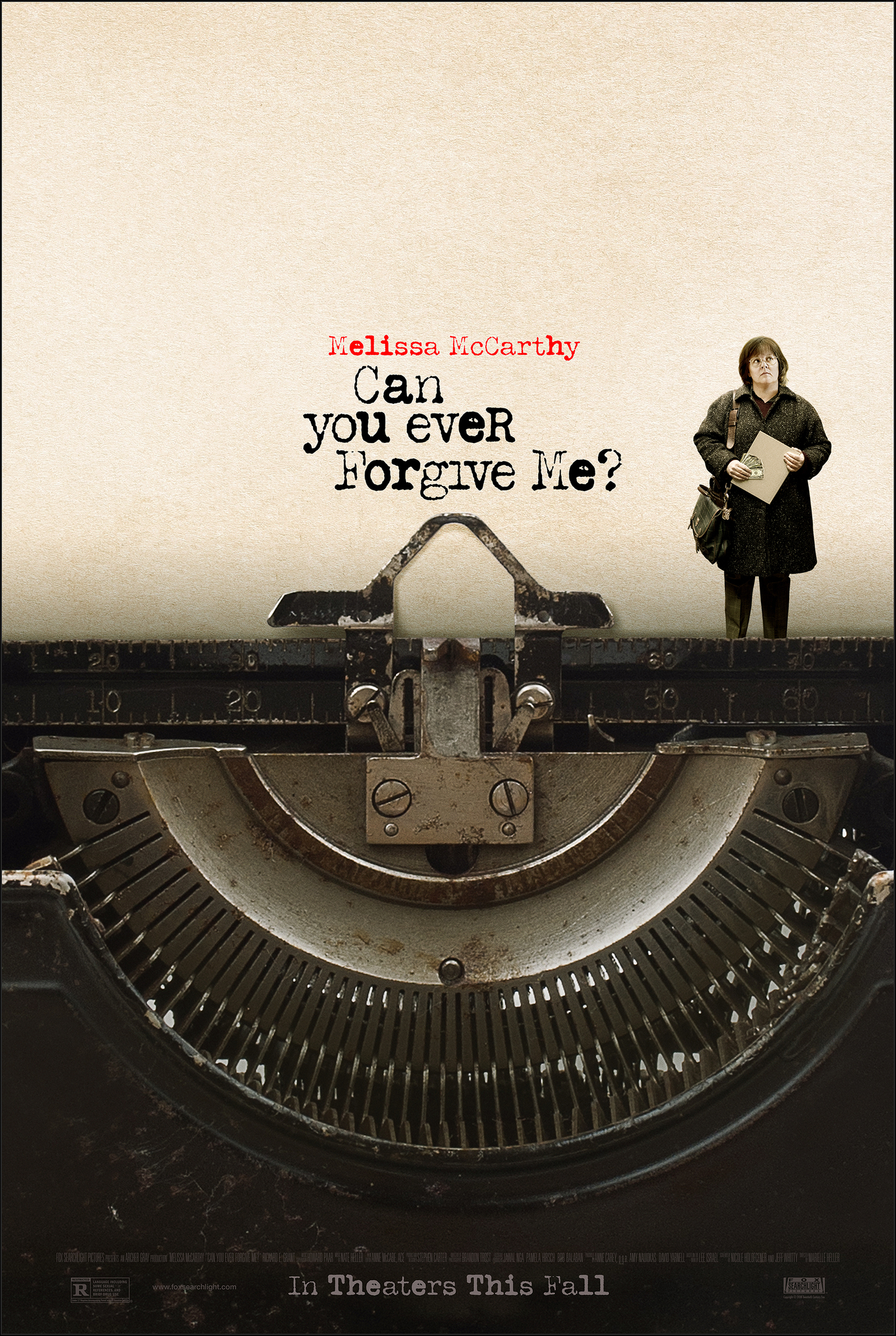


I think Can You Ever Forgive Me? has the finest screenplay I have seen this year. Originally adapted by novice screenwriter Jeff Whitty (Tony winner for Avenue Q) then rewritten by independent film vet Nicole Holofcener and finally given an uncredited lift from the film’s director Marielle Heller, this adaptation of Lee Isreal’s memoir shows us people we rarely see on screen – unpleasant, bitter misanthropes.
The story of an alcoholic 51 year old writer who is months behind in rent and cannot pay a vet bill for her cat stumbles into a money making scheme creating alleged letters from famous writers of the early 20th century created from whole cloth. The novelty of aging the paper, locating typewriters with typeface used by the author in the day, and the tension-filled moments of making the sale don’t fill much screen time. We are left with one of those invisible New Yorkers who is brilliant but angry and isolated.
The problem with Can You Ever Forgive Me? is the approach to the material by lead actress Melissa McCarthy and Heller. They don’t trust their audience to engage with a dysfunctional, possibly mentally ill woman. When we first see Isreal at home, we see organized chaos. Later, when three men enter the apartment and are unable to remain due to the overwhelming stench, we learn that Isreal is a hoarder. We see the unsanitary hidden areas where animal feces has lain for an indeterminate amount of time. We look into an overloaded kitchen sink where insects crawl undisturbed across unwashed dishes. These warning signs continue when Isreal attends a party at her agent’s home and steals half used rolls of toilet paper. She mentions a brother she never sees. Her former girlfriend very specifically tells a distraught Isreal that it is no longer her job to make things better before walking away.
Isreal finds companionship with a gay drug dealer Jack Hock. They have a caustic relationship at best. Neither is trusting. Richard E. Grant gives a memorable performance as Hock. He never hides the ugliness of his character. This man is vile and Grant revels in the opportunity. Sadly, McCarthy and Heller aren’t able to learn from him.
Heller has a melodic score from the era of writers Isreal is forging letters. Cinematography is warm light that belies the grunginess of these used book shops where Isreal peddles her efforts. The score and the lighting diminish the harsh reality of Isreal’s lonely existence. McCarthy, a seasoned comedic actress, plays the wretched nature of a woman who profits from dead celebrities and those who buy their letters in an effort to hold a piece of history as pitiful.
In a remarkable scene at the end of the film, Lee and Jack meet in a bar. Jack is ravaged by AIDS. As they part, Lee begins to laugh and tells Jack she had to suppress an instinct to trip him. The remark is truly heinous. McCarthy softens the moment by crying as she says it. Heller uses an extreme close up to catch the tear fall so we don’t miss it. For me, there is the flaw of Can You Ever Forgive Me? Had the role been played by a braver actress who trusted the audience to engage with a truly reprehensible woman, had the director didn’t feel compelled to soften the sharp edges, had the two trusted this spectacular material, this could have been a classic film.