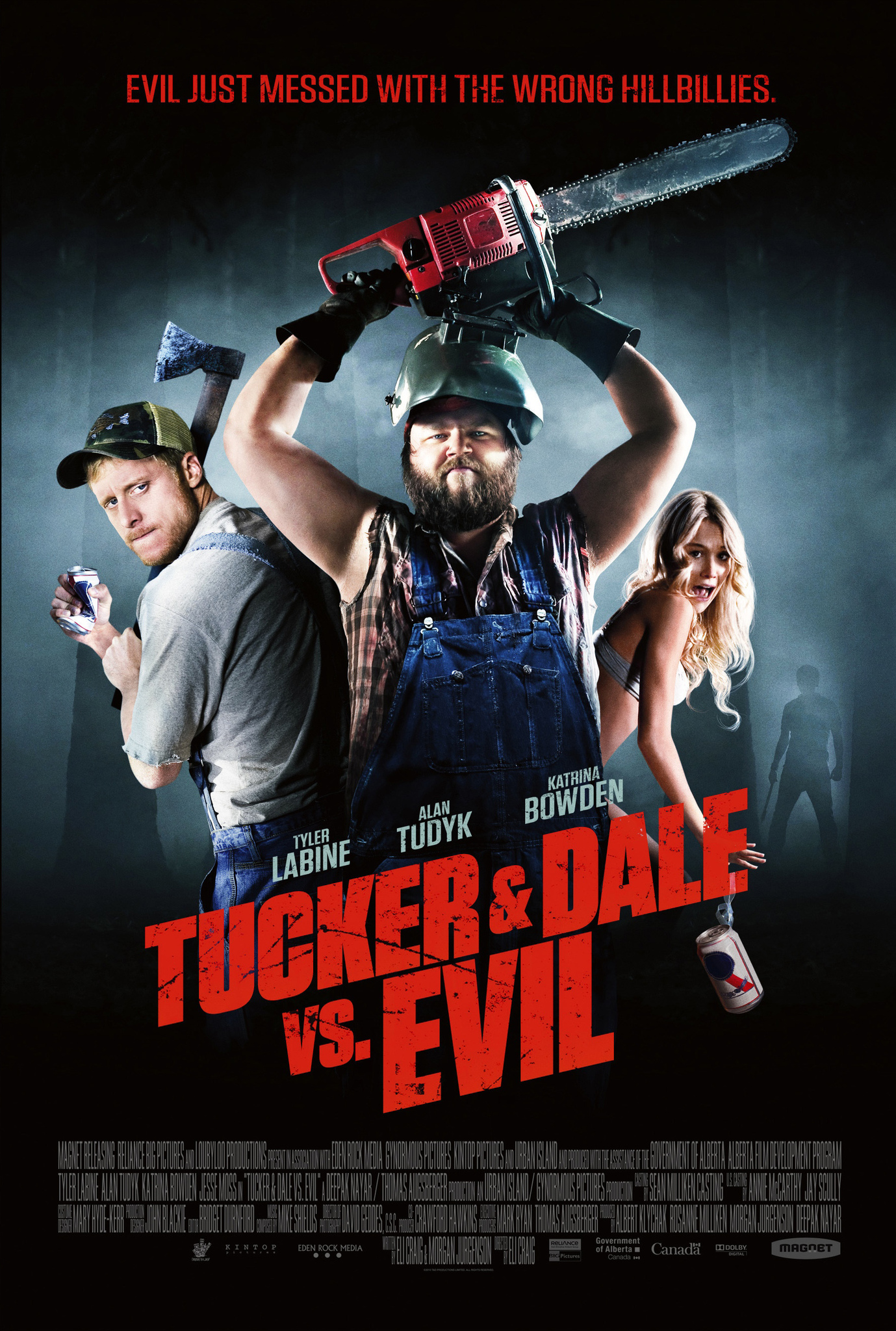
Horror is a genre in which some excellent work has been done to establish certain conventions over the years, as a result of the continuous popularity these films have enjoyed since the inception of cinema – even within the genre, we see many smaller subsets forming at an almost alarming rate, since every few years, we see entirely new categorizations appearing in the world of horror, in every conceivable medium. However, what is often the most interesting are those works designed to subvert these expectations, deconstructing the well-composed (but still very malleable) traditions that make horror films so memorable. The idea of murderous hillbillies living in the rural outback locales of America are about as old as the genre itself, particularly during the rise of the slasher and rural horror traditions – films like Deliverance and The Texas Chain Saw Massacre did very little to soothe the nerves of those venturing into the more untrodden locations of their nation, leading to an entire culture centred around the more animalistic, violence-obsessed members of the working-class. This was the impetus for Tucker and Dale vs. Evil, the hilarious and irreverent dark comedy by Eli Craig, which stands in contemplation of a kind of story that is almost always told from one perspective, which he easily shifts to form an entirely different kind of story, this one from the viewpoint of the people we almost always automatically assume are the villains. It joins a steadily growing canon of comedy films that provoke convention and propose changes to a genre that is often adherent to a few particular patterns – and through challenging some of these traditions and reconfiguring them into something unique, Craig and his collaborators craft an unforgettable entry into the horror genre, whether for better or worse.
Tucker and Dale vs. Evil is not the first film to aim to deconstruct horror – for about as long as films designed to frighten audiences have existed, there have been those that intentionally aim to subvert the same process in order to get to the root of the question that every horror film (regardless of the category under which it falls) seeks to answer: what is it that frightens us? Many of us would agree being lost in hostile terrain while being pursued by barbaric individuals with violent tendencies is not a particularly pleasant scenario – and Craig excellently exploits this premise throughout the film, looking at this concept, but in a way that turns it on its head. In Tucker and Dale vs. Evil, the naive college students looking for a good time are the villains, while the heroes are the working-class rednecks who may appear to be slightly sinister at first, but prove to be simply misunderstood. This seems like a relatively niche premise that would be better suited for a segment on a sketch comedy show – but through actually engaging with the material in a way that highlights its many interesting qualities, Craig produces something that effortlessly deconstructs the broadest tenets, simultaneously lampooning what is a well-established genre, and paying the most sincere tribute to what could have easily have been a dreadfully insufferable attempt at humour. It navigates a very narrow boundary between pushing the envelope and being excessive, but the director’s commitment to forming the film in a way that allows it to play like a classic exploitation thriller from a bygone era means that the same level of peculiar entertainment is present throughout, which allows the film to be so unexpectedly enjoyable.
Everything that makes Tucker and Dale vs. Evil interesting comes down to the perfect calibration between humour and horror, which can be overwhelming for some viewers who aren’t expecting the treacherous depths to which it is willing to go. From the first moments of the film, we could tell that Tucker and Dale vs. Evil was not aiming for the mainstream, but instead aligning itself with a long culture of cult films. When given the opportunity to make something widely accessible and appealing to a wide audience, or staying true to the specific vision that served as the starting point of the entire premise, it’s clear that Craig chose the latter, and rightly so. We see many more placid attempts at reinventing horror, so it only makes sense that we’d also encounter one that is as violent and brutal as it is subversive, which is exactly where this film is at its peak. There is certainly not any shortage of macabre imagery, with every frame of Tucker and Dale vs. Evil seemingly being plucked directly from the mind of someone with the perverse sense of humour to imagine making a film of this nature, and the resourcefulness to put those ideas into practice. It would be exceptionally easy to go too far with this material, and the film understands that excess, while effective, is not always the best approach, especially since it seems to be aiming to be enjoyable, and with wall-to-wall violence, there would not be much space for genuinely earnest storytelling. Craig finds the perfect balance between the horror and comedy, which is integral to the process of exploring the world of Tucker and Dale vs. Evil, which is a much more complex film than we’d initially imagine based on a cursory glance.
In terms of the premise, Tucker and Dale vs. Evil is a very promising film, but what truly pushes it to a place where it can be considered a really effective film on its own (divorced from any genre) comes in the performances. The film draws clear parallels between the two feuding groups – the villains are nearly faceless, anonymous college students, very few of which are developed beyond just mere archetypes, which was an intentional choice done in order to emphasize their role as nothing more than props, designed to be killed in increasingly bizarre and violent ways. Only a couple of them exist outside of essentially just bodies used for the sake of drawing out both laughter and screams, while still remaining relatively secondary as a whole. The true protagonists are played by Tyler Labine and Alan Tudyk, who embody these congenial, lovable country folk who were seeking out a weekend of rest and relaxation, only to discover that they are suspected of being mass murderers, based on nothing but the clearly incorrect intuition of a group of college students who had clearly seen too many horror films between them. Tudyk is the consummate professional, and actor who has shown a remarkable ability to morph into a variety of roles, being one of our most chameleonic performers, so naturally he is excellent here. The true star of Tucker and Dale vs. Evil is Labine, who is absolutely stellar – charming in a way that makes us wonder why he rarely receives roles that are worthy of his talents. Perhaps it’s just the specific character he was playing, but his ability to draw out the inherent charm and humour in an otherwise thinly-constructed individual proves how this film is essentially his, every scene orbiting around his attempts to be heroic, only to have it backfire. Tucker and Dale vs. Evil is not a film one imagines will act as a showcase for its performers, but Labine changes this from the first moment he appears on screen, proving to be quite a remarkable actor in a film that only benefitted from his continuously steadfast commitment to a more abstract character.
It can be quite difficult to get an entry-point on Tucker and Dale vs. Evil, especially since the film is one that is driven primarily by its atmosphere, which is an often disorienting blend of horror and humour, which the director finds a way to combine so that they are constantly playing off one another, rather than cancelling each other out, which is an unfortunately common occurrence amongst films that try to do both. The film is often very dark and oddly terrifying, which is something that many similar films tend to forget – as much as they may primarily be designed as comedies, these films also need an element of horror, and there are certainly moments of unhinged terror scattered throughout the film, but it all has a very clear purpose, acting as the gradual accumulation of nearly a century of well-crafted horror, compressed into this ambiguously charming attempt at challenging the conventions that have grown to be almost definitive of the genre. There is a lot of detail in the film, which may come as a surprise to those expecting an entertaining romp, rather than a fascinating character study masquerading as a pitch-black comedy with broad overtures of unhinged horror. To its credit, Tucker and Dale vs. Evil is a much better film than it seems on the surface – there is clearly a structure to the story, and it pays off spectacularly at the end, grappling the narrow boundary between genres and exploiting them in such a way that they are almost symbiotic. Definitely one of the primary candidates for the term “acquired taste”, but fascinating in both theory and execution, Tucker and Dale vs. Evil is a tremendous film that has a lot to offer, and manages to follow through on nearly all of it, which is what matters the most when it comes to experimenting with form and convention.