
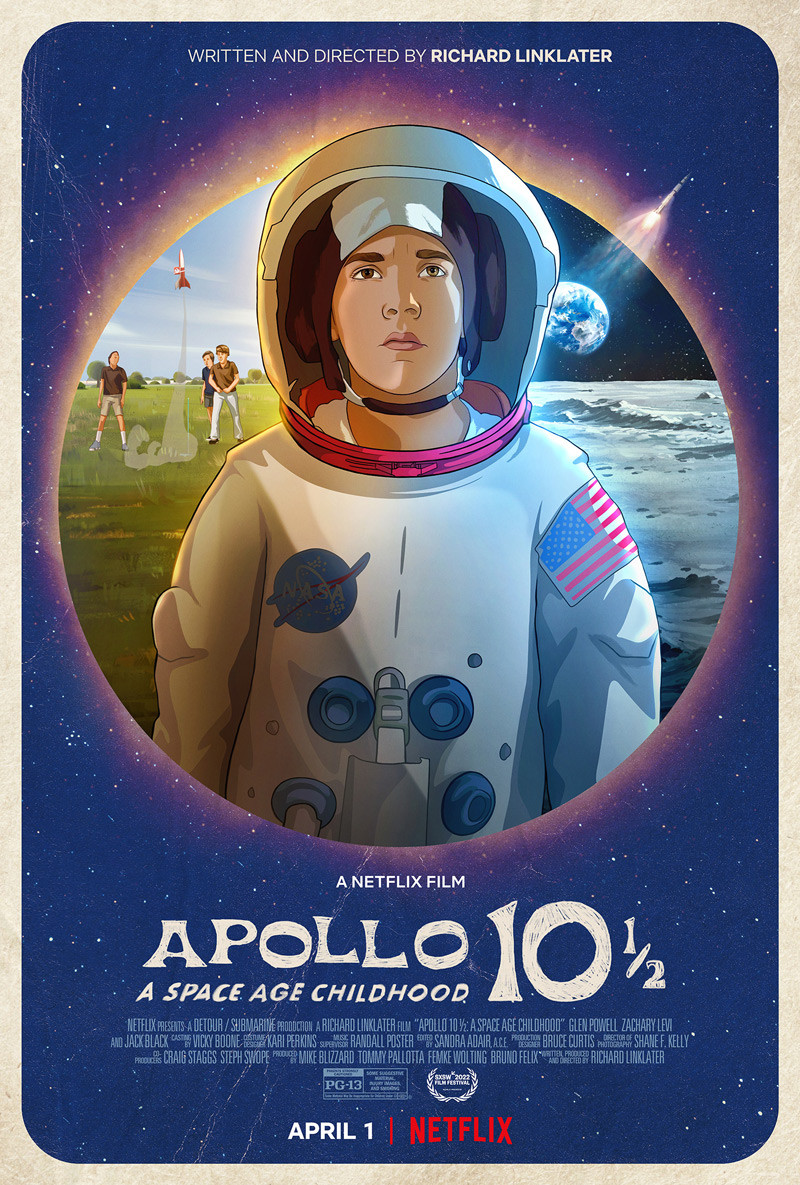
Richard Linklater has gone from a director of entertaining but conventional fare, to someone whose work has become so incredible, nearly every new work he produces is seen as an event, especially for those who adhere to his very peculiar brand of off-kilter humour that is often drawn from his experiences as someone who grew up during some of the most tumultuous moments in the history of the United States. His most recent effort is also certainly one of his most personal, with Apollo 10½: A Space Age Childhood taking place in his native Texas in the late 1960s, focusing on certain events to which the director was a first-hand witness. Structured around one event in particular – the days and weeks leading up to the moon landing – the film uses one of the most notable historic moments of the 20th century to tell a wonderfully endearing and fascinating story about childhood and life in the suburbs, captured in vivid detail by the director, who is addressing his own experiences through this charming little comedy. Rendered in the Rotoscope animation technique, which Linklater has utilized on a couple of occasions in the past (which is a divisive method, but one that is absolutely incredible and groundbreaking once you get to know the process), Apollo 10½ gradually becomes a film that is much larger than its more trivial size will have you believe, each moment drawn from a place of sincerity by one of the few directors who has found this quality being the main impetus for many of his films. Yet another tremendous entry into his wonderful career, and a film that frequently hints at deeper discussions that exceed the boundaries we are introduced to at the start, Apollo 10½ is a wonderful work.
Despite the general theme of space travel and scientific exploration, Apollo 10½ is not a film that is all too interested in the actual mechanics behind the process, which makes sense considering that this film is really a story of childhood more than anything else. For the vast majority of the film, we oscillate between two different perspectives in the life of the main character – the first is that which is grounded in reality, where Stanley is essentially an ordinary child growing up in the suburbs, while the second takes place in his imagination, where he fantasizes about being an astronaut being sent out on this historical mission, pioneering the “Apollo 10½ voyage”, from which the film gets its title. In both instances, his life is narrated by his older counterpart (which serves as a reunion for Linklater and his regular collaborator Jack Black, with whom he did some of his greatest work, and their first collaboration in over a decade), and we’re given extraordinary, first-hand insights into the experience of growing up in the 1960s. While the director and actor may be separated by roughly a decade in terms of their youth, they both bring such earnest sincerity to their ruminations, Black’s voice often swelling with pride at thinking back at his own childhood, which may have been slightly different to that of Linklater, but still doubtlessly saw the immense changes to the country, whether politically, socially or in terms of science and technology. This is what Apollo 10½ is essentially structured around, and it’s the source of many truly thrilling conversations on this period in history.
Apollo 10½ is primarily a coming-of-age story, which should not come as a surprise for those who are aware of Linklater’s interests as a filmmaker – he’s capable of working in a wide range of genres, but he has often shown particular propensity for stories of growing up, particularly those that take place in the past. Whether his breakthrough with films like Slacker and Dazed and Confused, or his radical experiment that turned into a masterful exercise in persistence and tenacity in Boyhood, there is something about growing up that seems to interest Linklater. This film places the audience in a similar position to where the director might have been as an 8-year-old watching the world change around him – we’re put in a dreamlike state, following his life over the course of a short amount of time, into which the director compresses several different ideas. Each moment of Apollo 10½ seems to be drawn directly from the director’s own memories, which serve to be the fuel for a thrilling document of the past. The process of self-reflective storytelling is one that is often underestimated, not only for its emotional heft, but also the artistic resonance – condensing an entire childhood into individual fragments, and having them beautifully pieced together to form an entirely new story that is equal parts a visual memoir and fascinating existential odyssey steeped in the culture of science fiction, makes for a wonderful story of coming into one’s own at a time when it seems most challenging to define the future.
Apollo 10½ is a coming-of-age story, but not solely in terms of the child protagonist. As is often the case with Linklater’s work, the protagonist represents something much more than just a singular perspective. He may have filtered many of his own memories through the character of Stanley, but he functions as more than just a surrogate for the director. Instead, he becomes a representative of every child growing up in suburban America, with the film being a thorough study of a country going through its own process of coming into its own. Much like Stanley and his friends, the United States was still growing – change was occurring fast than most could comprehend, with developments leading it in unexpected directions. A large portion of the film focuses on the main character discussing the rapid change that he saw all around him – entire neighbourhoods sprung up in only a matter of weeks, and there was a degree of modernity that felt innovative rather than artificial, which is essentially what technological progress is striving to be, improving on life without removing the heart that makes it worth enjoying. Linklater puts in a lot of work to balance his own personal musings on the past with a thrilling story – and there are certainly moments where it can be slightly excessive in how it feels impelled to explain every detail. Yet, it feels so genuine, with the fond ruminations on the past forming the foundation for a tremendously powerful glimpse into the past, as told by someone dedicated to representing the past in a way that was both truthful and exciting, especially since this era brought out moments of awe-inspired wonder, more than any work of science fiction ever could hope to achieve.
Reality is often far more enthralling than fiction, which is proven consistently throughout Apollo 10½, a film built on the memories of the past It may not seem like it, but this is a major achievement, a masterpiece of narrative and emotional control, which should not be a surprise for anyone who has encountered Linklater’s vast body of work. The decision to craft it as an animated film, supposedly as a means to evoke the Saturday morning cartoons that Linklater grew up watching, adds to the mystique. It’s a wonderfully peculiar piece of filmmaking that feels like it is drawn directly from first-hand accounts of the changing world, and the degree of fondness with which Linklater addresses the environments in which his childhood took place contrasts deeply with the film’s persistently endearing tone, which is often very funny, but not without meaning. Linklater plumbs the depths of his memory to deliver this striking, beautifully charming elegy to the 1960s, a decade of considerable changes to the fabric of the global culture in terms of social and technological advancement, to the point where many of these changes still resonate today as moments of incredible human ingenuity. Apollo 10½ is not the first film to take an extended voyage into the Space Age and the technological innovation that was taking place around it (nor is it the most thorough in terms of the actual process of sending people into space) – but it is one of the more earnest ones, especially since it is framed from the perspective of someone whose viewpoint we can all appreciate, since the feeling of childhood curiosity is familiar to the vast majority of viewers, who will very likely relate to the feeling of not knowing what the future holds or where it will take us, but being extraordinarily excited about it anyway – if there was ever a film that proved the importance of disregarding the destination and just enjoying the journey, this would be an exceptional candidate.
 The Postmodern Pelican