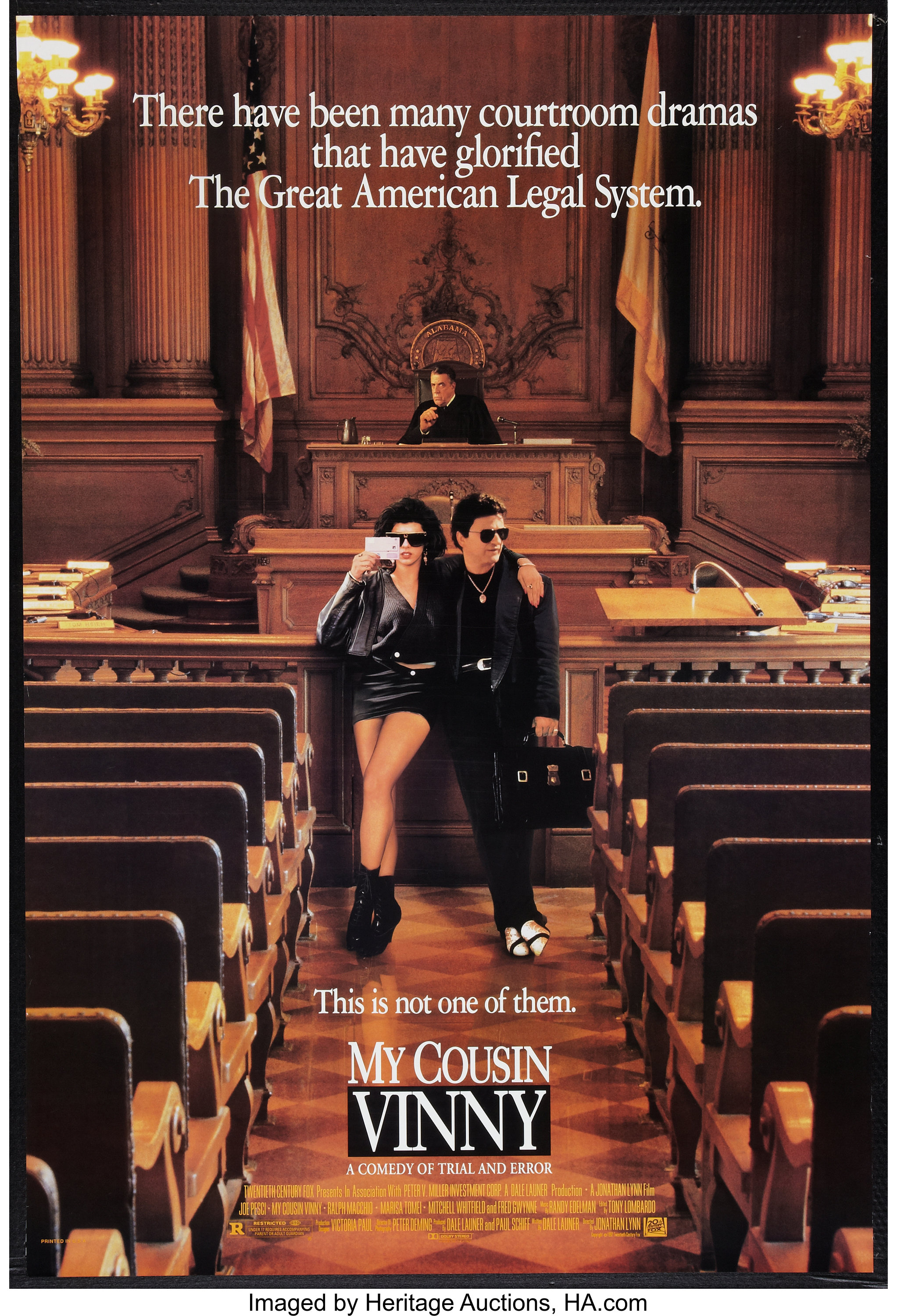
How do you begin to describe My Cousin Vinny without veering too close to either side of the extreme? One of the many comedies produced by Hollywood every year that essentially follows the same structure of taking a major star or two, placing them in an unexpected situation (which may or may not included entirely new geographical territories) with a healthy dose of tension, and then putting us on this journey as they try and resolve whatever challenge is standing in their way and then reconciling with a happy ending that any viewer can see coming from a major distance away. It’s a strong but predictable formula that has worked for many films that have become cherished by the public. Yet, My Cousin Vinny is slightly different in a number of ways – it may not be the most inventive film, nor the one with the most wildly strange ideas. Instead, it’s almost effortlessly solid – it has a great premise that is conventional but well-conceived, terrific performances that carry the film, and an easygoing demeanour that makes it such a wonderfully eccentric piece of 1990s comedic magic. This is very clearly the reason behind it being considered one of the most genuinely funny and beloved works of comedy from this era, with its steadfast commitment to its premise, the dedication to making sure that everything about it resonates with viewers on a very primal level – and more than anything else, it is in search of that perfect balance between humour and sentimentality that makes for very moving cinema.
My Cousin Vinny may be predictable (but only to a certain level – there are some genuine surprises to be found throughout the film), but it has something that not too many films of its nature tend to have – reliability. You can always depend on a film like this to be consistently funny, even in the sequences where it may be falling victim to traditions, which is less a criticism of this particular film, and more the unspoken guidelines that many studios asserted onto mainstream films as a means to ensure that they were palatable to all viewers. Where there is a space for a joke, My Cousin Vinny manages to place two or three in that space, pitching its humour to every level, and thus inviting the audience into this world, safe in its knowledge that it is genuinely very funny. Not all of the jokes may hit, and it can sometimes feel as if the film is pausing for the audience to laugh and react (which is not inherently a flaw, albeit one that just reveals more of its structure than a more polished film would aim to conceal in favour of the idea of spontaneity). Director Jonathan Lynn, and screenwriter Dale Launer (who considered this a passion project that was germinating for nearly two decades before it finally got made after pen was put to paper) know exactly what audiences will respond to, and even if some of the humour is slightly dated, there is always something valuable up on screen, and its one of those rare instances of a comedy being so well-composed, it can get away with the occasional moment of low-brow humour, since it feels like it is earnestly self-aware of its initial intentions, and knows that viewers aren’t searching for revolutionary wit, but rather reliable, consistent and (most importantly), very funny storytelling.
Launer’s writing is very strong, and his compositions of the characters, both those central to the narrative and those on the periphery, was extremely admirable. The cast is filled out with many fantastic actors, each and every one of them feeling like they fit perfectly into this world. The two that are most fondly remembered (and for good reason) are Joe Pesci as the titular cousin who takes on a major legal case, and Marisa Tomei as his long-suffering girlfriend, who proves to be much more useful than he initially imagined. They make a formidable pair, and are understandably the aspect of the film that has received the most attention. Pesci in particular is excellent – he was not an actor known for doing comedy (instead having his peculiar sense of humour woven into very serious films, almost as if he was cast as the comic relief that somehow both adds levity and contributes to the tension – consider his iconic performance in Goodfellas for one of the most well-known examples of this), but when it comes to playing the lead in a major comedy like they, he rises to the occasion. The image of the most endearing kind of sleaziness, his performance as Vinny Gambini is terrific. Tomei adds layers to a character that was clearly initially defined as a mindless moll to a man who does not respect her as a person, which is ultimately proven to be an intentional decision when she turns out to be the key to the resolution of the entire film. While Pesci and Tomei may be the most memorable parts in the film, Ralph Macchio, as one of the two college students accused of murder, and Fred Gwynne as the hard-nosed judge who grows frustrated with the titular character’s antics, are exceptionally strong, and add their own quirks to otherwise commonplace characters.
One of the more admirable qualities of My Cousin Vinny is that it is an extremely accessible film. Any comedy that runs two hours is inherently going to need to justify such a length, since there are several that take this approach and fail to deliver on many of its promises, whether it be running for too long and causing the viewer to get fatigued from the mile-a-minute humour, or the fact that there are too many storylines, which initially start out as padding but eventually grow into something much more complex as a result of all loose ends needing to be tied up, adding entirely unnecessary sub-plots. This film doesn’t have any of those problems – it moves at a rapid pace, and every scene feels essential – those that are directly related to the story progress the plot, while the sojourns outside of the central narrative are supplementary but add to the overall experience, whether it be to shade in some of these characters as more than just archetypes, or add a degree of foreshadowing to what we can already tell with be a conventional but compelling conclusion. It is a film that feels justified in taking its time, since everything ultimately has a resolution, which is rare for films that are as detail-oriented as this one. We know that the film will have a satisfying conclusion, so it is tremendously fun to carefully watch everything transpire, since the characters behind the actions are entertaining enough to keep us engaged, but not to the point where we lose track of the narrative. As enthralling as the peripheral antics may be, My Cousin Vinny is still a courtroom film, and its accuracy as a piece of judicial storytelling may have been flimsy, but it is still celebrated as one of the most captivating in the genre, which only strengthens the argument towards this being a comedy classic, whether conventional or not.
My Cousin Vinny is so much more than a run-of-the-mill film about an eccentric character in an unexpected situation – it does entail certain elements of the fish-out-of-water narrative, but it is mostly a really terrific, well-composed comedy that uses humour as a constructive tool to tell its story, rather than just as a crutch for a narrative that could have been told in many different ways. As a whole, the film is a fresh and invigorating deconstruction of the often self-serious courtroom drama – but rather than being an outright parody (which we have seen several times before), the film feels engaging and rich, telling a genuinely funny and heartwarming story drawn from the filmmakers’ own knowledge of the legal system (like the peculiar discovery that director Lynn holds a law degree), as well as their constant commitment to ensuring that all the jokes are necessary and contribute something. My Cousin Vinny is a film that finds humour in the serious subject matter, rather than being a string of jokes tied together by an overarching narrative. It sounds like a small distinction, but it is one that comes through absolutely beautifully and with an earnest sense of humour that elevates the film and makes it something special. As a whole, it carries itself with the confidence of a film that knows its value and inherent brilliance. It may be conventional, but it proves that traditions are not themselves a sign of failure, but rather an opportunity to do something new with well-worn cliches, which is one of the many reasons behind the well-earned success and undeniable longevity of this film.