
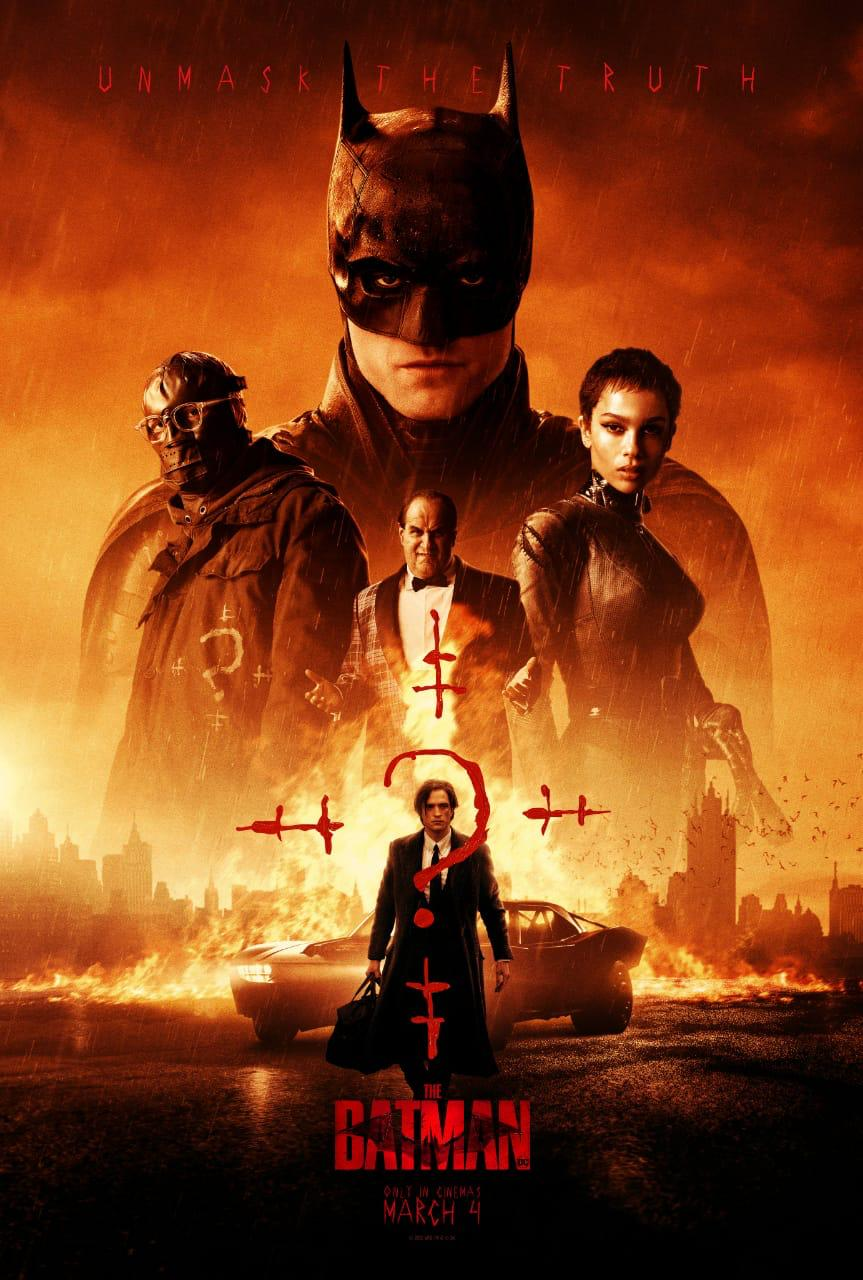
There comes a point where one needs to ask how many times can the same story be told before it becomes stale? In the past two decades, we have been witness to no less than three different instances of attempting to retell the Batman story, with this number growing even larger if we consider animated films and the various television shows that have come about as a result of the general fascination with the character. It is understandable – Batman essentially defines the concept of superheroes and is a figure that is adored on a global scale, as well as being of enormous historical importance. However, the question is whether we are ever likely going to see someone take the reigns on a version of this story that doesn’t present us with all the same qualities we’ve seen so many times already. When it was announced that Matt Reeves (one of the most consistently excellent directors of modern action and science fiction) would be tackling a new version of the character’s story, there seemed to be a lot of promise, especially when one of the finest young actors of his generation was attached to play the titular role – and while The Batman doesn’t squander this potential, or even betray it, it just simply doesn’t offer anything we haven’t seen before several times. There are certainly reasons to celebrate this film, whether it be the good performances or some of the directorial flourishes that show that Reeves was still in control to a certain degree, but they’re often rendered less impressive when they’re beaten down by yet another attempt to restart a story we’ve encountered on so many occasions, it’s actually starting to become difficult to keep track. Perhaps not enough to qualify The Batman as a failure (since it has many good qualities), it’s just not enough to make it stand out in any significant way, which is an enormous shame when we consider how much promise it carried at the outset.
If we go back a few decades, the idea of making a very dark, brooding Batman film would be somewhat revolutionary – whether we’re thinking of the joviality of the original 1960s television show, which made name for Adam West and Burt Ward, or the beautiful excess of the films directed by Tim Burton and Joel Schumacher, Batman was mostly seen as an opportunity for some off-kilter entertainment. However, considering nearly every bit of content we’ve received that features the character since then has presented as grim and bleak beyond belief, it starts to become relatively unconvincing, the idea of a more pared-down version of the character now being considered the standard. The Batman had the genuine opportunity to do something different – whether one responded well to the trilogy directed by Christopher Nolan (which many consider to be the gold-standard for superhero films), it’s difficult to argue that he mastered the idea of making a more serious version of Batman, with every subsequent attempt to replicate that success not being nearly as effective. Considering Reeves is far from a bad director, and someone who revitalized other franchises (turning The Planet of the Apes from the subject of widespread ridicule into one of the most acclaimed action film series in recent memory), so there was a lot of blind faith to be found leading into this film. Unfortunately, this is a clear case of reality not meeting expectations, since they were impossibly high based solely on the prestige attached to the film. Perhaps our anticipation should’ve been tempered, since there isn’t anything inherently bad about this film, but rather it just doesn’t do anything new, which can be a problem when we’ve encountered similar content so many times before – we simply yearn for a new perspective, and it’s doubtful that Reeves and his cohorts seem capable of offering it in any significant way.
Robert Pattinson’s casting as the titular character was met with a polarized response – for someone, he seemed like a wildly inappropriate choice for the role, while others (myself included) applauded the decision, since he has grown into one of the best young actors working today, someone who possesses an almost chameleonic set of talents that he constantly utilizes in the creation of memorable characters across many genres. Considering most recent versions of the character have skewed older and more overtly masculine, casting a younger and more subdued actor as Batman seemed like it was heading in the right direction. The disappointment was staggering when we realize that not only was the script not making good use of Pattinson (possibly relying too heavily on the original intention of having Ben Affleck reprise his divisive performance as the character), but that the actor was actually actively quite mediocre. This is not likely Pattinson’s fault, since he can only do so much with a character as thinly-written as this one, and adding the further nuance that not only is he brooding, but also comes across as vaguely immature and volatile, which is perhaps not the most interesting approach that such a character should take. Unfortunately, Batman is not necessarily the most interesting character in an objective sense, so its the responsibility of the individual actor and director to handle him in such a way that he is captivating – and for three long hours, we are witness to a version of the character that is dour and unheroic, one of the rare instances where we’ve seen someone take on this role and force it to plunge lower than it has before, which Pattinson can’t prevent, regardless of how much effort he puts into playing a role that never really was designed for an actor of his talent in the first place, since everything that makes him a great performer is abandoned in this film.
The supporting cast is marginally better, but not by much. Jeffrey Wright is as reliable as ever playing the dedicated, soon-to-be Commissioner Gordon, with one of the film’s few notable strengths being that it defines the character as more than just a moral man of principle, but a heroic figure all on his own, almost to the point where we have to wonder whether The Batman would have been better had Gordon been the focus, regardless of the title. Zoë Kravitz is in the same position as Pattinson insofar as she’s a great performer given a bland character, but she is at least allowed the space to expand on the role of Selina Kyle and show some personality, rather than hiding behind a mask (both physical and emotional). Amongst the rest of the ensemble, we can find the other most significant problem – while these films tend to feature multiple villains in varying capacities, The Batman seems to struggle to employ the same tactic in a way that makes sense. There are no less than four villains at the heart of this film, each one of them supposedly being the ultimate antagonist – and yet, none of them are developed enough. Colin Farrell is utterly unrecognizable as The Penguin, who we are led to believe is actually serving a purpose in the story, when in reality he barely registers, making us wonder whether the amount of work that went into transforming Farrell into the character was worth it. Paul Dano is suitably menacing for the first two hours of the film, but the moment The Batman looks behind the character’s mask and tries to make sense of him and his motivations, it loses us completely, taking a truly sinister villain and turning him into an incomprehensible madman. John Turturro comes closest to playing a great villain with a clear impact, but his time on screen is too short, and he doesn’t get the opportunity to fully embody the pure evil underpinning the character. Ultimately, when no one is a strong villain, the stakes become considerably less interesting, making the entire purpose of the film far more redundant than it needed to be, which is unfortunate considering how objectively gifted this cast is, and how much better The Batman would’ve been if more attention had been given to them.
Despite my reservations, there is certainly some excellent qualities to The Batman. Reeves is a director who knows how to put on a show, and this film feels like an event. A few years ago, the prospect of a superhero film that was proudly and unambiguously dedicated to its length seemed impossible, since we’d face the same questions about whether our attention span could last that long. At three hours in length, The Batman has a lot of space to work, and to its credit, it never really wastes any of it, since it rarely feels slow or like it is trying to fill up time. If there is a flaw, it would be that it feels like there are several films compressed into one (which goes back to the fact that there are too many villains in the film, so we never truly know when the evil has been defeated, since the antagonists just keep coming at an alarming rate – if this was intentional, it was not handled well), which is not ideal when we’re talking about more traditional films. Yet, The Batman was clearly doing its best to appease both sides of the cinematic divide, honouring the legacy of the character and his origins by staying relatively traditional (especially for the sake of those who guard these stories with every fibre of their being), while also trying to appease those who are not fully invested in superhero films, but can be swayed with the promise of something different. Perhaps it is deceptive, or just the sign of excellent marketing, but the idea that The Batman would be some film noir-infused interpretation of the character, which was flouted until very recently, seemed like a good approach, only for the final product to be as conventional as anything we’ve seen from the character in recent years. Perhaps it’s not the effects-driven spectacle that we have seen recently, but even in its current form, it seems like it wasn’t able to fully realize its vision. Unfortunately, attempts to make a more intimate and gritty version of Batman’s origins did not result in minimalism, but rather a kind of dour storytelling that once again would have been effective twenty years ago, but seems almost reductive from a modern perspective.
Mercifully, Reeves brings on a very gifted team to help construct the film and give it something of a striking tone, both visually and aurally, adding to the feeling that The Batman is a spectacle in its own right. Greig Fraser (who is steadily becoming a reliable cinematographer when it comes to these expansive productions, proving to have an incredibly keen eye for detail) captures the world beautifully, the framing and design of Gotham City being beautiful, to the point where our eye starts to wander away from the action as it explores the surroundings, which are often more interesting than the focal points of any particular scene. Michael Giacchino also puts together an absolutely gorgeous score, his compositions establishing a clear tone that the film sometimes struggles to live up to – the seamless interweaving of both new pieces and existing music, along with the striking images that accompany it, make The Batman a much more interesting film in terms of atmosphere than it probably should’ve been, since what was initially supposed to be supplementary to the narrative often serves to become almost overwhelming, enveloping the story in a way that feels increasingly troubling – rarely have we encountered instances where excellent production value and artistry can be seen as something of a hindrance. Mechanically, The Batman is a tremendous achievement, especially when we find how sparingly special effects are used – but a film like this should never be driven by the formal elements, since this is a direct contravention of the principles of storytelling, which only proves that the script was not nearly strong enough to sustain our attention for long enough before we become distracted by the elements designed to complement rather than propel the film. Naturally, when the script is so filled with cliches that any regular viewer can finish half of the sentences in the film, then it’s difficult to look beyond the most obviously striking qualities, which would’ve been more appropriately suited to a better film.
Despite its faults, The Batman is not a travesty, but rather a major disappointment. Had this same film been made without the gifted cast and crew, it isn’t likely to have amassed such high expectations that any work of art would struggle to meet. For what it’s worth, if we disregard how uneven the different components of the film can be, The Batman is very entertaining – its length isn’t an obstacle but rather an invitation to allow the viewer to really nestle into this world, and it does offer a sufficient amount of riveting activity to qualify as a decent film. As a generic action film, it is a lot of fun – it’s when it comes to contributing to the already over-saturated world of Batman films that it falters, adding nothing new, whether in terms of stories (how many times are we going to have to hear a character ramble about how Thomas and Martha Wayne were ambushed and murdered, leading to their son becoming the masked vigilante?), or the tone it takes, with much of this film following the recent trend of emotionally-distraught depictions of the character, who populates a dark and enigmatic world. There are many avenues that could have been taken to explore the character in a way that is a lot more meaningful and unique, so it’s not a case of the story being so stagnant that it doesn’t allow for a bit of experimentation. Reeves and his collaborators were too bonded to convention to do much outside of a few marginal improvements in terms of situating the story amongst the contemporary world. It doesn’t amount to much outside of being a relatively entertaining glimpse into the character and his journey to becoming the masked vigilante that has enraptured generations of viewers – if only we hadn’t already seen it countless times before.
 The Postmodern Pelican