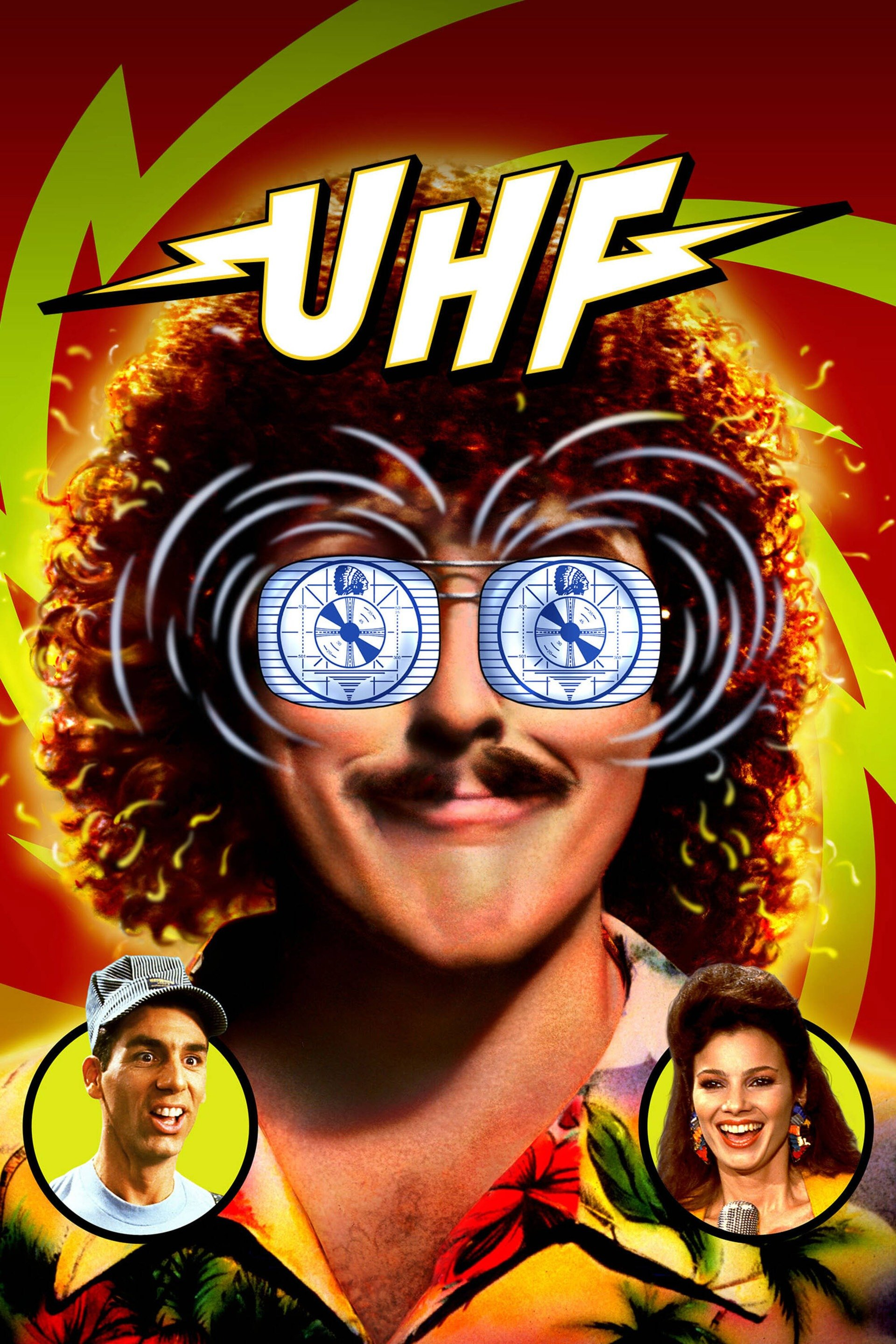
One of the more bizarre occurrences that we see from time to time is when a studio greenlights a film that is supposed to serve as nothing but a star vehicle for someone experiencing a degree of immense popularity at a particular moment, and instead of becoming sordid and uninteresting affairs, actually turn to be quite decent. In even rarer instances, these films can actually end up being excellent, embraced by an audience far wider than the target demographic that the project was originally aimed at in the first place. UHF is not often seen as being a particularly brilliant comedy in terms of mainstream appeal, but it has certainly developed a cult following, especially amongst those who appreciate the work of “Weird” Al Yankovic, the foremost maestro when it comes to the art of parody – and when he received the permission to take his iconic persona, which had already been entertaining audiences for well over a decade, and translates it into a feature-length film, he was certainly not going to let the opportunity go to waste. Working closely with a talented group of artists on both sides of the camera, Yankovic and his cohorts craft a deliriously funny satire on small-town America and its obsession with celebrity, consistently pushing boundaries that some may be surprised actually exist, but which he has made the entire foundation of his entire career, which is all focused on challenging conventions in a way that is creative and hilarious, while still carrying some semblance of artistic integrity, which ultimately makes UHF such an unconventionally rich and evocative comedy that is not afraid to be absurd, as long as it makes sure we know it is all for the right reasons.
What is most fascinating about UHF is that the viewer can immediately tell that this was not a film designed well ahead of time, with the general sentiment being that Yankovic, along with co-writer and director Jay Levey (who also happened to be his manager at the time) made up the majority of this film as they went along – but rather than suggesting recklessness or a careless waste of valuable resources, they took the opportunity to invite the kind of controlled chaos that has always defined Yankovic’s career, essentially being a logical expansion of his brand. The title stands for “ultra-high frequency” (referring to the frequency on which the cheap networks found in these small towns would be broadcast), which is unsurprisingly a term that we can expect to have been embraced by Yankovic, since it is the perfect descriptor of his style – off-the-wall, deranged and energetic, he makes sure to bring every part of this to the film when developing the wildly disparate ideas that would ultimately form the foundation for the story, once many of the broad concepts were allowed to simmer down into a more cohesive and meaningful format. It’s not particularly surprising to discover that the entire purpose of UHF in the first place was to serve as a platform for Yankovic’s parodies, extending them beyond his music (and the iconic videos that accompanied them), so it is really just an excuse for him to develop some of the more abstract ideas into a format that may not have worked in terms of his primary career as a singer and songwriter. Yet, it’s more than just a series of vignettes strung together by a funny but weak story – there’s a narrative that is developing throughout the film that amounts to something quite special, if we can surrender to the sheer absurdity of what the filmmakers are presenting to us.
Placing a label on Yankovic seems inappropriate – he’s mostly known for his music (and a particular kind at that), but he’s rarely been someone who has followed a singular career path, preferring to have a wide breadth of projects that appear alongside his main raison d’etre. He hasn’t done much acting in the traditional sense, but he is a natural-born performer, someone who has crafted a distinct image for himself over the years, maintaining a particular persona in each distinct period of his career, in terms of both his outward personality and visual aesthetic, which has changed only twice over the course of his professional life. UHF was a perfect experiment to see if the Weird Al persona could be translated to the screen – he’s a relatively well-loved personality, but there is a clear difference between listening to a few songs or watching him perform in increments of only a few minutes. While we are almost universally in agreement that he is a very gifted musician and performer, whether Yankovic is a good actor or not is up for debate, and UHF doesn’t answer it all that well. There actually is much less of Yankovic in the film than we’d imagine – he essentially functions as the eccentric but otherwise ordinary “straight man” character, while most of the heavy-lifting is done by the supporting cast, with the likes of Michael Richards, Fran Drescher and Kevin McCarthy playing pivotal roles, occupying archetypal characters that are important to the progression of the narrative. Yet, Yankovic is undeniably still the star of the film, and while he is not a bad actor by any means (since he does demonstrate some serious prowess in certain moments), UHF was never designed to be an acting showcase, but rather 90 minutes of his distinct personality traits stretched into the form of a coherent narrative, which is entertaining, even if it isn’t particularly revolutionary.
However bizarre as it may be in theory, there is a storyline to UHF, and one that is a lot stronger than many detractors may give it credit for. Despite being designed primarily to be a long-form version of Yankovic’s parodies, the intentions of the narrative run a lot deeper than just mindless, sketch-comedy based silliness. Instead, it becomes one of the most pointed satires on the subject of broadcast television – perhaps it isn’t as scathing as Network or fondly sentimental as Broadcast News, but it has such a unique energy that allows it to comment critically on the role of the media in shaping perspectives. Undeniably, the film isn’t aiming to view television as some maniacal force, used for authoritarian control of the masses – in fact, it takes a much fonder view of the medium than many other films made on the subject, viewing it as a neutral tool that can either be used to unite communities when those at the helm have good intentions, or for evil when it is controlled by people with more sinister reasons for taking charge. For the most part, the film isn’t particularly deep, but the satire hints at a general sense of critical thinking that may be surprising to those viewers who expected a more easygoing film. There is a lot of fun content in UHF, but it’s in the moments where it seems to actually be saying something interesting that we tend to pay more attention, and while this is perhaps not the right film to have such discussions (especially since countless similar ones have been made on the subject), there’s always value in a work of art critiquing something so omnipresent as television and the media in a way that is accessible and interesting, which seemed to be a fascinating byproduct of this otherwise deranged comedy, rather than the initial intention.
UHF is a peculiar curio of a film. Logically, we’d assume it was just a cheap attempt at capitalizing on the popularity of a musician, who decided to try his hand at acting by commissioning a film that functions as a star vehicle for the persona he had been maintaining for several years. We see these kinds of projects often, and while they’re not always bad, they can sometimes come across as lazy. This film is slightly different – undeniably, it has the same intentions of showcasing Yankovic on a wider scale, but not at the expense of actual entertainment. The film is filled to the brim with memorable gags and a lot of terrific writing (mostly the result of Yankovic writing the screenplay alongside the director, as opposed to having an outsider write it for him, and he clearly brings the same work ethic to this film), and has a genuine sense of wanting to have fun, even to the point where it can be intentionally quite bewildering. Hilarious and irreverent in all the ways that matter, UHF sees Yankovic making his debut as a major movie star, commanding the screen without ever losing the quality that made him initially popular – and while it may not be the most cohesive comedy (instead one driven by forthright silliness, if nothing else), the film is a delightfully irreverent, and often extremely insightful, satire that is grounded by a sense of bizarre, off-the-wall humour that may not be to everyone’s taste, but it’s certainly never something that goes to waste.