
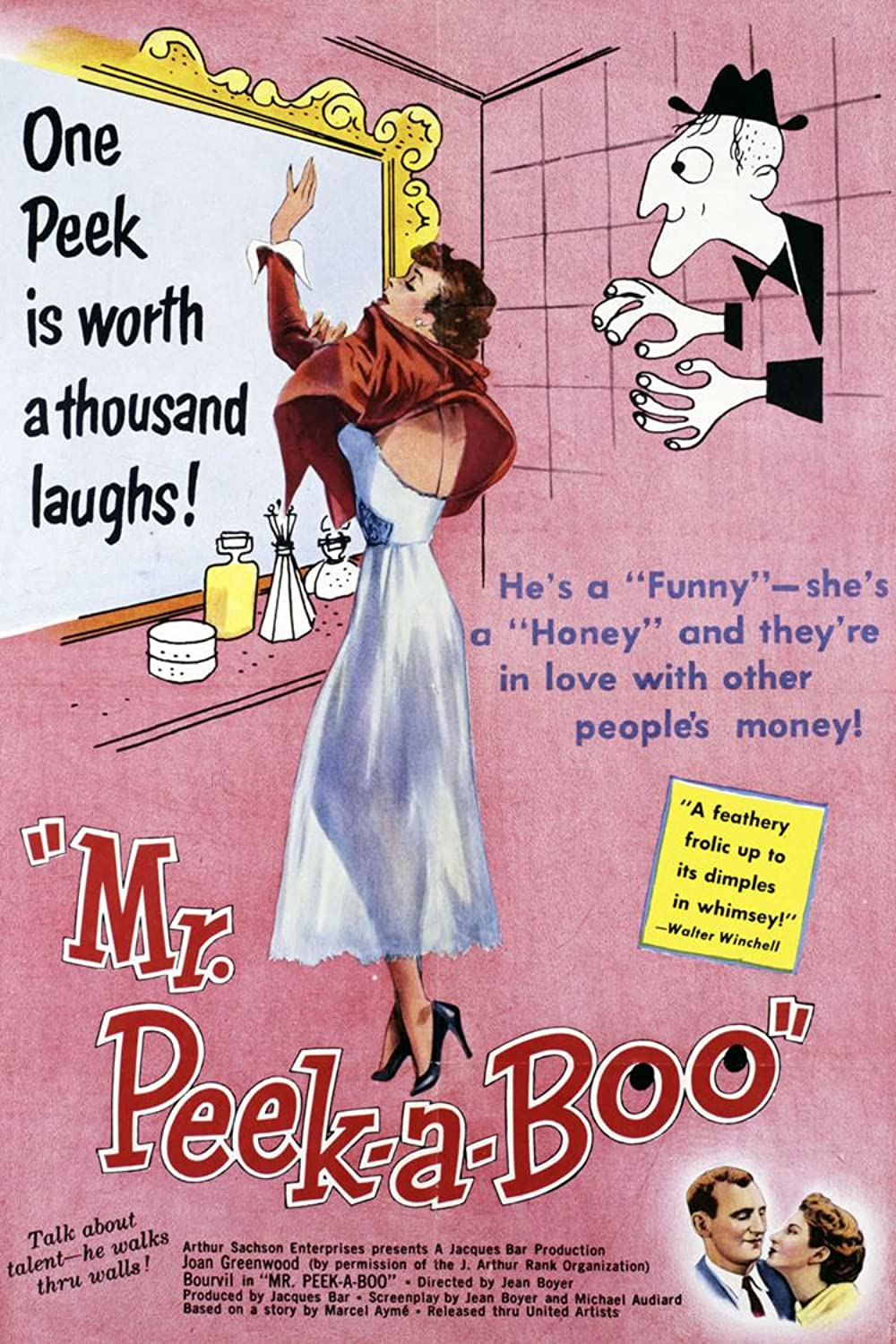
Some are blessed with the ability to fly, others the capacity to become invisible. Léon Dutilleul (Bourvil) has discovered that he can walk through walls, a skill that he initially enjoys, since it offers him the opportunity to essentially do whatever he desires, with everyone around him being entirely bewildered by this newfound ability, especially those who are victims of his actions. This is the foundation for Mr. Peek-a-Boo (French: Garou-Garou, le Passe-muraille), a deliriously funny and deeply surreal comedy by Jean Boyer, who tells an absurd story with the deepest and most profound conviction, we can’t help but be charmed by this strange world in which he immerses us. There are many reasons to adore Mr. Peek-a-Boo, whether it be its irreverent sense of humour, deeply scathing satirical edge, or simply the fact that it is unlike anything produced at the time (on a narrative and technical level), which is why its status as a relatively obscure, but mercifully not entirely forgotten, gem of the pre-French New Wave is so bewildering, since one would expect this to have been a major influence on the subversive, effortlessly cool approach taken by later filmmakers, who undoubtedly owe some degree of their career to Boyer and his profound ability to weave together a strange but captivating story that situates us on the outskirts of reality, and allows us to luxuriate in this deranged but endearing version of the world that seems recognizable, but is in actuality drawn from the most surreal recesses of the director’s imagination.
Mr. Peek-a-Boo is a film that exists outside of any real categorization, at least in terms of French cinema. It’s not the elegant comedy-of-manners of the 1930s, nor the subversive and scathing satires of the 1960s (and the fact that Boyer ultimately worked in both eras is indicative of his talents), but rather one that exists in between them, taking the sophisticated humour of the form, and the experimental nature of the latter, which was obviously still developing at the time, and put them into collision, which resulted in this wonderfully peculiar story that dismisses rhyme, reason and logic, and instead builds itself on the most intricate, character-based details that ultimately converge into this odd but captivating little comedy. It’s easy to see why audiences may have been confused at the time – when comedies normally drew their laughs from real-life situations presented in a humorous but believable way, the thought of a film centred entirely around a man who somehow discovers he can walk through walls, seems understandably divisive, especially when the film doesn’t attempt to rationalize it. However, it doesn’t ever need to, since those who are most likely to appreciate this opaque approach to the narrative are already open-minded enough to embrace the film as a whole – nothing makes sense in Mr. Peek-a-Boo, which is why it is such an absolute delight, an oddity of a film that doesn’t take its subject matter seriously in the least, but still proves that it has the insight and intelligence to be a well-constructed comedy that never goes entirely off-the-rails, even at its most absurd.
The film is grounded by some terrific performances, in particular the one given by Bourvil. By this point, he was known mainly as a broadly comedic actor, a stage clown with a good control of his movements, but not much depth in terms of dramatic material. Mr. Peek-a-Boo may not be the most serious film, but it is one that thrives on its ability to be very different from the work he was doing before, namely in how his character is developed beyond just being wildly funny. He’s great in the part, and manages to sell the absurdity of the film in a way a more self-aware actor may have struggled. He’s very funny, and uses his distinct style of acting, and frequent ability to deconstruct the various details relating to the character, to incredible effect. Joan Greenwood, Gérard Oury and Roger Tréville are all fantastic in their supporting roles, and contribute to the tapestry of eccentric characters Boyer was weaving together in this film, where the ensemble supplements Bourvil’s magnificent central performance, aiding us in believing that these wild leaps of logic were entirely realistic. It only creates a more vivid and distinct version of the world, where absolutely anything is possible by the sheer fact that every character is a unique, wildly inventive construction all on their own, which somehow makes the premise more plausible. It’s a well-written character-driven comedy with a lot of heart, which ultimately contributes to the very peculiar but ultimately meaningful storyline at the heart of the film.
Mr. Peek-a-Boo is a charming film, albeit one that requires us to become acclimated to its very strange version of the world, since the regular laws of logic seem to be entirely absent in the creation of this film. Boyer had a lot of experience in cinema, having had a career that already stretched to the earlier days of French filmmaking by this point, so this film was far from the work of a neophyte, which we can see in the film’s often carefree attitude to unpacking its stories. There aren’t many twists and turns, with the film just using a bold premise as a way of setting a foundation for a truly entertaining, enticing satire that comments on the nature of post-war French society through the lens of a truly absurd comedy in which all the rules are broken. This isn’t the kind of humour that everyone will appreciate – there’s a certain cynicism that persists throughout the film, which doesn’t dampen the mood but certainly does mean it isn’t always as cheerful as we’d expect (while still putting on the facade of being a very exuberant comedy, even when it is infusing the story with more sobering facts), and it can veer towards some slightly darker commentary that hints at Boyer’s broader ambitions for this story, which is essentially one constructed almost entirely from the fragments of a bold idea and a director willing to experiment, not being sure what the results will be, but certainly having the good foresight to take a few risks, resulting in a delightfully strange and always deeply captivating film.
 The Postmodern Pelican