
I Love Lucy isn’t just an iconic comedy show, it was an absolute institution. One simply cannot read any analysis on the history of television without this particular programme being mentioned, whether it be for its enormous viewership that put modern shows to shame, or its enduring legacy as one of the most important pieces of cultural comedy ever produced in the western world. The two figures at the heart of the show, Lucille Ball and Desi Arnaz, are cultural icons in their own right, and have been subjected to many interesting analyses over the year, mainly since they were a real life married couple that spent many years on television, playing husband and wife for millions of adoring fans. However, as viewers we only knew what we were seeing on screen, with the events that took place off-camera being less known. This is the starting point for Being the Ricardos, the biographical drama written and directed by Aaron Sorkin, who continues to make a firm transition into being one of the more relentless filmmakers of the past few decades, telling stories of 20th-century culture that interest and provoke him as an artist. Tackling a few fascinating issues, and filtering them through the lens of the intimidating world of showbusiness, which everyone involved in it will tell you is far from being for amateurs. Not a particularly original film, but one that is effective to a certain degree, Being the Ricardos has several very interesting ideas, and is perhaps better than it ought to have been, considering a spate of controversies that occurred during this film’s production, whether it be the casting or the director’s own comments about the subject. The final product is an unexpectedly decent, run-of-the-mill biographical drama which contains a few well-placed surprises, which can sometimes be cause for this film to be mistaken for a much more enduring and captivating film.
Telling another story about the intersections between culture and politics, Sorkin’s screenplay for Being the Ricardos dramatizes roughly a week in the life of Ball and Arnaz in what was very likely an extraordinarily tense few days, whereby not only were documents uncovered that indicated that Ball registered as a member of the Communist Party in the 1930s (which had the potential to be fatal during the 1950s), but that she and Arnaz were also expecting a baby, a joyful discovery that becomes an enormous challenge for the network and sponsors, who see a problem with writing a pregnancy storyline into the most beloved television show of the era. Despite centring on a lovingly married couple, the prospect of putting these pleasantly sexless individuals in a position where their intrinsic humanity would be exposed seemed like a scandal. These are all fascinating issues that Sorkin touches on, especially in how he looks at the power dynamic, not only between the main duo, who worked collectively as the co-presents of Desilu Productions, and the myriad of individuals that present as obstacles (including writers, network executives and representatives of the company sponsoring the show), but also between Ball and Arnaz themselves, their marriage and its inevitable fate being one of the primary driving forces between the tension of the film. Power is an invaluable resource to have in any industry, but when you are being transmitted into the living rooms of nearly 60 million people on a weekly basis, you tend to have even more sway than usual, leading to some fascinating discussions around the role of the media in shaping and maintaining perceptions, especially at such a crucial moment when audiences were worshipping the people they saw on television with the same fervent dedication as they would a religious figure, listening to their every word – as the old adage goes, with great power comes great responsibility, which is an appropriate way for us to make sense of Sorkin’s intentions when choosing to leap directly into the backstage antics of two of America’s most iconic entertainers and the various people in the periphery that both supported and challenged them.
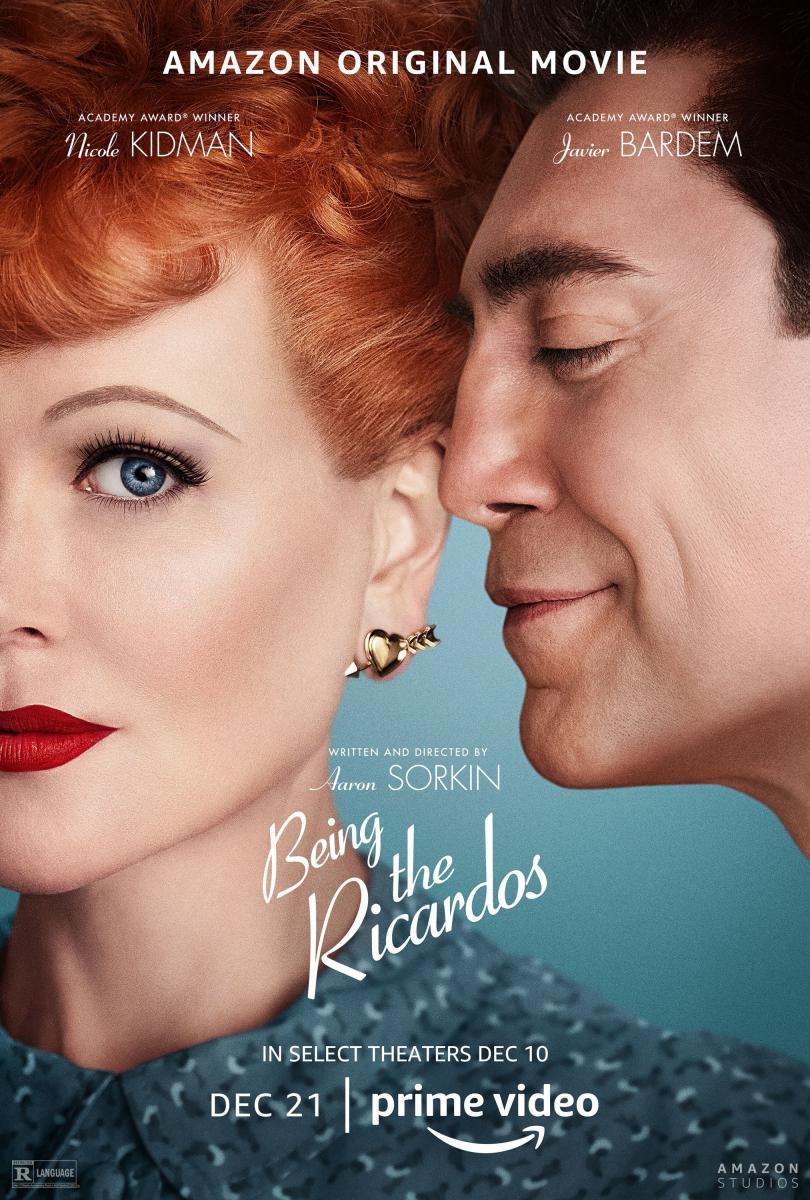
The casting of the two lead roles in Being the Ricardos was certainly not without controversy – neither Nicole Kidman nor Javier Bardem physically resemble Ball or Arnaz respectively, and seemed to be a blatant attempt at simply casting major stars in roles into which they would likely only marginally fit. Surprisingly, they do turn in decent performances, with Bardem’s interpretation of Arnaz being particularly notable. He does his best to capture the spirited personality of “The Cuban” (as he was fondly referred to by many), evoking the same cadence and physicality that made Arnaz such an electrifying performer. The resemblance isn’t strong, but there is very little doubt that he was channelling the entertainer. The same unfortunately can’t be said for Kidman, who does her best, but simply fails to be even vaguely convincing as Ball. Unfortunately, she did have the bigger task, since Lucy Ricardo is one of the most iconic characters in television history (even more so than the role played by her partner), so there was always going to be a set of inherent obstacles standing in her way. Kidman does well in playing a fiercely independent comedienne with a lot of gall and confidence in her skills and abilities to exist in the industry – it just never feels like she’s capturing Lucille Ball in any significant way. The physical resemblance is not the most important part of playing a real-life figure, but when the most fundamental characteristics of the character are missing, we start to wonder whether a different actress, perhaps one not quite as well-known, may have been more appropriate. Ultimately, Kidman and Bardem do turn in decent performances, but they’re unfortunately not strong enough as a whole to sustain the film, which begins to falter when we realize there isn’t going to be much effort to at least conveying the sense of illusion that we’re getting a glimpse into the lives of these iconic individuals.
However, while the performances may be slightly less effective than they ought to have been (which feels quite inappropriate considering Sorkin’s work normally brings out the best skills in the actors), Being the Ricardos is certainly a film that contains every bit of Sorkin’s creativity, carrying the same tone and register as nearly everything he has written – a straightforward drama punctuated with moments of comedy. This approach is one that has also divided viewers, but is one that I am slightly more favourable towards – at first, reports that Sorkin didn’t find I Love Lucy particularly funny or endearing seemed to imply that he was making a film that was far less reverent to the source material and its creators. It does show throughout the film, since there is a considerable lack of discussion as to why I Love Lucy was iconic – most of its successes are restricted to objective, numerical facts, rather than trying to explore what made this show so magical. However, despite some faults that have been present in a lot of his work, both as a writer and a director, Sorkin certainly understands television, having done inarguably his best work in the medium, to the point where it is almost surprising that he isn’t heralded as some renaissance man of broadcast programming. Most of his work looks at the role of the media, and how it holds considerable sway over the general public – and while the backstage affairs of I Love Lucy may not spring to mind when it comes to these conversations, Being the Ricardos does put in the effort to show the credibility entertainers had in using their popularity to lead impressionable viewers to hold certain beliefs – “if Lucille Ball is saying something, then surely it must be true” was undeniably a very common sentiment, and Sorkin does well in exploring this aspect of the story, which helps compensates for his lack of reverence for the actual show.
The most problematic aspect of this film is that it is never quite sure of exactly what it wants to be, and in the process the audience is unsure of where to look in many instances, since it is a bundled of arbitrary, scattered genres and conventions masquerading as an insightful biographical film. If we look at Being the Ricardos as an attempt to be a major film, naturally it’s going to feel somewhat disappointing. Sorkin is a gifted writer, but his skills as a director are still in need of further refining, since his style is very much rough around the edges, and his outright refusal to dig deep into the legacy of the show outside of objective statements of its success feel cold and distant. However, looking at it as a minor but interesting biographical drama can assist massively in redefining what Sorkin was aiming to do here – funny and insightful in many ways, Being the Ricardos is often a lot more effective than we’d believe based on a cursory glance. It has a lot of heart, which may not always manifest perfectly, but it is present – in the hands of a more seasoned director, there’s very little doubt that this would be a wonderful film, a charming and enduring ode to entertainment icons. The performances are decent, the writing is strong and the material it covers is definitely interesting – this is a clear case of the flaws being in the small details, which are often the downfall of a film such a this. However, for open-minded viewers, or those with the ability to separate fact from artistic licence, Being the Ricardos is a lot more interesting than we’d expect, and perhaps even borders on delightful at certain points – it just needed to maintain those moments to reach its full potential.
 The Postmodern Pelican
Aaron Sorkin is a wildly successful television writer. The West Wing serves as his primary example. It is no wonder that Sorkin has the famed trio of writers for I Love Lucy (Jess Oppenheimer, Bob Carroll and Madelyn Pugh) return years later to comment on the events of the film. In Sorkin’s world writers are the purveyors of truth.
The novelty of the film is learning the remarkable innovations that Arnaz and Ball created to design the television we still enjoy today. Desi Arnaz designed the three camera system that allowed a live studio audience to watch a filming. The film wonderfully depicts how Ball was able to visualize her physical comedy by relying on insuring each moment was true to character and respected the intelligence of the audience.
As a devoted fan of the series, I knew all the trivia shown in the movie. I thought it was a little thrilling how Sorkin reminded us of Ball’s jealousies and insecurities. It humanizes the television icon. Here is the acclaimed star of a series that routinely pulls millions of viewers capping at an astounding 44 millions watchers for the birth of little Ricky. Yet, Ball still snaps potshots at Judy Holliday.
Ball was a contender to star in the film adaptation of Born Yesterday. The New York Herald even announced that Ball was to begin a six month run on Broadway in July 1949 prior to the start of filming. Of course, Katharine Hepburn and George Cukor famously intervened by featuring Holliday in their film Adam’s Rib and subsequently convincing the studio head to cast Holliday to recreate her stage triumph for the screen. Ball withdrew from the stage commitment.
For me the essence of Being the Ricardos is the sentimental revelation that Sorkin so cleverly builds to throughout the film. Ball was raised by her mother and grandfather. She yearned for a traditional family, a home. Linda Lavin, playing the mature Pugh, points out that though Ball and Arnaz owed three lavish residences, the only home the couple enjoyed was the set of the Ricardos’ apartment.
There is a throwaway moment early in the film when Ricky enters the set and booms, “Lucy, I’m home.” Kidman pauses destroying the shot. She apologizes to the audience saying she got lost for a moment. That masked facial expression painfully resonates later when Pugh shares the insight about Lucy’s “home.”
That’s what I will take away from Being the Ricardos. When I watch Lucy reruns (and I will), I suspect that Ricky’s iconic announcement upon his arrival to the Ricardo apartment will always carry a tinge of wistful sadness for the iconic star in her greatest professional triumph coupled with her inability to fulfill her lifelong goal with the man she loved.