
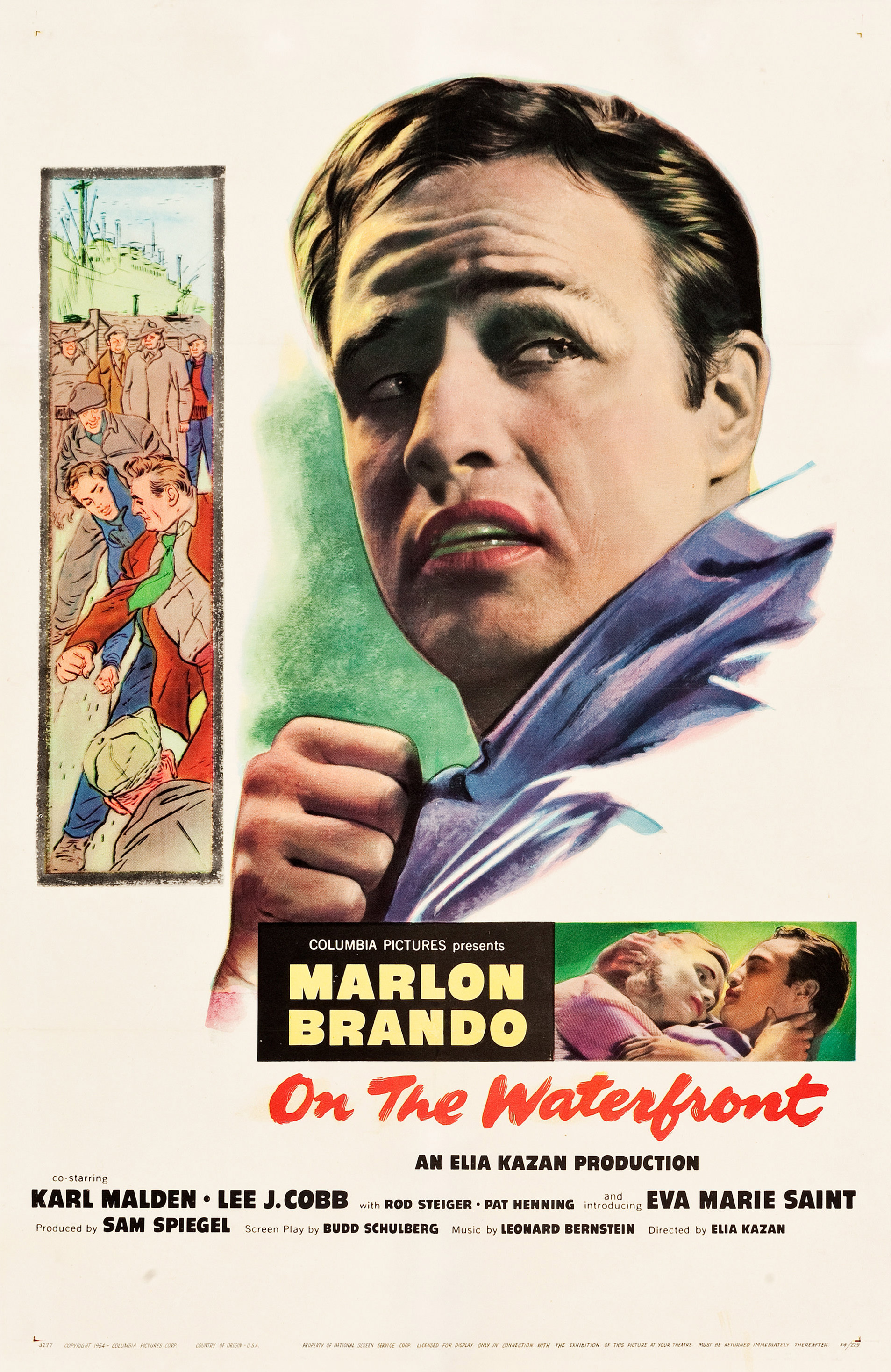
On the Waterfront has been so omnipotent in discussions around its importance in film history, it’s easy to forget how excellent it actually is, beyond the very obvious qualities that have made it one of the true classics of the Golden Age of Hollywood. Perception is divided on whether to celebrate what Elia Kazan did with this fascinating story of the interweaving relationships between a group of working-class longshoremen and the mob, or criticize it for the director’s well-known political leanings, but whichever opinion one takes, it’s difficult to imagine that anyone could watch this soul-stirring film and not feel some degree of emotion, whether being absolutely riveted by the intricate storytelling, or bewildered by the immense gall Kazan (and screenwriter Budd Schulberg) had in putting this film together. Revisiting a classic is always an interesting experience, since while we normally tend to view these films through the lens of its overall status, looking at the specific components that got it there remains fascinating. On the Waterfront is often considered Kazan’s masterpiece, and while it may have some imperfections, like any great film, it both embraces these shortcomings and rises above them, quietly establishing itself as something thoroughly impressive and meaningful. Simple but brimming with fierce emotions that are often not brought up when discussing this film and the circumstances surrounding its creation, Kazan truly did something extraordinary with this intimate social fable that launched an impressive second-act for a director who often managed to push the envelope with his cinematic ventures.
A discussion around On the Waterfront would be wildly flawed if it didn’t start by mentioning Marlon Brando. Not quite his breakthrough performance, as he had made a series of very successful films that brought his brooding, rugged masculinity and methodic approach to acting to the screen, his performance as Terry Malloy certainly consolidated him as someone whose place in the industry was well-secured. There have been arguments made towards this being Brando’s finest performance, and while I am more inclined to thinking his staggering work in Last Tango in Paris is his peak, there is value in looking at his spirited portrayal of a former boxer forced into a working-class existence, becoming nothing more than one of the myriads of people impacted by the draconian control of organized crime. Brando is joined by a tremendous ensemble, including a wonderful Eva Marie Saint in her debut performance, Karl Malden as a dedicated priest whose firm faith is only matched by his devil-may-care approach to opposing the criminals that surround his community, Lee J. Cobb in one of the most memorable villain performances of the 1950s (proving that a great antagonist doesn’t always need to be maniacal, but can be built from real human qualities, making his performance all the more unsettling), or a quietly brilliant Rod Steiger, who may not have much time on screen, but makes the most out of every minute – but this is still absolutely Brando’s film, and none of the supporting cast come close to achieving what the esteemed Brando managed to do.
Make no mistake – this praise for On the Waterfront is not by any means a resounding call of support for Kazan, whose politics have always been a cause of a great deal of spirited discussion. Throughout his career (and even after his death), he was referred to by a number of epithets, ranging from the mildly hateful to the outwardly vitriolic. Unfortunately, other than making several fantastic films, he is best known for testifying in front of the House Committee on Un-American Activities, whereby he named several of his peers who were associated with the Communist Party, one of the most damning accusations one could receive in the 1950s, and almost certainly a signal that one’s career is about to essentially end, at least in mainstream Hollywood, for which Kazan was labelled a traitor to the very end of his life. Several very eloquent analyses of On the Waterfront have deconstructed this film as an allegory for the director’s testimony – and it’s difficult to see the bruised and beaten Terry Malloy standing in a crowd of former friends who have grown hateful of him for his role in exposing the mob, and not feel as if there is some correlation between fiction and reality. Kazan’s life and career has been subjected to so much scrutiny, it’s redundant to relitigate it – but it’s important to note that every film is borne from some reality, and the sheer conviction held by the director and his collaborators to tell what is very possibly a semi-autobiographical allegory for his controversial actions, is certainly interesting and adds a fascinating layer to a film built on complexities that force us to inspect it from not only a narrative level, but provoking the many additional layers that occur alongside a relatively simple story. Whether or not one agrees with Kazan’s decision to sell out his colleagues is irrelevant when noting how On the Waterfront bears some remarkable similarity to his own views, almost to the point of becoming quite heavy-handed in its message.
Since conversations around On the Waterfront either focus on Brando’s impeccable performance, or the political leanings of the film, the discourse often neglects to remark on the actual filmmaking. Kazan had a knack for making powerful films about America, undoubtedly a result of his upbringing as a first-generation immigrant, having moved to the United States from Istanbul early in his life. While it wasn’t strictly a component of all of his films, much of the director’s work was derived from looking at different sides of life in the country, often focusing on either the trials and tribulations of the working-class, or the urban malaise of a rapidly-growing nation. On the Waterfront is a fascinating exploration of a group of men who make their living on the docks of New Jersey, their lives driven by commitment to a career that has bound them to be “deaf and dumb” in relation to the malicious dealings of the mob that surround them. It is a complex story that Kazan executes with a precise touch that would come to be mostly associated with more gritty works, drawing inspiration from the neo-realist movement that hadn’t quite taken off in mainstream Hollywood at the time, but would come to define the heart of American independent filmmaking, much of which owes its success (at least in terms of weaving together a very convincing project from a smaller story), to this film. There’s a gravitas to this story that elevates it beyond the sometimes convoluted subject matter – what prevents On the Waterfront from becoming a dour drama about socio-economic machinations is Kazan’s precise and careful directorial flourishes. He never succumbs to the temptation of hysterics, and instead keeps everything very simple and straightforward, which makes for a truly captivating piece of filmmaking that is both enthralling and emotionally impactful.
As it stands, On the Waterfront is just about as beloved as it should be – it has made its way into the cinematic canon, and remains a classic of the Golden Age of Hollywood. Whether it be for the wildly impressive performance given by Marlon Brando (his centrepiece monologue may be omnipresent in film culture, but it still never fails to move the viewer once they get to that moment), the powerful story or the circumstances surrounding the film’s creation. It’s a raw and brutally honest account of the working class, made with a kind of authenticity that was quite revolutionary for this time in the mainstream cinema, where most films took a more polished, elevated route, rather than this gritty, hard-hitting social drama. There is a message at the core of the film, and one that is certainly bound to be extremely polarizing, considering the nature of the film’s story and the real-life choices made by the director – but ultimately, this is rendered rather trivial once we’re fully immersed in this film, carefully following the gradual growth of these characters as they realize the corruption that envelops their society, some of them choosing to remain silent, others speaking out, knowing that doing so is putting a target on their back that will undoubtedly end in a complete rejection from their social group, if not a gruesome death if their voices are too damning. On the Waterfront is an exceptional film, and there’s never a bad time to revisit it and see, beyond its reputation, how this is a masterful, intricate exploration of social values, set to the striking backdrop of the New Jersey waterfront.
 The Postmodern Pelican
In 1954, organized labor unions were at their peak in the United States. It is interesting to note support for equity in wage, safety in the workplace, and a collective voice began its decline following detrimental portrayals in the arts.
The first strong cinematic examination of unions came from noted director John Ford. Best Picture winner in 1941 How Green was My Valley examines a battle of Welsh coal miners efforts to form a labor union. The failure of management to provide a safe workplace prompts the action and leaves the final word for the character of the local minister, “First, have your union. You need it. Alone you are weak. Together you are strong.”
Labor unions grew in popularity till 34.8% of American workers were employed in a union in 1954. At the height of that momentum, we see artistic efforts rewarded for undermining organized labor while efforts to support unions are demonized. The Best Picture of 1954 On The Waterfront depicted corrupt union officials.
The 1954 Tony Award winner for Best Musical The Pajama Game followed men and women textile workers in Cedar Rapids, Iowa who were unsuccessfully struggling against management for a raise of 7 1/2 cents per hour. Here it is a management employee who discerns that the business’s owner has reported to stockholders that the raise was awarded and then pocketing the money. The inherent message was that unions were impotent and required the largesse of management to succeed.
The great Independent film of 1954 Salt of the Earth used a documentary stylization to show a successful labor action against an unjust mining company in New Mexico. The HUAC saw that nearly all filmmakers who made Salt of the Earth were subsequently blacklisted.
Since 1954 there has been a steady decline of enrollment in unions in the US to a low of 11% in 2013.