
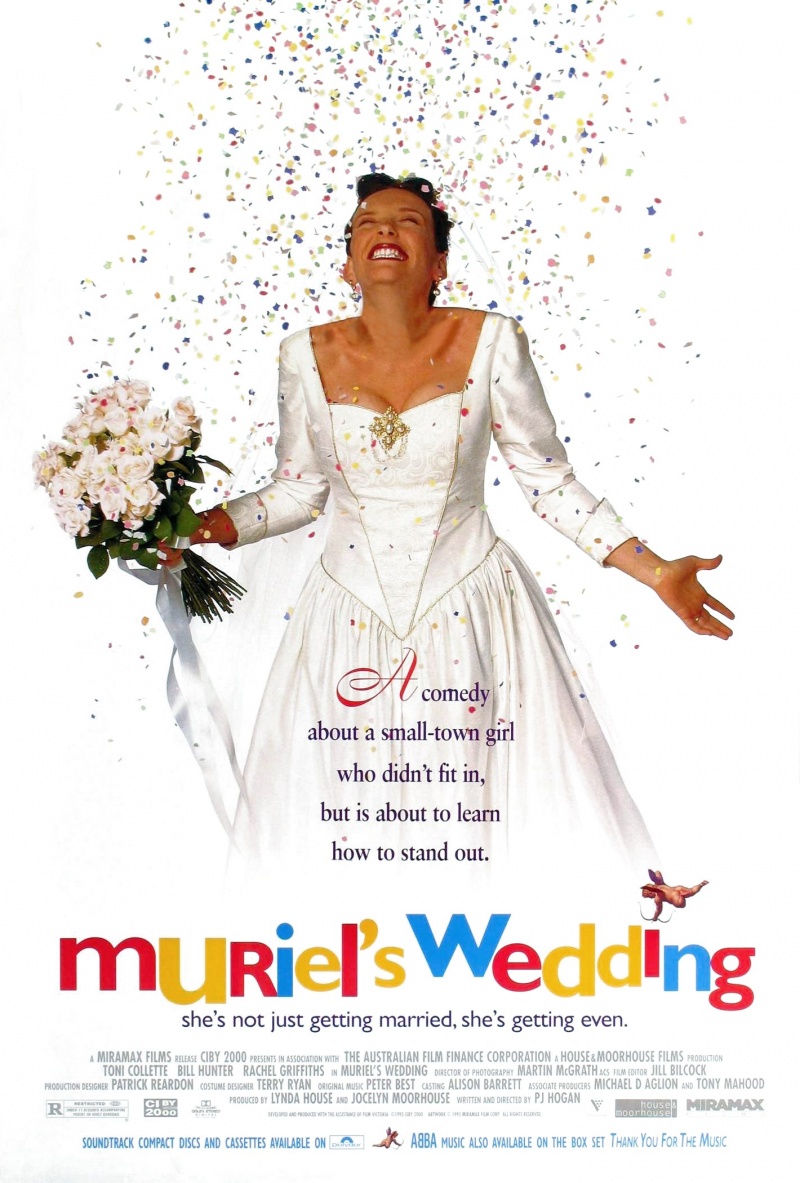
There’s something so compelling about Australian cinema – many fantastic discussions have been had about how their unique perspective and willingness to venture further than many others have resulted in some absolutely fantastic, and often quite provocative, works of filmmaking. Regardless of the specific genre, there is often a spark of genius that underpin these films and make them so captivating and timeless. Muriel’s Wedding is part of a wave of comedies produced in Australia from the start of the 1980s towards the end of the 1990s, where they found success both domestically and abroad, with this film in particular flourishing into something of a sensation – and it is quite difficult to argue against the reasons the film succeeded so tremendously, since it strikes a chord with viewers that may not necessarily be able to relate to the cultural quirks that went into the film, but could still appreciate the daring charms of P.J. Hogan’s wonderful comedy. Over a quarter of a century later, this film still stands as one of the funniest to come out of Australia, remaining as resonant and endearing today as it did upon its original release, a testament to the incredible work done by those involved in bringing this lovable story to the screen – and unlike the impression we get based on a quick glance, Muriel’s Wedding is a lot more complex than initially meets the eye, especially when it becomes clear that Hogan isn’t too concerned with the mechanics of the romantic comedy, but instead pursuing something slightly deeper and more meaningful, all of which goes into the construction of this adorable film.
Toni Collette has become one of contemporary cinema’s most reliable performers – regardless of the size of the role, whether leading the film or being a memorable supporting character, she is absolutely magnificent in nearly everything she does, possessing that rare ability that not many actors have, where she can elevate even the most dismal material. Muriel’s Wedding was her breakthrough role, and is essentially the film that gave her a career. Suddenly, this peculiar young Australian actress was being found in cinemas around the world, the global audience falling in love with her immediately, despite the fact that she is far from the conventional lead of such a film. Looking back, it’s unsurprising Collette received such a boost from this film – very few actors of her generation are as willing to surrender to character-based work than her, but I can only imagine encountering her for the first time, and seeing her giving such a bold performance, would be considered a major revelation, a step forward for performers that weren’t always conventional in their approach to their craft. What we can learn from Muriel’s Wedding is that Collette exists at the perfect intersection between leading star and dedicated character actress, her performance proving her talents and setting off a career that continues to be one of the most diverse and challenging in contemporary cinema, and we don’t even need to look to her other work to have this consolidated – absolutely everything that makes her such an interesting screen presence can be found here, where she commands the screen with an offbeat charisma that we simply can’t resist, helping the viewer fall even more in love with her wonderfully eccentric talents.
It would be strange to call Muriel’s Wedding a romantic comedy, despite the fact that it is very much rooted in the concept of falling in love, and is certainly a very funny film. It wouldn’t be inappropriate to call it a love story, however – but this doesn’t necessarily imply that the two are entirely the same. Muriel is a young woman yearning for a partner that can give her the ideal wedding she has been dreaming of for years, only to discover that there is more to life than just finding a husband. This is a film about three different kinds of love – the first is that which exists between family members, with the beautiful relationship between Muriel and her family (with the exception of her father, who is the film’s primary antagonist and the most substantial obstacle for Muriel to overcome) being the heart of the film. The second is slightly related, as it focuses on the friendship between the titular character and her childhood best friend, their companionship being rekindled by chance in adulthood (Rachel Griffiths is excellent, and often comes very close to matching Collette in her performance as the foul-mouthed but good-hearted Rhonda). The third, and most arguably important representation of love, is that which comes when someone decides that they are worthy, accepting and loving themselves for who they are. These components, when placed together, almost entirely distract from the actual romances that are peppered throughout the film – they’re not inconsequential, but just not all that impactful, especially not when there is a deeper meaning to everything else that surrounds this film.
There’s a free-spirited charm to this film that supersedes anything tangible. As much as Muriel’s Wedding would have you believe it’s just a conventional, ordinary comedy of errors, it has a subversive charm that goes above and beyond the specific plot details. This is a film about a young woman discovering herself in a world that is hostile to her peculiar charms, and the story does well in portraying Muriel in all of her imperfections, demonstrating that she is not without her flaws, but still somehow manages to be likeable. As much as the film would like us to be entertained, there’s a grittiness to this approach that can be appreciated by those who yearn for something a bit more complex. Some of the character motivations may be murky, but they’re at least genuine, and these appear like real people, no one entirely free of shortcomings, but also never beyond redemption. It helps the film become a much more interesting text, since Hogan and his collaborators aren’t interested in just making something conventional, instead choosing to go about telling of Muriel’s journey (both physically and mentally) through a very endearing but also quite profoundly moving comedy that never takes itself too seriously, but still isn’t afraid to have some more sobering conversations. There is as much sadness in this film as there is joy, the director working hard to balance the two, and ultimately finding the perfect combination can bring about the most emotive, enduring glimpse into the lives of ordinary people. Far too much is written about Muriel’s Wedding as an irreverent comedy, and not about how deep and moving the film manages to be in between the moments of hilarity, which is why there’s a lot more to be said about this film as a poignant, character-driven story, not just solely reputation as a piece of lovable filmmaking.
It’s difficult to not absolutely adore this film – Muriel’s Wedding is just such an endearing and charming film, designed to simultaneously provoke laughter and draw out tears. The perfect calibration of emotions is one of the film’s most substantial merits – how Hogan is able to both make us laugh and reflect on more serious matters (often in tandem) is a credit to his wonderful skills as a filmmaker, something that he would successful utilize in a few of his later films, when there seemed to be a movement towards positioning him as the next great populist director, with a few excellent comedies proving that Muriel’s Wedding was far from a fluke. Even though the director has receded in popularity and quality of output, this film stands as an achievement all on its own, with Collette’s performance being duly celebrated as some of her best work, and the film as a whole being an exceptionally well-made comedy with an abundance of heart and a sincere sense of humour that propels it forward and makes it such an unforgettable experience. It has received a lot of acclaim over the years, but there’s nothing quite like settling down and embracing the quirky charms of this small but unforgettable comedy, and whether in the smallest details or the broadest leaps of faith, Muriel’s Wedding is just an absolute delight, a film that persists as one of the most heartfelt coming-of-age stories from this era, and just a generally lovable film that never backs down from saying what it wants to say, and allowing us to luxuriate in the strange, offbeat world of Muriel Heslop – or is she still going by Mariel?
 The Postmodern Pelican
I contend that the contagion of joy that is Muriel’s Wedding is dependent on the music of ABBA. By my count, there are at least half a dozen pop songs from the four member Swedish music group comprised of two married couples. Director PJ Hogan worked diligently to win the trust of the band. They were quite hesitant to allow their music to be molded into this odd little comedy.
Perhaps the best way to understand the importance of ABBA to the success of Muriel’s Wedding is to look at the film that almost was. While filmmakers were wooing ABBA right up till the beginning of shooting, an alternative band needed to be in place to serve as Muriel’s favorite group. Hogan had decided on the Village People. It is conceivable the instead of Waterloo that Muriel and Rhonda could have been on that stage lip syncing YMCA. The comedic element is still there but the hopeful romantic mood would be dispelled.
Only a few years later, Hogan was signed to direct another wedding based comedy, My Best Friend’s Wedding. It, too, relied on its creative incorporation of pop tunes to add emotional rsonance.