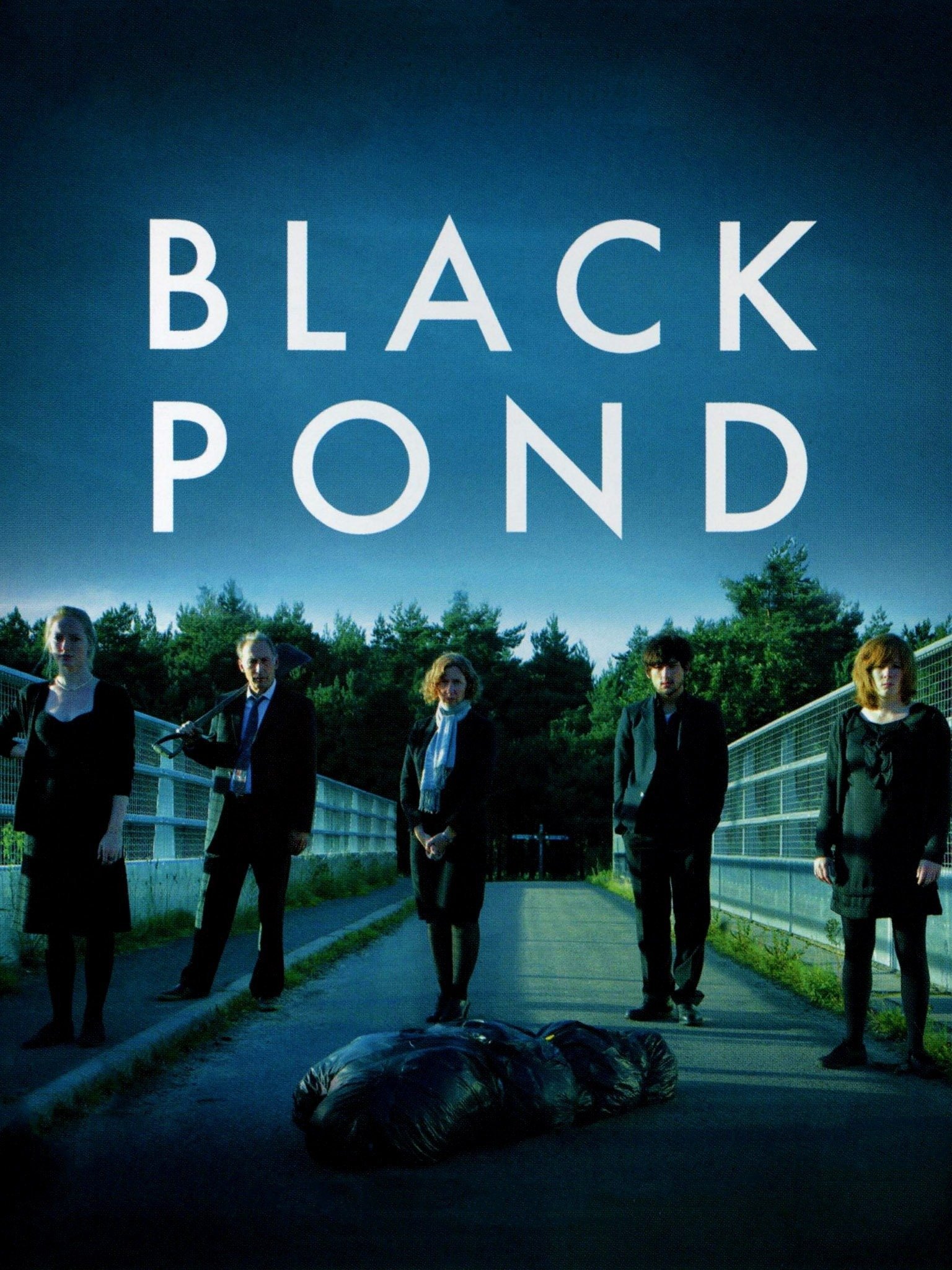
The Thompsons are a well-meaning, ordinary British family living in the countryside. They’re headed by the cheerful Tom (Chris Langham), his dedicated wife Sophie (Amanda Hadingue), and their two daughters (Anna O’Grady and Helen Cripps), who have recently left their pastoral home in pursuit of a life in London, where they stay with their roommate, Tim (Will Sharpe), who acts as a passive observer to many of their activities. One afternoon, Tom encounters a middle-aged man who introduces himself as Blake (Colin Hurley), immediately striking up a friendship after the stranger tells him a story about a woman who mysteriously disappeared, with the general consensus being that she went walking on a nearby body of water named the Black Pond, since its frozen state is dark enough to obscure anything beneath the surface – and the story of the widowed husband, who not only had to face a world without his beloved, but also without the knowledge of whether she was still out there, or if she had met her fate in some harrowing way. Feeling pity for the disturbed man (who is quite possibly the distraught husband in the story he told, as his mental state indicates someone who has experienced severe trauma over the years), Tom invites Blake to visit with the family for an evening – but doing so opens up a world of inconvenience when his new friend proves to have a sinister streak, borne from his agitated, depressive state that causes him to act erratically, in such a way that the family is soon confronted with a difficult situation that will test their mettle as both individuals and as a single unit, which is far more difficult to convincingly portray when the very fabric of their relationship has been hopelessly eroded beyond the point of any possible return.
Black Pond is a delightful enigma of a film. Reading any piece of criticism or reporting on the debut feature by Will Sharpe and Tom Kingsley will doubtlessly refer to a few keywords – “independent”, “low-budget” and “amateur” are normally the most oft-repeated phrases when it comes to this film, and quite accurately so. This is the epitome of a labour of love – scrappy young directors Sharpe and Kingsley took their shared talents, and put together a compelling dark comedy that centres on a family that exceeds the confines of the term dysfunctional, instead being a gloriously demented elegy to the broken promises of the common family dynamic. Black Pond is a film that disposes of all notions of common decency, dismissing them as nothing more than petty attempts to capture the spirit of something that quite simply doesn’t exist in the real world, at least not from the perspective of two filmmakers who may take a more cynical approach with their methods of storytelling, but do so with a candour and dedication that is indicative of a pair of artists looking to make a name for themselves without going through the familiar process of toiling in the industry and only being able to make such an ambitious feature after years of hard work, and introductory attempts to secure a place at the proverbial table. Sharpe and Kingsley are two absolutely essential voices – and looking into this film a decade after its release, it’s not surprising that it served to be a particularly strong starting-point for the filmmakers, most notable Sharpe, who has honed his skills on television and in film (both behind and in front of the camera), and gradually established himself as a fantastic young artist who is well on his way to making a profound impression. However, if there was any justice, Black Pond would’ve been the worldwide breakthrough it deserved to be ten years ago, since there are few films quite as unique and idiosyncratic in both its intentions and execution as this one.
We never quite know where we stand with Black Pond – from its first moments, it’s not clear where this film is heading, nor is its moral centre made particularly clear, which persists until the final moment. It’s the rare kind of film that presents us with the conclusion right at the beginning, but eliding just enough detail to prevent us from knowing how it reached this particular point. Instead, the mystery unravels as the film goes along – brief hints peppered throughout the film help add up to our knowledge of the central conflict, but we are constantly scrambling for answers, which isn’t made any easier by the peculiar manner in which the directors put the film together. This is a bizarre film, which it achieves through a number of different means – whether it’s through the erratic editing (clearly an intentional choice, since it only compounds the madness of the underlying premise), the bizarre performances that occupy an ambigious position between being works of highly-experimental camp, and beautifully naturalistic work, or simply the polarizing writing that seems to be revealing an endless amount about the story, but not to the point where we actually feel as if we know these characters, or are particularly clear on their intentions, there is always something amiss about this film, in the best way possible. Sharpe and Kingsley know exactly where to show the precise amount of restraint necessary to keep this film entertaining and engaging, but not without losing its very stark sense of darkly comical humour that is often more terrifying than it is cheerful or endearing. There’s a distinct sense that this film doesn’t quite know where it’s heading, but even at its most reckless, there’s a firm sensation that the directors are steering it in the right direction, which is proven to be entirely accurate by the time it’s had its way with us, having taken us on quite a bewildering journey.
Secrets are a motif that have been well-utilized in art, with the idea of concealing some truths, whether devastating or simply just too harrowing to reveal to the world, having informed a great number of significant works. Black Pond employs this, and heightens it to the point of nearly falling apart entirely. Starting the film with the concluding remarks (indicating the family at the core of the film were accused of murder), and then gradually unpeeling the layers, all the while keeping many of its more notable clues hidden from view, was a risky approach, especially since this is a film from two untested newcomers who were trying to not only make something they were passionate about, but in such a way that they’d be able to pursue this more comprehensively. It did work, but only to an extent – Black Pond is still a very bewildering film, and its a rare breed of crime-focused storytelling that alienates those who are most dedicated to this kind of narrative – it’s disconcerting and almost too bleak to be thrilling, and its emotional beats are far from satisfying, to the point where the final moments of the film inspire a wealth of different reactions – disgust, despair and even a form of poetic catharsis – but never the feeling that we have helped solve the mystery. This would normally be to this film’s detriment, but it works spectacularly well, since its execution only adds to the intrigue. Nothing is linear in this film, nor is it a piece that necessarily feels compelled to position itself within a particular genre, or even make a decision on whether it’s a piece of faux-reality, or a bold, melodramatic slice of excessive fiction. The fact that it managed to accomplish all of this, while still functioning as an audacious debut for its two directors, is all the more impressive and a further reason why Black Pond is quite a radical piece.
Impossible to pin down to a particular genre, and more of the kind of film that works better if the viewer goes in entirely blind and without any preconceived notions of what to expect, Black Pond is quite an experience – and one that announces itself as an undersung masterpiece almost immediately. It’s a powerful film – it starts as a stark, unforgiving array of images, plucked from a variety of talking-head interviews, journalistic reporting and first-hand accounts of the events by the family members and those around them, interspersed with glimpses into the circumstances being described. It then reaches a vaguely comedic peak in the middle, having a distinct sense of humour that is more thought-provoking than it is hilarious (even if some of the moments of unrestrained comedy are notable and add to the overall peculiarity of the film), before ending as a bleak and disturbing testament on the limitless bounds of the human imagination, and how it can concoct entire narratives out of the most inconsequential events, which this film does so perfectly, with a poise and striking sophistication we may not expect from newcomers. It’s a highly experimental film, which may bewilder some viewers, and its idiosyncratic style does pander to those with a more acquired taste – but if we look beyond this, and instead focus on the underlying concepts being presented, it’s difficult to argue with anything that implies that Black Pond is something other than a work of unhinged madness, condensed into a strange and unflinchingly profound package, making it an absolutely essential work of contemporary British independent filmmaking, and perhaps the first indication that a new wave of kitchen-sink realism-inspired cinema is on the horizon, one where experimental approaches to storytelling contrast with organic representations of everyday life – and that’s truly an exciting concept, if it comes to fruition.