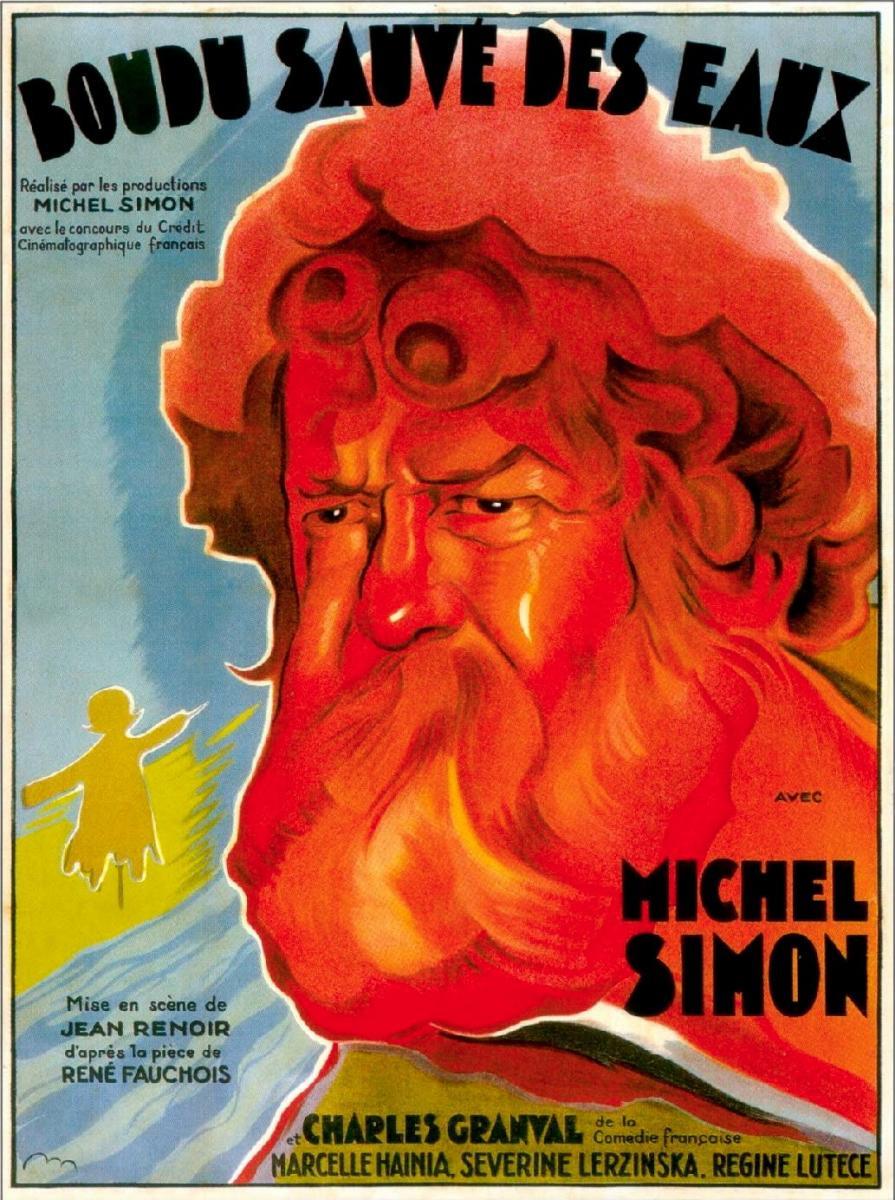
If anyone was going to make a film that deftly combined social satire with broadly slapstick comedy, it would be Jean Renoir. The esteemed French director was a cinematic pioneer that made some of the greatest films of their era, in a career that stretched across multiple decades. The 1930s were undeniably his most distinct period, with his two canonical masterpieces (Le Grande Illusion and The Rules of the Game) being produced during this era – however, a third film has made its way to the upper echelons of his output, with Boudu Saved from Drowning (French: Boudu sauvé des eaux), being one of his most cherished, if not slightly underpraised, works, one that has often been cited as one of his defining films, but mostly struggles to stand in contrast to the two aforementioned films, by virtue of its profound simplicity, compared with their achingly beautiful mysteries. The story of a down-on-his-luck vagabond attempting to end his life, only to be saved by a bourgeois couple that adopts him as their beneficiary and help turn his life around, is one that struck a chord at the time, and remains quite resonant, even by contemporary standards. As one of the most ingenious filmmakers of his generation, and someone who always had a firm grasp on the collective cultural pulse, Renoir was the right person to bring the stunning play by René Fauchois to the screen, adding his own distinctive directorial flourishes and layering on a variety of interesting ideas to the original text, leading to a film that is as entertaining in its widely-accessible style of comedy as it is shocking in how it peers behind the social veneer, providing us with an unflinching and wildly funny glimpse into Parisian society, and the economic divide that existed between classes which often defined interactions and set the standard for how the entire population defined itself and those around them.
It isn’t particularly difficult to see why Boudu Saved from Drowning has become such an enticing piece of filmmaking – not only does it have Renoir’s distinctive style permeating every frame, but the story is incredibly resonant. Regardless of where the viewer is from, we can all relate to the concept of the social divide, the hierarchy that exists solely to place individuals into various categories, from which they are able to have access to certain opportunities. Many works of literature, for as long as artistic expression has existed, have focused on the divide, most of them not taking a particularly positive approach to showing the class difference. Boudu Saved from Drowning is designed as an outrageous comedy, albeit one with a very profound message at the core, which is a common quality in Renoir’s work – his ability to infuse even the most exuberant comedies with either a deep sense of melancholy, or a scathing perspective on cultural issues, has made him one of the more unimpeachable masters of social critique to have ever worked in cinema. His candour and willingness to venture beyond the confines of the basic stories at the heart of his films made him someone who understood the fundamental aspects of the human condition, and was rarely apprehensive when it came to forming stories almost entirely focused on peeling back the layers and addressing some complex issues directly. This film is one of the very best examples of this in practice, with the premise being simple enough to not become convoluted, as well as having a certain ambiguity that allowed for a fascinating exploration of character motivations and social issues that are always a common concept in these stories.
Renoir made it very clear throughout his filmmaking career that he considered Michel Simon to be the greatest actor to ever work in any medium, a claim that is bold but very difficult to argue against. It was the filmmaker’s great fortune to collaborate with Simon on a few occasions, with Boudu Saved from Drowning being a film that came about as a result of a previous collaboration, with the actor suggesting that they work together on an adaptation of the play, a concept that intrigued but intimidated Renoir. However, whatever apprehensions he had in bringing Fauchois ‘s play to the screen were unfounded, since not only did he faithfully adapt the beautiful text, but he extracted one of Simon’s finest performances, the role that perhaps has defined the actor more than anything else he did, at least in retrospect. Boudu is a fascinating character – he’s a rambunctious, vulgar vagabond who takes advantage of anyone who crosses his path, including the empathetic middle-class couple who do everything they can to pull him out of his dreary state. He’s not a particularly likeable character, but Simon is so electrifying in the role, we can’t resist being absolutely captivated by what the actor is doing. Renoir’s camera is clearly in love with this performance, since it captures every nuance in his speech, every subtle movement in his grandiose gestures. It’s difficult to imagine anyone else turning in a performance quite as impressive as Simon, who takes this role and makes it something absolutely unforgettable, not merely matching the tone of the story, but essentially setting the tone for this brutally funny and deeply unsettling exploration of the social divide, as filtered through the perspective of a man who is given the opportunity to progress in life, but rather chooses the easier path.
Boudu Saved from Drowning is often considered one of the finest social satires to ever be produced, but there is a certain quality about it that makes it slightly more complex than we’d expect, based on the premise. It inspired a number of other works, whether direct adaptations (such as the solid but unremarkable Down and Out in Beverly Hills) or simply those that pay homage to Renoir’s very peculiar sense of humour. This is a film built from the foundations of the human condition, where the director takes the opportunity to critique society through the lens of a very broad comedy – it leads the film to consist of a number of hilarious sequences that follow the pattern of the comedy-of-errors that obviously inspired the story, only for the director to subvert expectations by inserting some very bleak commentary into these situations. It is never overwrought (even if it tends towards preaching from time to time – the “good Samaritan” narrative runs its course very fast, and is perhaps one of the only aspects of the film that needed further work), and the sobering conversations surrounding social inequality comes through in more subtle ways. Renoir didn’t make comedies purely for the sake of entertainment – he was an artist who was far too concerned with exploring the world and its people to just make mindlessly enjoyable films – but rather used humour as a powerful tool to expose different aspects of society, which he observed through his very keen, eagle-eyed understanding of many deeper issues. It doesn’t mean Boudu Saved from Drowning isn’t absolutely hilarious, since there are some wonderful moments of levity throughout, but there is always some depth to the comedy, which only enriches the story that the director is intent on telling.
As far as comedies of the 1930s go, Boudu Saved from Drowning is certainly one of the most essential. It was a product of a different time, produced in a world caught between two major wars, with the social, economic and political systems radically changing as a result of the shifting world – and while not all of this may be present in Renoir’s work, he certainly wasn’t averse to reflecting some components in even the most upbeat of comedies. This film in particular carries a lot of weight in looking at the social divide, almost as much as his upstairs-downstairs drama The Rules of the Game, which extracted a lot of interesting commentary from a deep exploration of the various social strata. In this film, the message is a lot clearer, and doesn’t need to depend on inference for us to fully understand the scope of the narrative. We’re immersed in this world, a passive observer (or perhaps even just a silent houseguest) into the lives of these characters, where we get a firsthand depiction of the various conventions that drove French culture at the time – and while this isn’t broadly representative of the entirety of the social sphere (it never claimed to be), it does carry enough depth to be a good starting point for some fascinating discussions. Lead with panache by one of the finest actors of his generation, directed by a truly gifted filmmaker, and featuring many complex ideas that complement the wonderfully endearing story of a clash between social classes, Boudu Saved from Drowning is a tremendous achievement, and a vital entry into a canon of socially-charged comedies.