
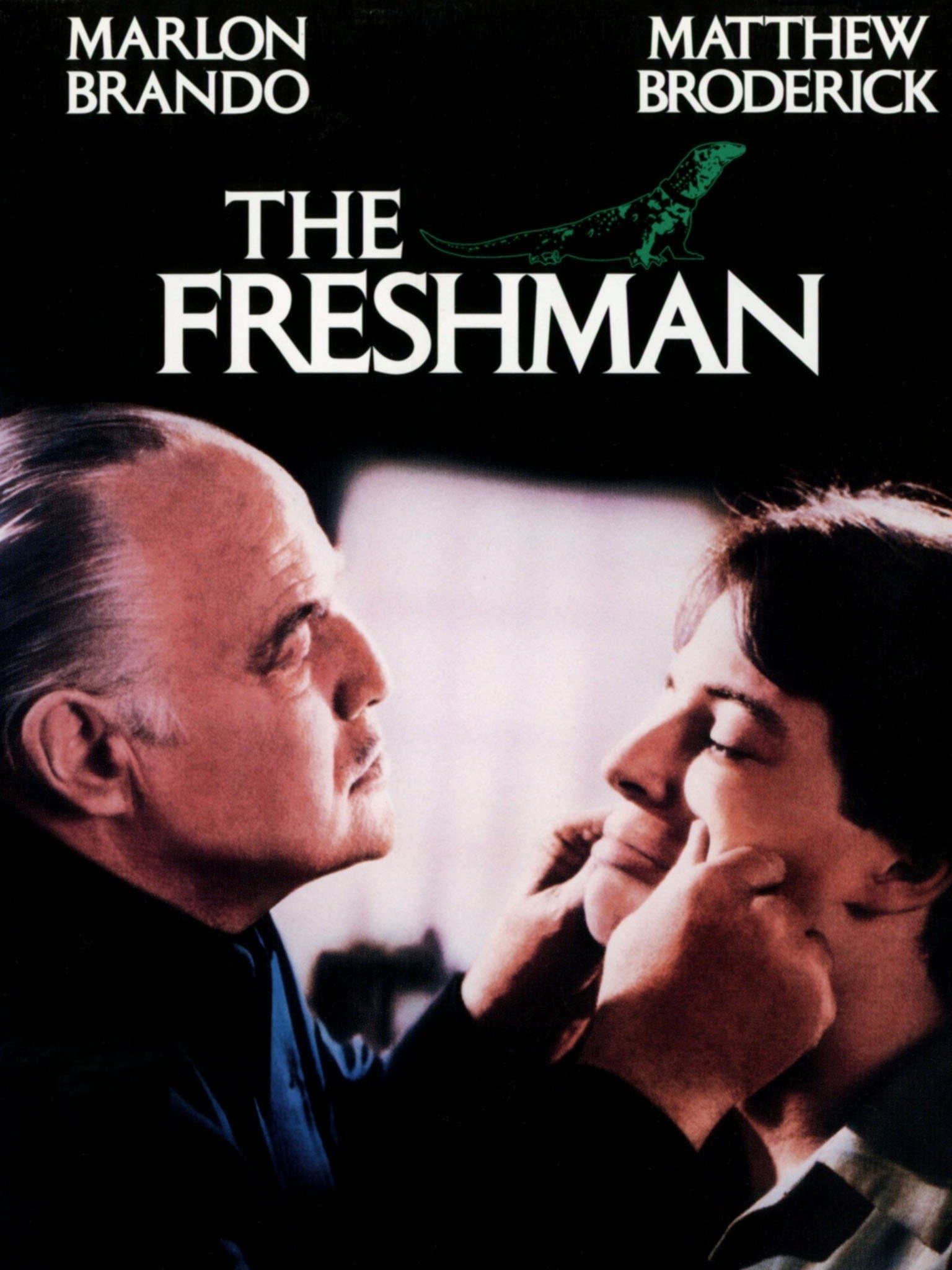
Clark Kellogg (Matthew Broderick) is a young man from Vermont who is about to embark on quite an adventure, setting off to attend film school in New York City. His arrival there is instantly troubled, particularly when he encounters Vic (Bruno Kirby), a street-smart hustler who promises the impressionable young man safe passage to his university, but ends up ripping him off and stealing all his possessions. However, it doesn’t take too long for Clark to spot him again, and he is intent on getting revenge, since this brief case of petty theft put him in quite an unfortunate situation. Vic has gambled away all the money he stole, but promises Clark something better – a job. He introduces him to his uncle, Carmine Sabatini (Marlon Brando), who claims to be an importer, and is looking for an assistant to help him with a regular weekly matter, transporting packages from the city to New Jersey, for which Clark can expect to make quite a substantial amount of money. However, it turns out that Carmine is quite a sinister figure, and whose dealings are actually not nearly as legitimate as those around him make it seem. However, the more Clark tries to escape becoming involved in the organized crime business, the further he is pulled in, with the charismatic Carmine and his many associates proving to be quite persuasive, especially when showering Clark with gifts and promises of wealth, which means a lot to the middle-class young man who has always yearned for fame. Over the course of a few weeks, Clark learns some horrifying secrets about the underworld of crime, all while dealing with the exuberant crime boss and those who surround him and try and force Clark into their deranged world of violence, crime and bizarre cuisine.
I’m not entirely sure who should be praised for The Freshman, whether it be Marlon Brando, for taking on a role that is (by its very definition) parodic of his status in the industry, Andrew Bergman for being fearless enough to actually wrangle the notoriously difficult actor to do so, or Matthew Broderick for having to share the screen with one of the most unpredictable stars to ever work in the medium. Regardless, The Freshman is an absolute delight, and a comedy that isn’t appreciated as much anymore as it should be, having faded away into relative obscurity, its legacy only being kept alive by either those who are interested in exploring every avenue of Brando’s career, or those who stumble upon the film late one evening. I was originally part of the latter group, but over the years, I’ve amassed such a fondness for this film, which I revisit periodically for the sake of seeing exactly how one of the most bizarre premises in film history actually resulted in an incredibly funny comedy that doesn’t take itself too seriously, and instead knows exactly how to plumb for the kind of humour that stands the test of time, even if some of the references this film makes can come across somewhat dated, and almost along the same lines as someone mocking the genre, rather than paying tribute to it. A few decades later, The Freshman is still a hilarious, irreverent romp through the gangster genre, brimming with a very peculiar energy, and a few unforgettable performances that are almost too good for such a relatively weak story. Yet, it all converges into a daring and entertaining jumble of ideas that manage to evade mediocrity long enough to confirm itself as a cult classic that is ripe for rediscovery by modern audiences, who are likely to extract a lot of value from this very strange, but oddly endearing, little comedy that dares to go where very few others would.
The fact that Bergman, who had developed into a decent screenwriter but was relatively untested as a director, managed to convince Marlon Brando to play the role of Carmine Sabatini is an absolute marvel. Considering how this film was made in the final stages of Brando’s career, when some of his choices were undeniably unconventional but still very much keeping with his own distinct approach to developing his parts along the lines of what he was willing to do, the fact that he took on a character that wasn’t only a blatant imitation of arguably his most iconic character, but one that essentially looked beyond the mystique that surrounded Vito Corleone a few decades earlier, is astounding. However, it’s the perfect example of writing a role based on someone, and taking the risk of asking them to do it – and had anyone else played the role of Sabatini, it may have been just as good of a film, but one that was profoundly different. Despite having a relatively small role, Brando is naturally first-billed, and not only is this a marketing ploy to convince curious viewers to give this film a chance, it also pays tribute to the fact that Bergman managed to get one of the most esteemed actors in film history to play this role, which is truly unbelievable. It would be foolish to say Brando was good in the part – even in the worst films, he still managed to bring out something worth watching. However, this is very clear a performance built on him as an iconic film star, rather than an actor who puts in the work. Bergman frames nearly every scene with Brando in a way that directly mirrors The Godfather, almost using the film as a reference point on how to portray the actor. Yet, Brando still gives a very funny performance (and comedies featuring the actor are few and far between, at least ones that are intentional), to the point where even strong performances like Matthew Broderick and Maximillien Schell pale in comparison when sharing the screen with him.
What started as an amusing anecdote of a director taking a risk and casting a particular person in a film eventually becomes a very interesting case of a world-renowned actor showing a rare instance of self-reflection. In the modern era, it’s not uncommon to find the boundary between the actor and the individual being crossed regularly, since we live in an age where the objective movie star just doesn’t exist anymore, and we’re obsessed with their lives to quite an uncomfortable degree at times. Seeing an actor like Brando (especially one so notoriously difficult to work with), playing a part that parodies himself in very explicit ways, is fascinating – and it’s even more interesting to see how much fun he is having with the part. Had someone else played the role, The Freshman would’ve been profoundly different – perhaps not so much in the story (which would’ve likely remained exactly the same had anyone else occupied the part), but in how it plays on Brando’s image, and how he essentially defined the gangster genre as a whole. He is giving less of a performance, and more lending his presence to a film that knows exactly how to use it in a very creative way. There’s an intrepidity that comes from someone daring to cast the person who an entire character is based off of, and still expecting them to turn in a performance that has many layers. Yet, The Freshman accomplishes this, and while it may not always be the strongest in terms of the narrative (with the final act being dreadfully rushed, and conclusion to this story coming across as an afterthought), it has such a vivacity in how it plays on its star’s personality and reputation, there is so much value in how it gradually strips away the layers to reveal quite a profound and interesting work of metafictional storytelling, which not many films have been able to convincingly convey without becoming too convoluted or self-indulgent.
Inarguably, a lot of emphasis has been placed on Brando’s position in this film, which is bizarre, since he is neither the star of the film, nor the central character. If anything, his presence in the film is more of a plot device than it is an actor giving a performance. Yet, nearly everything we remember about The Freshman is related to Brando in some form. It’s a fascinating experiment, and Bergman does exceptionally well in using him. However, there is still quite an enduring film underlying this aspect of the production, with Bergman writing a tremendously funny homage to the gangster genre. Some of the details may seem somewhat convenient, since it focuses on a young man who just encounters every form of good luck he can when moving to New York City (a welcome change of pace from films that place characters in places where they toggle from one disastrous situation to another), with the protagonist constantly calling into question the intentions behind these good deeds or bouts of terrific luck, to the point where it almost becomes a curse for him to be receiving such prosperity. It’s a bitingly funny satire of society, delivered in such a way that we don’t even realize the impact it has until it ends, and we suddenly figure out that there was a lot more to this film than just an excuse to have Brando relitigate a very popular character. There is a degree of ecological commentary in the film in how it centres itself on looking at the plight of endangered species (when it could’ve easily gone down a more traditional path of organized crime), as well as a lot of meta-commentary on how art informs life, and vice versa. It’s a fascinating tapestry of ideas that don’t always present themselves as being particularly noteworthy, but all eventually go into crafting The Freshman is a very funny and insightful film.
The Freshman is quite a film, and one that warrants a wider viewership, since it has been written off as more of a minor parody of the gangster genre, rather than the loving homage that it actually is. Bergman is a competent but unremarkable director, which actually worked to the benefit of this film, since his more subdued style meant that there wasn’t any expectation for this to be a definitive entry into the genre it is paying tribute to, but rather a delightfully irreverent comedy that surprises the viewer with something quite unexpectedly moving, even when it is at its most outrageous. There’s a sensitivity to this film that works incredibly well in context, and it actually manages to be quite heartfelt in some instances, which only adds nuance to an already very interesting film. It may have some incredibly silly humour, and can come across as being too superficial and rushed, but there’s a sincerity to this film that overtakes all these negative qualities, transforming it into a truly compelling comedy with a lot of heart and a great set of performances grounding it, giving this film a very distinct quality that makes it something that should be appreciated by contemporary audiences, who are hopefully able to get the same value out of The Freshman as audiences from three decades ago, who were truly bewildered and beguiled by this fascinating subversion of a popular genre that sometimes needed to take itself less seriously.
 The Postmodern Pelican
I suspect that Brando’s reported $3.3 million payday plus 11 percent of the gross was sufficient motivation to take the small role.
This was the time period when Brando was quite willing to sell his name for a substantial fee. Just a decade earlier Brando was paid $3.7 million plus 11.75 percent of the gross for approximately two weeks of filming on Superman.