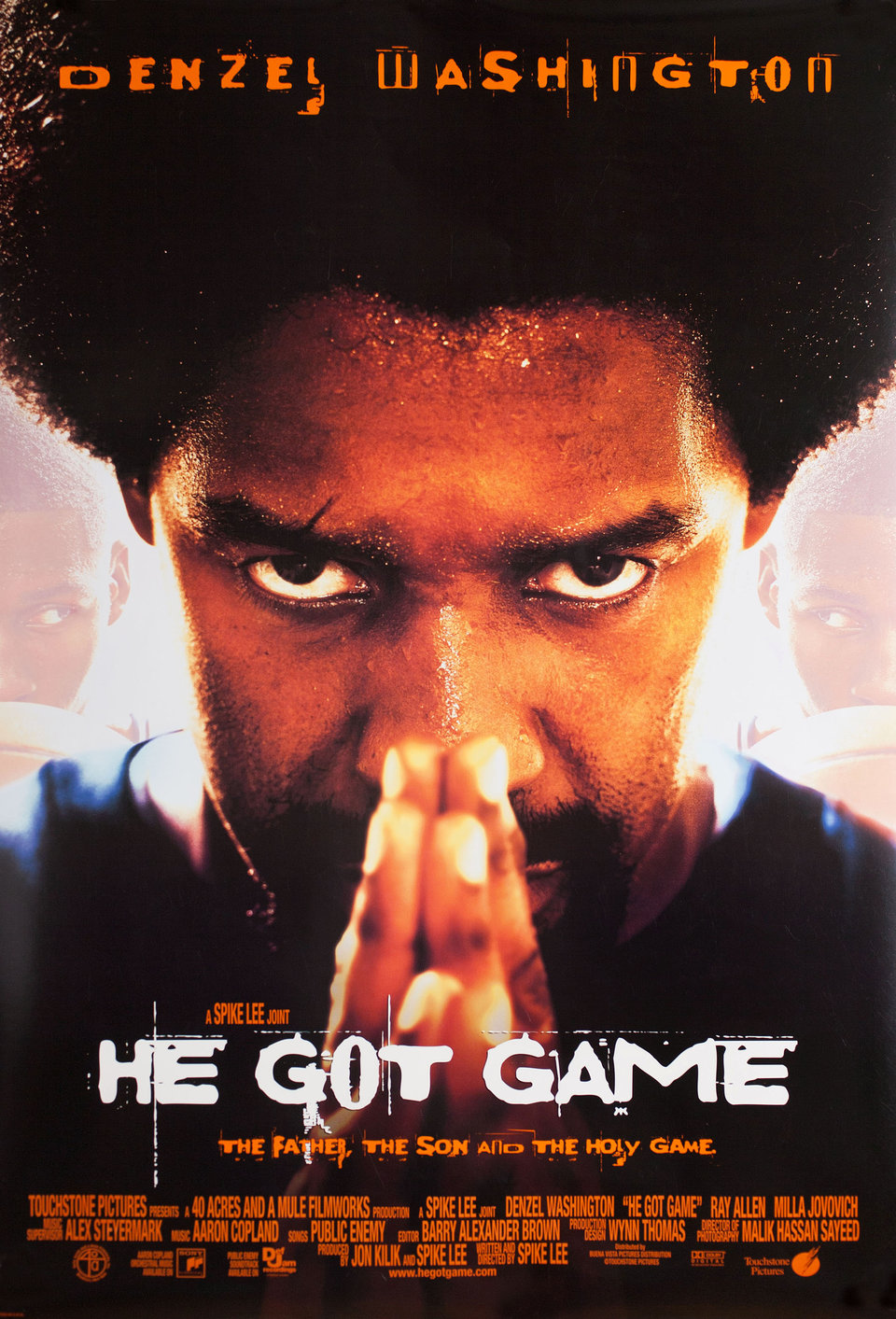
When he isn’t making groundbreaking, subversive cinematic masterpieces, Spike Lee can usually be found sitting court-side at any of the seasonal games of his beloved New York Knicks. One of the most visible fans of the basketball team, the esteemed director has made his love of the sport known throughout his career, being an evergreen supporter. It only stood to reason that at least one of his films would focus on the sport, which is precisely how He Got Game came into existence. The story of a convicted murderer being released momentarily from prison in order to attempt to convince his son, who just happens to be one of the most promising young basketball players in the United States at the present moment, to agree to enrol at the alma mater of the state’s governor, in exchange for having his sentence reduced, is one that is filled to the brim with many of Lee’s most familiar directorial tactics. Not only is it a beautiful love letter to the director’s favourite sport, but it’s also a poignant exploration of a father-son relationship (which Lee was known to infuse into many of his films at the time), as well as a deep and meaningful glimpse into the horrors of the prison reform system, and the social hierarchy that seems to be supporting it. He Got Game is a stunning film that is far more than just a run-of-the-mill sports drama, working consistently to push the boundaries of the art form in the way that only Lee, in his position as one of the foremost cinematic provocateurs of his generation, possibly could. It’s a simple film, but one that is teeming with subtext that adds to the overall experience, and as we gradually make our way through this world Lee is setting down for us, we start to see the intricate detail that accompanies it, which guides us towards a deeper understanding of the intimidating issues that serve as the foundation for this powerful film.
Nearly every piece of criticism written about Lee’s directorial career, whether positive or negative, will always somehow refer to the fact that he’s not a filmmaker who plays by the rules. Whether he’s deconstructing the entire cinematic artform (and its social underpinnings in the process), or doing something more subtle, the director is constantly inviting us to look deeper into whatever specific concept he chose to be the basis for a particular film. In the case of He Got Game, Lee goes in search of a way to make a sports drama that not only actively avoids all the expected clichés that are associated with the genre, but contributes something new to the discussion, ideas that are intrinsically related to the importance of sport as a cultural pastime, but not strictly tied to it in a way that prevents them from being looked at in isolation. Basketball serves as the framing device for most of the film, but there is a lot more simmering below the surface, and as we’ve come to learn throughout his career, the only thing we can expect from Lee is the unexpected, even to the point where his attempt to make a film centred around a particular sport turns into a multilayered exploration of the depths of society’s inherent shortcomings, filtered through the lens of two people on opposing sides of the spectrum of public perception, drawn together in such a way that the contrast provides enough fuel for an endless discussion on the subtle nuances of this film and how it portrays a relatively standard story. Lee is a master of his craft, but even at his most simple, he can’t avoid inserting an abundance of meta-commentary, all done through his distinctive style of telling a story and editing it to reflect a jagged, unconventional way of thinking – but when has Lee ever been a director who fits into the confines of convention?
Despite his long career that has seen him traverse every conceivable genre and work with several notable filmmakers, to the point where he has easily ascended into the pantheon of all-time great actors, Denzel Washington’s best work has always been under the guidance of Lee. The director drew out the actor’s greatest performances in films like Malcolm X and Mo’ Better Blues, and their partnership has been one of the finest in the history of contemporary cinema, enough to rival absolutely any other regular director-acting pairings. He Got Game is yet another tremendous collaboration, and Washington turns in one of his finest performances. We’ve become conditioned to seeing him play moral men who are normally on the right side of the law (and when they’re not, they’re either intentionally designed to be crooked, as is the case with films like Training Day, or they’re fashioned as characters who engage in some minor immorality for the sake of the greater good), so for him to play a role of a convicted murderer looking for a second chance is something of a change of pace, even if it’s not entirely revolutionary for Washington, who has played similarly complex characters before. Jake Shuttleworth is a fascinating individual – he is one of the rare felons who openly accepts his wrongdoing and never tries to deny his guilt, but rather uses the healing nature of time to make amends. This is explored beautifully throughout the film, whereby Jake doesn’t take any risk that could get him into more trouble – he sets out to accomplish his assignment, and in the process attempts to fix the raw wounds he left behind as a result of his actions. It’s a quiet, brooding performance from an actor who consistently challenged himself to deliver impeccable work, and while it may not be recognized as one of his best in most instances, there’s no denying his portrayal of Jake is amongst his most unheralded, and yet another opportunity for the esteemed actor to prove his ability to play absolutely any role.
Putting aside the specific plot mechanics of He Got Game is important, since while the story is absolutely riveting, the most engrossing parts of the film are those that are less easily described by words, but rather experienced through sensations. Lee has a knack for telling very moving stories that depend on the mood, being atmospheric blends of psychological drama and tender comedy, both of which exist in abundance throughout his long and prolific career. Here, we are presented with the very abstract concept of freedom, where Lee is asking some deep and insightful questions about what it truly means to be free. This is represented in the contrast between Jake and his son – the former is momentarily afforded his freedom, but under the caveat that he is heavily monitored, and will be severely punished if he takes even the slightest liberty beyond what he has been afforded. This is the very obvious representation of the concept in practice – but as we can see in his son’s storyline, Jesus Shuttleworth is also placed under strict confines, albeit in a more abstract sense. His fame and talent has given him the freedom to choose absolutely any future for himself – but as he soon learns, such liberty doesn’t come easily, and he is constantly bombarded with questions, requests and demands, all of which keep him from fully embracing the benefits of being the most promising young athlete in the country. The two contrasting stories are fascinating, whether in isolation or in the instances where they overlap, and Lee’s style of presenting them both through his distinctly experimental lens, where he himself is make use of his artistic license to tell the story, elevates He Got Game to an entirely new level, where even the most simplistic of moments come across as striking and compelling.
Yet, it all converges into the very simple fact that He Got Game is very little more than a story about a father and son trying to mend their broken relationship, while still having to deal with the boundaries that prevent them from being part of the other’s life in the way they’d expect. Whether it be the fact that Jake is only free for a few days, and thus has to make the best of his limited time with his son, or Jesus’ refusal to allow his father back into his life, both as a result of rejecting him for causing the accidental death of his mother, and because he knows he can’t possibly handle the trauma of having his father exit his life again so suddenly. Lee’s films cover a range of subjects, and can rarely be categorized under the same set of ideas – but what is very common throughout his career is an emphasis on family, so it’s hardly surprising that the most moving moments of He Got Game come in the sequences where family plays an impactful role. Whether it be the flashbacks to happier times, or the moments where there is focus on the attempts to repair this fragmented relationship, the film is beautifully profound, and slowly unveils its deep and unwavering commitment to the theme of overcoming a difficult past. Understanding the role trauma plays in the central relationship is pivotal, and helps us realize the complexities that underpin this film – and every moment is sold beautifully by the striking performances by Washington and Ray Allen (as well as a large cast of supporting players) who contribute to this stunning tableau of a father-son relationship that has been weathered by time and trauma, but hasn’t entirely been destroyed, since there is always a possibility of hope on the horizon, which is perhaps the most inspiring component of this undeniably challenging film.
He Got Game is an incredible film, and while it may not reside at the top of Lee’s long career as a filmmaker, it’s still very much worth one’s time, especially in how it features one of the director’s most profoundly moving stories of overcoming seemingly insurmountable challenges. It may see the director working in a considerably minor key – after all, there isn’t much on the surface that attracts viewers in the same way as some of his more provocative films (and the fact that the film funnels its story through the guise of a basketball drama may prevent some more cynical viewers from giving it a chance). However, it develops into an insightful and honest account of a relationship being repaired, one that is foregrounded by an exploration of the uniting qualities of a beloved sport, but far from limiting itself solely to this side of the story. He Got Game is an exquisite film – Lee rarely (if ever) makes something that lacks artistic merit and creative nuance, so much that even what appears to be a passion project centring on his favourite sport becomes a poignant and hard-hitting investigation of some extremely deep and complex themes relating to a father trying to reconnect with his estranged son, and showing how both men, despite being on opposing sides of many societal spectra, are bound together by certain qualities that prevent them from ever entirely drifting apart. This is a film that advocates for the insatiable quest for hope in even the most harrowing of situations, and proves that even when working from a very straightforward premise, he was capable of evoking the most sincere, heartfelt emotions, which is all the more reason to consider him one of the best contemporary cinematic storytellers.