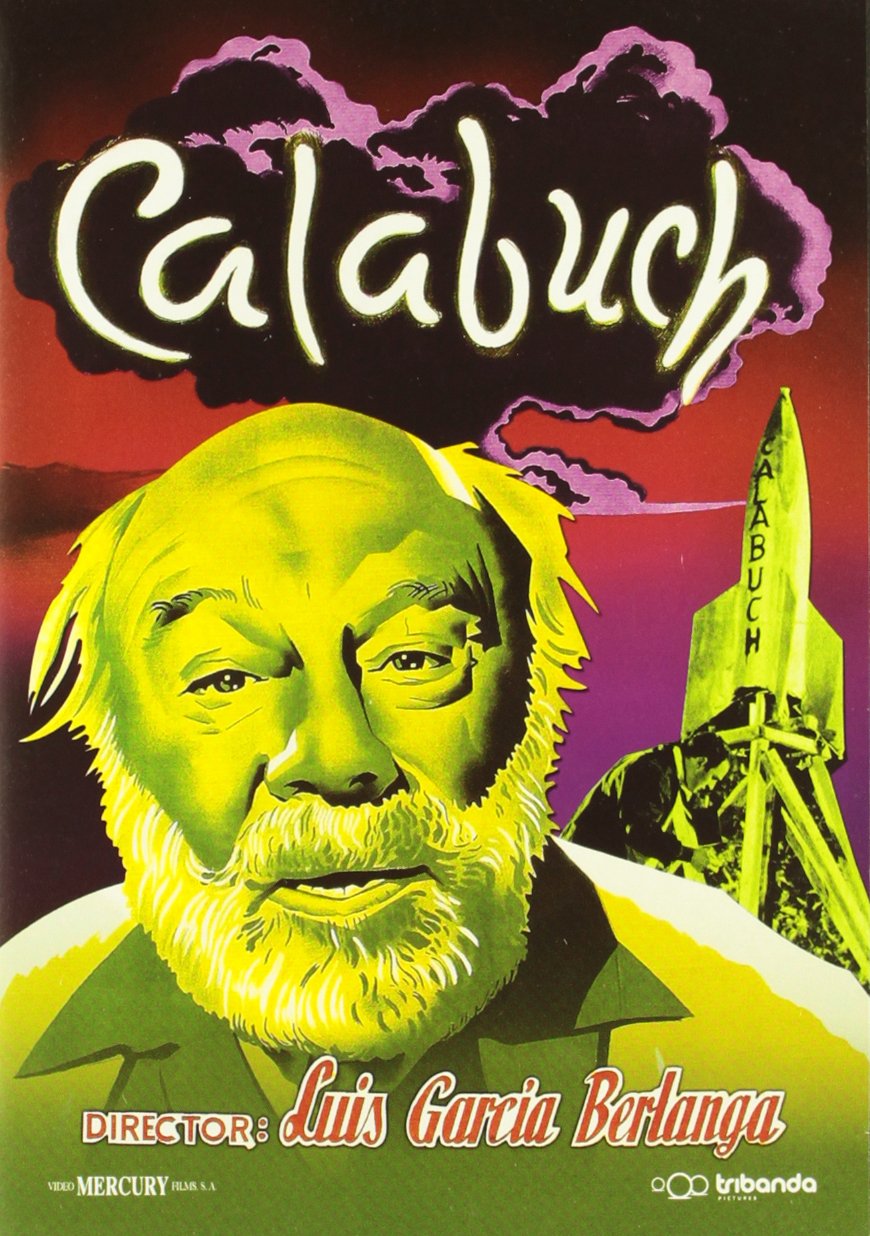
Professor George Hamilton (Edmund Gwenn) is a profoundly gifted scientist who has been working tirelessly with the American government to produce new technological innovations that will help push them further on the global scale. However, he is upset and chagrined to realize that his work is being used to develop weapons of mass destruction. Not wanting to be associated with the nation’s growing dominance in the growingly hostile atomic race, he decides to abscond from his position, and disappear into the ether. He runs away, and finds himself on the idyllic shores of a small Spanish village known as Calabuch, which seems to be preserved in time – the people live simple lives, and don’t pay too much attention to the march of time, existing in their own preserved version of the past. It doesn’t take long for Professor Hamilton, who now goes by “Uncle Jorge”, to assimilate into their society, and everyone is ready and willing to accept this stranger into their lives, not being aware of the dangers of trusting people they don’t know. Suddenly, he realizes that this is perhaps the best place for his skills – a village stuck in the past, but where the worries are so trivial, and the activities so simple, he doesn’t need to worry about the world around it. “Uncle Jorge” becomes an invaluable part of the community – a wise elder to the many curious children that surround him, a surrogate father to the wayward young men who need some guidance, and the kind of inventive person that the town needs to help them solve some troublesome issues, whether philosophical or technical. However, the rest of the world is actively looking for the missing scientist, and are doing their best to find him – but is it necessarily ethical to search for someone who just doesn’t want to be found in the first place, especially if their reasons for starting afresh have to do with maintaining peace and order in a world gradually descending into madness?
Once you have seen a few films by Luis García Berlanga, you start to notice a few familiar patterns – an emphasis on community and the people who populate a particular corner of the world, stories that take the form of quaint little social fables, and a sense of cultural cohesion that gives invaluable insights into the lives of those who populate any of the charming villages across Spain. Berlanga was a supremely gifted filmmaker, but someone who is unfortunately not given the credit he deserves, despite many of his films being outright masterpieces, both in form and function. The Rocket from Calabuch is one of his most unheralded films, a multicultural social odyssey that blends different traditions together in the formation of a compelling, earnest story of individuality and community values. Residing in relative obscurity, but certainly cherished by those who have been fortunate to experience it, the film is a masterful combination of comedy and drama, the rare kind of satire that jabs rather than outright pierces cultural conventions, and demonstrates its director’s incredible ability to command the narrative, forming a compelling tale of communal life without becoming too heavy-handed in its exploration of certain themes. It may not be enough for The Rocket from Calabuch to stand alongside some of the director’s more notable masterworks, such as The Executioner or Placido, but it functions in a way that makes sense in context, and gives the viewer something to hold onto, whether they’re a seasoned veteran of Berlanga’s films, or a newcomer to his beautifully chaotic approach to representing life as it is, and how it should always be in an ideal version of our world.
Magical realism is perhaps the best term to describe what Berlanga does with his films – his firm grasp on the cultural consciousness coupled with his background in traditional Catholic values, means that there is always a sense of the mystical underpinning his films. Miracles of Thursday is a forthright account of religious belief, and his other films make use of similar iconography in telling their story. The Rocket from Calabuch is slightly different in terms of its plot, since instead of focusing on religion directly, it uses the character of Professor Hamilton as a surrogate for the saviour figure, a man who (quite literally) descends into this village, a stranger to all of them at first, but someone who still makes his way into their lives and leaves an indelible impression on each of their existences, in the same way as the celestial beings who multitudes of the faithful have professed to encountering in the past. Whether this was an intentional choice, or just a happy accident on the part of the director, the film makes great use of this theoretical framework, and has some profoundly meaningful comments to make on the subject. Yet, even at its most sincerely emotional, The Rocket from Calabuch never comes across as overwrought, and its style is one that is more akin to a sweetly sentimental parable, rather than a sprawling religious epic. This is a common theme throughout Berlanga’s work, and is a quality that has constantly been the subject of imitation, with very few managing to reach the profoundly meaningful heights that the director did with this film. He is playing in a slightly minor key, and some of his ideas aren’t realized as flawlessly as they would in later films – but on the virtue of being simple and effective in telling a straightforward story, it may be difficult to find anything quite as endearing.
Community values play an imperative role in the creation of this story, yet another common thread throughout Berlanga’s films – you can easily attribute it to the director’s Meditterean background, as the concept of communal life is rarely better exemplified than in the seaside villages and towns in which everyone is involved in one another’s affairs and daily lives. These are not singular tales of individuals embarking on their own solitary journeys. Few directors valued the idea of the ensemble more than Berlanga (who is often compared to the likes of Robert Altman, in how he uses large ensembles to tell his stories), and The Rocket from Calabuch is certainly not a deviation from what we’d expect. Many of the same familiar faces show up throughout this film (including the delightful José Isbert, who remains one of the funniest character actors to ever work in European cinema, mostly due to his constant collaborations with Berlanga), and they’re joined by a few international actors, such as the tremendously talented Edmund Gwenn, who turns in his final screen performance in an unexpectedly endearing and appropriate swan song for an actor who had such an incredible stature in the industry, and the delightful Valentina Cortese, who was towards the start of her career here. Community is very important to Berlanga’s films, so it only makes sense that he would practice an approach the prioritized placing everyone on equal footing, and whether a major character or a scene-stealing supporting role, everyone in The Rocket from Calabuch is given some degree of attention, making for a vivid tapestry of lives, connected by the simplest thread of traditional values, which help drive this film and give it the nuance it needed to succeed.
Berlanga’s control of tone is simply unmatched, and his ability to form provocative satires without being mean-spirited, is one of the reasons he has remained such an enduring figure, since he touches on more universal qualities, themes and concepts that resonate with all of us, regardless of generation or cultural background. Films that penetrate these common divisions, whether it be in terms of the era in which it was made, or the specific faction of the audience that encounters it, are often those tend to be more timeless, since their ideas are less focused on a particular temporal or geographical situation, but rather more common qualities that many more of us can relate to in some way. Berlanga does this often – even when he is eviscerating the hypocrisy of the Spanish government, or going against the very principle of politics during the era, his work reflects a keen understanding of what will speak most resoundingly to the worldwide audience. The deft combination of slapstick comedy and ethereal satire is one that shouldn’t necessarily work as well as it did, with the director striking the perfect balance and leaving us appropriately enthralled without needing to hammer in the commentary all that much. His peculiar sense of humour carries over into even the most intricate recesses of the film – authority is questioned, religion and politics are torn apart in favour of a few well-placed jokes, and everyone appears to be existing in a slightly heightened version of reality, living simple lives in which their worries are more trivial. It gives the viewer a wonderfully insightful glimpse into one side of Spanish society at the time, but reconfigured in a way that is entertaining rather than heavy-handed, and the humour is simply impeccable, each moment brimming with a distinctive energy throughout The Rocket from Calabuch is simply unprecedented.
It takes a lot of effort to make something that is simultaneously so deeply complex, but presented in as simple a package as this, and Berlanga deserves nothing but the most resounding praise for his ability to filter some very serious matters into a film that aims to be nothing more than a charming comedy that will entertain and enthral audiences, while still provoking a great deal of thought in the process. Grounded by a magnificent cast, who find the right balance between the outrageous comedy and more tender moments, and driven by a sense of wonderfully intricate social commentary, The Rocket from Calabuch is a film that is difficult not to absolutely fall in love with – the content is relatable enough for us not to get lost when it veers towards more topical conversations, and for every moment ingrained in a particular time and place, there is something that we can all understand, at least enough to be captivated by the dizzyingly beautiful portrayal of life put on display for us. Simple but poignant, and driven by such an immensely striking point of view, The Rocket from Calabuch is a triumph. Not many films manage to be so profoundly effective in showing the inner machinations of a society undergoing change, while still being refreshingly funny and upbeat at the same time. It’s a wonderful film, and one that deserves to be seen, especially since Berlanga hasn’t garnered the acclaim he deserves, despite being one of the most definitive and brilliant artists Spain has ever produced, as made abundantly clear throughout his artistic career, of which this film is one of his most defining works.