
If the last two decades in film discourse have taught us anything, it’s that we must not be hasty in judging a film, especially those that are more ambitious than we’d expect them to be, or those which seem to be doing something radically different, which audiences have a tendency to write off as being failed audacity. I have learned to be very apprehensive when approaching films that are considered to be notoriously bad (particularly those from earlier decades), because it often results in a situation where the film itself is actually quite good, or at the very least doesn’t warrant the bombardment of hatred it received on its original release. Two films that demonstrated the value of critical reappraisal in recent years are The Room and Speed Racer, the former a work of incredibly unhinged ambition that went off the rails faster than it left the stations, and the latter being an instance of a misunderstood classic that was simply not appreciated as much when it was originally released. Before either of these films, there was another that stands as something quite extraordinary, an exercise in high-camp, and proof that a film can easily be produced at the wrong period in time. Xanadu is a film so incredibly revolutionary and ahead of its time, it’s still patiently waiting for the rapturous reappraisal that sees it more as “the silly roller-blading musical” that it has been unfairly labelled as. Instead, it’s an exercise in high-camp, a daring and provocative attempt at capturing the unhinged energy of the 1980s in a format that is palatable to audiences, and entertaining to them at the same time. There is a spark of pure magic that persists throughout the entire film, which seems to be built on a foundation of unintentional camp, showing an endearing lack of self-awareness, and instead functioning as an oddly compelling musical that doesn’t take itself seriously, at least not as much as the critics who eviscerated it on its original release, which makes it ripe for a more tolerant and insightful analysis from a modern standpoint.
The most fundamental problem with Xanadu is that it was a film produced in 1980, but wasn’t aimed at audiences from the 1980s – hindsight is certainly something that we all take into account when looking at how older films were received, but this is a case of a film have incredible foresight, to the point where it seems to be pitching itself to audiences that may not have even been born yet, since it takes some degree of the irony that the millennial generation cherishes so much to decode exactly why Xanadu is misunderstood and worthy of another look. Looking at it from our modern cultural perspective, every frame of this film is brimming with a unique energy that may have been considered unreliable at the time of its production, but with the advent of more cutting-edge humour, where camp has infiltrated as a legitimately essential tool of comedy, it’s difficult to argue against Xanadu being a misrepresent masterwork that is likely going to hold more value as a piece of entertainment in the contemporary sphere than it did when it was released. Four decades is a long time to wait to finally be considered a great film (although I’d personally argue that Xanadu is definitely incredibly entertaining, which is a by-product of the fact that it is indeed not very good, but in an interesting way), but there has rarely been a better time for younger audiences to come into contact with this bewildering, delightfully irreverent musical comedy that manages to be both thoroughly entertaining, and oddly intoxicating in the subject matter, and the methods with which it is gradually revealed to us. On both a conceptual and cinematic level, Xanadu is quite an achievement – a bold and intrepid musical comedy that launches itself into the centre of an industry that had rarely been kind to an ambition that isn’t guided by some major artistic figure. Its path to success was going to be a challenge from the outset, and while it may have taken a few decades, it’s a joy to be witnessing the gradual emergence of this film as some undervalued masterwork, which is exactly what it manages to be.
They simply don’t make films like Xanadu anymore – every frame of this film is positively leaking trash cinema brilliance, with this description being only the highest praise. Anyone with even a basic working knowledge of underground cinema will tell you how notoriously difficult it is to produce work that is essentially well-curated trash, condensed into the form of a film, which isn’t necessarily intended to reach a wide audience, but rather make a statement. Xanadu follows this, albeit only unintentionally – this is a major studio film that was produced with the exact attention of grabbing the attention of the prospective audience, ushering them into their local and cinema and putting a show for them – but when you’re dealing with something as theoretically and practically absurd as this, it’s not all that difficult to figure out precisely why Xanadu was appropriated by the exact group that dedicated their life to the appreciation of more obscure films that didn’t fit into any preconceived group or genre, but instead a wild bunch of stories that may be wildly disparate and deviant in both subject matter and appearance, but are united in how they enthral us with their camp sensibilities. Some of this is intentional, other times it isn’t – and in the case of Xanadu, the lack of self-awareness clearly positions it in the latter group, which is exactly where the brilliance starts to come into focus. This is a film that means well, and has nothing but the best intentions – and when you have something that is so dedicated to its ridiculous premise, it becomes almost endearing based solely on the conviction with which it executes some of its absurd ideas, you know that you’re witnessing something special, and once you are under the spell of Xanadu, it’s impossible to get out of it – but when you’re as thoroughly charmed as you are when watching a film like this, its flaws become almost worthy of celebration, since there is something so delightful about seeing a film take a few risks, not afraid of failure – its this kind of pluck and conviction that makes Xanadu watching all on its own.
It does help that, beyond its bizarre story and strange tone that seems somewhat too deranged for even the most absurd camp romp, that Xanadu is quite a well-made film, having several fascinating components that work well both individually and in contrast with each other. It goes without saying that the music (mainly by Jeff Lynne and his Electric Light Orchestra, who also used to be similarly reviled for their apparently inconsequential music, which have subsequently been reevaluated as vitally important to the development of electronic music) consists of some all-time great tracks, with “I’m Alive” and “Xanadu” being foot-tapping masterpieces of disco-infused brilliance. They pull you out of the scattershot story and remind you of a very important concept when it comes to cinema – not every film needs to be perfectly formed and free of flaws, and having various shortcomings doesn’t mean that something is a failure. Some films simply exist for the sake of giving the viewer a good time, and there are few films I have had more fun watching than Xanadu, which is so deeply enamoured with the concept of just having fun, its exuberance is truly infectious, and makes for an absolutely delightful 90 minutes of viewing. The film is also worth it for the wonderful work being done by Olivia Newton-John, an absolutely brilliant performer who cinema could never really find a place for, despite being a part of Grease, arguably one of the most important films musicals of all time, and a film that most certainly lead to her performance here. There’s also a wonderful supporting role occupied by the iconic Gene Kelly, whose participation I initially thought was the result of some hostage situation, but soon came to realize was a much-needed dosage of Old Hollywood glamour, which this film marries with a fundamentally modern (for the time) perspective, in its pursuit of some ambitious, multimodal narrative, which works out perfectly and gives Xanadu a complexity that it may not always make the best use of, but still makes the film worth watching.
The very definition of a film that takes you to another planet, Xanadu is the best kind of entertainment, filled to the brim with a distinct energy that we simply can’t help but being enchanted by. Undeniably, this was less of a review and more of a passionate defence for a film I truly believe warrants another look, and there has never been a better time (nor a more open-minded generation) to elevate this beyond the critical evisceration it has received over the past forty years. It may not be a perfect film, nor even a particularly great one (I’m still debating whether this dizzying array of images counts as a film overall), but there’s very little space to deny that Xanadu is a singular experience, one that exudes the kind of trashy 1980s charm that makes it such an enduring decade for entertaining films that may not be particularly good, but can enthrall us in unexpectedly spectacular ways, taking us on a journey that may be filled with clichés that can test our patience, as well as a slapdash narrative that exists only to string together some very impressive musical sequences (and while we can easily criticize the story of Xanadu, its difficult to say anything negative about some of the musical numbers, which are truly spellbinding) – but it’s all rendered redundant when we realize that this film exists solely to be a necessary dosage of pure entertainment, and absolutely nothing else. It may be dated in the way that hastily-produced 1980s films tended to be, but there’s a beguiling excellence underpinning every decision that lingers beneath this film, which culminates in such an irreverent experience, a charming and upbeat injection of pure energy that never abates, right until the final moment. It may not always make sense, and it can take some remarkable flights of fantasy, but it adds up to something so beautifully strange, we can’t help but being entertained by the sheer madness of it all.
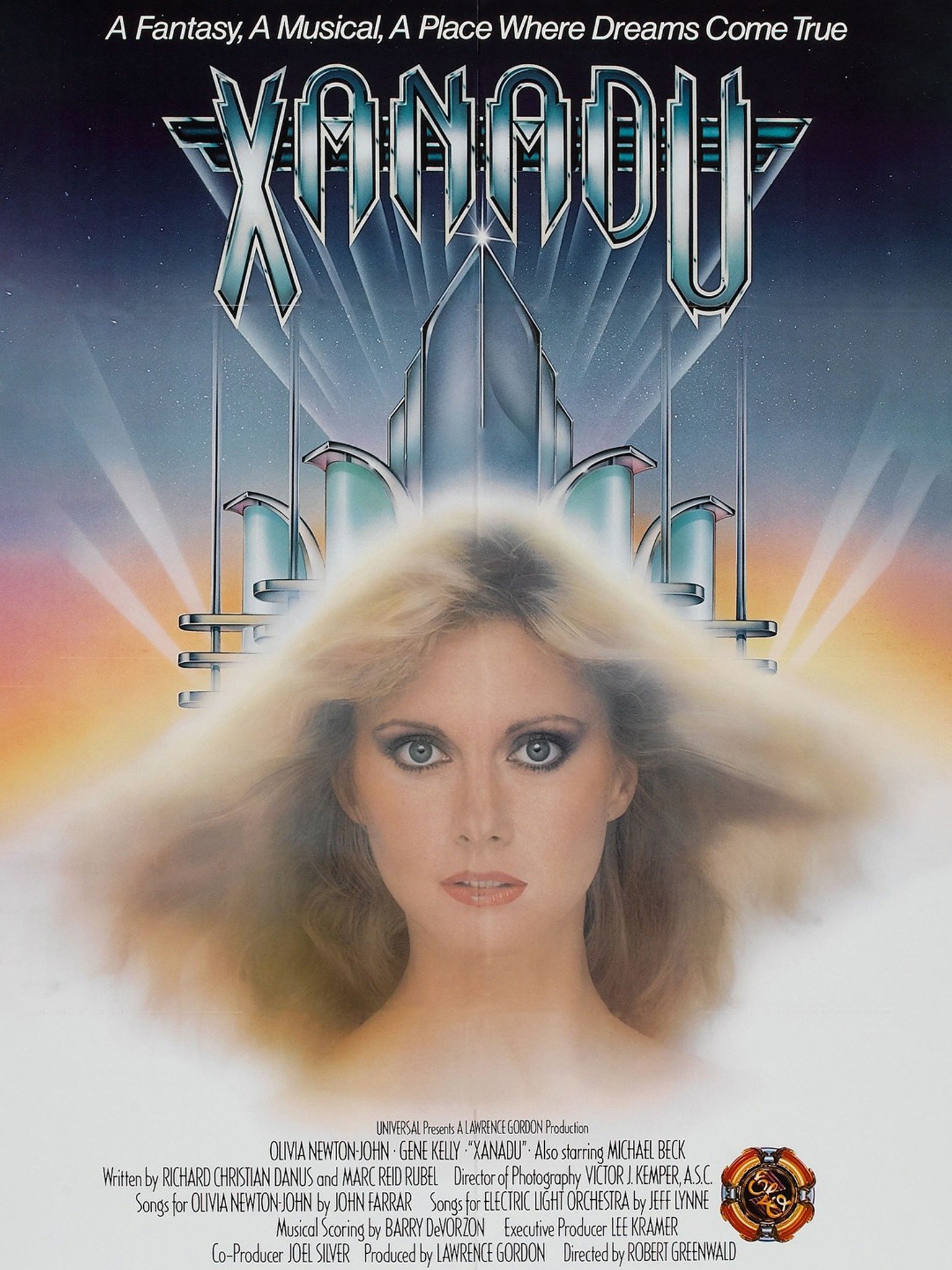


Following the blockbuster Grease, Olivia Newton-John was a hot commodity in Hollywood. She grappled between two choices for her follow up project, Xanadu and Sgt. Pepper’s Lonely Hearts Club Band.
For the most part, Xanadu is a musical version of the 1947 Down to Earth with lovely Rita Hayworth as a Muse in an ill-fated love affair with a human. The novelty of humans involvement with spirits was popularized in Heaven Can Wait, an earlier comedy. Some minor characters from Heaven Can Wait were carried over to Down to Earth making the film qualify as a timid sequel.
Neither film was successful, neither artistically nor financially. In Down to Earth the Muse is perturbed by her depiction in movies and Hayworth seeks out love interest and Hollywood film producer Larry Parks to remedy the annoyance. In Xanadu, the Muse is an inspiration to a young entrepreneur building a roller disco. Both scenarios qualify as lazy writing. The stories serve only to create a goal that brings two disparate characters together, however briefly.
Xanadu did feature a score of enticing earworms that captured the public’s fantasy. The film was far more entertaining as a tongue in cheek Broadway musical that won plaudits and financial reward.