
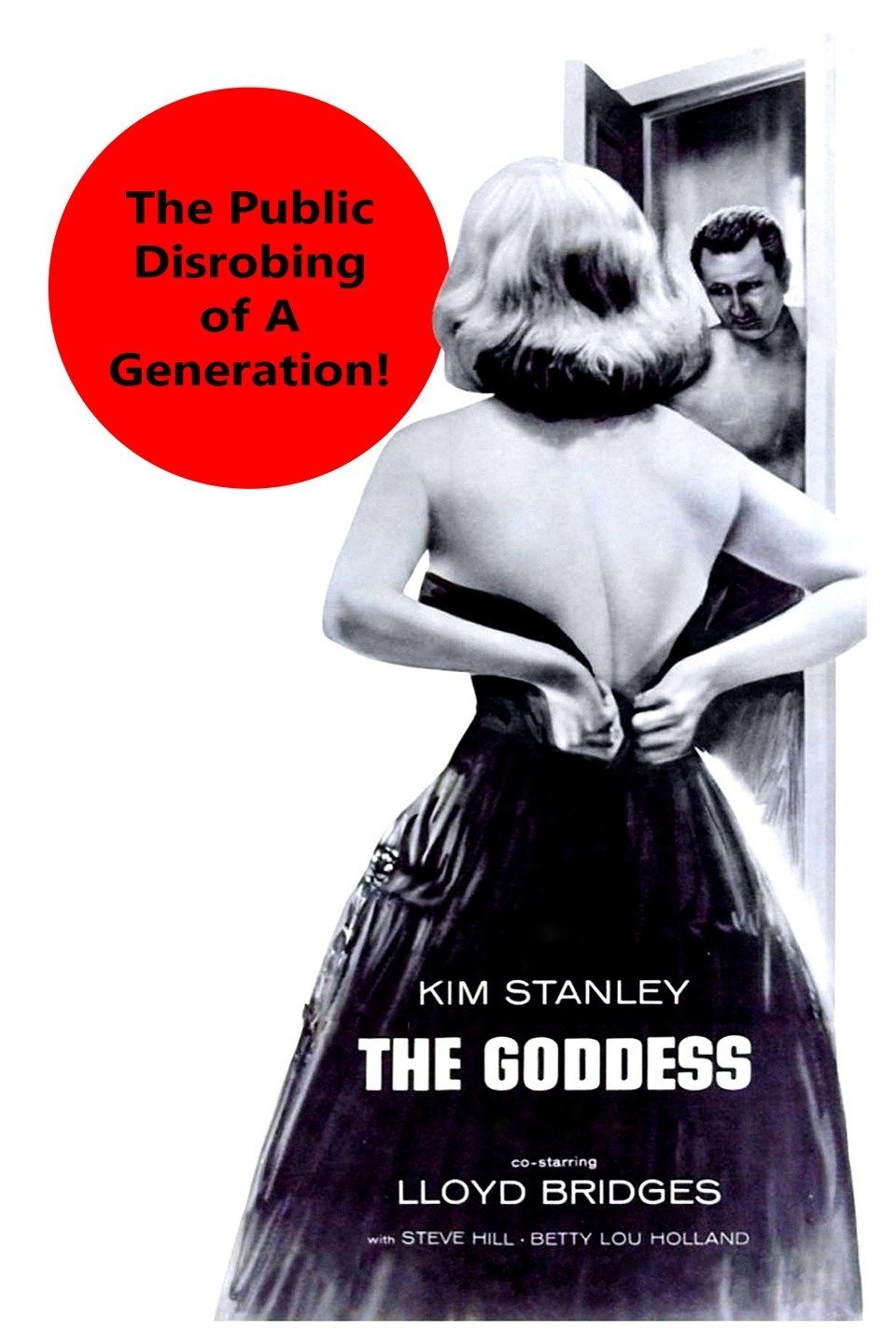
In the early 1930s, somewhere in the Deep South, a young woman (Betty Lou Holland) is growing weary of how limited her life has become now that she has a daughter. She will do anything to rid herself of the child, who she sees as nothing but a burden – and while she was too young then to realize how hurtful her mother’s comments were, the child who grows into the quiet and sensitive Emily Ann Faulkner (Kim Stanley) has a firm understanding that she was never really wanted by anyone, a theme that has continued through every failed relationship she has pursued in her young life. However, like any young woman, Emily Ann dreams of stardom, seeing the beautiful, glamour-laden streets of Hollywood as almost an entirely different world, albeit one that she is certain she belongs in, if she is ever given the opportunity. Luckily for her, she does get her big break, particularly in her marriage to the dashing Dutch (Lloyd Bridges), a film star whose reputation trickles down to his wife, who takes advantage of this goodwill, and turns herself in Rita Shawn, the most glamourous movie star working in Hollywood. However, what her adoring audiences don’t realize is that their matinee idol is a profoundly lonely woman – her marriage has broken down, and her pursuit of stardom left her alone, isolated with an abundance of fame, but the lack of confidence to do anything meaningful with it. Rattling around her huge, innovative mansion can only give her a certain amount of pleasure before the alienation begins to erode at her spirit, forcing down a path of self-harm and despair, from which she seems increasingly less likely to recover, should it continue. Her hopes of living the opulent life of her movie star heroes grow less likely by the day, as she soon starts to realize that fame means nothing if you don’t have the depth to look beyond the extravagance and focus instead on one’s own personal journey.
John Cromwell’s The Goddess is a challenging film, in both the sense that it is a provocative, harrowing account of the pratfalls of fame, and since it may be considered somewhat overwrought in its exploration of certain themes. Cromwell, who was working from a screenplay by Paddy Chayefsky (inarguably one of the most important writers to work in any medium), had quite a few obstacles that stood between the inception of this story, and the final product – and while it is certainly not the first nor the last film that looks into the experiences of those who have flirtations with fame (whether briefly or over a long period of time), it does go about looking into these themes with a distinct perspective that may not always work out exceptionally well, but at least makes for interesting viewing, with the contrast between genres and gradual introduction of a range of fascinating ideas allowing the film to rise above the conventions in a way that feels compelling, at least in the moment that we’re witnessing them. Flawed but still admirable in the intentions it had, and the lengths to which it was willing to go to tell this story (which is far more resonant than many would give it credit for, especially in how it strips the process of achieving fame of the enviable glamour that drive many of these films), The Goddess is a complex film that may not be the underpraised masterpiece that some may believe it to be, but is still a decent enough effort that hints at its underlying ideas with a conviction that allows it to be elevated far beyond the simple confines of the run-of-the-mill socially-based drama that lingered omnipresently over films from this era.
Kim Stanley had a fascinating career, albeit one that is understandably not well-known, since most of her work was confined to the stage and on television, meaning that it hasn’t been imprinted in the cultural cache as much as film tends to be, widely available for future generations. However, even in her occasional film appearance, she proved her skills without any hesitation – her performance in Séance on a Wet Afternoon is one of the greatest portrayals ever committed to film, and a towering achievement of acting that truly set the standard for future performances, showing the depths to which someone could go with the right approach. The Goddess is unfortunately not a particularly worthy film of her talents, and while she does rise above the paltry material at times, her presence seems distracting – she plays the role of Emily Ann from her teenage years to the height of her stardom in her mid-thirties, and not even an actress as gifted as Stanley could convincingly play someone like this. It seems almost absurd that she was cast as the definition of glamour – and while there can be an argument made that casting a more mature, steadily-skilled actress as a blonde bombshell adds a layer of commentary to beauty standards, as well as looking into the psychological depths of someone who struggles with her own self-image. If this was the intention (which is perfectly likely), the film didn’t explore it to its full-extent, often defaulting to Stanley’s excellent skills in trying to portray someone trying to find her identity in a world that has gradually started to grow hostile to her, despite claiming to adore her unconditionally. Stanley is undeniably great (and her interactions with Betty Lou Holland in the final act of the film are exceptional), but there is something missing to the film, a genuine sincerity that seems to have been lost as a result of the film struggling to find a clear approach for its story.
The areas in which The Goddess seems to struggle are the ones in which it had the most potential. Chayefsky is normally an exceptional writer, who produces dialogue that stands amongst any of the greatest works of literature. However, this is a strange misstep for the writer, since the majority of the film consists of stilted monologues that are supposed to develop the characters, but instead turns them into mere archetypes. It doesn’t at all suggest there aren’t some merits – there are a few pivotal moments where Chayefsky strikes the right balance between exposition and forthright development, and these are the sequences where the film thrives. However, they’re few and far between, and it almost appears as if this was written as a small segment of a larger piece – the story of the rise and fall of a popular actress is one of the few instances where a longer length (or multiple parts) seems entirely justified. There simply isn’t enough space in the 105 minutes of this film to explore all the nuances of Emily’s transformation into Rita, and while this isn’t necessarily indicative of a bad film, the fact that it seemed like all that was retained from the larger set of ideas were the less-interesting ones, the smaller conversations that feel genuine, but don’t quite add as much to the story as it seems to believe it does. There are some interesting discussions embedded in this film, and there are many moments where Cromwell and Chayefsky use the material well – but it just ends up coming up short, which is an enormous disappointment, considering the wonderful results that could’ve come about with a more sensitive understanding of the overarching issues, rather than a muddled set of ideas that don’t add up to much in the end.
The biggest problem with The Goddess is that it has the right ideas, but the wrong concept on how to execute them – and considering the wealth of potential that underpinned this film, it’s an enormous disappointment, because there was so much that could’ve been done with this premise. Cromwell was certainly a very interesting filmmaker, but his work here was too scattershot for the material, and the script by Chayefsky wasn’t strong enough to persist on its own, so it required a more assured hand behind the camera, which meant that there was an inherent disadvantage, since Cromwell’s execution left quite a bit to be desired, despite that fact that he was a decently talented filmmaker on his own terms. Wonderful work by Kim Stanley and Betty Lou Holland aren’t quite enough to salvage the scraps of potential, and while The Goddess isn’t an affront to decency, it just feels like an overbloated melodrama that doesn’t really have anything entirely original to say. There was so much that could’ve been done with this story, so the fact that it chose to go on the path of least resistance and play it extraordinarily safe means that defending this film’s shortcomings are difficult, since there’s a sense of uneasiness that pervades it, which could’ve easily been replaced with an awe-inspiring approach to some common ideas. Ultimately, The Goddess is a decent but uninspiring effort that didn’t reach any of its potential, and instead chose to be a surface-level exploration of fame, and with the immense amount of films that traverse similar narrative territory, this prosaic and unconvincing approach simply doesn’t qualify for any real praise, which is exceptionally disappointing, but not unheard of from time to time when it comes to films that can’t match their ideas with inherent ambition, which is the case here.


Fascinating review. A well crafted examination of this misfire that identifies the flaws of this frustrating effort that should have been so much more.