
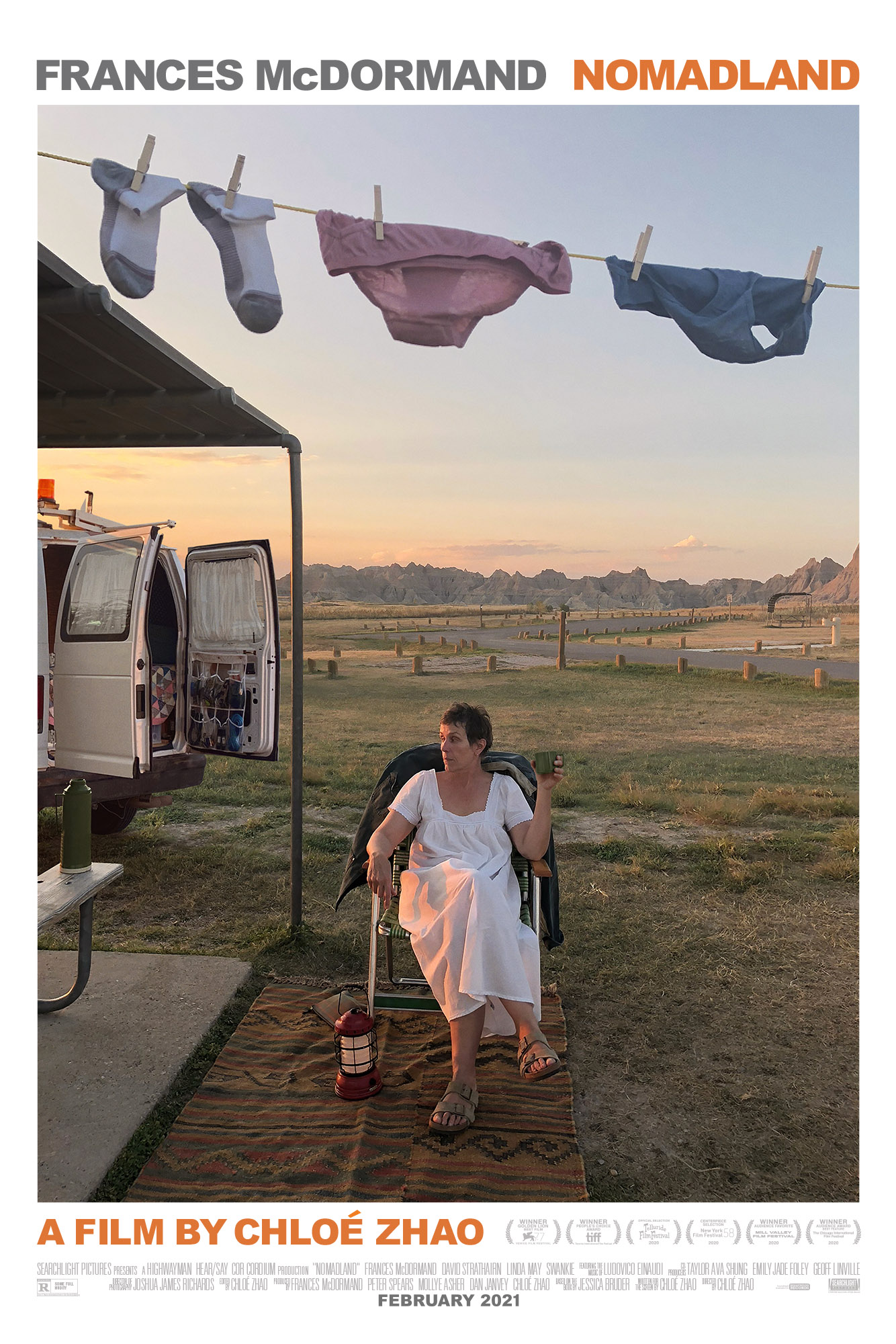
Nomadland is the kind of film that really only comes around once or twice in a decade, one that manages to be so profound and understanding in its exploration of the human condition, the very act of just witnessing it seems close to a privilege. Chloé Zhao has been steadily building herself to becoming one of the most exciting young filmmakers working today, and after her critical breakthrough with The Rider, all eyes were on her next project, which was announced to be an adaptation of the non-fiction book by Jessica Bruder, which tells the story of a middle-aged widow who abandons her working-class job and goes on a journey across the American Midwest in search of both adventure and, as she later realizes, the meaning of life, which she learns isn’t found in books or the minds of great philosophers, but emblazoned onto the roads that lay ahead of her on this quest of self-discovery. There were enormous expectations awaiting Zhao’s next film, and she absolutely delivered with Nomadland – and it wouldn’t be wrong to call this a film that is going to define the next decade of filmmaking, with its style and intention being indicative of a return to a very bold kind of realism that was lost over the years. This form of storytelling has now been reappropriated by a gifted young director who continues to stun with her incredible control of the medium, and her ability to plumb for the most meaningful commentary in these gritty, unflinchingly honest pieces of contemporary Americana that demonstrate the lives of ordinary people making their way through a hostile world that is often against their very existence. Nomadland is the pinnacle of a number of ideas relating to modern realism, and the perfect convergence of all of Zhao’s previous ideas, which are collected under this strikingly complex and achingly beautiful ode to the human condition.
There are two people integral to the creation of this film – the first was the aforementioned director, with Zhao demonstrating that she is someone we should start paying attention to if we haven’t already. The second is Frances McDormand, who is playing the role she was born to play. While an incredibly recognizable and popular actress, Hollywood has never quite known what to do with McDormand – she’s undeniably gifted, and has done some immensely powerful work over the course of her career. However, she has always been caught between character actress and movie star, with different films using her in a variety of ways, making her consistent but not always used to the best of her abilities. Nomadland challenges this, especially considering how it comes while she is at the peak of a career revival, where recent career choices (namely the miniseries Olive Kitteridge and the successful film Three Billboards Outside Ebbing, Missouri) reminded us of what she is capable of doing when placed at the centre of a major production. The avoidance of both recency bias and hyperbole prevents me from saying that what she is doing here is her finest work – and when you’ve had as storied a career as McDormand, its difficult to pinpoint it to a precise peak. However, the combination of her ability to extract the most meaning from even the most challenging moments, and her use of her entire body as a tool for telling this story, leads one to easily consider this a vital moment in the career of one of cinema’s finest performers. Her mark is indelible on this film – not only is she playing the central role, but she was heavily involved in bringing Bruder’s book to the screen, her passion for the source material evident in absolutely every frame that she is on screen.
Nomadland is not a film that necessarily lends itself to easy interpretation, because despite being exceptionally simple in the narrative it is spinning, there is a complexity underpinning it that makes it far more challenging than we’d expect. In its most reduced description, this film functions as a heartbreaking elegy to the myriads of lonely individuals that populate a world that they feel they don’t belong in, and who are often either considered trivial, abstract entities, or rendered invisible altogether. Centring on the lives of modern nomads, people who travel across the country in their mobile homes, never settling down in one place for long enough to start a life, is fertile ground for a hauntingly beautiful exploration of a number of contemporary issues, which Zhao unfurls throughout the film. The original book was an account of how there is an entire community of individuals across the United States that live their lives literally hand-to-mouth, working brief menial jobs that pay them just enough to get them to the next point – and through adaptation these ideas into the form of a stunning metaphysical drama about the trials and tribulations of those who consider the idea of being perpetually transient the most appealing concept imaginable, Zhao creates something absolutely staggering. A series of moments woven into a coherent narrative, channelled through the perspective of a simple but effective protagonist, Nomadland is a startlingly brilliant glimpse into the lives of people who don’t ever have the opportunity to have their voices elevated to such a level – and Zhao’s insistence on populating the film with real nomads, and giving them the platform to tell their story on their own terms, is absolutely incredible and adds a level of nuance and authenticity that only bolsters the experience of making our way through this gorgeous film, which is clearly fully-committed to looking at these experiences, rather than just being a surface-level overview of a modern existential phenomenon.
Yet, the beauty of Nomadland doesn’t solely reside in how it represents the lives of these individuals, which may form a large portion of the story and give it the narrative foundation, but aren’t the sole focus. This film is a metaphysical odyssey centred around an ordinary person trying to come to terms with the nature of the world, and realizing her own worth through seeing life from a number of different perspectives. This is where the film thrives – hearing these first-hand accounts from real-life nomads is compelling, but it only works in contrast with the overriding themes of the film, which they complement rather than define. Zhao and McDormand are exploring a number of abstract concepts in a way that leads one to define Nomadland as less of a coherent story about a woman going on a journey, and more a meditation on existence. The film frequently ruminates on a number of complex ideas, all of which should be relatable to every viewer in some way – the story is centred on some profoundly American concepts, but the themes are universal. This is a film made for anyone who has been counted out or made to feel like they don’t belong, showing how it is perfectly understandable to not fit in, since there is an entire community of people that are in search of their place in the world, and that simply looking beyond our own lives can be a fruitful experience, since sampling from the wisdom of those who have been through it themselves can bring about a new understanding on the concepts that we have always felt to be sacrosanct and immovable. This is not the case here, since this film is fully-committed to showing the various ways we can derive meaning from even the most unremarkable situation, since life is filled with unexpected surprises if we’re just willing to look beyond our own personal quandaries and gaze at it through a slightly different perspective.
The beauty of Nomadland is that, despite its very complex themes, the film never feels as if it is preaching to us, rarely ever coming across as heavy-handed in how it balances the narrative and emotional content. Zhao is a very gifted filmmaker in both the stories she tells, and the style she employs in the process, with her camera being used as a tool to capture every subtle movement in the actors that appear before it. It’s a relatively simple achievement, but one that proves that a more straightforward approach can be equally effective to those that promise a spectacle. Every theme in Nomadland is supported by some deeply compelling foundation, rooted deep within the human condition. Whether it be provoking the idea that memory can be a burden to us (insofar as we fixate on the past so much, we lose sight of the gifts that the present moment holds for us, if we’re willing to reach out and grasp them), or the fact that we simply don’t have all the answers to our complex existences and should stop being so preoccupied with rationalizing everything, Zhao infuses every moment of her film with a vivacity and striking honesty that propels it forward and makes it so fascinating and deeply encouraging to those of us who have ever felt as lost as the characters interwoven into this story. This is a beautifully easygoing film, where the human complexities of the story interact with the quiet, meditative state that reminds us of any long road-trip, especially those that we undergo without any known destination in mind. This is essentially a film about finding joy in even the most challenging moments, looking for the hope in situations that feel entirely void of any positivity, only to discover that there is a wealth of positivity underlying any challenge if we approach it with the right mindset and the willingness to abandon our own preconceived notions of what the world is supposed to be, and instead embrace the spirit of the unknown without any hesitation.
Nomadland comes very close to being a masterpiece, and perhaps with some time and a few more viewings, it will achieve a place in that elusive canon. However, even as it stands, this is an utterly incredible film, made by a director who continues to surprise audience with the depth of her understanding of the human condition, her films intricate portraits of regular people, but repurposed to be stunning glimpses into life’s many idiosyncracies. Zhao is a profoundly gifted filmmaker that is making her mark on the industry in ways that hearken back to many of the greatest directors who committed themselves entirely to their craft in the earlier days of their career, and who eventually grew to become titans of the industry. There is a space in those hallowed halls already being carved for Zhao, who seems to be well on her way to defining an entirely new generation of directors. Her work in Nomadland on its own is enough to warrant this, with her deft combination of well-placed sensitivity, but also her incredibly curious perspective, making for an enthralling and fascinating character study that never abandons its principles, even when it seems to be steadily venturing into unchartered territory. Anchored by some of Frances McDormand’s best work, and punctuated with a wide array of scene-stealing supporting performances from a bevvy of unprofessional actors who prove the hidden talents that exist around us, and complemented by absolutely stunning cinematography and an astonishing score, Nomadland is an absolute triumph, and one of the best films of the past year. In the end, the best way to describe this film and its approach to exploring some of life’s most complex questions is to rehash this taut but relevant adage: sometimes, it’s not about the destination, but the journey we take to get there.
 The Postmodern Pelican
A truly insightful assessment. Well done. And published on the day that Chloe Zhao makes AMPAS history as the sole woman to be nominated in four separate categories in the same year!