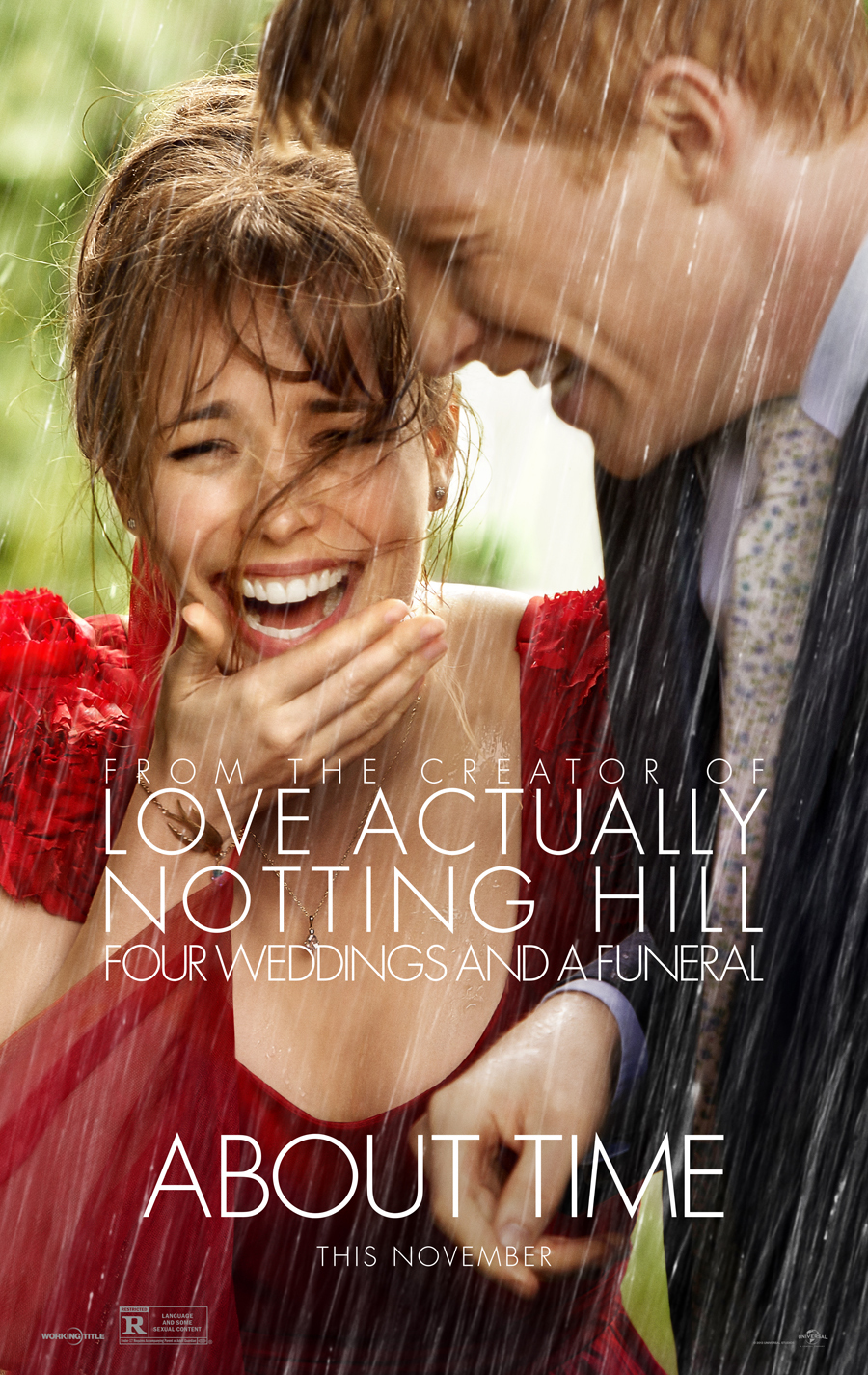
Perhaps its a sign of having grown accustomed to nearly every kind of emotion embedded in the cinematic form, or maybe just an indication of callousness, I don’t tend to find myself brought to tears by a film very often. There are numerous occasions where I feel my heartstrings being plucked with great ferocity, and some filmmakers have been able to elicit some very strong reactions through their film – but the experience of shedding a tear isn’t one that occurs very often. Therefore, it stands to reason that any film that can do it is immediately going to be worth discussing – and when talking about Richard Curtis’ About Time, it’s important to note that there are few (if any) films that have made me weep with the intensity that came about in the final few scenes of this film. Curtis is something of an anomaly as an artistic figure – someone who has been behind several classics (helming a few of them), but whose voice is often neglected in favour of the more visible elements of the film. Naturally, About Time is a film that will always be compared to the director’s previous work, including those where he was involved in the production in some way, whether as a writer or producer, and this immediately will draw allegations to its inferiority – but when we isolate this film as its own independent project, perceiving its dizzying ambition and (most importantly), its unabashed approach to genuine, earnest emotion, it’s not difficult to envision it as a success. A far-cry from Love, Actually, but still an absolutely worthwhile endeavour that has more resonance than it probably should have been allowed, Curtis’ film is an extraordinary achievement, a simple and elegant foray into the ambigious spaces between comedy, drama and romance – and an absolutely daring work that is so admirably assured in its convictions, and is willing to venture deep into the soul in order to convey a complex range of emotions that make for truly compelling viewing.
Ambiguity is a major aspect of About Time – not only does it toggle a wide range of genres, it is almost entirely centred on occupying the vague space between past, present and future. The story itself is one that may not be particularly noteworthy in comparison to other work of subdued science fiction (whereby a young man discovers that, after reaching adulthood, all the men in his family are able to travel through time, a fact that he uses to change the course of his life and reach the apex of happiness he believes everyone is entitled to experiencing), but where the film thrives is in how it takes this thin premise, and turns it into one of the most heart-wrenchingly beautiful explorations of a number of themes – romance, family, individuality – committed to film in the last decade. Curtis may not be someone who is known for producing a diverse range of stories – everything he as written, produced or directed has been along the same similar thematic territory – but as we can see here, he is someone who is so self-assured in his vision, there isn’t much need for him to push the envelope, leaving space for a film like About Time to be genuinely moving while still experimenting with the form enough to qualify as something of a revolutionary entry into a genre that truly benefits from as fresh and diverse a perspective as Curtis and his collaborators are offering here. Perhaps not the sprawling yuletide odyssey that was Love, Actually, or the transgressive brilliance of The Boat that Rocked, this film is still an exceptional work that is in dire need of a re-evaluation, since it is well-liked enough to be considered something of a success, but as both a work of emotional filmmaking, and as a piece of speculative storytelling, About Time is quite incredible, and deserves a much better reputation, far beyond the allegations that it is a slight, underwhelming effort that takes a bold premise and makes it toothless and conventional, which could quite simply not be any further from the truth.
Integral to this film’s success are the performances given by its small but dedicated cast. Curtis has enough friends in the industry to employ a relatively decent ensemble, populating his roles with some of contemporary cinema’s most exciting voices. Leading the film are the enchanting Domnhall Gleeson (who is rarely ever anything but endearing), and Rachel McAdams, who is at her most effervescent here. Any film that centralizes romance needs actors in the parts that can effectively explore these characters, both individually (through the strength of their own performances), and across from one another. Mercifully, Gleeson and McAdams have impeccable chemistry, playing the parts with a sincerity that is often missing in even the most cherished romantic comedies. They’re supported wonderfully by an array of scene-stealing supporting players, such as a foul-mouthed Tom Hollander, or a very warm and sophisticated Lindsay Duncan, an actress in dire need of reappraisal, since her talents are far too immense for the thankless roles she usually ends up playing – Curtis seems to be one of the few directors capable of using her effectively. However, About Time is almost entirely worth watching for the work Bill Nighy is doing in it. It’s very rare to find a film featuring Nighy and not consider him one of the best parts of it – and About Time is no exception, with his performance as the warm, good-natured patriarch being an absolute highlight of the film. The best kind of performance an actor can give is one that doesn’t play all its cards at the outset – and what we may think is just a very funny, heartwarming performance by one of the best character actors working today, ends up being the heart of the film. If there was any proof that Nighy is a gifted actor, his ability to make us both laugh and weep (perhaps even at the same time), is simply unprecedented, and just contributes to a film that already had a great deal of merit simmering beneath it.
Most interestingly, About Time appears to be a run-of-the-mill romantic comedy with some experimental elements thrown in to bolster the central passion that drives the film – and for the most part, this is exactly what the story entails. However, there comes a point where we realizing that Curtis wasn’t making a necessarily romantic film at all, but rather a hard-hitting drama with overtures of romance, which concealed the more abstract themes that needed to transpire organically. On the surface, we are genuinely under the impression that this is just an irreverent comedy about time-travel, with broad overtures of romance – but as this quirky passion subsides, and the film settles into its resolution, there are a series of new challenges presented to the characters (and the audience, who are taken on a sweeping voyage alongside the protagonist – a great quality of Curtis’ work is that he is consistent in giving viewers the chance to be active in the story through immersing them in his worlds), which is mostly centred on the concept of family. About Time is a very joyful film, but there’s a persistent sadness that is almost equally as notable, a kind of poetic melancholy that may not be expected based on the introductory segments, where we’re lead to believe that this is going to be a well-meaning, buoyant comedy about love and time-travel, two concepts that are not as disparate as one would expect. This is ultimately where the film is the most heartbreaking – not only a firm manifesto to living each day as if it is the best you have ever experienced but an elegy to familial relationships (particularly between parents and children), which are often taken for granted. The final few scenes of this film will make even the most cynical viewer weep, which may not sound particularly pleasant, but the thoroughly meaningful way in which the director approach difficult material is absolutely incredible, and is perhaps the primary reason why About Time is such a success.
About Time doesn’t have the strongest reputation, and it’s not difficult to understand why – it’s not the most consistent film, since its tone toggles between outrageous comedy and downbeat drama, with liberal doses of romance and science fiction thrown in for good measure. Under the guidance of a novice, a film like this would simply buckle under the weight of all this ambition, but considering how Curtis is a notable part of the industry, occupying many different positions over the year, he knew the importance of constantly being in control, even if the audacity could sometimes derail as simple a story as this. About Time may not be a modern masterpiece – it struggles with its tone at some points, and it can sometimes deviate from logic on numerous occasions, with the general perception being that this is a film that builds a fascinating world of futuristic speculation, but foregoes its tightly-conceived logic the moment it becomes convenient, which is more often than not. However, despite minor flaws, this is still an exceptionally strong film – made with conviction, executed with good-hearted faithfulness to a convincing story, some tremendous performances that is some of the best work these actors have done (Nighy in particular being a standout), and a genuinely interesting concept that takes aim at some of life’s biggest problems, and addresses some deeply philosophical issues with sincerity and pathos, which immediately qualifies this as a film that requires the viewer to suspend disbelief and surrender ourselves to its peculiar charms. Once we do that, there is very little chance we won’t be thoroughly engaged with this sweet, sentimental and entirely unforgettable piece of ambitious storytelling.