“All these wretches are the same”
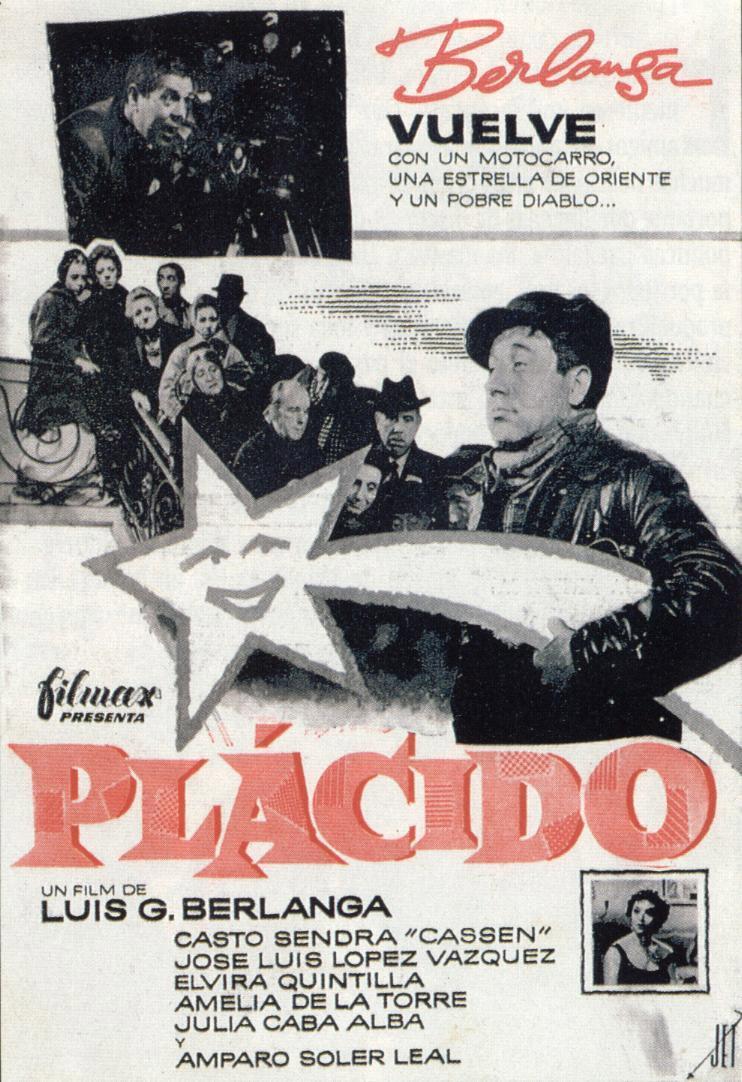
For those familiar with the work of Luis García Berlanga, Plácido is exactly what you’d expect – a darkly comical fable that sees the esteemed director eviscerating society through carefully-curated satire that is often more haunting than it is hilarious. For those who are newer to his career, Plácido may be something of a challenge at first – the madcap energy of this film may be difficult to get a saddle on, but needless to say, once the viewer has become acclimated to the story and are fully-immersed into Berlanga’s word, we can see the scathing brilliance underlining every scene and the aspects that went into making this one of the most fascinating comedies of the 1960s. Berlanga isn’t necessarily venturing too far out of what he was known to do (and considering many will probably come to this film after experiencing one of his others masterpieces, namely Welcome Mr Marshall! or The Executioner, it may seem somewhat familiar in terms of tone), but rather sees him putting together yet another sardonic satire that takes aim at the human race as a whole, this time focusing on the upper-class and their relationship with the poor, which makes for a fertile examination of the class divide, and the ways in which society tends to gravitate towards empty gestures as some political statement of immense charity. There’s a lot simmering below the surface of Plácido, especially when it comes to the director’s fascinating portrayal of the differences between the bourgeoisie and the proletariat, which forms the basis of the film, and is the fundamental premise that gives this film the chance to make some truly scathing statements that are oddly resonant, even entirely detached from the specific cultural era to which this film was clearly made as a response.
Whether we view Plácido as an indictment on Franco-era Spanish socio-political machinations, or simply a clever and subversive piece of satire, there’s no doubt that this is a film that executes its message very well. As in the same of some of the best works of dark comedy, Plácido takes a simple premise and doesn’t compound too much complexity on it, rather allowing it to unfold organically, where the bold strokes of the story interweave with the small idiosyncrasies of society that the director was so insistent on exploring. Berlanga was a director often looking to say something, to make some kind of statement, even if it was concealed beneath many layers of pitch-black comedy, and a film like this may appear to be far too ambitious to be entirely effective, especially when it seems like the message is gradually being lost in the bustling plot, which is certainly a challenge to come to terms with at first. Throughout Plácido, the director is taking a straightforward premise – a lowly driver has to race against time to make a payment, while an annual charity festival aimed at helping the poor occurs around him – and turns it into one of the most harrowing pieces of inter-class conflict ever captured on film. We’ve seen many works take a satirical look at the positioning of the unfortunate as novelties, there to be used and exploited by the upper-class, whether as a means of gaining status or soothing their own greedy souls, and Plácido joins them as one of the very best looks into this process, which may seem absurd on screen, but is most terrifying when we realize how there is some kernel of truth embedded somewhere in this film, and rather than creating situations that are as entertaining as they are far-fetched, Berlanga is simply heightening reality in a way that delivers a haunting, unsettling message in the form of an exuberant, outrageous comedy with smatterings of slapstick to break the impact of the fall that comes in those uncomfortable final moments.
Plácido is a very deceptive film, which is quite par-for-the-course when considering the work Berlanga did over the course of his career. We’re lead to believe that this film is going to be an entertaining romp that satirizes the class indifference in fresh and exciting ways. Coming just after the peak of Italian neo-realism, where such concepts were often the subject of more intense and harrowing works of documentary-style fiction, Plácido takes a very different approach, channelling these ideas through the perspective of a sardonic comedy that is propelled less by its message, and more by its unique way of conveying it. This is a puzzling film – on the surface, its not all that easy to follow, since dialogue overlaps, the characters aren’t given traditional introductions, and instead of being eased into the satire, we’re viciously thrown into the middle of it, forced to scramble our way out of the confusion to make sense of what we’re seeing. However, despite sounding like the result of poor filmmaking, this gives Plácido a certain exuberance that deeply benefits its story. Satire often tends to be very restrained, with a simmering anger towards its particular subject matter only revealing itself as the story plods along – this film demonstrates the opposite, where we’re introduced to the central conceit at the outset, and watch as Berlanga negotiates the boundaries of what he can outright say, and what has to remain in the realm of pure implication, which makes for oddly engaging viewing.
Plácido is a film that may pulsate with a certain kind of vitriol, but it never feels mean-spirited or mocking, especially to the poorer characters, who could have so easily been used as mere plot devices, rather than being developed into fully-formed individuals. Despite the bleak story being told here, Berlanga shows great humanity with this film, never venturing too far out of the realm of plausibility, while still affording the less-fortunate characters the chance to succeed. The film revolves around the titular character trying to may a payment before the day runs out, or face the draconian consequences – and while he is put through the wringer consistently, he does manage to achieve it, which shows that even at its most unsettling, there is some kind of hope underpinning this film. However, Berlanga isn’t interested in creating something that celebrates the factions of society he’s focusing on – the entire concept of a group of wealthy people creating an entire festival around the idea of giving the poor a day of luxury is inherently very cynical, and right until the final moments, Plácido is openly critical of the upper-class, showing them as myopic, mindless drones driven by wealth, and only compelled to do some good when it is of benefit to them. The film is brimming with small details that give nuance to the interactions between the classes, showing the director’s contempt for the wealthy and empathy with the lower-class, who were always shown as the victims, but here are finally given something discernibly interesting, rather than just being background characters for the more greedy nobility and celebrities that populate the film. Social critique is always most effective when there is actually some depth to it, and for all of its rambling sequences and frantic appearance, there is a clear message being conveyed in Plácido, which makes it truly worth watching.
Inarguably, there is a lot going on in Plácido, but this chaos is exactly what gives it a certain brilliance. Berlanga pushed the envelope further than many of his contemporaries would have dared, which gives it the opportunity to be an early pioneer of a very cynical kind of dark comedy. The postwar period, particularly in terms of European culture, was mainly populated by comedies that were more rousing and positive, and called for unity. Perhaps as a result of Spain being neutral in the Second World War (or at least having that as the official policy), this period gave many Spanish directors the chance to capitalize on more perverted forms of comedy, which may be seen as callous considering much of the continent was still being rebuilt, but also shows how there are few ideas more binding than that of comedy – and considering that many artists were still feeling the pressure of a dictatorship that censored much of what they’re producing, it makes sense that such critical messages would be delivered as bold comedies rather than directly scathing dramas that openly criticized the government. Implication doesn’t have much of a place in Plácido, which thrives on its ability to be direct, with its only allusions being those moments that would push it towards morally-reprehensible territory had these ideas been overtly expressed. Berlanga’s intrepid approach, when coupled with his unique creative style, creates an unforgettable work of fiction that has its roots firmly within reality (Berlanga was inspired by the Francoist principle that claimed everyone who can should “sit a poor man at your table” around Christmas, to give them the chance to feel joy, a noble concept that was tarnished by the true intentions of it just being a way to satiate the dirty consciousnesses of the privileged). It’s a daring and provocative film that has numerous fascinating ideas simmering below the surface, and the good sense to realize them in interesting and effective ways. It’s a frazzled and disconcerting work, but extracts just enough brilliance from its bold premise to be something of a masterwork.
Whether we view Plácido as an indictment on Franco-era Spanish socio-political machinations, or simply a clever and subversive piece of satire, there’s no doubt that this is a film that executes its message very well. As in the same of some of the best works of dark comedy, Plácido takes a simple premise and doesn’t compound too much complexity on it, rather allowing it to unfold organically, where the bold strokes of the story interweave with the small idiosyncrasies of society that the director was so insistent on exploring. Berlanga was a director often looking to say something, to make some kind of statement, even if it was concealed beneath many layers of pitch-black comedy, and a film like this may appear to be far too ambitious to be entirely effective, especially when it seems like the message is gradually being lost in the bustling plot, which is certainly a challenge to come to terms with at first. Throughout Plácido, the director is taking a straightforward premise – a lowly driver has to race against time to make a payment, while an annual charity festival aimed at helping the poor occurs around him – and turns it into one of the most harrowing pieces of inter-class conflict ever captured on film. We’ve seen many works take a satirical look at the positioning of the unfortunate as novelties, there to be used and exploited by the upper-class, whether as a means of gaining status or soothing their own greedy souls, and Plácido joins them as one of the very best looks into this process, which may seem absurd on screen, but is most terrifying when we realize how there is some kernel of truth embedded somewhere in this film, and rather than creating situations that are as entertaining as they are far-fetched, Berlanga is simply heightening reality in a way that delivers a haunting, unsettling message in the form of an exuberant, outrageous comedy with smatterings of slapstick to break the impact of the fall that comes in those uncomfortable final moments.
Plácido is a very deceptive film, which is quite par-for-the-course when considering the work Berlanga did over the course of his career. We’re lead to believe that this film is going to be an entertaining romp that satirizes the class indifference in fresh and exciting ways. Coming just after the peak of Italian neo-realism, where such concepts were often the subject of more intense and harrowing works of documentary-style fiction, Plácido takes a very different approach, channelling these ideas through the perspective of a sardonic comedy that is propelled less by its message, and more by its unique way of conveying it. This is a puzzling film – on the surface, its not all that easy to follow, since dialogue overlaps, the characters aren’t given traditional introductions, and instead of being eased into the satire, we’re viciously thrown into the middle of it, forced to scramble our way out of the confusion to make sense of what we’re seeing. However, despite sounding like the result of poor filmmaking, this gives Plácido a certain exuberance that deeply benefits its story. Satire often tends to be very restrained, with a simmering anger towards its particular subject matter only revealing itself as the story plods along – this film demonstrates the opposite, where we’re introduced to the central conceit at the outset, and watch as Berlanga negotiates the boundaries of what he can outright say, and what has to remain in the realm of pure implication, which makes for oddly engaging viewing.
Plácido is a film that may pulsate with a certain kind of vitriol, but it never feels mean-spirited or mocking, especially to the poorer characters, who could have so easily been used as mere plot devices, rather than being developed into fully-formed individuals. Despite the bleak story being told here, Berlanga shows great humanity with this film, never venturing too far out of the realm of plausibility, while still affording the less-fortunate characters the chance to succeed. The film revolves around the titular character trying to may a payment before the day runs out, or face the draconian consequences – and while he is put through the wringer consistently, he does manage to achieve it, which shows that even at its most unsettling, there is some kind of hope underpinning this film. However, Berlanga isn’t interested in creating something that celebrates the factions of society he’s focusing on – the entire concept of a group of wealthy people creating an entire festival around the idea of giving the poor a day of luxury is inherently very cynical, and right until the final moments, Plácido is openly critical of the upper-class, showing them as myopic, mindless drones driven by wealth, and only compelled to do some good when it is of benefit to them. The film is brimming with small details that give nuance to the interactions between the classes, showing the director’s contempt for the wealthy and empathy with the lower-class, who were always shown as the victims, but here are finally given something discernibly interesting, rather than just being background characters for the more greedy nobility and celebrities that populate the film. Social critique is always most effective when there is actually some depth to it, and for all of its rambling sequences and frantic appearance, there is a clear message being conveyed in Plácido, which makes it truly worth watching.
Inarguably, there is a lot going on in Plácido, but this chaos is exactly what gives it a certain brilliance. Berlanga pushed the envelope further than many of his contemporaries would have dared, which gives it the opportunity to be an early pioneer of a very cynical kind of dark comedy. The postwar period, particularly in terms of European culture, was mainly populated by comedies that were more rousing and positive, and called for unity. Perhaps as a result of Spain being neutral in the Second World War (or at least having that as the official policy), this period gave many Spanish directors the chance to capitalize on more perverted forms of comedy, which may be seen as callous considering much of the continent was still being rebuilt, but also shows how there are few ideas more binding than that of comedy – and considering that many artists were still feeling the pressure of a dictatorship that censored much of what they’re producing, it makes sense that such critical messages would be delivered as bold comedies rather than directly scathing dramas that openly criticized the government. Implication doesn’t have much of a place in Plácido, which thrives on its ability to be direct, with its only allusions being those moments that would push it towards morally-reprehensible territory had these ideas been overtly expressed. Berlanga’s intrepid approach, when coupled with his unique creative style, creates an unforgettable work of fiction that has its roots firmly within reality (Berlanga was inspired by the Francoist principle that claimed everyone who can should “sit a poor man at your table” around Christmas, to give them the chance to feel joy, a noble concept that was tarnished by the true intentions of it just being a way to satiate the dirty consciousnesses of the privileged). It’s a daring and provocative film that has numerous fascinating ideas simmering below the surface, and the good sense to realize them in interesting and effective ways. It’s a frazzled and disconcerting work, but extracts just enough brilliance from its bold premise to be something of a masterwork.