 Something that has become quite apparent as I’ve worked through the career of Frank Perry in order to shed light on him as one of the most underpraised American masters, is that as he progressed in the industry, he became a better filmmaker. His first films were slightly weaker and far less-interesting that some of the work he’d do later, and with the exception of his final few films where he truly went off the rails, he reached his peak towards the end of the 1960s and found his niche as one of the most fascinating parts of the New Hollywood movement. Having said this, we can look to his first film to see the roots of his style, which may not be very prominent, but are still scattered throughout it in a way that points to the director being on the precipice of greatness, even if he didn’t achieve it here. David and Lisa is possibly his most substantial success at the time (in terms of critical acclaim and the accolades that professed Perry as the new auteur), which is quite bizarre since it is amongst his weakest films, a simple but ineffective social drama that doesn’t really say all that much, and abides almost too close to the conventions that were predominant at the time. David and Lisa is an interesting work insofar as it stands as the first film in the career of a filmmaker who wouldn’t ever find the enormous success he deserved, but as an individual piece, its quite ineffectual and minor, which creates the uneasy sensation that there should be something much more to this film than presented to us, with the story never reaching the crescendo it seems to be yearning to get to. Whatever the reason, it’s an important work in considering Perry’s career (as well as his collaborations with Eleanor Perry, his wife and creative partner), and not much else than that.
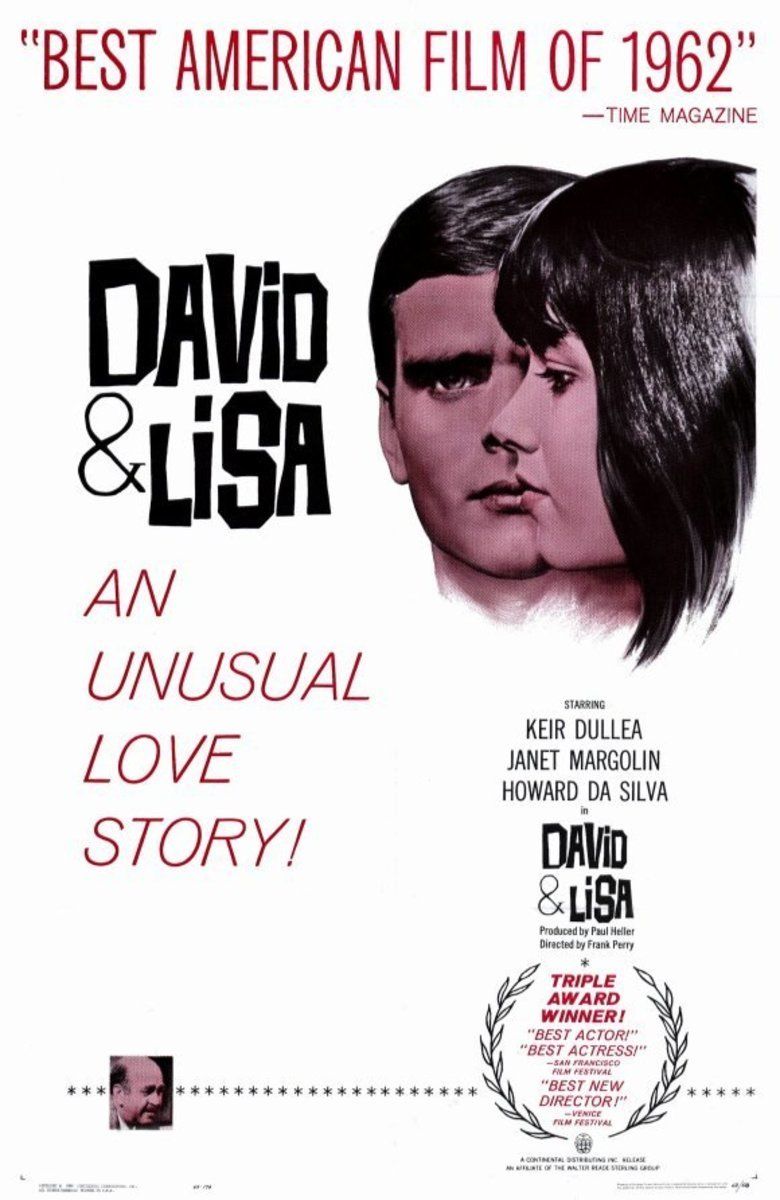
The film is set in a school for children and teenagers who suffer from various mental conditions. David Clemens (Keir Dullea) is a quiet young man who seems to be afflicted with some form of obsessive-compulsive disorder, which gives him a sense of solitude, refusing to engage with anyone and being terrified of being touched, genuinely feeling that the touch of another could kill him. This makes him quite a polarizing figure for the other residents of the home, some of which avoid him due to his stark and unforgiving personality, while others are deeply fascinated by him. It seems the only two people who genuinely want to penetrate David’s mind and find out what it is that has made him this way are his psychiatrist, Dr Swinford (Howard da Silva), who sees potential in David and wants to help him develop into a functioning adult, and Lisa (Janet Margolin), a neurodivergent young woman who seems to have some kind of schizophrenia, with her personality being split between “Lisa” (who is a mute), and “Muriel”, a playful girl who only speaks in rhymes. It seems that David finds an unlikely companion in Lisa, who understands him in a way no one else does. They both play an important role in the development of the other, culminating in a strong friendship that finds them working through their individual issues to see something in the other that they’ve been missing – and while this is initially delightful for the staff of the institution, who relish in the witnessing of this success, it also creates more challenges for them, as David and Lisa, now kindred spirits, are not the kind to play by the rules in any logical way.
Considering the elements that went into the making of this film, it is quite surprising that David and Lisa wasn’t a substantially better film. The early 1960s were brimming with these quiet, affecting character-driven dramas that take deep glimpses into the human condition while delivering beautiful stories about the different nuances of life. Added to this, the creative duo of Frank and Eleanor Perry seemed like it would produce better results – Eleanor Perry was a masterful storyteller, able to weave together compelling stories that had real characters and authentic emotion, and Frank Perry would interpret her screenplays in a way that didn’t distract from their brilliance, but rather supplemented it in a wonderfully effective manner. They worked well together, which is why the relative blandness of David and Lisa is such a surprise and a major reason why it’s such a difficult film for those who subscribe to the idea that Frank Perry deserved much more than he received in his lifetime in terms of recognition. Ultimately, David and Lisa is a bit of a bore – the story is not all that special, and while it may be revolutionary for the time in which it was made to look at mental health in such a way, it is retrospectively not all that impressive. However, one aspect of this film that is certainly interesting at the very least is how its story focuses on certain minds of mental health long before our culture was more accepting of the idea of autism and other forms of neurodivergence, which are essentially the traits that underpin all these characters – David and Lisa is slightly ahead of its time in terms of having serious discussions on these issues, tackling a subject that the culture had yet to develop a widespread vocabulary, and simply couldn’t understand it then as we do now. Much like the writer and director would do with some of their later collaborations, David and Lisa is made with exceptional compassion, which is essentially what keeps it afloat and is one of the few redeeming factors of this otherwise lacklustre film.
The execution is really what puts David and Lisa at a disadvantage – the script (adapted from a pair of companion novellas by Theodore Isaac Rubin) isn’t all that impressive, often being overwrought and filled with cliches that may not indicate weakness on the part of the person adopting them, but rather the inability to turn something relatively simple into an effective screenplay. In moving from the page to the screen, the film isn’t much better – the “point-and-shoot” method that underpinned the era is definitely there, which would be fine with a stronger source to work from, but eventually just devolves into a series of unfortunately bland conversations that really don’t carry the emotional heft that they should, based on the clear attempts of the filmmakers to persuade us to feeling one way or another. The film does ultimately fall flat because of it, which isn’t pleasant to witness since there was such promise here. It doesn’t help that the film is lead by Keir Dullea, an actor who does well in playing villains, but was such a singularly unremarkable leading man early in his career, he turns David from a socially-awkward, reserved young man into an unnerving, unpleasant presence who the audience can’t relate to, only because he’s so deeply unlikeable. Perry doesn’t give Dullea much to work with, other than a series of vague guidelines on how to play the part, with the final result being quite an uncomfortable portrayal of what should feasibly be a much more interesting character. It’s only worsened by the fact that Janet Margolin is legitimately wonderful as the other half of the titular duo, but really isn’t give a fraction of the space as Dullea to explore her character, becoming nothing more than a plot device to her co-star’s journey, rather than standing on her own. She’s luminous as the complex Lisa but isn’t developed beyond a few quirks, which only makes her performance all the more compelling, and the film more disappointing since it didn’t do nearly enough with her character. That fact that the title of the original story was changed from Lisa and David to the inverse suggests how singularly uninterested the filmmakers were in focusing on Lisa, who is a much more compelling character in every way.
David and Lisa is not an essential work, and really only serves the function to be a footnote in the endeavours of film completionists, whether those looking to explore 1960s representation of social issues, or simply work through the varied career of Frank and Eleanor Perry. This film undeniably pales in comparison to their later work, being a rather dismal attempt as a social drama by simply not caring too much about insightful portrayals of the subject matter, and lacking the heft that more successful entries into the canon of great dramas from this period had woven into their narratives. The performances are weak, with the exception of Margolin, and the general aura of the film is one of relative laziness – not much effort went into the making of the film, as evident by the lacklustre execution, unremarkable portrayal of deeply insightful issues and a general lack of any of the flair Perry would employ later on. It has moments of genuine emotion, and it does make a few interesting statements – but ultimately this simply just isn’t enough for a film that seems to be uninterested in greatness, settling for the bare minimum and in return receiving just that, becoming something of a chore to get through, which is far from ideal for a film that should’ve strived for much more than it attempted.
 The Postmodern Pelican