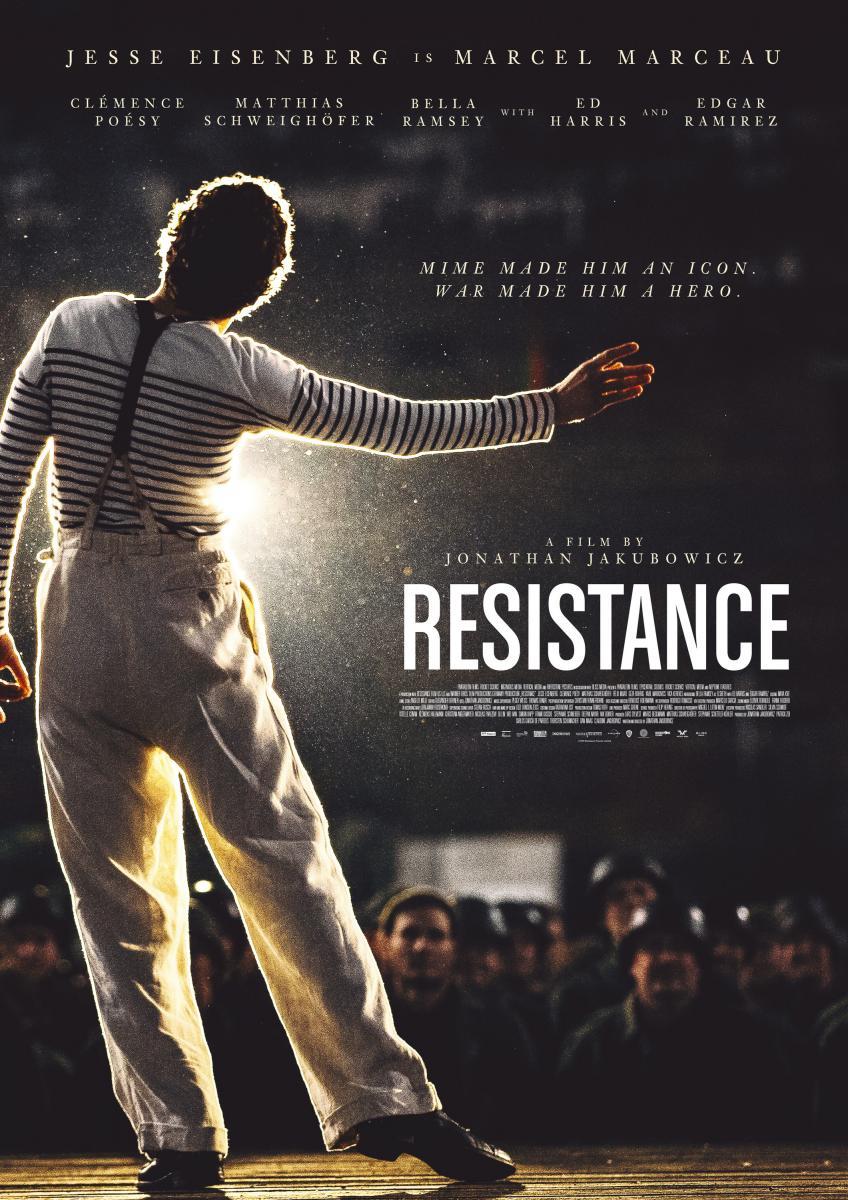
Set during the early days of the Nazi occupation of France, Marcel Mangel (Jesse Eisenberg) is a young Jewish artist who secretly performs imitations of some of Hollywood’s most famous entertainers in small cabarets, perfecting the art of mime in the hopes of realizing his passion as a feasible career path. However, his dreams are momentarily derailed with the encroaching influence of the Nazis, who are inching closer to dominating the territory and executing their orders to exterminate any Jews that they come across. Marcel, realizing the gravity of the situation, joins his brother Alain (Félix Moati) and another young rebel, Emma (Clémence Poésy) in the resistance force, taking on the enormous task of transporting several young Jewish children out of France and into safety, which entails secretly crossing into the Alps. Marcel is faced with challenges he never thought he’d have to encounter, such as dealing with the very real possibility of death but is not deterred from aiding these children in their escape. The group finds themselves encountering extraordinary obstacles, particularly when they are the next targets of the notoriously ferocious Nazi officer, Klaus Barbie (Matthias Schweighöfer), who immediately sets his sights on this ragged band of rebels who are subverting what is supposed to be the natural order of the war. He pursues them in a deadly game of cat-and-mouse throughout France, intent on derailing their plans in the same way they are avoiding becoming his next victims. Along the way, the group learns some of life’s hardest lessons, and Marcel finally gets the courage to embrace who he is from the experience of saving lives – and thus becomes the legendary Marcel Marceau, a universally-beloved cultural icon, and an enormously respected wartime hero.
Resistance is a film that works better in theory than it does in execution – certainly nowhere close to a disaster, it is simply an admirable piece of filmmaking set during the war that tells a solid story without contributing anything we haven’t seen before. Jonathan Jakubowicz has been hovering around having his major breakthrough for a while now, with his two previous films having earned some acclaim in their own right, without ever being indicative of a defining work by an up-and-coming filmmaker. Resistance is unfortunately not quite the film that changed that, but like the director demonstrated previously, he is able to make a worthwhile entry into a genre without necessarily being revolutionary, which could either be a great disservice to the subject matter or the best way to approach it. Ultimately, despite its shortcomings, I was certainly quite fond of Resistance solely for its intention to be a rousing portrayal of a remarkable story, as well as its tendency to make use of many of the most successful, if not taut, elements of the war genre. Its a film about heroism and courage, and should essentially be judged as such – and while there are certain elements that don’t work as well as others, Jakubowicz has made a relatively solid film that doesn’t purport to be any more profound or intelligent than it actually is, and is willing to put in the necessary work to be a thoroughly compelling, if not deeply touching, tale of the little-known humanitarian efforts of one of the twentieth century’s most important cultural figures, which is reason enough for us to call Resistance a relative success in a few different ways.
A great deal of the publicity around Resistance was focused on Jesse Eisenberg, who was selected to play the lead of Marcel Marceau. There have been many attempts to bring the legendary mime’s story to the screen, whether it be his revolutionary entertainment career or his valiant wartime efforts. Naturally, the idea of casting Eisenberg, who may be a talented actor, but not one known for the subtletly, nor the remarkable physicality, needed to embody Marceau. The film does tend towards presenting him prior to his entertainment career and thus focused more on his resistance efforts as opposed to his work as a mime, which lightened the burden on Eisenberg, who didn’t need to be too concerned about the more well-known aspects of the character. However, even if we disregard this part of the performance, Eisenberg is tremendous as Marceau – much of his career has been defined by criticisms about his typecasting in the role of the smarmy, intelligent young man who appears to always be one step ahead of everyone around him, always resorting to the same set of tics in order to play this kind of character. Unfortunately, Eisenberg has been coasting off these archetypes for a decade now since his breakthrough, with a few more notable performances coming through on occasion. Resistance is certainly one of them, as he’s no longer restricted to the kind of character he normally played but was instead able to extend on his own innate talents with more sincerity, which he enthusiastically does, overcoming the challenges of playing a historical icon that very few expected him to ever be associated with, and pulling it off perfectly. Eisenberg is really good, and even in the weaker moments of the film, he manages to pull himself up based on his dedication, and as a result elevates the film along the way.
Eisenberg is supported by a great cast, many of which get some terrific moments of their own. Resistance is very much built on the ensemble, and while none of them are the focal point in the way Marceau is (a logical decision, but one that would not have been made if he didn’t become the icon we know him as today), they hold their own, especially against relatively intimidating material. Clémence Poésy and Félix Moati prove themselves to be amongst the most impressive burgeoning French stars, having already been working in the industry for over a decade, but not getting the platform to portray their incredible talents as they were here, often relegated to smaller part in the occasional big-budget feature film that often casts them as token European characters. Moati steals the film away from Eisenberg as the heroic Alain, Marceau’s brother who takes charge of the resistance effort, demonstrating an ease on the screen that would’ve been considered a true breakthrough moment had this film been better and more widely-seen. However, the most impressive performance in the film comes on behalf of Matthias Schweighöfer, who is tasked with the intimidating challenge of playing the notorious Klaus Barbie or, “The Butcher of Lyon”, the man who was responsible for some of the most horrific crimes ever committed on the human race. Unlike many films that portray Nazis, Barbie isn’t presented as a mindlessly evil individual – the film is certainly not sympathetic to him, nor does it even consider humanizing him. Rather, it provided method to the madness, with a simmering intensity below the malice. Schweighöfer doesn’t play the role as a one-dimensional villain – rather, he’s a layered antagonist, a bundle of intricate neuroses that give him more depth and make the character even more sinister. Schweighöfer may be the only actor to come out of Resistance in a way that is memorable – all the rest are perfectly adequate and often very good, but we remember the incredible intensity Schweighöfer brought to the role more than anything, with his smirking malice leaving an indelible impression
Ultimately, there isn’t much to Resistance – it is a competently made war drama that succeeds in its fundamental intention to tell the story of the Lyon resistance, and in particular show the efforts one of their members, Marcel Marceau, had in saving the lives of thousands of children, whether directly or indirectly. It is often very well-composed, with some impressive production design and effort put into replicating the era. The performances are quite good, ranging from solid to remarkably powerful. As a whole, Resistance is a film that serves its purpose and not much else. For those who enjoy these rousing, slightly predictable but ultimately incredibly solid historical dramas, this film works perfectly well, being a worthy entry into the genre without being all that remarkable. Jonathan Jakubowicz is gradually making a name for himself as a director behind these solid, meaningful historical dramas, with this and Hands of Stone being terrific biographical films that tell their story in a very traditional way. Resistance hits many familiar beats, but does have some moments of genuine suspense (and the final climactic scene with the escape into Switzerland, and the subsequent moment of victory, were incredible and almost made up for the occasional unstable tonal shifts). This film doesn’t stand out as anything other than a fascinating true-life portrayal of the heroism of a group of very brave resistance fighters, but its more than sufficient in providing a thrilling story that carries an effective amount of heft, which it manages to convey with sincerity, which is ultimately more important than anything else a film like this could’ve done in relaying this powerful tale of courage, and the beautiful underlying message that remains resonant to this very day.