 Literary adaptations come in many different forms – there are those that remain very close to the source material, and those that update it, whether contemporizing it or just extracting a few general themes and infusing them into a more loosely-structured version of the story. Occasionally, there are adaptations that somehow manage to do both in some way, making a version of a beloved work in a way that cannot be called anything other than fiercely loyal, but also standing independent in its endeavour to be unique on its own terms. Autumn de Wilde’s adaptation of Jane Austen’s seminal novel Emma is precisely this – an extraordinarily entertaining film that finds the originality in a famous story, while never abandoning the fundamental elements, whether stylistic or narrative, that made it such an iconic text in the first place. An impressive debut for the acclaimed photographer, Emma is an astonishing work of period comedy, a film that delves deep into Austen’s world, channelling the good-natured humour, upbeat portrayal of the pastoral lives of the British upper-class, and the devilishly enthralling romance that made these novels that are as predictable as they are bewitching. de Wilde’s adaptation is an exceptional work in every aspect, finding a lot of elegance and humour in a novel that has unfortunately become a relic of a previous time in literature, with Emma showing these novels aren’t just the twee, outdated portrayals of romance, but capable of something far more profound, and incredibly meaningful – and the fact that it manages to be utterly captivating is only further proof that this is a terrific piece of filmmaking.
In tackling Emma, de Wilde had the unenviable task of immersing herself into the world of Jane Austen, clearly aware of the challenges that come in bringing her novels to the screen. Not only was she faced with the obstacle of the many previous versions of this story produced over the years, the director needed to prove why adapting this novel is not only worthwhile but necessary. Literary adaptations, particularly of works that have been translated to film before, are not always viewed with the enthusiasm they were in previous years, particularly when they don’t feature any elements that would set them apart. Instead of retreating from these problems, de Wilde embraces them, proving to be able to take on the insurmountable challenges that come with this kind of adaptation. Fundamentally, she employs the tactic of adapting a beloved work without changing all that much – Emma is neither a modernized version nor one that stands out as being a radically revolutionary perspective on the story. Much like we can attribute the success of Greta Gerwig’s Little Women, what de Wilde does with Emma is return it to what Austen most likely envisioned it to be. The lavish design is certainly present, but doesn’t supplement the story, nor does it replace the presence of a plot we’ve seen many times before, whether directly or through homage. Rather, it becomes a part of the overall experience, where the director takes a remarkably simple approach, which turns out to be possibly the best version of this story, mainly because it never seeks to epenthesize anything into a story that is just about perfect exactly how it is.
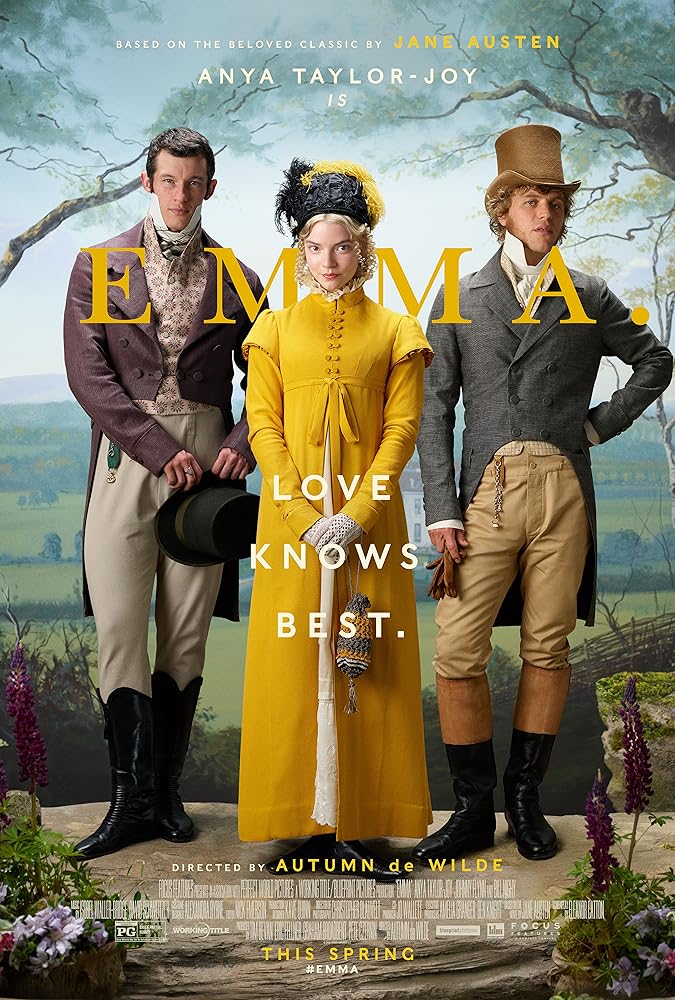
The mistake many directors tend to make is believing that addition automatically results in originality, when the reality is that it can become self-indulgent, which is certainly not at all true for this version of Emma, which is as humble as it is effortlessly charming. The film doesn’t necessarily move away from the style – the costumes in the film are gorgeous, not only because of how detailed they are, but also because de Wilde uses them to convey the fascinating symmetry she was trying to make with the film. Her background in photography is evoked beautifully in Emma, with each frame being perfectly-calibrated, composed in a way only someone who knew the indelible power of a single image could possibly provide – the use of colour and framing are sometimes underappreciated in films like these, where the existence of beautiful costumes and impeccable design are often the extent to which the filmmakers are willing to go to evoke a certain era. In this film, de Wilde creates a gorgeous world, blending the splendour of countryside estates with the rugged natural beauty of the lush surroundings, and never surrendering to the temptation of excess. Additionally, the music by Isobel Waller-Bridge and David Schweitzer is impeccable, complementing the idiosyncratic nature of this adaptation with a buoyant, joyful score that sets the tone wonderfully. Emma is a beautifully-made film and one where the creative elements don’t serve to distract, but rather to bolster an already incredible adaptation.
While certainly being the most faithful adaptation to the source material, both in terms of how it embraces the story and the ways in which it realizes it visually, Emma does manage to comment on some aspects that are often missing from adaptations. Ultimately, this is a film primarily about female defiance, and the societal boundaries built around how women were perceived. The fact that Emma Woodhouse is one of literature’s most enduring figures is not accidental – Austen’s protagonists were always fiercely defiant of any rules that sought to weaken their role in society, and would often openly challenge the conventions that kept them always at a distance from achieving the same as their male counterparts. At the time in which this novel was written, the only aspiration a woman should have would be to marry well. There wasn’t much for a female protagonist to do other than briefly flirt with the idea of rebelling against normativity before settling down (normally with someone who embodied her defiant spirit). These novels were undeniably beautiful in their composition, and the characters all very compelling. However, they also didn’t lend too much to representation, and while the idea of inclusivity and equality has become more of a contemporary issue in the arts, it was clear that Austen was writing from the perspective of someone who had to follow the rules, or risk failure. Thus, characters like Emma Woodhouse, with her sardonic humour and refusal to comply with the more inconsequential details of her daily life, were born, the product of an author whose work has remained so relevant, purely as a result of the exceptional nuance she imbues into her characters.
The director understood that there needed to be an enormous shift in how these stories are told, but also that rewriting the entire storyline to make it more facilitative of a more contemporary rhetoric would cause the loss of some of Austen’s more subversive commentary, which was embedded between the author’s conventional, but still pensive, approach to the issues that she quietly remarked on in many of her novels. de Wilde goes to great lengths to keep within the confines, while still highlighting the less-obvious elements. The result is a film in which a happy medium between archaic practices and modern, socially-charged critique, which is ultimately a truly wonderful example of an update not necessarily needing the go beyond what is expected. The fact that Emma was made from the perspective of a female director is only going to enrichen the film’s subversive approach to femininity (as it did with the iconic Clueless, which derived a lot of inspiration from this novel), as it provided insight and depth into a story that has always been inherently focused on the intersections between gender and social perceptions, which is often forgotten when it comes to this kind of romance. Far too many adaptations are preoccupied with the more charming side of the texts, rather than looking into the underlying commentary, which is yet another of the multitude of reasons why Emma is such a tremendously successful adaptation.
It would appear that with every performance she gives, Anya Taylor-Joy only further reaffirms the clear fact that she’s one of her generation’s finest actresses, and has often been right on the verge of achieving the kind of recognition reserved for only the most talented performers. Emma Woodhouse is a complex character, not only because she has to carry this entire plot (with the innumerable intertwining), but also because it requires an actress who can convey the vast emotional depth of the character, whether it be her incredible wit, or more nuanced approach to the underlying melancholy of a woman whose pride has always been facilitating romance for those around her, but who is slowly growing disillusioned with the loneliness that has always followed her. Emma doesn’t quite fit in, and while she is very much loved, she’s always kept at a distance from those – whether it be in her remarkable intelligence, fierce wit or ability to make anything she wishes transpire, she is more someone who others can admire rather than adore.
If any of her previous roles weren’t enough, Taylor-Joy’s performance here is a star-making turn, with her ability to not only balance the immense dialogue but also to find the depth in a character that may have easily been played as a mindlessly likeable protagonist, rather than one with a lot of personality and intricate eccentricities, being the mark of a truly great actress. The supporting cast is terrific as well – Bill Nighy is a welcome presence at the frantic father who is used mainly as a comedic device, but quietly harbours a lot of emotional gravitas, as does Miranda Hart, who portrays herself capable of far more than just comedy, being a vital part of the film’s most heartbreaking moment. Johnny Flynn (who is himself on the precipice of much wider acclaim) is incredible as the aloof Mr Knightley, who inadvertently finds himself falling in love with Emma, contrasted with Josh O’Connor as an eccentric priest, and Callum Turner as the epitome of the upper-class, who ultimately reveals himself to be a lot more than just the dashing hero he’s portrayed to be. The performances in Emma are remarkable not only because the ensemble is incredible, but because there is a clear attempt to remove the traces of archetype from each one of these characters. Each individual is developed beautifully, carefully-developed to avoid any sense of cliche, and through the attentive work done by de Wilde in translating these characters to the screen, and the work the actors put into playing them, we have a memorable ensemble that both fascinates and entertain.
Emma is a very special film – as an adaptation, it breathes new life into a tired genre, bringing with it a sense of humour and good-natured provocations that have been missing in the more self-indulgent attempts to adapt this category of novel. Autumn de Wilde deftly avoids any allegations of making an overtly twee film – the more adorable elements, such as the gleeful approach to the visual style and the more humorous tone, are done as an artistic choice, intentionally put together to show that a film like this does not need to be dour, nor flippant, about the more serious themes it looks at, which creates a fascinating dynamic, and one that immediately sets this film apart from others. Ultimately, the film is a tremendous success and takes on the intimidating task of not only adapting a beloved Jane Austen novel, but doing so in a way that would allow it to be both loyal to the source, while still unique in its own way. Whether it be through the incredible performance Anya Taylor-Joy gives as the titular protagonist, the supporting cast and their effortless ability to evoke every bit of potential from these seemingly one-dimensional characters, or the many endearing stylistic choices made by the many talented individuals working on this film, Emma is a truly enchanting experience, one that will leave you in a state of pure bliss. There are many different aspects of this film that went into its success, but we can all attribute it to one very simple concept, which appeared to be the guiding principle the director employed: this is a film that intended to have fun, and in the process becomes an utter delight for audiences, who are now truly privileged to have received what is most likely going to become one of the definitive literary adaptations of the past few years and a truly extraordinary journey into the past.
 The Postmodern Pelican
I didn’t care for Emma. The Oscar nominated costumes and hair design are noteworthy. The feature film directorial debut by Autumn de Wilde promises a satisfying career. Anya Taylor-Joy is tolerable as the shallow and decidedly uninteresting Emma. She receives strong support from Miranda Hart, Bill Nighy, and Johnny Flynn.
Everything here is catnip for the devoted Jane Austen enthusiast who relishes formalities that mask honest emotion and charm that seeks to replace wit. I found the film admirable but stodgy, failing to bring life to the painful comedy of manners that screenwriter Emma Thompson and director Ang Lee were able to draw out from the drawing rooms of Austen’s Sense and Sensibility.