 When we are introduced to Cecilia (Elisabeth Moss), she’s about to attempt to escape, which isn’t a rare occurrence in horror films. However, the difference is that she’s trying to run away from her home, which houses her boyfriend, Adrian (Oliver Jackson-Cohen), a beloved technological innovator who has amassed enormous wealth and massive respect from the industry, which hides the sinister fact that he asserts a manipulative control over Cecilia, dictating her every move and insisting on keeping her as submissive as possible. Growing weary, she successfully retreats from the relationship, which only leads Adrian to commit suicide – or so it would seem, as she starts to suspect that he’s a lot closer than she thought he’d be, gradually coming to the realization that he didn’t actually take his own life, but rather staged it as a way of creating the illusion that he had perished, allowing him to realize his most ambitious projects yet: a method of turning invisible, which he successfully completes, and uses for the sole purpose of terrorizing Cecilia, who grows increasingly more paranoid and fearful as their interactions become more intense. Forced to fight against an unseen abuser, while trying to convince those around her that her suspicions are not the delusions of a mentally fragile woman, but rather the realizations of someone still working through the trauma of an abusive relationship. Cecilia learns that even those who care for her have their limits, and when they associate her erratic behaviour with her increasingly panicked mental state, they have no choice to conclude that she isn’t being haunted by anyone other than her own mind – and how can Cecilia possibly convince them otherwise, especially when the evidence does not help her case at all?
We’re in a renaissance of horror filmmaking – no longer are directors endeavouring to just scare us, but rather intent on conveying some meaning between the frightful scares that we are so collectively drawn to. The Invisible Man is one of the most potent horror films of the past few years, managing to not only be an effective entry into the genre, but also a powerful statement on domestic abuse and mental health, two topics that have been explored in films before but rarely from the perspective of the kind of supernatural chaos director Leigh Whannell seems to be focusing on here. Anchored by an incredible performance by Elisabeth Moss, and told with a sincerity that seems quite rare for films in the genre, The Invisible Man is a resounding success – a gripping horror that often threatens to overwhelm with an intensity that can only come from a director focused solely on their craft, creating something that has a meaning, rather than just existing for the sake of entertaining audiences. The film naturally does go in some expected directors, and it never once proposes itself as some steadfast example of originality. Rather, it derives all merits from how the director takes a familiar formula and works through some of the tropes, infusing a more resonant meaning into nearly every frame, and executing this challenging, heartwrenching story with tact, elegance and an endless supply of dread that never fails to engross the viewer in this complex story that is more than just what it appears to be at the outset, and perhaps even surprise us in many instances with its unconventional brilliance.
By no means a controversial opinion, with every new performance she gives, I grow increasingly convinced that Elisabeth Moss is well on her way to becoming one of her generation’s defining stars, having lent her enormous talents to many different projects, ranging from bold television shows to small-scale independent movies, and now much bigger films that see her bringing her immense gifts to a much wider audience, who can witness her incredible control of character, and her ability to play nuanced individuals that are distant from the archetypes they’d be if given to less-established performances. Moss is at the centre of The Invisible Man, which is built almost entirely on her incredible portrayal of a domestic violence victim slowly descending into despair as a result of a vicious ex-boyfriend who has made it his mission, in both life and death, to terrorize her to the point of complete insanity. Moss always thrives in playing these ordinary individuals who are faced with problems that cause them to gradually question their own sanity (for anyone who hasn’t seen Queen of Earth, its highly-recommended, particularly for how it’s a great forerunner for this film in how it shows Moss’ rapid decline into paranoia), eventually succumbing to the anguish they have been so ardently avoiding. Her expressiveness, coupled with her incredible ability to find the nuance in a character that sometimes seems to be rather one-dimensional in how she works through the story elevates the role beyond simply the suffering protagonist, evolving in a powerful portrayal of a victim deciding to not agree to complacency, and rather than accepting the pain she’s been inflicted with, she decides to fight back in her own way, but only after a harrowing demonstration of the peril she faces, both physically and emotionally, at the hands of those who are either actively terrorizing her, or refusing to believe the validity of what she is saying. For those who have been following Moss’ career for a while, The Invisible Man is not going to show anything we haven’t seen her do before but rather serves as the manifestation of the innumerable gifts she has for playing these kinds of broken characters who eventually collect all their emotional and psychological fragments and go directly against the source of their misery, intent on getting the vindication they believe they deserve.
The Invisible Man doesn’t make a secret of the fact that this is primarily a film about domestic abuse and the mental ramifications of a scenario in which one partner is subjected to maltreatment by someone they thought they could trust. In many ways, this film appears to be an attempt to update an older text, which was previously realized as a series of highly-successful (but relatively benign) monster movies at the height of the Golden Age of Hollywood, by blending it with themes that may not be new to our generation, but certainly have found a place in cinema where they can be expressed without the fear of audiences being too despondent at seeing such a harrowing portrayal of something that may hit quite close to home for many people. Horror films that abandon the implausibility to deliver stark social messages are not very common, but they often tend to be overwrought or forced, which The Invisible Man deftly avoids, defying expectations to be a powerful story of a young woman growing weary of running, and instead changing direction and facing the reality of her situation directly, as this may be the only way she gets the resolution she deserves. Less about revenge and more about the protagonist enduring immense suffering and then going in search of some way to escape it, Whannell’s film is layered with meaning and becomes quite unsettling in its bold portrayal of abuse, which is never an easy topic to explore in even the most heartwrenching of social dramas, so for the director to boldly introduce this theme to us in the guise of a horror film, where the true terror comes in the story’s relationship to reality, was almost revolutionary. The theme of trauma lingers heavily over the film, with the story demonstrating the unpredictable, unpleasant experience of working through a horrifying situation and the linger after-effects that tend to be even more uncomfortable, with the haunting memories that most victims in this position tend to have been replaced with a more literal story about an abuser continuing to torment his emotional casualty, even seemingly from beyond the grave.
Such an unconventional approach to serious themes like this require a film that isn’t going to trivialize them, but also not dwell on them in such a way that the more artistic intentions of the story don’t go amiss. The result is that Whannell finds the perfect balance between the compelling story and the execution of it, in which neither the potency of the plot, nor the unhinged terror of the style, are lost. The Invisible Man is a slow-burning horror that is constructed with a sense of immense sincerity, where the focus isn’t on being the most artistic or creative film, nor is it ever an attempt to revolutionize the horror genre, which is increasingly becoming an area in which many young filmmakers are trying to make their names in the industry, especially because this is the genre that tends to see the intersections between critical acclaim and adoration from the general public, who tend to react well to this brand of subversive horror filmmaking. Whannell goes to great lengths to ensure that this film has the right amount of terror to unsettle us, but not an overabundance because this normally leads to fatigue. The Invisible Man keeps us guessing right until the end, with the predictable twists being present (this film would not have worked had it not been constructed from the main artistic framework that many similar films tend to follow extremely close, which the director adapts in unexpected ways), and the moments in which the fear is unleashed on us, we come to understand why each moment is carefully-chosen by a film that is not just a straightforward narrative with added elements of more socially-resonant themes, but rather the meticulously-constructed psychological horror curated with great care by a director whose intentions with this film are quite extraordinary.
This is not an easy film to watch, even when it is at its most heartwarming. Horror film has often been built on the idea of terror not coming from what we can see, but rather from what is lurking just out of sight, residing in the shadows – this film takes this much further, focusing almost entirely on the fear of the unknown and unseen. Launching into uncharted territory for this kind of thematic content, which has certainly been touched on in many films including some of the more artistic horror films made in recent years, where serious matters don’t only contextualize the horror, it tends to define it and set the rest of the story up to follow in these challenging conventions. Whannell manages to take an iconic novel, adopting some of its major themes and infusing them into this poignant tale of a woman trying her best to survive, especially after she was momentarily given relief after escaping an abusive relationship, which she realizes is not as easy as it would appear here. One of the most harrowing portrayals of abuse and gaslighting ever committed to film, The Invisible Man is a unique demonstration of trauma that is unwavering in its commitment to a powerful story that exceeds beyond the confines of simple horror, striving for something much deeper. Anchored with a truly spellbinding leading performance by Elisabeth Moss, who surrenders her talents to this uncomfortable, terrifying manifesto on abuse and the psychological impact of surviving it. Its a very intense film, but also a rewarding one, as the thematic content, when perceived in conjunction with the relentless fear embedded in the genre, turns The Invisible Man into one of the most daring and affecting horror films that launches what is clearly going to be a banner decade for horror filmmaking, especially if this same standard is adhered to, and where serious issues don’t need to be avoided to make an entertaining film, but can easily be assimilated into trite conventions, resulting in a truly astounding addition to a new, exciting generation of horror filmmaking where audacity and artistic expression of deeper ideas supersede everything else.
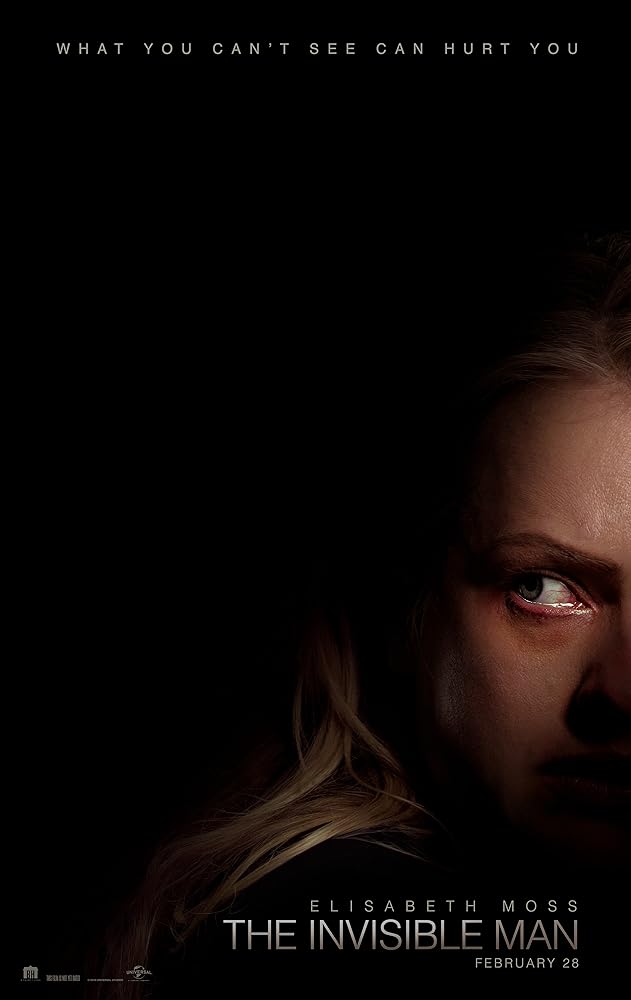
 The Postmodern Pelican
“One of the most harrowing portrayals of abuse . . . ”
Nope.
Try Oscar winner Olivia Colman in Tyrannosaur
or Oscar winner Nicole Kidman in Big Little Lies
or Oscar winner Sally Field in Sybil
or Oscar winner Dianne Wiest in Independence Day
or Oscar winner Kathy Bates in Dolores Claiborne
or Oscar nominee Angela Bassett in What’s Love Got to Do With It
or Oscar winner Billy Bob Thornton in Sling Blade
or Oscar winner Whoopi Goldberg in The Color Purple
or Oscar winner Leonardo DiCaprio in This Boy’s Life
or Oscar winner Monique in Precious
or Oscar winner Matt Damon in Good Will Hunting
or Oscar winner Anjelica Huston’s Bastard Out of Carolina
The Invisible Man is a run of the mill, forgettable flick.