 His recent output has made us collectively reevaluate the career of Adam Sandler, where his skills as a comedic actor, which were previously subjected to enormous disdain as a result of his vast amount of seeming-lacklustre work, being given another chance, with the clear conclusion being that, despite often appearing in awful films, Sandler as a performer is one of the most hard-working individuals in contemporary cinema. However, what becomes increasingly more rare in these pieces that sing the praises of an actor who they all propose as being a misunderstood genius are analyses of the work that doesn’t necessarily see him playing against type, but rather the films that were very much within his range, but still managed to be successes on their own terms. For every Uncut Gems there is a Murder Mystery, and for every Punch-Drunk-Love, there’s a 50 First Dates. Sandler’s career has been a divisive series of successful comedies that are derided for their vulgarity or lowbrow appeal, and smaller, more fascinating character studies that allow him to momentarily step out of his comfort zone and challenge himself as an actor. For the sake of this review, we’ll be looking at the former, focusing on Big Daddy, a film I believe encapsulates everything that made Sandler such an enormous star, a film that doesn’t necessarily require him to venture too far from what he does well, but still proving that even when working within the confines of a more mainstream comedy, he is still capable of being a magnetic presence that allows commands the screen, even when the film around him may not be particularly great.
Sonny Koufax (Adam Sandler) is the quintessential slacker – he’s a law graduate who has decided against pursuing a career in his field of study, choosing to rather live a life of luxury, the result of a minor accident that gave him a large amount of money, and his position as the son of an affluent family that he can easily depend on for assistance when he needs it. However, his life is in shambles, especially since his girlfriend (Kristy Swanson) left him, and his roommate and best friend, Kevin (Jon Stewart) moves to China to further his own career. Sonny is left with no one but himself – but this soon changes with the arrival of Julian (Cole and Dylan Sprouse), a precocious five-year-old who is allegedly the unexpected offspring of Kevin, who is already on his way to Asia. The boy’s mother has unfortunately passed away, and the only alternative is to send him to an orphanage, which the empathetic Sonny refuses to do. He decides to take on the role of the boy’s father, convincing the adoption authorities that he will take care of the child, at least only temporarily until they can find him a new family. Unfortunately, Julian finds his way into his foster father’s heart, with Sonny soon becoming besotted with the child, with his eccentric behaviour and sweet-natured curiosity reminding Sonny of better days, as well as motivating him to put his life back together and start taking responsibility for himself and others. However, with the encroaching danger of the truth coming out, and the realization that they can’t hold onto this lie for much longer, Sonny and Julian have to try and make the best of the situation, in the hopes that they’ll eventually be able to find a way to stay friends, even through the adversity they’re bound to encounter.
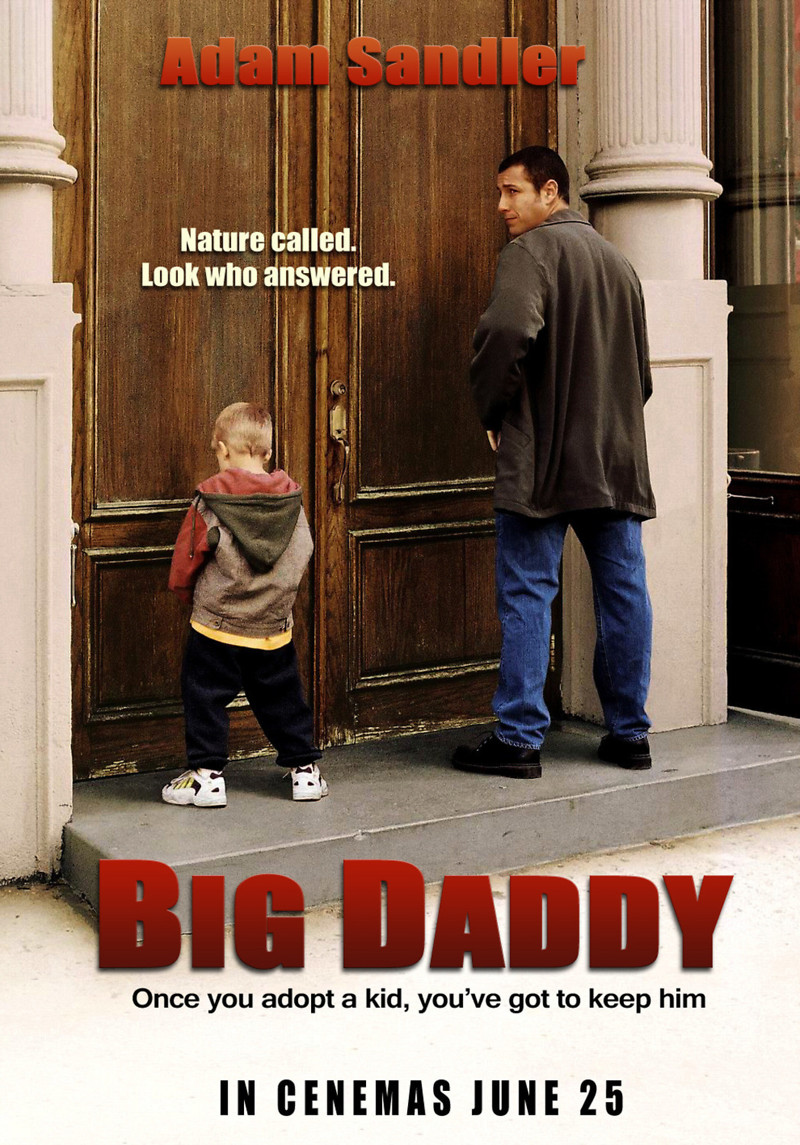
Like many of Sandler’s more beloved comedies, particularly those produced during the height of his stardom in the 1990s, certain images are etched into the cultural consciousness as fond representations of these films and the messages they convey. The image of Sandler and one of the young twins that occupy one of the co-lead roles urinating onto a building is indicative of the two conflicting elements that compose Big Daddy, and have made it one of Sandler’s more divisive comedies – the bold, broad slapstick and the more emotionally-charged sentimentality, both of which work in tandem to make one of the actor’s most effective comedies, but one that has its share of detractors. Like other films produced during this time, Big Daddy takes the form of comedy that may be family-oriented but makes great use of its slightly inappropriate tone, whether some minor cursing (normally coming from the younger characters, as the idea of foul-mouthed children was perceived as being so endlessly hilarious during this period), or subject matter that was only slightly rebellious to social standards. Big Daddy is the kind of film that essentially functions less as a revolutionary attempt to subvert the genre and more of a heartwarming exploration of various themes that go along with its message of family-friendly entertainment. It’s a solid comedy that doesn’t take any risks (and sometimes falls victims to some narrative inconsistencies inserted into the film to propel the story forward, in the hopes that no one would question such coincidences), but doesn’t necessarily need to, because when a film is striving to just be the sum of its part, there’s no need for it to be anything more.
Big Daddy is one of the films that forced the world to perceive Sandler as being capable of only one kind of character, the immature young man who doesn’t do much other than living a relatively comfortable life, which he acquires through very little effort as a result of pure luck. This man-child persona is something that has haunted Sandler for his entire career (not that he seems to be intent on changing this perception all that often, as it clearly is something that works, with most audiences reacting extremely well to it), especially when we look back retrospectively and see how this was the beginning of a career that would hit some memorably dismal lows before it would pick up again. However, a more optimistic view and the one I feel is only appropriate in this instance, is that Sandler is simply very good at what he does, regardless of the role. There are not many films in which Sandler doesn’t succeed, with the only difference in quality being in the film itself. Like any actor, he does tend to give weaker performances than others, but his commitment to his roles is surely one of his defining qualities. He’s not an actor who appeals to everyone, but as Big Daddy shows, he possesses a charisma that is often impossible to resist, especially since this is one of the roles in which he is more muted, with his character being less of an outrageous caricature and more of a likeable ruffian learning life’s hard lessons. Cole and Dylan Sprouse take turns in playing Julian and are as wonderful as many child performers tend to be at this age. Inarguably more focused on how adorable they are than their ability to handle the story, Big Daddy brings out a lot of heart in the interactions between Sandler and the twins (with one of the more interesting parts of this film being the process of trying to figure out which twin is appearing on screen, an almost impossible activity, and indicative of the great work done in keeping the character consistent), with every bit of success in this film coming from their scenes together.
Big Daddy is a film that understands its limitations – it doesn’t propose itself as being anything other than an entertaining comedy that takes a different, humourous look at father-son relationships from the perspective of two eccentric characters that start out in conflict and eventually learn to love each other. Predictable to a fault, hitting all the beats that it is supposed to, the film doesn’t purport to being more than just a quirky comedy that exists only to entertain. In this regard, its a massive success – it is a heartwarming film that evokes genuine laughs (with some of them being quite intelligent, and the many running jokes actually working out very well), and manages to be an endearing comedy that ventures into conventional narrative territory while still remaining unique in its own way, particularly in its approach to a resonant story that could have so easily been either overwrought or flippant, deftly avoiding all of them through its intention to be as simple as possible, finding the heart in a predictable story. This is not the film that will change perceptions of Sandler, and its financial success at the time may have persuaded the actor to continue in this vein of playing broad archetypes, but as a piece of mindless entertaining, Big Daddy is very effective, especially when it comes to blending humour with more touching subject matter. There isn’t much to this film other than its effectiveness as a mainstream comedy, but it is an effective diversion, and a wonderfully sweet portrayal of family from an actor whose work has always been strong, even if the same can’t always be said about the films he appears in, with Big Daddy being a safe, solid reminder of his skills as an actor who can elevate any material.
 The Postmodern Pelican