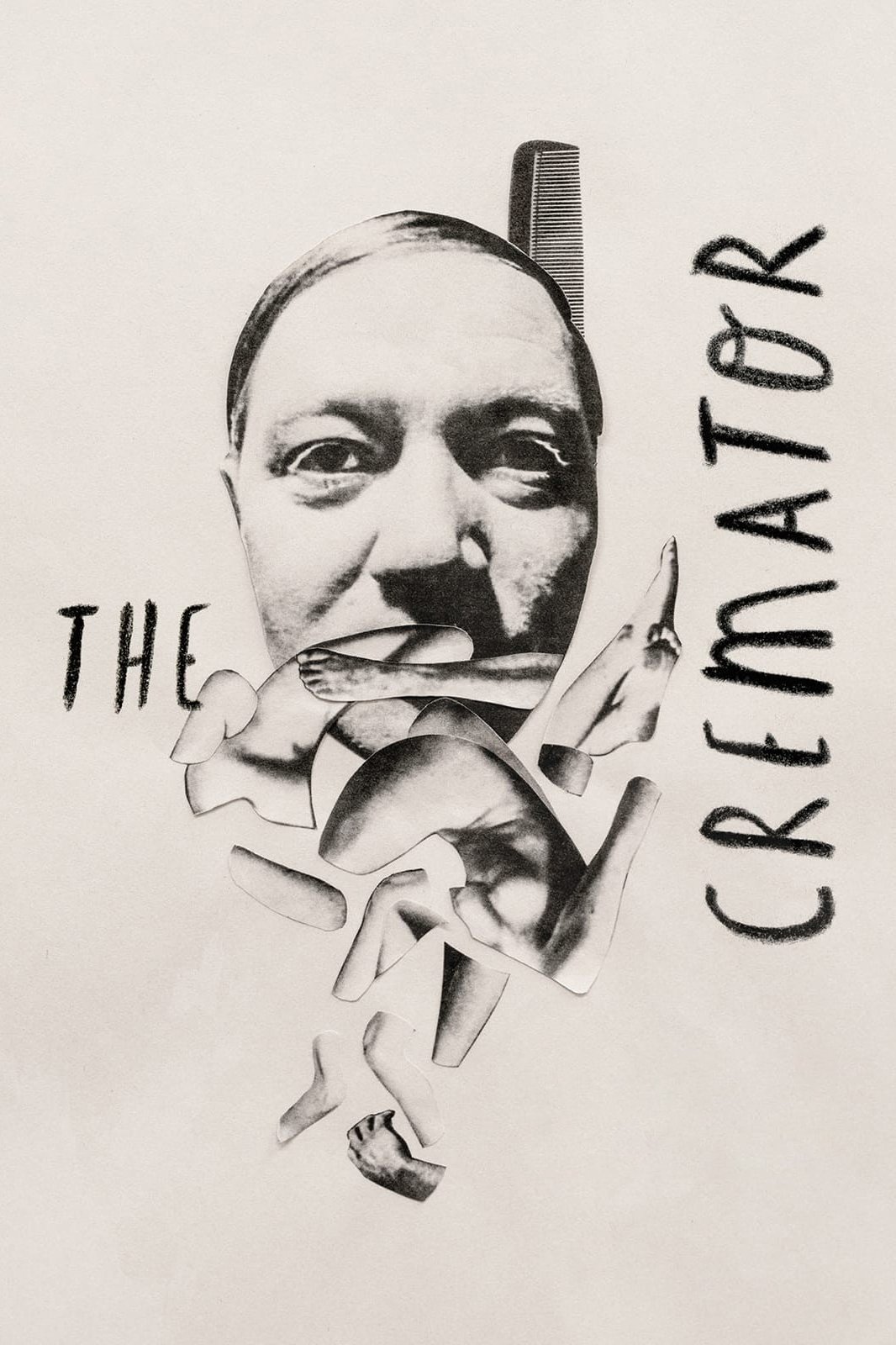
Karel Kopfrkingl (Rudolf Hrušínský) is a mild-mannered man who has a passion for his career – he runs a small but renowned crematorium in Prague, where many of the city’s most established individuals briefly reside after their death, put under the meticulous care of a man who adores his chosen profession. His work is extremely important to him, seeing it less as simply a way of changing the composition of dead bodies, and more of a way of separating the spiritual from the carnal, with his responsibility being to liberate the souls of the deceased and allow them to enter into the ether, so they may find new homes and continue to live eternally while the flesh is consumed by the cleansing flame. A fiercely proud nationalist, Karel begins to grow concerned with the encroaching danger of the imminent Second World War, with the effects of this brutal conflict beginning to show in his surroundings. He eventually begins to realize that there are apparent differences in how human beings are composed, and with the rhetoric being that some are more superior than others, Karel begins to believe the discourse surrounding race and identity, as it hails from the civilized, intelligent nation of Germany, the home of many of his favourite composers and intellectuals. Karel comes to the conclusion that he has not chosen the wrong path – in fact, he is right where he is intended to be, serving as a guide for the souls of the many people who have perished during this time, and will continue to fall victim to the hopeless cause of eugenics and cultural cleansing, with Karel doing his part to contribute to the dominance of the master race, seeing his work as a way of freeing those trapped within the wrong bodies and helping them find hosts in more socially-accepted hosts. Nothing seems to be able to stop him from executing his intentions, not even his dearly beloved family, who will soon find themselves entering into the realm of the departed, by the hands of their own patriarch, who is gradually developing into a kind of unhinged madness that no one can convince him to abandon.
There aren’t many films quite like The Cremator (Czech: Spalovač mrtvol), the gloriously demented dark comedy that Juraj Herz unleashed onto the world at the peak of the Czech New Wave, a cinematic movement that he both helped define and vehemently opposed being classified under. This contradiction certainly holds true for this film, which takes the form of a surreal nightmare that could cause even the most demented of artists to be awoken in complete despair. A film that is categorically impossible to define in any lucid terminology or generic classification, The Cremator is a claustrophobic meditation on death and the various challenging questions that surround it, but are very rarely asked with this kind of explicit honesty, as well as hardly ever achieving this kind of poignancy, which is especially bizarre considering how this is one of the most arid films ever made on the subject, the kind of work that is more startling than it is entertaining, where we are invited to express our discomfort through the repulsion we will undoubtedly encounter at some point. Herz crafts a film that boldly negotiates its place as one of the most grotesque explorations of our species, offering a glimpse into the darkest recesses of the human condition, and boldly provoking issues of sanity and social disorder, all delivered in a way that makes this a profoundly unique, but incredibly unsettling, tale of despair and demise that is almost insatiable in its attempts to terrify, almost as intent on making us feel the same discomfort as it does darkly comical humour, which makes this a unique, but disparagingly disconcerting morality tale, a fable without any clear lesson other than to surrender yourself to the innumerable existential quandaries that are always lurking beneath our society, with the majority of us acknowledging their existence, but being singularly unable to bring ourselves to look further into them, for fears of the haunting truths we might find lurking within.
To only confuse viewers further, The Cremator is an outsider in a cinematic movement that was already on the outskirts of conventional filmmaking, with the style and tone of the film being far from what we’d expect, even from the radical Czech New Wave, of which the director was one of the formative figures, even if this film seems to be even too abstract from the work done by that band of radical outsiders. Stylistically, this is a film that is very much driven by madness, which is reflected in how Herz manifests his wild ideas into this incredibly bizarre portrayal of one man’s search for meaning and the warped ideals he brings along on the journey, which the director asserts onto an offbeat morality tale that loses all semblance of logic the moment we’re introduced into this world controlled by nothing but unmitigated absurdity, thrust into this film to only challenge the already-abstract concepts that we have to endure. There are many cinematic and literary sources that tend to be used as descriptors for what Herz was trying to make with The Cremator – German Expressionism is the movement most commonly associated with this film, with the gothic overtones, attention on the angst of modern existence, and unconventional production design indicating the director being heavily inspired by the unsettling works that inarguably defined cinema. The secondary source of this film’s offbeat appearance and disquieting tone is clearly taken from the Surrealists, whose work often reflected the underlying despair a society felt, channelling it through absurd and vaguely-comical images and scenarios, which is once again a perfectly adequate way to describe the intentions behind The Cremator. Herz’s combination of the bleak anxieties of Expressionism, and the peculiar sensibilities of early Surrealism result in a massively unorthodox series of images that convey a powerful, if not often deeply outlandish, message about existence that would not have been nearly as effective had the director taken a more conventional path, or strived to make us feel anything less than the unhinged terror he peddles with such ferocity here.
It seems inappropriate to talk about The Cremator without mentioning Franz Kafka. The spectre of the iconic author’s work lingers over much of Czech cinema at the time, especially in the bohemian spirit with which members of the New Wave defied authority and explored their various existential quandaries. However, this film seems to be the closest this era in filmmaking got to capturing Kafka on screen, particularly in the complex messages that hide deeper meanings about the world around us, and the dread that comes when we realize how we truly are alone, a fact that we can either allow us to liberate ourselves from conventions, or launch us into complete despair. Cold and arid like the author’s work, The Cremator is just as meaningful, as well as outright terrifying, as Kafka’s finest work, particularly in how it uses sharp, darkly comical moments of terror as a way of vaguely concealing a bleak storyline, which slowly unravels the further we venture into the plot, creating the sensation of entrapment in this labyrinth of anguish. Herz constructs a masterful exploration of the fundamental of evil, which he contrasts with commentary on human nature, proposing the question of whether the tendency to inflict suffering on others is innate, or socially-mediated. As demonstrated in the incredible leading performance by Rudolf Hrušínský, not everyone is necessarily born with sinister intentions, but can be the product of their surroundings. In what is an alternative perspective on the Holocaust from the viewpoint of a different nation, the director makes use of satirical tension to prove that morbidity can sometimes lead to twisted comedy, and comments on the protagonist’s descent into evil, which is less of an inborn quality, and more a gradual process inspired by his impressionable nature intertwining with his nationalistic tendencies, which create a sense not only of fierce pride in his own race, but disparaging opinions on those outside of it, and when working in conjunction with his empathetic spirit, he feels compelled to relieve those outside the confines of what is perceived to be the master race, putting through a few moments of agony for an eternity of superiority.
Karel genuinely believes what he is doing is not only right, but a sacred action that liberates those who are suffering from the mortal coil – what starts as the belief in helping the deceased cross over eventually becomes a macabre portrayal of a very unconventional serial killer, whose mental state remains intact and he functions like he normally would, but his psychological understanding of the world around him becomes warped by the society he exists in, and the influence of those with power, as anyone with a platform was perceived by proletariats like Karel as being arbiters of nothing but the truth, regardless of how deceiving their message may be. It’s a challenging role, especially in how he is supposed to represent both an abstract sense of human evil, but also be an ambassador for the ordinary people who were gullible enough to believe the horrifying rhetoric spewed during an era in which it became acceptable, and perhaps even encouraged, to form divisions. Hrušínský does exceptionally well in exploring this character and finding the authenticity in a role that could’ve so easily been exploitative or a parody. His genial personality, contrasted with an underlying malice that hints towards his eventual psychological decline, makes this an unforgettable performance that engrosses the audience with its horrifying charms that are both repulsive and irresistible, and the actor’s quaint personality, and tendency to always appear to be caught between friendliness and pure, unhinged evil, makes this an impressive portrayal of a conflicted man who finds himself falling victim to the deception of a warped cultural system.
It’s in the film’s positioning of the protagonist as this conflicted individual that The Cremator is able to make its most profound statements, and unveil the unexpectedly humanistic message underlying it. Despite its harrowing subject matter, Herz has made something that ultimately does have some semblance of compassion lurking beneath it. The Cremator is not simply about the Holocaust (hence it remains entirely resonant today as it did half a century ago), but rather a steadfast manifesto on suffering and existential despair. It uses an almost romantic perspective on death and the serenity that comes with eternal rest, which it contrasts with the despair of suffering, particularly in the final act, where every bit of warmth and good-natured humour retreats from a film, and what started as a mannered comedy about social norms in an oppressive society devolves into something else entirely, a hopeless portrayal of fear and anguish that never wavers from presenting the viewer with the most uncomfortable of situations, provoking us to look beyond the minimalistic confines of a film that is executed with an intrepid spirit of defiance against everything that we hold sacred. The Cremator is a film that keeps the viewer at a slight distance, but still gives us voyeuristic access into the mind of a demented individual whose quest to cleanse society, not merely to bolster the status of those who meet the idealistic cultural criteria, but to do those burdened with the innate sin of being born in the wrong ethnic group, is not an easy theme for the viewer to take in, and the discomfort with which the director executes these ideas is certainly quite intense. However, this is not an exploitative film, and much like other films made by his compatriots at the time, Herz is trying to shock us as a way of conveying a certain message, and while the film does appear thoroughly absurd, it’s all for the sake of invoking an atmosphere of complete despair, through making use of outrageous situations, which facilitate deeper thought than more traditionally-structured stories.
It may be difficult to watch at times, but The Cremator is far from an exercise in sadism, especially because it compensates for its bleak tone and sometimes unsettling content with a clear motivation to evoke some kind of change. Not strictly focused on the Prague Spring and the situation around the period in which this film was made, as was conventional for many Czech New Wave films, but rather a darkly comical horror that takes a retrospective glance at a moment in the history of the country, from the perspective of an individual whose identity becomes corrupted by the irresistible forces that lead a discourse of division, and how he goes from representing the good, hardworking proletariat, to one of the supposed architects of a new world order that would eliminate all those he deems unnecessary or unworthy. The director brings intense social commentary, infusing it into his abstract, surrealist vision that harbours fascinating insights into the psychology that causes seemingly ordinary individuals to do evil deeds. It all comes together in a film that thrives on its complex view of the human condition, with Herz making a film that can only be described as an inventive ode to existential angst, filled with nightmarish imagery that contrasts with darkly satirical ruminations on human nature and our relationship with death. The film intentionally evokes a sense of enormous dread in the viewer, and most will find themselves exasperated by the time the final chilling moments of the film leave us feeling bleak and unsettled, a suitably expected reaction for a film that takes us on a harrowing journey, alluring us with its promise of offbeat dark comedy, and entrapping in this unconventional social fable, where the moral of the story is far more complex than it would appear. A brilliant work of demented genius, The Cremator is a masterpiece of world cinema, and one of the rare horror films that terrifies us, perhaps not through anything tangibly frightening, but by evoking a sense of disconcerting despair and insatiable suspense that leads us to look beyond the absurd exterior and rather peer into the horrifying image of humanity that Herz so powerfully presents to us, never to be forgotten.