 Regardless of how you feel about the company, Pixar is fully in command of their craft, as demonstrated by their most recent cinematic offering, the crowd-pleasing fantasy comedy Onward, another in their endless line of impeccably-produced animated adventures that sometimes tends to avoid deviating too far from a familiar structure, while still be entertaining enough to qualify it as a decent entry into its canon of films. Their first original film since Coco (incidentally also their very best in years), Onwards is exactly what we’d expect, both in terms of the positive aspects and the negative qualities that come along with it. By no means a failure (in fact, it is remarkably fun, and a really beautifully-constructed film), but also not close to some of the studio’s masterpieces, which they seem to be struggling to produce as time progresses, and their dominance (some more cynical viewers may consider this a stranglehold over the industry). It may be formulaic, predictable and somewhat muddled when it comes to world-building or submerging us in a compelling narrative, but Onward is also sentimental, endearing and incredibly emotional, which is also something that we’ve come to expect from Pixar – for all of their faults, they certainly know exactly how to evoke the tears, and this film is not any exception, being just as heartwarming as we’d anticipate. The problems come when we go a bit deeper into this film, focusing less on what it says, and rather how it says it. The harshest criticism we can assert on Onward is that it’s predictable and lacks some flavour that the studio has often thrived on – but when you have something as beautifully-made as this, the plot-driven flaws tend to dissipate eventually.
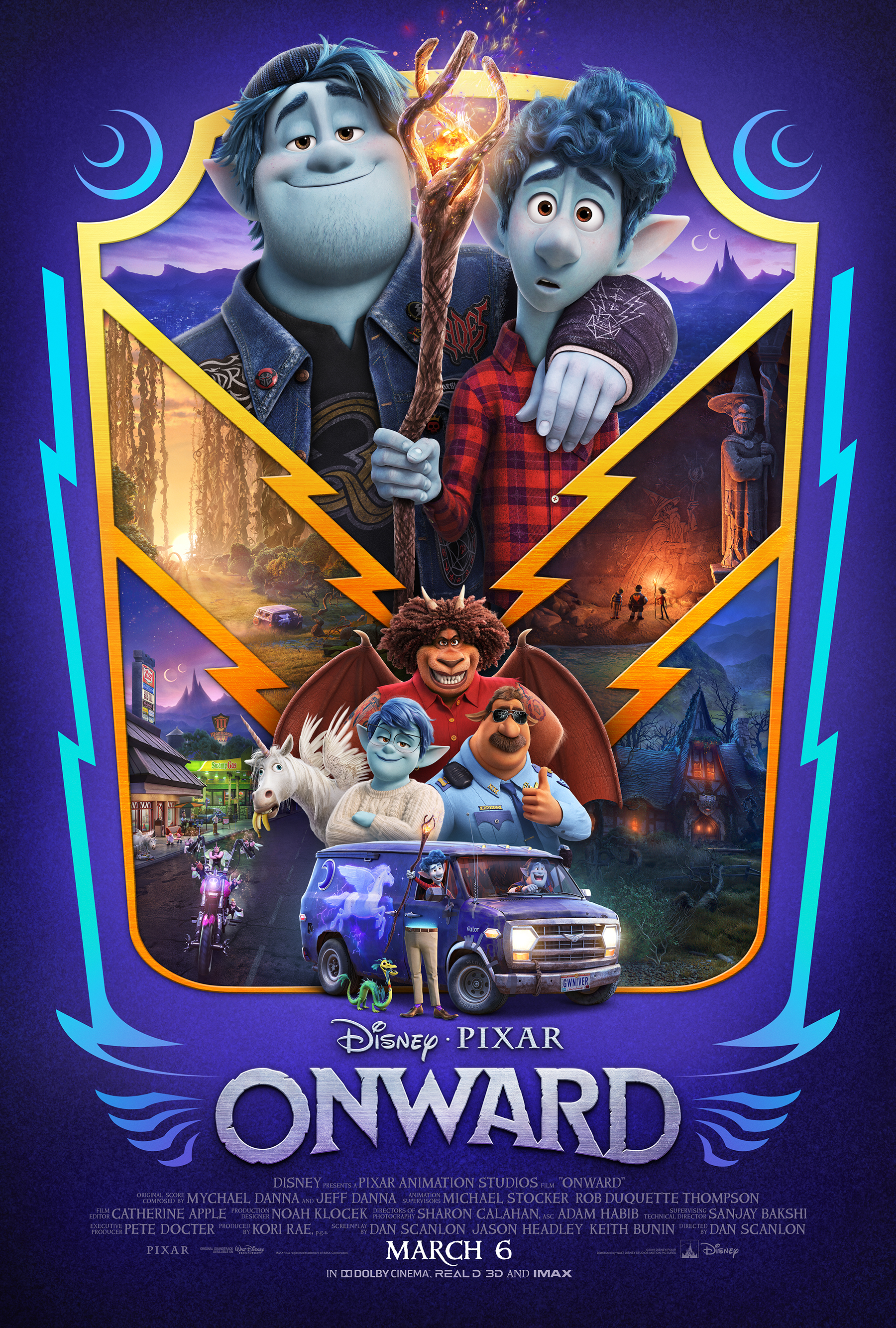
Onward is an incredibly charming film – that’s almost an undeniable fact when it comes to Pixar’s output, especially when they aren’t trying to capitalize on their existing properties with lacklustre sequels, and actually taking something of a risk in making an entirely unique film. They tend to do the best when they’re working from something original, and this film exemplifies that one of the studio’s biggest strengths comes when they’re experimenting with something new. There’s an expected amount of warmhearted humour that persists throughout the film, enough to qualify this as a truly terrific animated adventure. Set in an alternative reality where various magical beings reside and live ordinary lives, the story follows two brothers, Ian (Tom Holland) and Barley (Chris Pratt), a pair of young elves who lost their father years before, and are on a quest to reunite with him after they’re bestowed with a gift that will bring him back for a single day. The two protagonists realize that this is much harder than it would appear (if it had been simple, the film would’ve been over within the first fifteen minutes), and so the only solution is to abandon their modern lives and venture into the unknown, undergoing a quest that was previously restricted to the realm of the games that Barley dedicated his life to. Along the way, as per usual, these good-hearted, but naive, young heroes learn many lessons and come to discover facts about each other and themselves that they had been previously unaware of, and sometimes it takes a life-threatening quest with mythical beasts, perilous obstacles and otherworldly guidance to make us value what is right in front of us.
The problem with Onward is that, despite being an original story, it’s not a film that seems to be all that interested in taking any risks. When it comes to their initial ideas, Pixar often tends to make films that push boundaries – who would’ve thought a film about toys coming to life could become a generation-defining masterpiece? Over the quarter-century that they’ve been playing a part in building childhoods and reminding adults of the joys of youth, the studio has rarely ever done something that could be considered anything close to boring. I’m hesitant to say this, but this seems to change with Onward, a film that has its heart in the right place, but its mind in countless others. Not necessarily the kind of story we’d associate with Pixar, who normally tend to be a bit bolder with their choices of film, the film has the dazzling beauty and emotional resonance of their previous work, but the plot of something that feels almost too simple for them – and as soon as one asserts a conventional story onto the familiar that all these films tend to have, regardless of the central plot, you get something entertaining, but thoroughly unexciting. This doesn’t negate the countless charms of this film, or the fact that it is beautifully made (while their stories may be growing increasingly less-inspired, Pixar continues to push the boundaries of digital animation), but does prove to be something of a disappointment, especially considering that this is a film that could’ve benefitted from a fresher approach to what was certainly a fascinating core idea. The decision to do very little in regards to actually exploring this world, and presenting us with something we haven’t seen before was one of the more disconcerting flaws of this film, with the idea of mythical creatures living together in some warped version of our world being something we’ve seen so many times, there was no way Onward was going to be able to give us new insights into this idea without putting in the necessary work alongside it.
Onward does make up for some of its unoriginal plot by casting a relatively solid group of actors to voice the characters. Like many of their earlier films, this one doesn’t rely on an enormous ensemble of characters, with the film mainly consisting of less than half a dozen principal roles, which allows the film to actually develop them, something that recent films neglect to do. Tom Holland and Chris Pratt momentarily step aside from their superhero commitments and cross the hallway to lend their voices to the two main characters, and both are quite good, especially considering they’re playing derivatives of the roles that made them household names in the first place. The most compelling parts of the cast are the newcomers, namely Julia Louis-Dreyfus, who returns to Pixar for the first time since A Bug’s Life over two decades ago, and Octavia Spencer, who continues to be a welcome presence, regardless of the role she’s playing. As the over-protective mother, Louis-Dreyfus exceeds the confines of the traditional maternal role, and actually ends up being the heart of the film, even when it starts to pull attention away from her. Spencer is a lot of fun, bringing the genial warmth and offbeat humour to a role that could’ve so easily been a one-note character, but ends up being a real scene-stealer, especially in how the film actually realizes that Spencer is capable of a lot of depth, even when its in a voice performance. The character development in Onward is the most notable merit and the aspect in which it most frequently succeeds, mainly because the effort that normally would go into a bold, audacious story was instead spent on creating memorable protagonists that have some depth, rather than just being a bundle of archetypal tics, used for the sole purpose of propelling the story forward.
We shouldn’t dismiss Onward too quickly, because what it lacks in originality, it makes up for in emotional resonance – Pixar has somehow managed to find the key to tugging on our heartstrings, as they frequently manage to move audiences with their tender approach to themes that tend to be relatable to many of us, even if the general story is set in an entirely different world, or focusing on entirely different species (or even brands) of characters. This film always shows itself as being intent on caring about the audience, giving us a compelling story that thrills us beyond the beautiful animation, and actually rouses us to feel the excitement the film is intent on exploring in detail. Like they’ve done before, themes of friendship and family are prominent in this film, with the film conveying the common (but no less important) message about overcoming all obstacles and working through loss in a way that feels extremely positive and actually incites a great deal of passion into the viewer, who can look beyond the predictable story and actually feel inspired by this film’s various thematic messages. Onward doesn’t always work in the way it clearly intends to, and it doesn’t come close to reaching the heights of Pixar’s masterpieces. However, its nonetheless a solid, endearing adventure with moments of comedic brilliance, a beautiful style that sees the studio once again positioning themselves at the forefront of the animation industry, and most importantly, an enormous amount of heart, which goes into the making of a soulful tale of the value of family and the importance of realizing your own worth, especially in times of great adversity. If a film is going to be derivative, it’s preferable that its actually compelling and meaningful, which is definitely one of the best ways to describe the entertaining and heartfelt intricacies of the wonderfully charming Onward.
 The Postmodern Pelican