
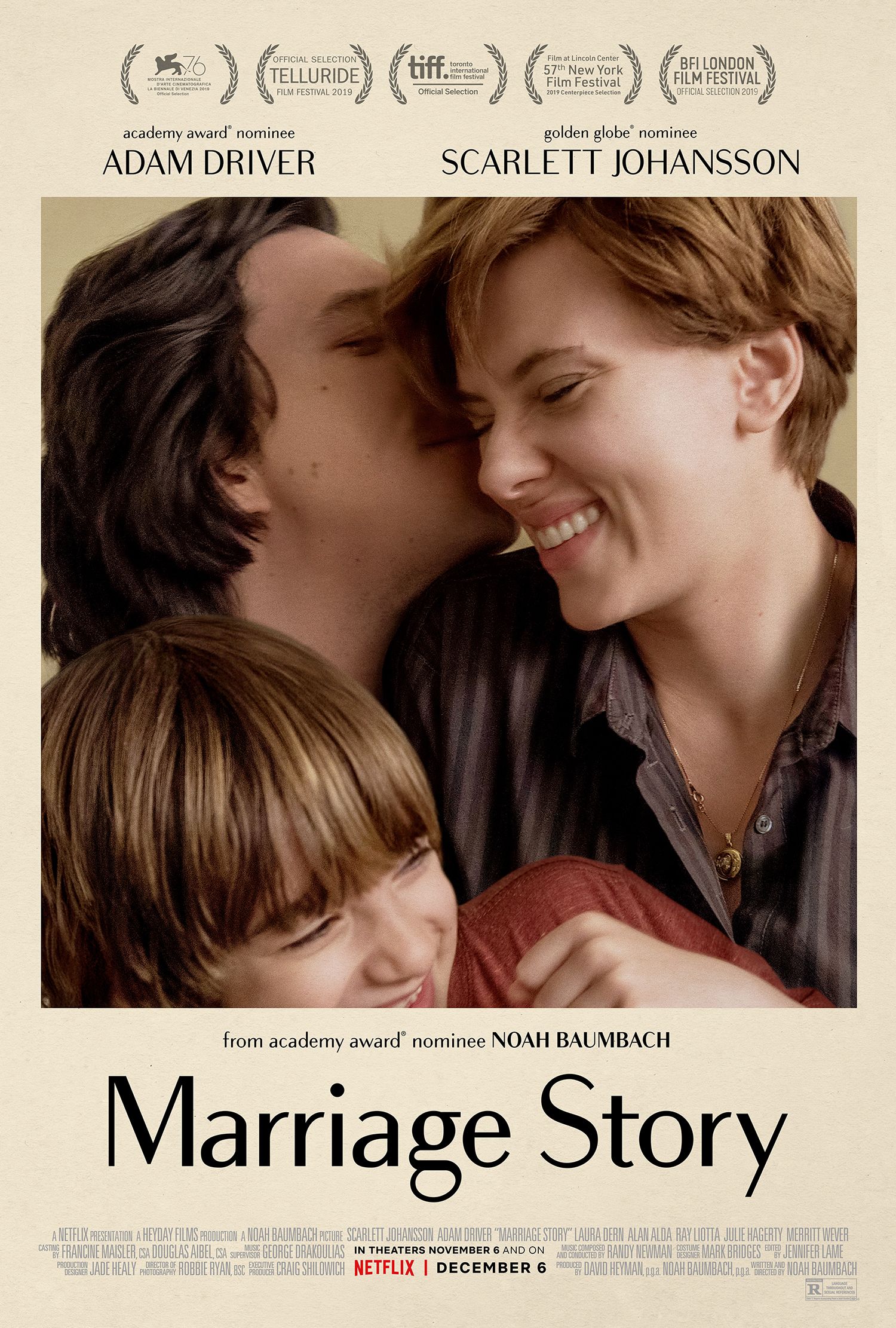
Nicole (Scarlett Johansson) and Charlie (Adam Driver) have been married for quite a while, being initially brought together by their shared interest in the arts. He’s a theatre director right on the precipice of his breakthrough, already being well-regarded in the avant-garde circles he is a part of, and being set for the Broadway stage. She’s an actress, and the person who has consistently helped him bring his vision to the stage, being his muse, the impetus behind some of his greatest work, and his most important artistic and emotional collaborator. However, their marriage is far from perfect, and soon after being introduced to them, we discover that they’re in the process of ending their marriage due to irreconcilable differences that have caused them to grow apart. The reasons for it are far more complex than we initially realize – he wants to remain in New York, where he’s comfortable and has connections. She wants to venture to Los Angeles, her hometown and the place where she feels her career should flourish, but there’s an underlying tension that proves them to no longer be all that compatible, with their marriage limiting them, rather than allowing them to focus on their own individual ambitions. Caught between them is their son, Henry (Azhy Robertson), a precocious eight-year-old who finds himself the unintentional subject of most of the conflict, with both parents trying to earn custody over a child who doesn’t quite understand the circumstances surrounding the divorce, but knows that something is different, and passively watches as his parents challenge each other for dominance. Over the course of about a year, the family undergoes considerable change – Charlie and Nicole learn more about themselves (and about each other) in the process of venturing out of the marriage than they had during it, and while the lawyers might see this situation as nothing more than a transaction, there’s obviously something far deeper, a kind of embedded adoration they feel that may not be as strong as their initial love, but prevents them from ever truly falling apart from each other. As far as anyone else is concerned, Charlie and Nicole are essential components of each other, and not even their divorce, which brings an end to the traditional conception of love, can change the fact that they are indelible parts of each other, and their shared past is inescapable.
Noah Baumbach is not a newcomer to filmmaking, despite the newly-minted adoration from general audiences he’s received this year as a result of Marriage Story, a film that goes beneath the veneer of cinema and sees the director crafting arguably his most personal work to date. A mainstay of the independent film industry, he’s been around for long enough to have established himself as a tremendously talented director, and someone who has built a career that demonstrates a clear understanding of very human issues. Baumbach has done more than enough to earn our confidence in delivering a sensitive story like he does here (not to mention he trod very familiar ground over a decade ago with the astounding The Squid and the Whale, one of the first truly great independent films to show that humour can be found in even the direst situations, a trend that has tended to persist), and while this may be a step forward in terms of his style and the specific approach that he takes to the story, this is a film that is distinctly the work of Baumbach, who never sacrifices the qualities that made him such an enduring figure throughout his career. This is his most noteworthy film to date, being embraced by a much wider audience, and as is the case with auteurs that have gone ignored for far too long, Baumbach’s breakthrough into the mainstream is amongst his best work yet – suddenly, he’s no longer the hardworking indie director who makes small but memorable films that are less widely-seen, but adored by the small group that see it, but rather a dedicated filmmaker who is suddenly proposed as one of the most distinctive artists of his generation, someone who has spent his decade crafting brilliant works without receiving the adulation he deserves, which changes with his work here. Marriage Story sees the director making a statement – perhaps not one that is very different from the kind he normally makes, but rather one that feels a lot more emotionally-charged. This is exceptionally strong work from a director who has finally struck the right tone to take his work to a wider audience, Marriage Story represents a considerable improvement for Baumbach in terms of recognition, which makes his success with this film, and the fact that he doesn’t disregard his distinctive style for the sake of seeking out a wider audience, all that more poignant, because very few deserve it more than he does, and this is the perfect film to introduce him to those who haven’t yet experienced his brilliant work for themselves.
Marriage Story, as the simple but evocative title suggests, is a film that looks at one marriage – the allusions to Ingmar Bergman’s Scenes from a Marriage don’t end here, as this very takes on a very similar tone, demonstrating the slow, gradual disintegration of a marriage, with Baumbach deconstructing each element of the relationship and showing it from both perspectives, intricately weaving between the various trials and tribulations of a couple in the process of going their separate ways. Films about divorce are challenging enough already – they’re very difficult to get right in terms of tone, with many tending towards either being needlessly callous or hopelessly melodramatic. Baumbach swiftly avoids both, presenting us with a stark and honest portrayal of two individuals going through the process of falling out of love, being confronted with various challenges along the way. The comparisons to something like Kramer vs Kramer is certainly also not unintentional (even if this film is far kinder to Johansson’s character than Benton’s was to Joanna, played by Meryl Streep), with Marriage Story being an equally unflinching look at the harrowing process of divorce from a profoundly human perspective, or rather a pair of them. The film is delivered in an almost episodic style, and over the course of a considerable period of about a year, done to show the growth of both the characters and how they flourish into new people as a result of having to redefine their lives, which is far less endearing than it may appear, chronicling many of their challenges along the way. Baumbach’s work is strikingly beautiful and often heartwarming, but not without also addressing the very serious message that this film is intent on showing. This is the rare kind of film that finds the sentimental humour in even the most devastating of situations, and while it may be initially quite uncomfortable for those who have experienced a divorce, whether directly or by association, there’s a melancholic sweetness pervading the film that makes it quite an endearing, and often strangely funny, piece about two people coming to terms with the inevitability of change, and the intimidating concept of starting all over again.
Like several works that address something like divorce, Marriage Story is focused on two different viewpoints, with Baumbach offering both characters the chance to have their story told, without favouring one over the other. It was pivotal that the right actors occupied these roles, and the director certainly chose the right people for the parts. Adam Driver plays Charlie, the role that is most aligned with Baumbach himself (insofar as this film was written with his own divorce in mind), a theatre director chasing acclaim without sacrificing his artistry. By now, Driver has been subjected to an immense amount of praise, and deservedly so – he’s one of the most gifted actors of his generation, and over the past decade has slowly begun to build himself up to being one of the most defining actors working today, with his talents unraveling to reveal remarkable capabilities to play any character with each new film he makes. Marriage Story gives him the kind of lead role that he’s slowly shown himself to be more than capable of playing, with the actor demonstrating all the qualities we have grown to respect and adore – a hearty sense of humour, a profound ability to play the most dramatic of moments without ever resorting to insincerity, and a certain charm that never feels misplaced, regardless of the situation it appears in. Yet, what makes Driver so compelling is that his performance as Charlie feels so lived-in and authentic – each moment appears to be rooted in something so close to reality, with the flair he uses to construct the character being remarkably honest. Driver is beyond impressive in Marriage Story – his unconventional charisma works well in defining Charlie as an inherently flawed, but still decent individual, and someone who is far more than just the pretentious artist the film sets him up to be at the outset. His performance is one of the year’s most fascinating – subtle, nuanced but not without its broader moments, he manages to convey a specific kind of emotional resonance that is hardly ever glimpsed in the archetype he’s playing – his restraint throughout the film makes his eventual breakdown towards the end of the film all that more heartwrenching, because we’ve seen him so often try and make it work, and his realization that perhaps giving up is easier is truly harrowing, and a poignant reminder that resilience doesn’t always come very easy, especially when we feel the very fabric of our existence is falling apart.
Marriage Story certainly isn’t myopic, and never neglects to look at Nicole’s side of the story as well. Some have argued that Baumbach treats Driver’s character with too much sympathy and tends to construct him as the victim, which couldn’t be further from the truth, especially when Scarlett Johansson is giving an equally powerful performance, just one that requires her to play a very different kind of character, someone who is in search of her own independence, but also struggling with her own insecurities and quandaries. Johansson has been acting longer than Driver, and thus has had the opportunity to prove herself more often – yet, it’s only in this film where she truly rises above expectations, delivering one of the most memorable performances of her career, playing a role that intends her to evoke a certain maturity and elegance that she has shown in the past, but rarely in this kind of role, where it defines the character rather than just being a peripheral quality. Nicole, much like Charlie, is a complex individual, and Johansson does exceptionally well in bringing her to life, not as someone who serves an antagonistic role due to her decision to go forward with the divorce, but as a woman trying to find herself in a marriage where she lost all sense of individuality. She gives such a natural performance, abandoning some of the tics that have plagued some of her previous performances, and playing a character so precise, yet also so delicate. However, this doesn’t mean she is weak, both in her performance and the role she plays. Nicole, like Charlie, is only trying to navigate through a world she’s struggling to understand. The difference is that while Charlie seems to be the one in danger of losing the most, Nicole is taking the bigger risk. The film never blames her, not does it revile her – it just presents her story in a different way. Johansson is incredible, handling the dialogue with sincerity and conviction, delivering one of her most memorable performances to date, and one that may not be unexpected (as she’s proven herself to be extraordinarily talented on many occasions), but still relatively new territory for an actress who feels like she’s on the verge of entering a new stage of her career, where these kinds of fascinating, character-driven roles are commonplace for her. Her work here is poised, deeply compelling and incredibly intense, which works alongside the actress’ unique charms to convey the other half of one of the year’s most unimpeachably brilliant cinematic duos.
Much like the director’s other work, Marriage Story also has an extensive supporting cast, and while none of them quite rise to the challenge in the same way the two leads did, there are some memorable performances scattered throughout the film that bolster it and lend it a lot of charm. Laura Dern deserves a lot of praise for her role as the cutthroat lawyer who represents Nicole, with the normally genial actress demonstrating vitriol rarely ever conveyed in her more likeable performances. Dern is such a capable actress, and she clearly has fun playing a vicious character who feels no remorse, a sinister streak underpinning her otherwise lovely demeanour. Alan Alda, in many ways, plays the complete opposite of Dern – he is as warm and funny as he always is (not many people can attest to defining the idea of a national treasure, but Alda is certainly one of the few), and plays an extremely likeable character, to the point where he is almost frustratingly lovely – the film challenges many expectations by managing to take expectations and completely subvert them, when even someone as endearing as the gentle and amicable Alda can be used as a way of showing the despair that comes with divorce. Ray Liotta shows up, and seems to be at his most angry, playing the live-wire Jay Marotta, another lawyer who represents Charlie, who is just as vicious as Dern’s Nora, as well as being equally as greedy. Smaller roles by Julie Hagerty, Merritt Wever and Wallace Shawn complete the film and give it the comic relief that is so often needed to break the intensity of some of the more dramatic scenes. The supporting cast may not give the exceptional performances that the leads do, but they certainly do add a lot to the film, and give it a great deal of nuance along the way, with their funny, delicate and authentic performances just being another in the many different layers that makes Marriage Story such a resounding success.
Despite the nature of the plot, Marriage Story is about love, and it’s innumerable forms. The film never feels like a vengeful manifesto that goes against the institution of marriage and the eventual demise of what appeared to be a relatively loving one, with Baumbach’s script lacking the bitterness or vitriol that many artists, when being inspired by their own personal challenges and shortcomings, would tend to include. The film looks at love in very different forms, with the director taking a relatively daring approach to showing that beneath the dissipation of their marriage, there are still some feelings between the two main characters – perhaps not enough to bring them back together again (and had the film resorted to ending it in this way, all the goodwill that came with Baumbach’s mature and intricate portrayal of the process and aftermath of a divorce would’ve been far less effective and much more jarring), but sufficient enough to show that the end of a marriage doesn’t equate to the erasure of the memories that were made during it. Too many films on this subject neglect this aspect of divorce, normally showing the characters as being immediately belligerent and hateful, without exploring the roots of what made them fall in love in the first place. Bergman’s film is a great forerunner to this kind of representation of marriage – the film may be entirely occupied with the divorce, but the actual fallout and legal proceedings, with pivotal, are otherwise inconsequential when we consider the rest of the film, which is far more meaningful. Baumbach keeps everything at the most human level, never venturing away from his intention to show the experience as something filled with many challenges, and despite how simple one intends to make it, there’s not only a legal burden, but an emotional one as well – the formalities may eventually subside after settlement and judicial rulings, but the psychological toll it takes on an individual is far more difficult to endure, which is where one’s mettle is really tested. Marriage Story is most certainly Baumbach’s most emotional film, where he approaches the underlying story with more delicacy, trading wit for melancholia, and showing a more complex side of life that appears bleak, but not without some form of hope. If anyone was going to make a film that boldly presents divorce to us without resorting to overly saccharine storytelling, it was most certainly going to be Baumbach, whose grip on the human condition has never been more evident than it is here.
Marriage Story isn’t strictly about divorce – it’s an earnest, daringly intimate odyssey into the life of a couple forced to confront the challenges when they decide to take the terrifying step towards diverging and becoming independent individuals. The idea of a “new start” is one art loves, but it rarely shows that despite the healing nature of starting over, there’s a process of despair that comes along with it. This is precisely why Marriage Story works so well – it’s a profoundly human story, with Baumbach presenting us with a raw, gritty film that’s executed with the sincerity of a quiet realist drama rather than a broad melodrama or quirky comedy, both of which are flirted with here, but intentionally so, as a way of showing the layered nature of existence, where joys and tragedies are persistent in life, and we often just need to take these situations in our stride. Charlie and Nicole are faced with the daunting realization that they’re entering a new stage of their lives, where there’s no longer any space to depend on each other – they’re afforded the opportunity to pursue their own ambitions, liberated from the burden of a nuclear family – the question is whether or not they see it this way. For them, not only are they pivotal in the life of the other, their memories as a family are far more powerful than the idea of starting over, and they struggle with the notion that no matter how much they embrace their new freedom, there will always be a part of them that belongs to the other – whether a memory or a lingering emotion, they’re indelible to each other. However, while the story is unquestionably heavy at times, the film never disregards the humour in its pursuit of this deeply resonant message, with the trials and tribulations of these individuals being an equal blend of joy and despair, just like how life truly is. The film would just not have worked if the director didn’t find the balance, and considering Baumbach has often engaged with more difficult subjects, he was well-suited to be the person to deliver the year’s most poignant love stories, where not only does he look at the love between a married couple, but that between parents and children and collaborators, all of which form the beautifully complex tapestry of characters and situations that Marriage Story portrays.
One of the most gorgeous moments in the film – and the one that finally allows all the underlying themes to converge – comes when Charlie sings a rendition of “Being Alive” from Company, the lyrics for which speak directly to the themes of this film, particularly the idea of being alone. Marriage Story is not simply a film about a couple getting divorced – it’s a complex exploration of two individuals coming to terms with the volatility of life, and embracing the idea that their most trusted, supportive confidante will no longer be by their side. It’s easy to just look at this as a semi-autobiographical tale of divorce, but as we’ve said before, Baumbach is in search of something much deeper here. This is a neo-realist tale of life and its many challenges – the director just uses a familiar concept of a disintegrating marriage to present us with differing viewpoints, as the protagonists go from a single entity sharing a life, and becoming two individuals, given the chance, regardless of by choice, to start life over again, even if this is an absurd notion, mainly because life is not defined by the future, but also forged by individual memories. This is where the film is the most touching, in how it shows that despite growing apart and ending their marriage, the protagonists still value each other and have a deep love that transcends the confines of marriage – it’s a different kind of love, something that is just as heartbreaking as it is uplifting, but also ineradicable, because being alive is more than just looking forwards, especially when the past is normally what defines us as individuals. Baumbach has made one of the year’s most extraordinary films, exploring the depths of the human condition with humour and pathos, telling an earnest story about people dealing with change, and all the challenges that life tends to throw at us, sometimes unexpectedly. The performances are astounding, the filmmaking ravishing (the cinematography by Robbie Ryan evokes the spirit of the simple but effective family dramas of the 1970s, and the score by Randy Newman is destined to become one of the finest of the decade) and the story poignant, powerful and utterly unforgettable. Marriage Story is a film that tends to linger, and stands as one of the most heartfelt dramas of the year, and a poignant reminder of the value of simply just existing, in spite of the and in celebration of the good. Like Bobby says at the end of Company:
“Make me alive, make me confused
Mock me with praise, let me be used
Vary my days, but alone is alone, not alive!”

 The Postmodern Pelican
I think the title of Marriage Story is ironic. The marriage is already over when the film begins. The story is two parallel tales of a wife rediscovering herself while a husband gains awareness that marriage means a mutual commitment, not the self-absorbed vision that this marriage has been for him.
Participants in long term marriages get it. We sacrifice for one another. We support each other’s dreams. When financial need and children muddy the waters, priorities shift. One’s sense of self, often the woman’s, can get lost.
As the breathtaking end of Marriage Story, Charlie sings Being Alive the closing number from Stephen Sondheim’s musical Company. The song is Bobby’s growing awareness that the sacrifice required for love has value. This film has been Charlie’s wake up call that he failed to sacrifice. He greedily allowed Nicole to subjugate herself to Charlie in an effort have peace in their marriage. The performance of the song at a bar before a small audience of his peers is a public admission of Charlie’s growth as a man and his willingness to be better in next relationship.
Honestly, married men all too often are guilty of letting their career take precedence and permitting their wife’s career to flounder as she raises their children. Nicole is angrily and determinedly seeking to regain her sense of self. And she does.
I think Noah Baumbach creates a brilliant, telling moment at the end of the film. Charlie is holding their son in his arms. Nicole stoops, ties Charlie’s untied shoelace, and pats his calf when she is done. The gesture demonstrates that love continues. Love exists in acts of kindness. Love is natural when a person feels whole.
Boy, does this movie lose its luster on a second viewing! it’s not bad. It’s still a solid melodrama.
The film’s main thesis that women sacrifice too much in marriage and men accept that sacrifice as something to which they feel entitled to receive is still evident on a second screening. It just doesn’t equate to a landmark revelation. The film echoes the 1979 Best Picture winner Kramer vs Kramer.
Both kitchen sink melodramas depict the pain of divorce. Kramer vs. Kramer had surprising social relevance 40 years ago. The idea that a woman could lose herself in a marriage and need to leave her children for a time to heal that rupture of her identity touched a nerve. The film was widely debated and became the fodder of talk radio and daytime talk shoes.
The film was conceived as a reversal of the 1940s women’s picture with a gender reversal. However, the twist resonated strongly with audiences. Much of that power came from the work of Meryl Streep. As Joanna Kramer, Streep took what was essentially written as a villain and, even writing that powerful speech in the courtroom confrontation, made Joanna Kramer a lost soul that generated compassion despite the fact she abandoned her child. Streep and, to a lesser degree, Dustin Hoffman redefined what a generation perceived as parental obligations.
Upon a second viewing, Marriage Story fades in comparison to Robert Benton’s tale of domestic crisis. That doesn’t make Marriage Story a bad movie, simply a lesser one. The script is overly written. Every line is beautifully articulated with import and subtext, but even artists don;t speak so eloquently in the height of emotion.
The acting is solid in Marriage Story yet, Adam Driver and Scarlett Johannson cannot register the same visceral impact as Hoffman and Streep. Rewatching these two solid performances from contemporary action movie heroes stretching their acting muscles, I couldn’t help but wonder what two more talented actors could do with the roles. I imagined Sterling K. Brown and Lupita Nyong’o as Charlie and Nicole. God, now that’s a movie I would like to see!
Marriage Story is good flick. It most certainly is not a notable artistic achievement.