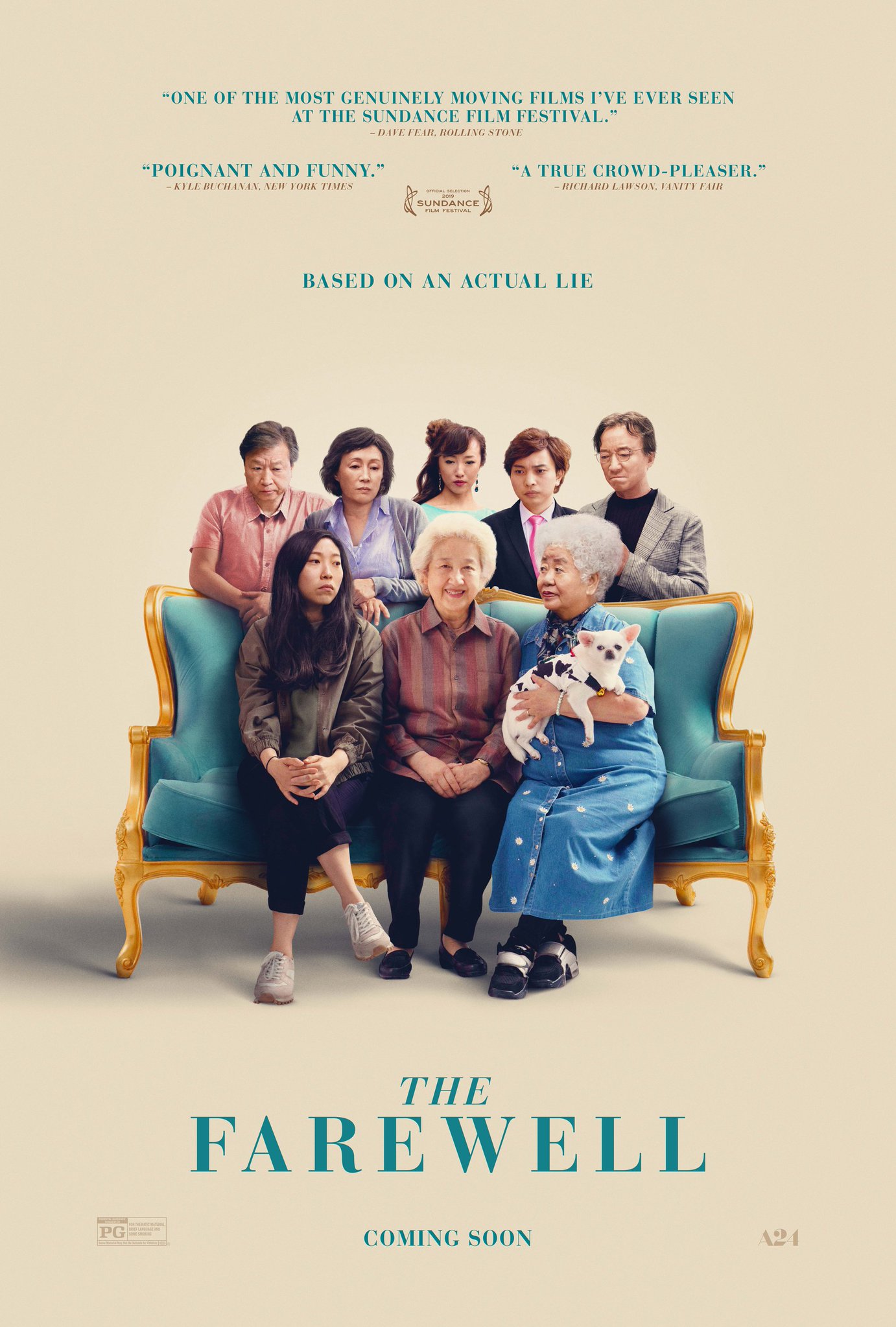
 Saying goodbye is never easy. This is something I think all of us know a bit too well – whether it’s temporary or long-term, a farewell is an experience that often tests our resilience and proves that sometimes the most difficult moments are the most necessary. This seems to be the theme underlying Lulu Wang’s astonishing film, The Farewell, a piece of contemporary cinema that stands as one of the most fascinating films of the year, and story most certainly worth telling. As the opening words of the film proclaim, it is based “on an actual lie”, which is not only a great subversion of the “based on a true story” trope, but also a gateway into Wang’s beautifully meditative odyssey into the human condition, her heartwarming drama peppered with moments of wonderful humour and sobering tragedy. When we talk about cinematic achievements and the boldness of certain filmmakers, spectacle and grandeur aren’t always the way to impressive results. Rather, it occasionally takes something small and intimate, but no less intrepid, to prove that sometimes, the greatest stories are those that come directly from the heart, and are meant to reside in the soul of every viewer who engages with the raw honesty the artist is conveying. The Farewell is one such film.
The Farewell has numerous different concepts simmering below the surface, which seems counteractive to the rather simple execution of the film as a whole. However, considering this is a piece borne directly from the experiences of the young filmmaker behind the camera, it only makes sense that there would be a great deal of story packaged into this relatively straightforward plot, which seems to follow one simple idea, but rather flourishes into one of the most extraordinary pieces of filmmaking of the year. You can derive so many different themes from the film – mortality, cross-generation differences, cultural change and most importantly, family. What makes The Farewell so brilliant is that it never intends to lead us down any of these different narrative avenues, rather allowing us to find our own way through the labyrinthine intentions that linger over the film. Each individual will find a different meaning in this film, latching onto one idea over the other, finding something of merit in Wang’s beautifully simple expression of humanity in its many different forms. Regardless of the story being told – whereby a matriarch of a Chinese family is not told by her relatives that she’s dying – the film ventures off in many different directions, where the plot becomes almost inconsequential, and rather just a way of harbouring some of the many resonant ideas the film expresses. Is there anything more empathetic and admirable than an artist using her own personal story, not as a way of looking for sympathy, but in uniting everyone in our shared but unique humanity?
Wang presents us with so many different ideas, but the one that really stands out amongst the others is that of family. The Farewell has often been called “the film that will make you call your grandmother” – and that certainly isn’t just a marketing ploy, but rather an indication of the fact that below this often very funny film is a certain resonance, one that everyone who has ever felt a deep connection with a family member, whether biological or chosen, will recognize. Wang isn’t too concerned with the idea of death, and despite being an omnipotent presence throughout the film, it proves to be relatively benign, existing as nothing other than a way of progressing the plot and allowing the more complex themes of the film to manifest. The director is clearly against making a film that laments about the difficulty of losing a loved one – the number of films that take on this subject is far too many to count, and it’s something that hasn’t only already been done on numerous occasions, it’s also one that is rarely possible to approach in any original way. We all lose people we care about – but how many of us have the opportunity to say goodbye to them in a way that actually means something, not only to them but to us as well? The central idea that The Farewell explores is not only the strength of family in difficult times but the role of the individual in a family that is in crisis. It’s a remarkably restrained portrayal of a family so close to falling apart, but standing united, no matter the circumstances. The tenderness in which Wang tells this story shows a director who isn’t only willing to show us the most vulnerable sides of her own personal history, but to do it in a way that isn’t mocking or done for the purpose of comedy, but rather to be an honest portrayal of a modern family, from her own perspective.
The intersections between cultures also play an intrinsic part in the development of The Farewell and is the major reason why the story is able to flourish even beyond the confines of its oddly-specific true-life inspirations. The film is an American production done almost entirely in Chinese, which is already something that shouldn’t only signal a considerable step forward in representation, but also a pertinent demonstration of the brilliance that can come with giving diversity the space it deserves to flourish. The film reminded me of Ang Lee’s Eat Drink Man Woman, another story that made use of its platform to dispell common tropes and show that Eastern culture was far more than just a set of archetypes, but rather also capable of complexity and nuance. This is certainly evident in works that are produced from within these cultures, but to outsiders, The Farewell is almost a breath of fresh air, mainly because the culture shift that takes place with the very literal jump from the United States to China, as seen through the eyes of the protagonist Billi, is done with such elegance and tact, it never has to resort to cheap “culture shock” tropes, while still keeping with the root of what makes those kinds of stories so effective – the alienation, the unfamiliarity and the sensation of feeling lost in a world that we just can’t recognize. The difference is that Billi’s journey, both physical and metaphysical, represents a return, rather than an introduction. She’s coming home to China, a country she left with fond memories, returning to doubtlessly make new ones that will most certainly not be so warmly embraced in the future. The Farewell isn’t only a film about embracing family, but also of homecoming. There’s a melancholy that lingers over the film, one that extends further than the idea of death – we’ve already mentioned how, despite the plot, death really doesn’t play a pivotal part of the film – and into the space of exploring exactly what it is that composes us as individuals: is it a sense of unity with a particular group we’re branded to, a familiarity with a specific place, or perhaps something more complex?
Wang, in adapting a chapter of her own life to the screen, takes one of the fundamental risks any artist in her position does: she constructs her version of a story, and puts it into the hands of a group of collaborators that forge their own interpretation of it, alongside Wang’s guidance, in bringing the story to life. Two individuals in particular need to be singled out for their astonishing work. First of them is Awkwafina – with the exception of only a few people, it’s unlikely that had anyone been asked, that we’d be able to even recognize the alternative rapper and comedian who has undergone one of the most astounding career ascents I’ve seen in my lifetime – from bit-part player in a few small projects to someone who is most certainly one of the most exciting voices in modern culture, Awkwafina has truly become a star. However, while she may have earned legions of fans for her scene-stealing supporting work, it’s The Farewell that finally showed that beneath the exuberant personality, there is a deeply talented actress who can shed the comedic persona without a moment’s notice, taking on the role of a woman in the middle of numerous crises. She demonstrates a restraint that is rarely facilitated on screen – her vulnerability in taking on the role of the artist’s surrogate, understanding every emotional intonation of the story and how the role is far more than just an expression of Wang’s inner turmoil, but a complex portrait of her own personal quandaries. Awkwafina’s performance is beautifully complemented by the rest of the cast but in particular Zhao Shuzhen, whose performance as Nai Nai, the matriarch who doesn’t know she is dying, grounds the film, and lends it the gravitas it needs to be effective.
Shuzhen’s performance is truly revelatory, not only because the actress herself is utterly incredible, but because it speaks to a deeper theme that the film explores, albeit not with the same urgency as the rest of the themes, mainly because it isn’t something that can be overtly described, but rather expressed through imagery, tone and intention. Despite being a film centred on death, or rather on the precipice of it, The Farewell celebrates life more than anything else, and like most works that take a very honest approach to this kind of story, it does so with a blend of pathos and humour. Somehow, Wang manages to not only tell her beautiful and unique story but also to infuse it with a certain fragility that makes it truly mesmerizing. The film is both grim and buoyant – there are moments of heartbreaking despair, matched only by sweetly sentimental moments of heartfelt humour. The Farewell doesn’t fit into the confines of comedy or drama – it is both, and neither. I’d argue this is one of the few films that manages to capture the zeitgeist of existence as it is, without any categorization or need to classify it as one thing over the other. It all converges back into the character of Nai Nai, whose impending demise may be the driving force, but whose joy for life makes the film work. Even at its saddest, The Farewell is bolstered by how it portrays the character not as the dying matriarch, but as the embodiment of living every moment, taking advantage of each day. The film is littered with many lessons taken from Chinese culture, parables and pieces of wisdom that inform us: yet, none of them strikes quite as hard as the image of Nai Nai teaching Billi the catharsis of raw emotional expression, and having the final frame of the film, where everything else seems without hope, reflect this very simple idea. It’s chilling and utterly beautiful, and the perfect encapsulation of everything that The Farewell does so brilliantly.
Ultimately, what makes The Farewell so effective is how effortlessly simple it is in scope, but still exhibits extraordinary depth in how it takes hold of the human condition, with Wang taking exploring many facets of existence in a way that feels so natural, but also so deeply moving at the same time. The audience is taken on an elegant but heartfelt journey into a time in her life, and a moment in her family’s history, that is heart-wrenchingly sad, but also not without hope. There’s an undeniable sense of optimism that pervades the film, flowing through it steadily and without any hesitation, demonstrating the beautiful intricacies of life that Wang clearly understands in a way only the most empathetic and honest of artists are able to. It’s a wonderful piece of filmmaking, a piece that occurs at the intersections between reality and fiction, presenting us with a very different perspective on something as intimidating as life and all the wonderful eccentricities that keep it so interesting. The Farewell is the kind of film that means a lot more in retrospect than it does immediately, and through Wang’s meticulous attention to detail, her willingness to go to very vulnerable places in her own story, and her steadfast conviction to tell a story that was most certainly worth telling, despite being radically against what we would normally expect, all go towards making this one of the year’s most extraordinary achievements, and a singularly unforgettable film in a multitude of ways.
 The Postmodern Pelican
I was interested to see how the audience pleasing summer hit The Farewell would be addressed in today’s Independent Spirit Award (ISA) nominations. The film is popular, over $17 million in box office receipts in the US.
ISA named the film one of the top five of the year but snubbed writer/director Lulu Wang for her efforts, though Wang is nominated for a Bonnie, an ISA cash prize of $50,000 for an outstanding woman filmmaker.
The screenplay snub is particularly painful. The Farewell is a tale that contrasts the older generation who remained in the homeland, the middle aged generation who immigrated to the US for a possibilities and the youngest generation who were raised with the native tongue of the parents as a second language and have embraced the cultural traits of another society.
I think the script is brilliant in the carefully nuanced way it allows these characters to speak with an acknowledgement of the unique experience and values in each generation. Such a thoughtful and authentic script deserves recognition.
The only other ISA nomination is for the break out star, 75 year old Zhao Shuzhen, who is masterful in her performance as Nai Nai, the family’s matriarch. The non-English speaking actress creates a complex portrait of an aging woman. The script mandates Nai Nai address conflicting emotions, some expressed and some unspoken. Shuzhen raises to the occasion with a face that demands our attention.
Though six women were nominated for Best Actress (meaning fifth place was a tie), lead actress Awkwafina, while highly touted for a nomination, was ignored. The breakout attention getter from Crazy Rich Asians, the woman is more a performer than actress. She is rather flat throughout the film. The script does most of the work of making her character Billi memorable and plausibly true.
I think prognosticators are more excited by the prospect of an Asian being nominated for Best Actress for the first time since 1935 when Merle Oberon (part Indian and part Maori descent) was recognized for The Dark Angel. Of course, some white women have been nominated for Best Actress for pretending to be Asian such as Luise Rainer in The Good Earth and Jennifer Jones in Love is a Many Splendored Thing.