 It’s unfortunate that Born Yesterday doesn’t get enough of the love it deserves. It is decently acclaimed and has many ardent admirers, but it has often struggled to be seen as anything other than just an effective comedy hailing from the mind of George Cukor, who was never really able to reach the same heights as he did with The Philadelphia Story nearly a decade later. The legacy of Born Yesterday has unfortunately come to be as a piece of awards trivia, as it harbours the performance that bested the iconic work of Bette Davis and Gloria Swanson in roles that have been lovingly embraced, becoming indelible parts of film history. Unfortunately, while it is a notable surprise, it often trivializes the fact that Born Yesterday, while perhaps not as daring as the more memorable films from that year, is still a delightful comedy that is equal parts screwball comedy and meaningful social satire that takes aim at the cultural zeitgeist and political matters, stealthily being smarter than it would initially appear based on the premise. It is a hilariously outrageous but also suitably emotional blend of comedy and drama, with a smart script and exceptional execution that makes this nothing short of a comic masterpiece, and a film that is so much more than its legacy would lead you to believe.
George Cukor seemed to have a penchant for films about ordinary people being transformed into members of the high society through interacting with people who teach them proper behaviour. This kind of concept served as the basis for one of his other masterpieces, the astoundingly brilliant My Fair Lady, adapted from George Bernard Shaw’s wonderful Pygmalion. This play seems to also have been somewhat of an inspiration for this film, which was in turn based on the stage production of the same name, written by Garson Kanin (who, along with his wife Ruth Gordon, collaborated with Cukor the previous year on the exceptional Adam’s Rib, a career-high for everyone involved). The concept of transforming a simple woman from a vulgar but endearing ruffian into the epitome of elegance and grace has certainly been a subject of many works but has never been quite as masterful through the lens of Cukor’s camera. Less of a film about transformation, and rather a story of becoming enlightened and breaking out of your own individual constraints, Born Yesterday is a meaningful social drama expertly disguised as a quirky comedy, managing to get its message across through the perspective of outrageous comedy, without ever losing its gravitas. The film navigates the delicate boundary between genres, but Cukor proves himself to be a maestro when it comes to balancing different subjects, and it all results in one of the most pleasant films of the 1950s, one that has a lot of fun without ever losing sight of the bigger concepts it endeavours to represent.
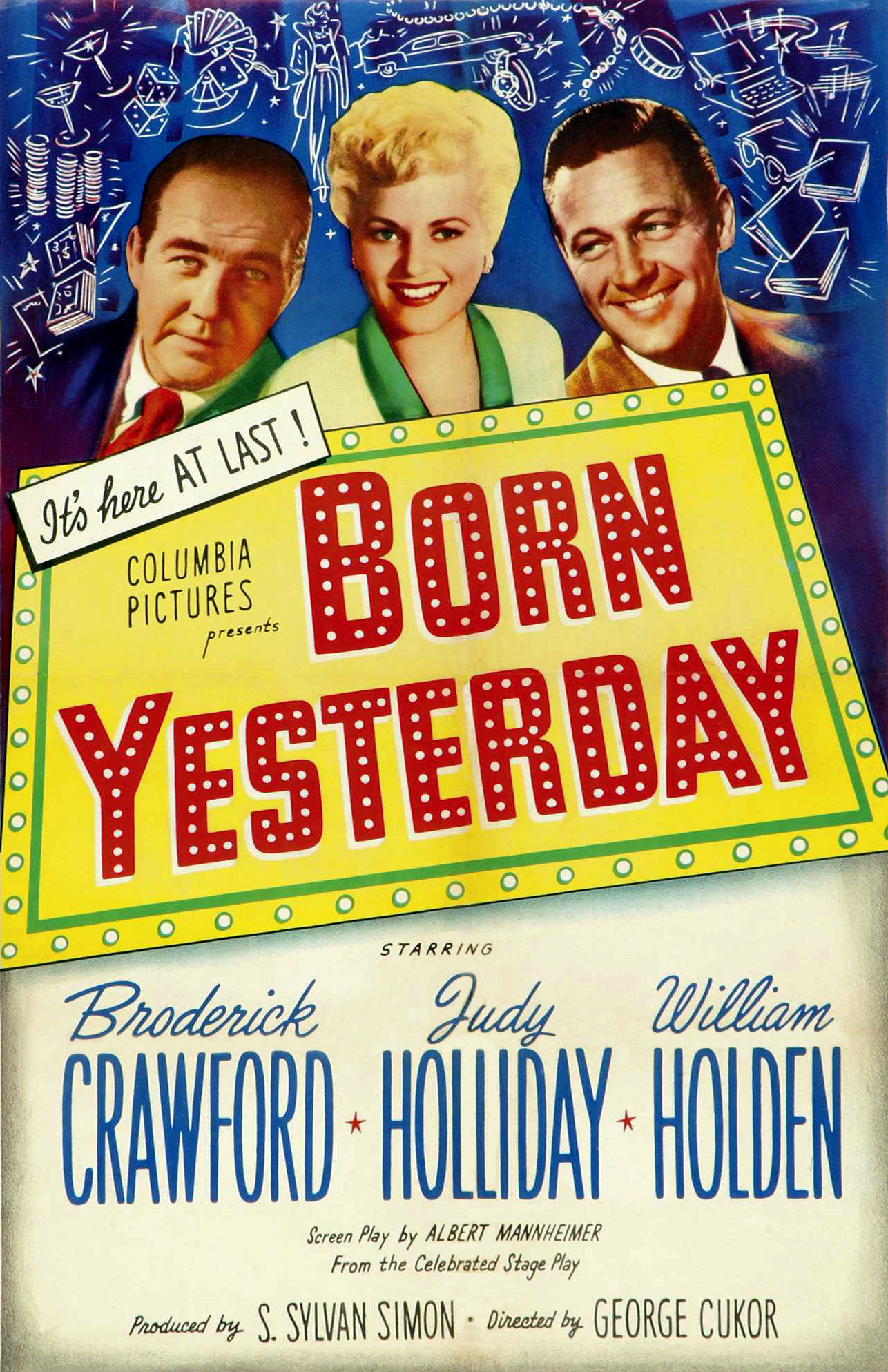
Billie Dawn (Holliday) is a young woman who is romantically involved with Harry Brock (Broderick Crawford), a business tycoon who has made his fortune through crooked dealings, often using his wife as a scapegoat. A woman that doesn’t pay much attention, Billie is often dismissed as the archetypal “dumb broad” that people like Harry so gleefully manipulate to get their way. It’s on a trip to Washington D.C. that Harry finally sees that he needs to “educate” his girlfriend, as her brassy attitude and constant social faux pas cause him great embarrassment, especially when he is there to convince various politicians to contribute to his highly secretive and incredibly illegal cause. Billie apparently needs manners, and Harry hires Paul (William Holden), a young journalist, to give her some culture and help her flourish into a more socially-acceptable version of what a businessman’s wife should appear to be. However, Billie is far smarter than anyone gives her credit for – she was just never given the opportunity to prove it, and it’s through her initially hostile relationship with Paul that she starts to see that she’s far more than just a trophy, but someone worth something, and that she deserves better. It starts to become quite contentious when, in her newly-enlightened state, Billie realizes that she also deserves better than Harry, whose abusive attitude and hostility towards any form of empathy for anyone other than himself eventually drive her away, albeit not without proving that she was far more than Harry ever thought she could be, and that she’s not leaving silently.
Born Yesterday was not only a reunion between the director and the writer of Adam’s Rib, but also for Cukor and Judy Holliday, who astounded audiences as Doris Attinger, the most unexpected of murderers, in the classic screwball comedy. Her performance managed to wonderfully complement, and sometimes even overshadow, the terrific work done by Katharine Hepburn and Spencer Tracy, which is not an easy feat when a film is designed as a vehicle for two majors stars. However, Holliday didn’t need to be concerned with such a scenario in Born Yesterday, which is entirely her film, from beginning to end. This performance has always been somewhat contentious – its certainly easy to just write it off as another ditzy role masquerading as comedy, especially because unlike other iterations of this kind of story, the character doesn’t undergo any revolutionary change, but rather learns to value herself based on her own charms. However, those who dismiss Holliday’s work here are ignoring the fact that what she’s doing here is quite astonishing – playing such a simple character is not easy, and Holliday (who was notoriously intelligent) not only has to take on an entirely new set of quirks, she had to master her comedic timing in a way that didn’t draw attention to the intricacies of the character from the outset. Far from the bundle of quirks often found in these kinds of characters, Holliday plays a woman whose head is in the clouds, but still anchoring her firmly down, never taking the tempting opportunity to cross the boundary into purely implausible, no matter how funny it would be. She’s helped tremendously by William Holden (at his most charming) and Broderick Crawford (whose brutish Harry Brock is one of the most intentionally-pathetic villains of all time), who give terrific performances on their own, but never distract from Holliday, who is so deeply compelling, it’s a shame this performance is viewed less on its own terms and more in contrast to other performances from the same time, because while it may seem to lack some depth, its gravitas and nuance are far-better concealed than one would realize.
What makes Born Yesterday so captivating is that it never feels as if it is trying too hard – it is undeniably a comedy, but never needs to work all that much to prove it, rather allowing the quaint charms of Kanin’s play, and some terrific directorial flourishes from Cukor, to do all the work when it comes to infusing this often very serious story with effective touches of lovable humour. The film relies on a combination of very subtle sight gags (a scene towards the end of the film, where Billie is confronting Harry, which would normally be an extremely serious moment, is given much-needed levity by the running gag of a maid entering and exiting the room while they’re having a very heated argument) and complex satirical humour – set entirely in Washington D.C., the film is very much focused on looking at political matters, considering them from the perspective of outsiders, who may not be aware of the nature of democracy in the same way that those who take advantage of it are. Not necessarily complex in how it approaches the subject, the film does feature some very smart humour in this regard, and manages to still be quite biting, far more than even the most acidic political satires made today. The only shortcoming of the film is that the constant use of political motifs seemed to be heading somewhere, which was not the case. It doesn’t converge into anything particularly meaningful, other than as a signal to show that Billie has somehow developed past simply being a materialistic young woman, and proof that she too has value, which is the primary message of the film as a whole.
Born Yesterday is a delight, and is a reminder than while cinema has progressed significantly over the years, sometimes there’s nothing quite as entertaining as an endearing little comedy like this. It isn’t particularly serious, and while it does look at some meaningful themes, its never too intense to detract from the fact that this is just an entertaining diversion, one that combines elements of screwball comedy, lovable romance and profound satire in how it represents society, which it does through only the most endearing of means. George Cukor was always a director who made his films with an assured vision, and thus didn’t ever need to go too far in how he portrayed whatever story he was looking at. Born Yesterday is one of his more effective films, because what it lacks in innovation it makes up for in scrappy audacity – whether in the remarkable leading performance from Judy Holliday, who was astonishing as a woman yearning for a better life, or in the witty dialogue delivered with the glorious rapidity only films of this period could feasibly convey, or just in its wonderful empathy for the story, which tries to provide some cohesion between ordinary folk and those making the biggest decisions, showing that they aren’t always all that different. Perhaps the most impactful and indelible message of Born Yesterday is that sometimes we can feel overwhelmed and lost in a world that we don’t quite understand, especially when it comes to the biggest decisions that influence us, which is perfectly alright – in the end, who actually knows what they’re doing anyway?
 The Postmodern Pelican
I am not convinced that the win for Judy Holliday was a shocker at the time.
Studio head Harry Cohn wanted a name with box office clout to play Billie Dawn. George Cukor and Katharine Hepburn conspired to give Holliday recognition with movie audiences. Holliday was cast as a neglected wife who shoots her philandering husband in their comedy Adam’s Rib. In the key scene of the character’s testimony, Cukor shot the entire sequence focusing on Holliday. The camera was placed to showcase Holliday and Hepburn generously took a backseat to allow the film novice the opportunity to win acclaim. It worked, and Holliday landed the opportunity to play the role she first created on stage. This created a feeling during Oscar season for actors especially to support Holliday’s campaign and send a message the justification of actors being able to recreate their stage triumphs on film.
The Oscar race, in hindsight, had further specific points that indicated Holliday’s victory. At the Golden Globes, Holliday’s performance was so popular she was nominated for Best Actress in a Comedy as well as Best Actress in a Drama, both for Born Yesterday. She won the comedy prize.
In addition, Hollywood was starry eyed for the theater then. The Oscar ceremony was held simultaneously in Los Angeles and New York. From 1949 to 1956, every Best Actress winner but one was given to an actress starring in an adaptation of a Broadway play. The exception was Audrey Hepburn who won the Tony for Best Actress a few months shy of winning her Oscar.
Lastly. Holliday was brilliant, and her performance was enhanced by Cukor who timed audience laughter in previews and then edited the film to match the laughs so material would not be missed due to the measured response so easily achieved on live performances.