 Joker is the rare kind of film that wasn’t supposed to work. There were so many elements that went into the making of this film that would’ve suggested that it was heading for failure – in all honesty, who of us were expecting the director of The Hangover and its contemptable sequels to succeed in making a dark, meaningful character study of a beloved literary figure? How many were predicting that DC would get it right this time, after years of cinematic output that mostly tarnished the goodwill that it amassed over nearly a decade? Joker is not a film that seemed all that likely to succeed, and while it was going to certainly be something worth seeing, the reluctance towards any positive anticipation was certainly not unfounded. Surprisingly, despite enormous hesitations, and the intention to hope for the best, but prepare for the worst, were proven to be premature, because Joker is, for all intents and purposes, a terrific film. It takes hold of a familiar story, and while it may not depart from convention all that often (as well as relying a bit too much on the numerous other works that went into its composition), there is a sense that there is a really good film lurking within it. There is an inherent difficulty that goes into reviewing a film like Joker – not only does it have a lot simmering beneath it, it also inspired considerable discourse from audiences and critics, who are divided on the film and its messages. Both sides make fascinating points, and the discussions are relevant (even if it is too easy to get caught up in the discourse, which tends to cloud individual judgments on either side of the debate). The problem is that there’s nothing I can contribute, other than to speak directly from the heart and say in full earnest that I found this to a tremendously effective film, one that is striking and often quite successful in conveying its message, and achieves almost exactly what it sets out to do, even if it was somewhat problematic from time to time.
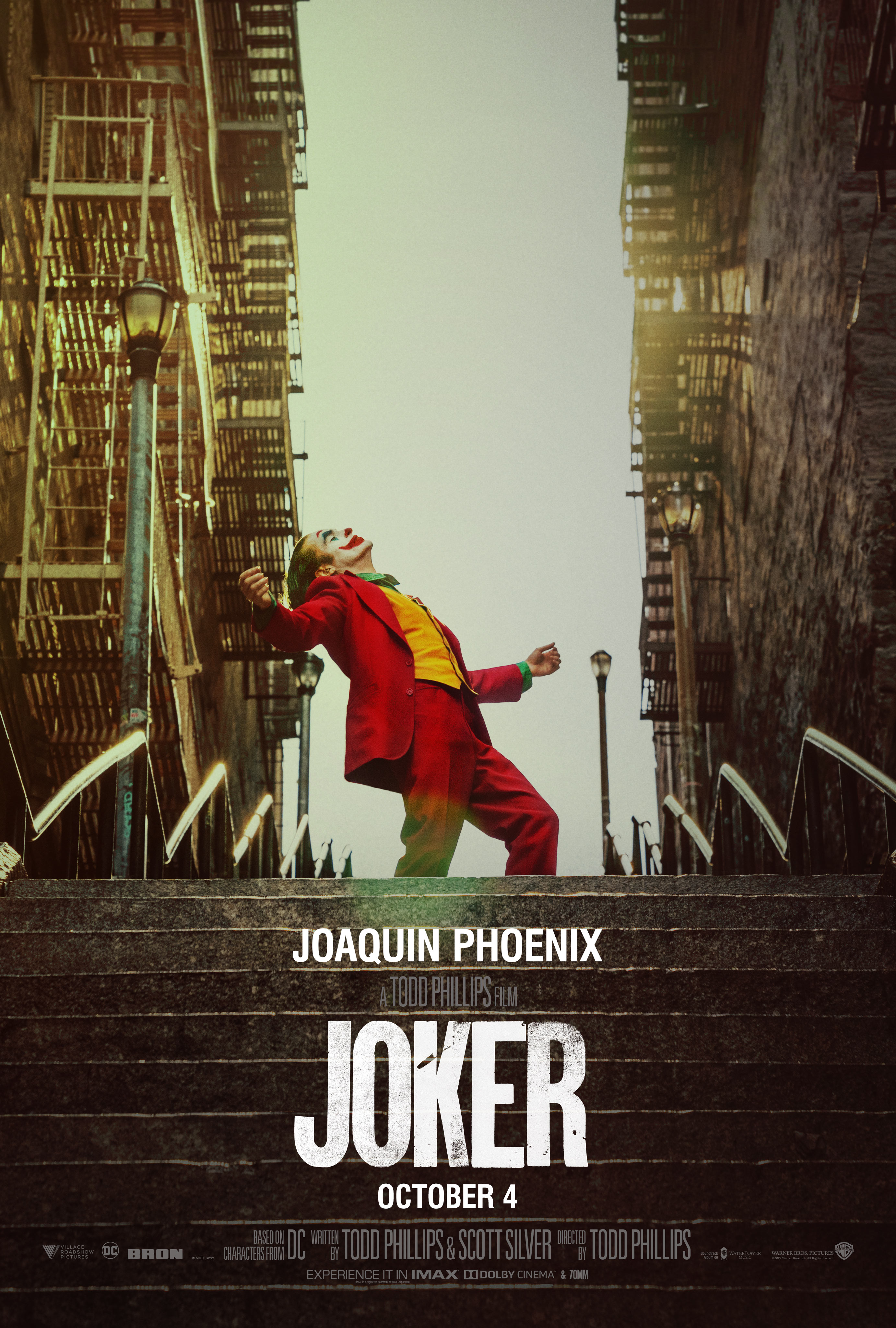
When we break it down, Joker is an effective, if not extremely harrowing, attempt to voyage into the core of the human psyche through the guise of an origin story for the most iconic comic book villain ever created, The Joker. Constructed around someone who we are lead to believe eventually becomes the eventual villain (although the film leaves the origin of the real Joker quite ambigious – we never actually know if the main character here eventually becomes the Clown Prince of Crime, or rather serves as an inspiration for the eventual villain to manifest), the film tries to take us into the mind of an ordinary man driven to insanity by a variety of forces, both physical and internal. Arthur Fleck (Joaquin Phoenix) is a man who has to grapple with severe mental health issues, as well as feeling out of place in a world in which timid people like him don’t normally fare too well. He is also trying to escape from his past by attempting a career in stand-up comedy, which doesn’t go nearly as well as he hoped it would – and when it becomes clear that his efforts are all for nothing, he begins to believe that the problem isn’t necessarily him, but rather the world around him that looks unkindly upon those who are different. Arthur Fleck as we know him dies, and Joker is born, less of a man and more of a maniacal entity out to wreak havoc and cause a movement that will dismantle the apathetic world that destroys people who dare to show weakness or be different in any way.
The issue with Joker, and one of the areas in which the discussion is perpetually active, is the idea that society has somehow wronged the main character, and is the reason for his descent into madness. This is most definitely an area of concern and one that shouldn’t be taken lightly. However, to the film’s credit, the intention isn’t to demonstrate how others have caused Arthur’s mental instability – at the outset of the film, he has just been released from a mental institution and is seeking a better life. It’s difficult to defend the film, especially because this is one area in which it tends to be rather ham-fisted, skirting around the issue with a sense of unease that never really offers any satiation, nor a direct solution to the issue that it is proposing. If there’s a weakness in Joker, its that the film boldly proclaims to be about the impact of the environment on one’s mental state, but never actually seems to find a way to coherently portray that idea without coming across as apologetic to the controversial people who cause harm to the world, reductive to those with mental illnesses, and motivational to the slackers who can identify with Arthur to the point where they see themselves reflected in his plight. This could perhaps be the only area in which the film falters, but even when it does, we can’t deny that what it says, while controversial, does bear a great deal of relevance to the modern world – whether we agree or disagree with his manifesto, the ideologies that Joker harbours can be found in a faction of the real population, which is certainly unsettling, if not outright terrifying.
If we put aside the flaws that come with the sometimes heavy-handed social commentary and take it to a more simple level, we can see the areas in which Joker finds itself succeeding. Everyone involved seemed to be intent on taking on the titular character, one that has been subjected to innumerable different interpretations, venturing into his origins in an attempt to provide some clarification into his reasons for becoming the malicious villain he has developed into over the decades. Obviously, this film is not trying to be the definitive Joker origin story (Alan Moore’s The Killing Joke is not only the greatest DC comic, but can legitimately make a claim to being the finest graphic novel ever written), but rather a character study, one the dives beneath the surface and takes on a journey into the roots of a character that has rarely been subjected to this kind of focus. However, had this film not had this title, or been so clearly promoted as being centred around this famous character, it would be difficult to discern that this is a film about The Joker. This is not a criticism, but rather the area in which Joker succeeds – it isn’t a comic book film in any way, not bearing any of the qualities that tend to be present in all of them, even the most original. Rather, this is a gritty psychological thriller about a man slowly descending into madness, and the film very smartly focused on this aspect, not only because this is as far from the often overwhelming blockbusters that tend to clog up the box office every year, but also the perfect remedy for the fatigue that has been produced by the constant films that thrive on large budgets and enormous concepts, all the while staying committed to following the same formula that underpins these films and never allows them to flourish into anything entirely original. Joker keeps everything relatively simple, and even when tempted with the chance to be excessive, it opted for a more simple approach, rejecting the opportunity to be formulaic, and dedicating itself to a more complex approach to the genre.
Obviously far from being subtle or nuanced, Joker is a film that takes a radically different stance than we’d have expected, and gets to the very core of the psychological roots of a character that is often portrayed to be a villain without clear motives or reason for his madness, and even when certain individuals have attempted to shed some light onto who he is as a character, they come up short simply because nearly every other representation of this character has seen him take on a secondary role to another character. Joker remedies this by providing us with a daring portrait of a man slowly losing his ability to function based on his earnest belief that the world has somehow caused him irreparable harm, and the only option is to take revenge on a society that seemingly doesn’t care all that much about him in the first place. We can’t necessarily agree with the character’s ideologies, but we also shouldn’t dismiss this film and its message as an attempt to justify the behaviour of a deplorable group of individuals who seemingly inspired this film (the inspirations for the specific events depicted in the film, if any, are never made clear, nor are the real-world individuals that served as a basis for the character). The film’s portrayal of mental illness may not be particularly subtle either, and it can sometimes feel very disconcerting the way in which it suggests that anyone who suffers from some condition has the potential to evolve into a murderous psychopath, solely based on how those around them react – another legitimate concern, but one that’s compensated by the film’s ardent insistence that Arthur Fleck definitely does not represent the entire community as a whole, but rather is a figure that embodies a sense of despair that often manifests in acting out, one where society isn’t the cause, but rather the ways in which that individual sees society, and how they react to certain issues.
This seems to be the point Joker is trying to convey – it doesn’t glamourize violence, nor does it condone what the character does. No matter how much the film apparently tries, Arthur is never portrayed in a positive way. Being the main character in a film like this doesn’t equate to being a protagonist – sometimes films can be made that focus on vile characters without any redeeming qualities. The intention of Joker was simply to be an intimate character study of an iconic figure, one where the audience is given the chance to explore his mind from afar and speculate on the roots of his insanity that would eventually fester into complete mental pandemonium, and subsequent societal chaos. We’ve all seen the jokes that comment on how Phillips and his collaborators shifted the Joker narrative from having an ordinary man thrown into a vat of acid to being thrown into society. The difference is that by taking a newer approach to the character, the film not only interprets the Joker in its own way but allows other portrayals, whether good or bad, to stand on their own. A major merit throughout Joker is its insistence on originality – it doesn’t try and compare itself to previous versions of the character, but rather adds to the rich cinematic tapestry that has seen interpretations from a variety of brilliantly talented actors and Jared Leto. To compare and contrast is a futile exercise, not only because this film goes its own way in exploring the character, but also because it is so different from the archetypal comic book film, bearing no resemblance to anything we normally see. Had we been told that this was simply a dark drama about a man gradually going crazy as a result of his own paranoia and belief that society is out to get him, none of us would have been any the wiser, with this film just being an intense psychological thriller that seems to be intent on terror more than entertainment.
Then we get to the matter of Joaquin Phoenix, the rare kind of actor who is perpetually growing as a performer, regardless of the film he’s appearing in. There are two distinct stages in his career – the earlier stage defined by films like Gladiator and Walk the Line, where he was positioned as a mainstream leading man, which never quite worked out, as he possesses a sinister quality that always prevented him from being particularly effective in these roles, and the later stage, where he started venturing into the arthouse, working with filmmakers like James Gray and Paul Thomas Anderson, who gave him the chance to develop his finest work to date – very few actors have ever come close to giving the performances Phoenix did in The Master, Her and Inherent Vice, a trio of portrayals that launched the actor to his status as one of the most unconventional actors of his generation. Since then, he oscillates between different genres, but staying consistently great, even when the films aren’t always very good. Joker sees him take on one of his most challenging roles, and we’d be foolish to consider this performance anything less than some of his most unique work. Unhinged and playing off his natural eccentricities that have often formed the basis for many of his more complex characters, Phoenix’s portrayal of the titular character in Joker is truly something noteworthy, even if you tend towards viewing it as excessive and too gauche to be considered particularly great. While it is a very measured performance, one that relies a lot on artificiality and a relative absence of subtletly, we need to consider how Phoenix is not normally an actor who is known for doing too much – thus, the small tics and moments of relentless chaos that reside in this performance are not the work of someone who can’t be nuanced, but rather someone who has finally been given the chance to play a character that is truly deranged, where he interprets one of the most iconic villains in a way that is more berserk and frighteningly unbalanced than we’ve ever seen before. Each component of this character has some deeper meaning, being drawn from numerous inspirations that all went into the creation of a complex, if not impenetrably mysterious, figure that gives Phoenix the chance to construct another fascinating, enigmatic figure. Joker ultimately rests on the actor’s performance, and whether one adores or despises this film depends almost entirely on how we view this portrayal – the film doesn’t really focus all that much on the events surrounding him, but rather his psychological state (in fact, the second act meanders too much into his mind, when it would’ve been beneficial to actually see some progression of the plot – there are moments of repetition, which do work, but could’ve been used more effectively to give the character more nuance). There’s an underlying intensity to this performance that seems so different from what Phoenix has normally done, even if he’s played unstable characters before, and suggests that the actor is entering into a new era of his career, and whether or not this is good remains to be seen, but its certainly something we should take note of. Its a performance that begs to be taken seriously, much like the character himself, and similarly, its at its most terrifying when we underestimate it.
Everything about Joker converges into a single dark, twisted film that holds the audience hostage in a way that very few films are able to. The film is a relentlessly tense experience, taking the character on a metaphysical journey into the depths of the human condition. This is by far the bleakest film ever made on such a mainstream property, which is another area in which the film deserves praise. It would’ve been so easy to take a more innocuous approach and present the character in a way that was unsettling but otherwise relatively safe – but this wouldn’t have given the film the complexities that it thrives on. Phillips deserves credit for taking such a bold approach to the character, and while some may comment that it was too preoccupied with paying tribute to a variety of other films (Taxi Driver and The King of Comedy have been noted as being legitimate influences on the film, but other films such as Network and One Flew Over the Cuckoo’s Nest can also be considered inspirations – the final act of the film resonates with allusions to the tragic story to Christine Chubbuck), the energy this film derives from translating a familiar character onto a framework constructed by homages to other films is worth seeing, even if there are times when it doesn’t work as well as it should. Its a dark, meditative character study about a character who we are not meant to relate to, but rather to engage with as someone who feels out of place in society, who finds solace from his internal quandaries with physical violence. Twisted and perverse, to the point where it could legitimately be considered self-indulgent, the film somehow just finds a way to make the premise work, resulting in a petrifying, uncomfortable portrayal of one individual’s complete loss of sanity.
The point still remains that Joker is a film that really wasn’t supposed to succeed in the way it did – call me cynical, but my expectations for this film were incredibly low because nothing (with the exception of the presence of Phoenix) inspired much confidence. Yet, as we’ve said throughout this discussion, there’s an underlying quality that allows this film to make sense of a story that has been told many times before in various forms, both in terms of this character and the other figures, fictional and otherwise, that went into his complex composition here. Perhaps its the reckless, devil-may-care attitude the film takes to a subject that doesn’t normally lend itself particularly well to mainstream cinema – its difficult to remember the last time a major film was this depraved and disturbing. Another reason is Phoenix’s performance, which runs the gamut from terrifying to outrageous, and whether in the quiet moments of silent intensity, or those in which he loses all inhibition and descends into a deranged form of excess that shows us another side of the actor, he is impressive, even if the film itself doesn’t always bolster it as well as it should’ve in certain moments. This is an understandably divisive film, which seems to serve the film better than had it been universally loved. It stirs discussion, incites discourse and allows debate, which is essentially the point of art as a whole. There doesn’t seem to be much of a downside to the film – it suggests that comic book movies don’t need to be bombastic or excessive, but can also be mature, intimate and deviant. Whatever it is about this film, we can’t deny that it stands out, and whether or not we find it a roaring triumph or a dismal failure, it’s entirely memorable, a fascinating experiment into the intersections between broad blockbusters and intimate character studies. Ultimately, when all is said and done, Joker has made an imprint and can possibly represent a seismic shift in how these kinds of stories are translated to the screen, and whether for better or for worse, what this film does is just impossible to ignore.
 The Postmodern Pelican
In this review, Mr. Jenner writes about Joker, “A major merit throughout Joker is its insistence on originality.” For me, the fault of the film is director Todd Phillips’s stunning absence of originality
The film’s debt to Scorsese classics Taxi Driver and The King of Comedy are readily evident in the screenplay. However, Phillips is far more interested in paying homage to ‘70s cinema in the imagery of Joker.
Let’s begin with the moment of street violence that Arthur Fleck endures. In Michael Winner’s 1974 hit film Death Wish, Paul Kersey gets a taste of vigilante justice when mugged after the funeral for his beloved wife. A chance encounter later introduces the architect to guns. Kersey begins to carry one and like Fleck in the subway uses the gun to kill violent street thugs. Phillips places the camera during these encounters with the same precision used by Winner. The camera gives us the perspective of the violent encounter from the eyes of the shooter. This placement effectively allows us to identify with the vigilante.
The film Network ends with the live television murder of Howard Beale as part of the Mao Tse-Tung Hour. Following the homicide, Sidney Lumet has the camera focus on the control board to watch four separate monitors covering the newcaster’s slaughter. For the on camera death in Joker, Phillips cuts to a bank of two dozen or so monitors covering various angels of the unexpected demise of an on air personality. Of course, Phillips honors Sidney Lumet’s closing shot of the 1976 classic film but Phillips has to do it bigger, grander than the original he honors.
In a tribute to Milos Forman’s One Flew Over the Cuckoo’s Nest, Arthur suffocates his hospital bedridden mother with a pillow. In Forman’s scene the room is silent because McMurphy is not wired to any apparatus to monitor for life support. Penny Fleck is. Phillips simply ignores that fact that these bedside monitors would screech when the patient’s pulse and breathing stop. That is ignored to capture the mood Forman created in his Oscar winning film.
On a more muted tribute, The Clown Murders, directed by Martyn Burke in 1976, featured clowns who danced as they committed their macabre random actgs of street violence. Of course Phoenix’s noted 52 pound loss of body weight gives him a lithe body to execute his dance moves. His footwork is far superior than that of the actors in the low budget horror flick.
Phillips readily pays homage to Scorsese. The reflected imagery on the police car windows during the riot is straight out of Travis Bickle’s late night cab rides and the carefully practiced walk on stage is lifted verbatim from The King of Comedy. Those are merely two oof multiple tributes to Scorsese and his vision.
When does homage become plagiarism? I think Joker is it. The cineastes in the audience can see so much of the film is lifted from visual sequencing in classic films of the 1970s that originality seems to be an afterthought.
This is actually a very insight, and you are certainly not wrong at all! However, when I mention the originality, I’m referring to this film as a superhero film, and how it takes a very different approach. The cinematic references in the film can be overwrought. You’re absolutely right in that regard. However, I’d take a film like this that actually tries to infuse some life into a genre of filmmaking over the more formulaic comic book adaptations that have dominated over the past decade. Thank you for the thoughts!