
“The whole past is just fiction”
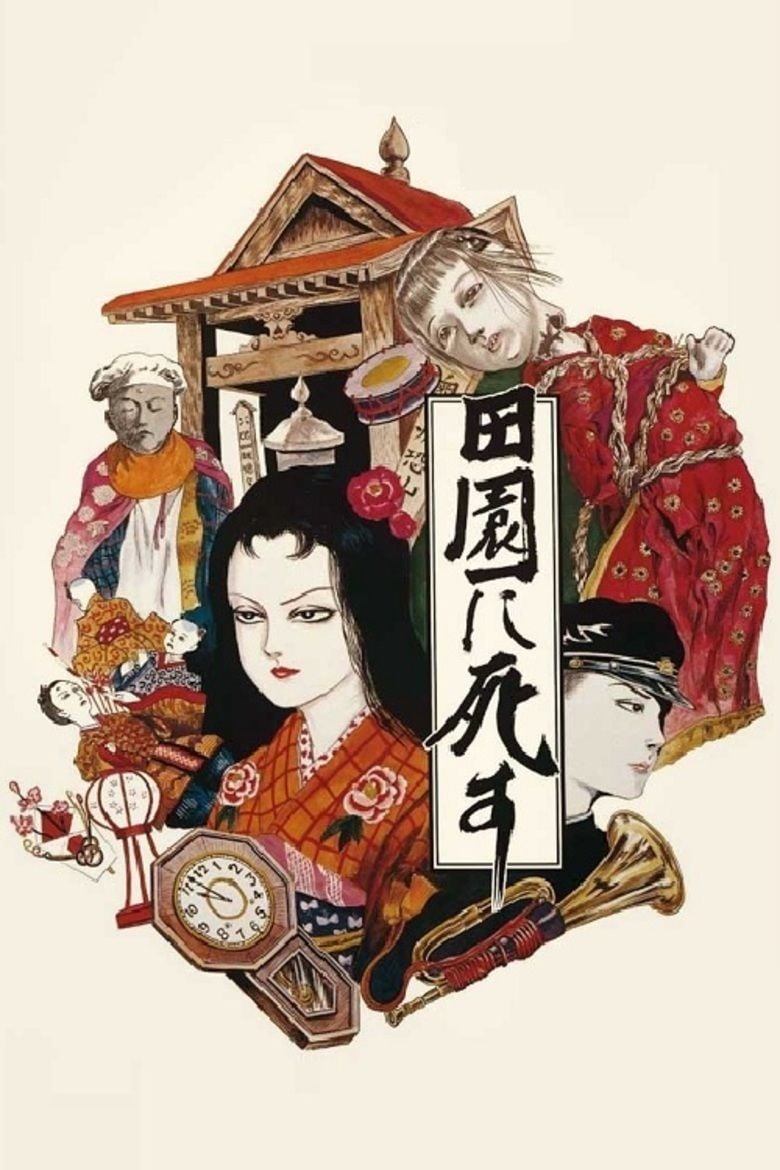
I don’t think we’ll ever understand exactly what was going on in the gloriously twisted mind of Shūji Terayama, whose groundbreaking work spans a few decades and looked at growing up in a way very few artists ever managed to. Perhaps his most beloved film is Pastoral: To Die in the Country (Japanese: 田園に死す), a deeply sentimental but also highly amusing dark comedy that serves to be a fascinating journey into childhood, and an almost unsettling surreal exploration of broad themes that are by no means uncommon in fiction, but are repurposed to be almost uncanny in how they’re presented to us, familiar yet detached from reality. Featuring the same outrageous absurdity that has come to be associated with Japanese surrealism, but also retaining the immense heart and incredible intelligence to tell a compelling and beautiful story about youth and the intersections between the past and the present, Pastoral: To Die in the Country is an undersung masterpiece, a deliriously strange but unquestionably meaningful depiction of memory and the revisiting of the past as a way of informing the present, and shaping the future, and one of the most gorgeous films of its era.
Set in the early 1950s, we are introduced to a young man (Hiroyuki Takano), clearly based on Terayama himself. He is growing up in rural Japan just after the end of the Second World War – this is not a theme that is ever explicitly explored, but there are some underlying references to the country being in a process of rebuilding, even if the film, for the most part, takes place in a small village. His life is quite simple – he has to endure a mother who seems to be incapable of doing anything other than smothering him and trying to ensure he remains a child as long as possible, and the beautiful older woman who lives next door, who incites the young man’s sexual awakening, as he starts to realize that he is is finally entering into some form of maturity. One day, he stumbles upon something on the outskirts of his village – a circus, consisting of many eccentric individuals who have chosen a life of absurd entertainment as their path. The young man is entirely captivated by these people, who seem to relish in their independence and their willingness to challenge societal norms by choosing a life of deviant behaviour. It is soon revealed, however, that what we are seeing is not entirely true, as it turns out to be the work of a director (Kantaro Suga), who is making a film based on his life, with the young man we have been introduced to being his narrative counterpart. The film is a way of the director reflecting on his own memories and the formative moments in his adolescence, as well as a way of avoiding the banality of everyday life. However, as the film progresses, boundaries begin to blur, and we see that absolutely nothing, even what we perceive to be the truth, is necessarily what it seems.
Various writers have referred to Pastoral: To Die in the Country as the visual equivalent of a haiku – and it is certainly difficult to argue with such a comparison, especially because what Terayama was doing here was not to construct a lucid and coherent story, but rather a series of moments in the life of two people: a young man growing up in rural Japan, and his adult equivalent, a jaded and depressed film director looking for some deeper meaning, with both characters quite heavily implied to be based on Terayama himself. Featuring all the most fascinating elements of early postmodernism, particularly in its structure, its inclusion of metafictional themes (which is always an audacious endeavour that should never go underpraised, especially in something as bold as this) and disregard for narrative cohesion, Pastoral: To Die in the Country is an astoundingly gorgeous film, one that approaches its subject with such profound delicacy, but also steadfast attention to the banality of everyday life, and how sometimes looking towards the past is both a beautiful endeavour, but one that is ultimately proven fruitless through the widespread tendency to assign a certain degree of fondness to the “good old days” that make the present somewhat pale in comparison. A variety of singular moments that may be confusing and impenetrable at the start, everything converges into a vivid and beautiful avant-garde masterpiece about the past and its influence on the future.
Pastoral: To Die in the Country is essentially just like any other semi-autobiographical work, insofar as it takes the form of a coming-of-age tale, where the artist deconstructs their life into a series of small but significant moments where their innocence is demonstrated in comparison to the later stages of more cynical adulthood. Moreover, like any film rooted in reality, it is primarily about memory, and Terayama’s approach to representing the past is astounding – depicting his childhood not as one continuous narrative, but rather in a more non-linear fashion, he is able to delve deeply into the scattered nature of reflecting on past experiences. Pastoral: To Die in the Country is a film of fragments, with broken pieces of his childhood being scattered throughout, but ultimately come together to form a complex narrative tapestry of one individual’s journey from innocence to experience. There is a certain blurring of boundaries that goes into this film, particularly in how it serves to not merely be a nostalgic remembrance of the glorious days of being youthful and wild, but also as a shattering of the boundaries between fact and fiction. Pastoral: To Die in the Country starts as a sweet, if not deeply strange, coming-of-age story, before being revealed to be a film-within-a-film, the project of a man disillusioned with his adult life and hoping to recapture the spirit of his youth. His wish is granted when the film loses all semblance of logic as the adult protagonist somehow ventures into the past, where he interacts with his younger self. This has two motivations: it allows him to revisit a time when he felt truly happy and fulfilled, in spite of the innumerable challenges that came with his rural upbringing, and as a way of informing his future self of what is to come. Life is short, and he still has so much to learn – but the future is inevitable, which means we should rather stop focusing on what is to come, and rather cherishing this very moment. Before we know it, our youth has fled, and the all that we are left with are the jaded remnants of bitterness towards the loss of the beautifully reckless naivete, which starts to envelop an individual should they feel they had not experienced all that life had to offer.
It does go without saying that what Terayama did with Pastoral: To Die in the Country is nothing short of a miracle, because not only did he give us a deeply personal story about his past, he provides the audience with one of the most empathetic portrayals of growing up ever committed to film. Throughout his work as a film director, playwright and author, we can see that he possessed a certain interest in coming-of-age stories, with this film being the manifestation of all his curiosities. There is a certain tranquillity present in the film – the main character never has to endure any palpable hardships, and with the exception of the occasional encounter with a sinister and vaguely-otherworldly entity, his life is relatively easy and composed of moments of sincere innocence. The easygoing nature of this film is one of its most significant merits – as we have seen from other popular magical realists and surrealists who have looked at childhood (Pastoral: To Die in the Country seems to be a great companion to the recent works of Alejandro Jodorowsky, whose films The Dance of Reality and Endless Poetry were similarly autobiographical films that blended cultural realism with exuberant colours and gorgeous absurdity to portray the strange nature of memory), it is not necessary to place your protagonist in situations that are recognizable, nor even all that realistic, as long as the underlying reasoning behind each moment is one working actively towards depicting the past as something that comforts us, even when it often makes very little sense. The simple and calming nature of this film accumulates into something much deeper, but never heavy-handed. Deeply experimental but never alienating, Pastoral: To Die in the Country is quite extraordinary in its approach to looking at some very complex themes in a truly simple and poetic manner.
It would be entirely foolish to ignore the technical prowess of this film, as Terayama makes sure to bring a certain visual panache to Pastoral: To Die in the Country, which supplements the story beautifully. At the core, the director approaches the past in a way that is almost unreal, embracing the quality of the absurd – his childhood is portrayed as one of carnal desire, with the film being remarkably similar to Mikhail Bakhtin’s theory of the carnivalesque, whereby chaos and desire intermingle in such a way that brings different people together, binding them through their eccentric behaviour, and where their deviant actions are not only condoned but actively encouraged, as its in the social pandemonium the carnivalesque brings that the true roots of humanity can be understood. Terayama seems to indirectly apply these qualities to Pastoral: To Die in the Country, juxtaposing the exuberant vivacity of the past with hauntingly arid imagery in the present day, and while the majority of this film may appear garish and gaudy, the stark and artificial images form an important underlying commentary – nostalgia forces us to look at the past and the present in very different ways. Just consider how the present is shown in bleak sepia tone, with an emphasis on small, intimate spaces, while the past is depicted in gorgeous kaleidoscopic colour, and filmed in the beautiful, lush countryside where the natural beauty of the landscape is extremely evident. It demonstrates our tendency to not only look at the past as a series of hilariously chaotic moments, but also how we tend to be far more kind to our memories, viewing them as colourful and entertaining, and very different from the banal nature of modern life, which is entirely lifeless when compared to our fondest memories.
The quote that appears at the beginning of this review seems to summarize exactly what makes Pastoral: To Die in the Country so unique – it isn’t a film that endeavours to be entirely realistic, and it openly admits to its interest in taking poetic licence by approaching the memories of the director not as sacrosanct, but as some form of very realistic fiction. One of the main characters mentions towards the end of the film that “the past can always be rearranged”, and that seems to be what Shūji Terayama is doing with this film – taking fragments of his past, and rearranging them in a way that not only depicts his memories, but also the scattered nature of remembrance, he crafts a poignant story about embracing the past. Through the seamless blending of the corporeality of existence and the artificial colours that are only found in dreams, as well as some resonant but disconcerting themes, Pastoral: To Die in the Country is an achievement like no other – it is often impenetrable, especially in the early stages of the film, where we are presented with disconnected vignettes that seek to describe life in a very unique way without giving much context, but we are able to acclimate to the director’s unique vision and undying empathy towards the human condition. Pastoral: To Die in the Country is a strange, often absurd film about the ambiguities that exist between adolescence and adulthood, and the journey between them – not only that of maturing as we grow older and move into the future, but also the inverse, whereby we continuously revisit the past and look at the moments that defined us. It’s not a film that always makes sense, but it’s also not a film that needs to make sense. It achieves exactly what it sets out to do – but what that is remains up to the viewer, with each person doubtlessly appreciating and interpreting this small but toweringly beautiful film differently, which is exactly how it should be with something that seeks to just depict reality in its own twisted, subversive and brilliant way.
 The Postmodern Pelican