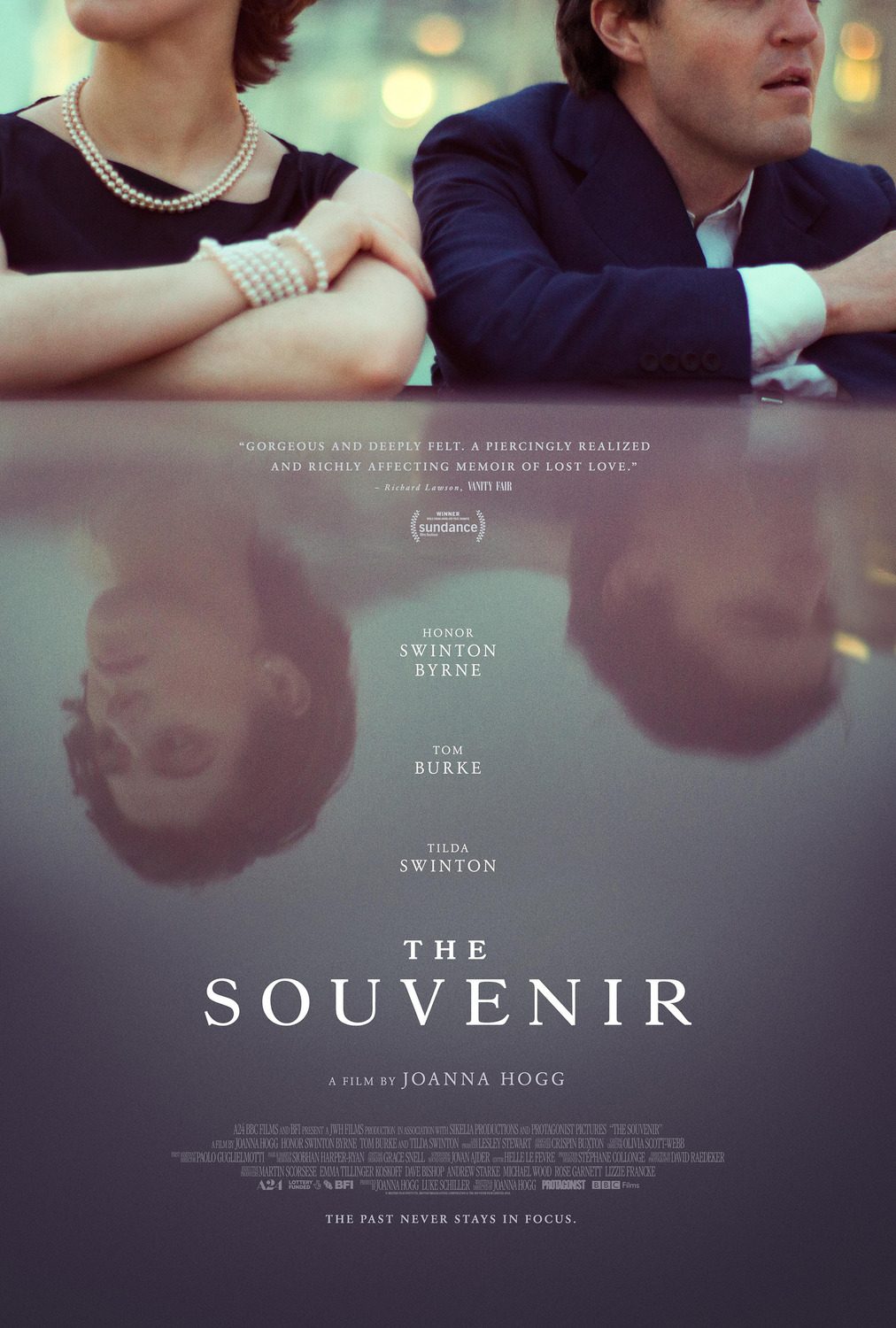
Memory is a powerful tool when telling a story. Joanna Hogg knew this, even though she has admitted that she didn’t trust her own memories, hence why her autobiographical feature film, The Souvenir, was gestating for over thirty years, and only came into palpable existence this year. What specific impetus lead her to portray her own early days as a young filmmaker is not particularly clear in this film, nor is it particularly relevant or even all that interesting (but perhaps the growing need of feminist voices in contemporary cinema played a part). Yet, whatever the reason, it is essential and poignant, and resulted in Hogg making one of the year’s most astoundingly beautiful films, a work that extends beyond social realism, and comes dangerously close to just being a stark and uncompromising representation of reality. It is a slice of life concealed in a thin veneer of fiction as the director takes the viewer on a journey into her own past, where we see the character’s metamorphosis from an innocent and fragile young woman into a world-weary, intelligent and visionary artist. One half of a planned two-part story, The Souvenir is a strikingly gorgeous, relentlessly intelligent and deeply moving film about memory, reflection and the indescribably seductive nature of the past, and how it tends to influence the future in innumerable ways.
It is a difficult (and perhaps entirely redundant) endeavour to try and figure out where Hogg’s life ends and The Souvenir begins – it is well-documented that Hogg was inspired by her own artistic process and her development into a filmmaker in the conception of this film, so there is certainly some element of reality to the majority of this film. Set in the mid-1980s, The Souvenir introduces us to Julie (Honor Swinton-Byrne), Hogg’s cinematic counterpart. A young woman on the verge of entering into the world after college, where she hopes to become a film director, she has enormous artistic ambitions, and she even starts to feel her experiences in film school aren’t getting her anywhere (and testimonials from others that call it “the cheapest camera hire in the world” certainly doesn’t help). These are often supported (and occasionally dismissed) by another person, a mysterious government worker named Anthony (Tom Burke), who has an ambigious past and who still remains an enigmatic figure to Julie, who can’t help from being captivated by the eloquent and intelligent older man who captures her heart through his biting wit, unhinged intelligence and seductive aloofness. Yet, she eventually finds herself held emotionally captive by Anthony, whose hesitance to reveal much about himself or his activities causes Julie immense despair – yet, she can’t retreat from the relationship, for reasons never made entirely clear: does she truly love Anthony and believes he can change or does his alleged affection for her take on a more sinister quality, where leaving is not only difficult but entirely impossible?
In the most simple terms, The Souvenir is a film about a romance, yet there are few films that could be considered further from romantic than this. A twisted, sordid tale of emotional manipulation and provocative, sadomasochistic control hidden beneath the guise of a love story between two individuals, Hogg does not dare take the route of presenting us with two inherently likeable individuals, which prevents this film from ever being seen as an unrealistic portrayal of romance, and rather more of a cauterizing depiction of the psychological damage an abusive relationship (in any form, whether physical or emotional) can have on both parties, especially when there are other underlying vices that cause the tension and hostility. Hogg’s delicate approach to telling the story of this relationship in both its moments of towering beauty, or the harrowing degradation, was done with such precision and honesty, one would be forgiven for thinking it was a work of complete fiction, because it is extremely rare to find an autobiographical film this overtly bleak and void of any hope. There is a tendency for many artists, when construction works that are based on their own lives, to fall into the deplorable pits of sentimental nostalgia, with very few ever finding the balance between reality and fiction. Ultimately, no one can ever give an entirely objective view of their own life – there will always be some element of bias towards it, especially in something like The Souvenir, where the most pleasant of situations are not represented, but rather the moments between.
The focus in this film is not on reminiscing on the relationship between the main characters – it undoubtedly had an impact on Hogg (especially through the film’s very bleak coda, which sees the relationship come to a shockingly tragic and untimely end due to Anthony’s death from a heroin overdose), but rather ruminating on the impact of this relationship, and the effects it had on Hogg, both as a person and as an artist. This seems to be the intention of The Souvenir – the relationship at the core is certainly a fascinating one, and the way in which the director oscillates between the moments of unrequited joy, and deeply upsetting tragedy, is astonishing. It also helps that she portrays both characters not as being perfect individuals – both Julie and Anthony are severely flawed, and not in the quirky and relatable manner that many romantic films tend to portray lovers. Julie is not some sprite of a girl who depends entirely on the validation of a man, nor is Anthony a rugged and charming man whose surface flaws mask a very soft heart, and whose hardened exterior is a defence for his insecurities. In fact, all things considered, both are rather deplorable in their own way, going about their lives in ways that are often far from admirable and even overtly dishonest – but that doesn’t make them any less compelling, and perhaps even allows us to like them more because they are so authentic.
Authenticity is the reason behind the brilliance of The Souvenir. A filmmaker who has always been artistically rooted in a profoundly recognizable form of life, Hogg opts to underplay everything in this film, presenting it to us in a way that hearkens back to the earliest days of neo-realism, superseding the likes of her compatriot forefathers like Mike Leigh and Ken Loach, and being far more aligned with the style of someone like Éric Rohmer, whose minimalistic style is clearly an inspiration for Hogg. The Souvenir takes a very naturalistic approach, deconstructing reality and reducing life to a series of small but impactful moments, delivered with such concise simplicity, but with a ferocious intensity simmering below. Hogg’s vision does not rely on any element of literary license, yet there is an unmistakable poetry pulsating through The Souvenir, but not one found in cinema most of the time, but normally in the most intimate passages of great written memoirs, where a single life, whether noteworthy or entirely ordinary, is picked apart, each moment becoming a beautiful snapshot of an individual journey to some metaphysical destination, and where each experience is just another fragment in an imperfectly beautiful piece of humanity, where the individual themselves is both the artist and the artwork – Julie is working to construct a film, but she is really working on building herself and developing into a functional creative mind in her own right.
Memory and reflection thus form a pivotal element in The Souvenir, and it often feels as if Hogg is talking to us directly, relaying her experiences through this genuine and moving portrait of her younger years. It is always difficult to approach memory in a way that doesn’t only make an impact, but also feels natural and not forced. Hogg certainly does succeed, and her past becomes a deliriously twisted tale of intrigue and social discomfort as she explores her formative years – both as an artist and as a woman. The character of Julie is undergoing many different forms of education throughout the film – academically, she is in the final stages of film school, where theory is no longer her priority, but practical execution of her skills, which will determine if she is going to continue on this path. Emotionally, her education is far more poignant and perhaps even somewhat harrowing, as we follow her deeply disturbing relationship with Anthony, whose manipulative nature and ability to emotionally coerce the young woman to doing anything he wishes is not easy to watch, but it effectively demonstrates how one’s perception of the world is not only influenced by our experiences, but also through our relationships. The Souvenir is not a film about the relationship, even though it almost exclusively follows its trials and tribulations – its a film about looking back at the memories of past relationships (not necessarily only romantic, but also in terms of familial bonds, which I’d assume the second part of this duology will address more clearly) and how they influence us in our current lives, whether emotionally or creatively.
In bringing her past to life in The Souvenir, Hogg works in collaboration with her longtime childhood friend, Tilda Swinton (who also has a film counterpart here, albeit a very small one), who here plays a version of Hogg’s mother, whose old-fashioned mentality sometimes quietly conflicts with that of her daughter, who is played quite brilliantly by Swinton’s own daughter, Honor Swinton-Byrne, whose performance in The Souvenir is the very definition of a star-making turn, and whose mighty work in portraying Julie is undoubtedly going to be one of the year’s most brilliant discoveries. A rising star, Swinton-Byrne is absolutely astounding, finding a humanity in a character that was born to be ordinary but is working hard to prove those who believe her upper-class life prevents her from the empathy required in great artists. Acting across from her for most of the film is Tom Burke, whose ferocious performance as Anthony is truly extraordinary – an undeniably complex character whose past is ambigious and whose motives are entirely unknown, Burke oscillates between charming and sinister but is never anything less than fascinating. He and Swinton-Byrne make a formidable pair, and their performances are not only remarkable in isolation but brilliant when contrasted with each other. Their chemistry is so natural, and their innate instincts as inherently empathetic actors resonate throughout their performances, which makes for truly enthralling viewing that only lends the film further realistic gravitas.
The Souvenir is an astoundingly gorgeous film, but an even more poignant exploration of the human condition. Joanna Hogg is a genius and has been working hard for a long time to realize her superb artistic vision, but I feel this was the first time she made something that will reach the wider audience her career has warranted, with the various fragmented elements of this film – the portrayal of artistic growth, the process of going from innocence to experience and the influence relationships have on the mind of a creative individual – all work alongside the broad themes of memory and reflection, whereby the director looks directly at her own past and returns to these experiences in a way that is deeply personal and unquestionably intimate, but also extremely resonant and moving. Her honesty as an artist is unparalleled, and the metafictional elements of the film portray a very different kind of social realism, one that isn’t necessarily seeking to portray life’s innumerable eccentricities in raw, gritty honesty, but to look deeper at the past, not as one coherent stream-of-consciousness, but as a series of formative moments, good and bad, that all converge into the fascinating, complex and creative individual that forms the core of The Souvenir, making this a steadfast and unapologetically human drama about themes that many of us will be able to relate to in some way. It goes without saying that wherever Hogg is going to take us with the second part of this story, we are all more than willing to blindly follow her, because as her work here demonstrates, she is an absolutely essential voice that we should start appreciating now. Better late than never.