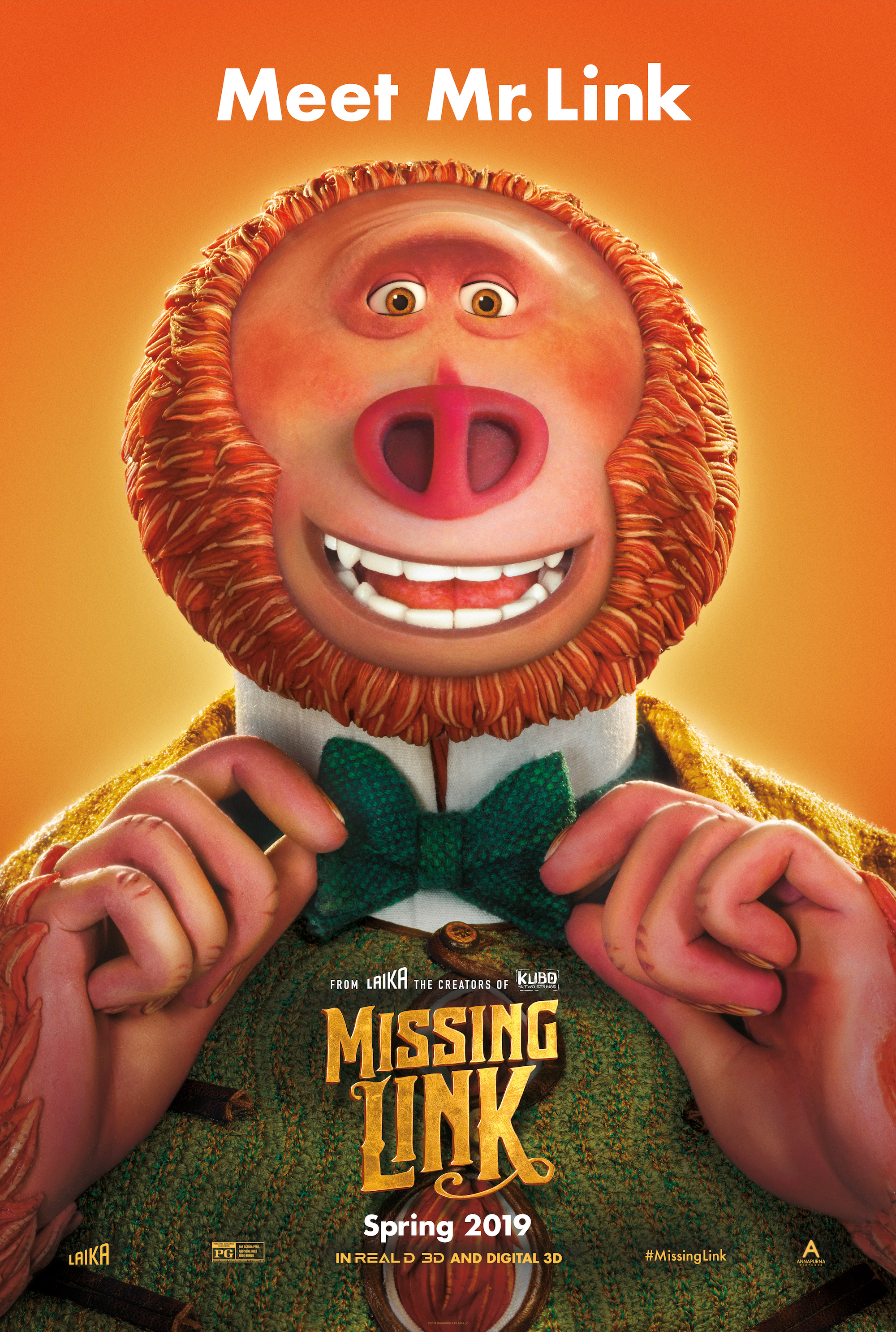
 The late nineteenth century was a time of great scientific interest, with explorers and theorists from all around the world, specifically Europe, staking their claim to greatness by being the first person to make some enormous discovery that would doubtlessly see them enter the hallowed halls of history. One of the most significant theories of this era was that of evolution, and the moment Charles Darwin proposed his contentious belief that we share a common ancestor with apes, many scrambled to find out for themselves whether or not this assertion was true – and whether as a way of building on his theory or proving Darwin wrong, it was something that still remains quite controversial. This leads us to Missing Link – Sir Lionel Frost (Hugh Jackman) is on the precipice of greatness – or at least he thinks he is. He is desperate to join the great men of science in their exclusive society, but since he has yet to prove his mettle as a great explorer and adventurer, he is unable to win their respect. This is until he receives a letter from an anonymous source somewhere in North America who promises to provide proof towards the evidence of the mythical being we all know as Bigfoot. Knowing that such a discovery will undoubtedly make him a very famous man, Sir Lionel goes in search of this elusive Sasquatch. Expecting to find a primitive beast, he is shocked to be introduced to Mr Link, or Susan (Zach Galifianakis), the world-famous Bigfoot, who is as eloquent and civilized as any human could be. Realizing the scope of his discovery, Sir Lionel attempts to bring Mr Link back to England – but when his rivals hear of his questionable discovery, they take it upon themselves to disprove him, even if it means resorting to violence.
Laika is a film studio that is redefining animation – with each of their previous feature films (Coraline, Paranorman, The Boxtrolls and Kubo and the Two Strings), they proved themselves to be at the forefront of alternative animation, whereby they are able to make unique stories that don’t pander to the taut Disney-Pixar model, and while they may still be struggling to find their grounding as a relatively new studio in comparison to others, they have evidently made enormous strides, and are well on their way to greatness, which they’ll achieve with time. Their latest film, Missing Link, continues their streak of near-perfect films, not only proving that the studio is more than capable of branching out into more unique and broader stories (both in terms of the themes and the production value), but also that they are willing to tell the stories no one else would dare – caught between the lovable sincerity of a children’s film, and the stark social commentary of something aimed more at adults, Missing Link is the rare animated film that doesn’t ever allow itself to get distracted by pandering to one section of the audience, opting for something that will enthral and entertain absolutely everyone in equal measure. An easygoing, pleasant and amicable adventure comedy, Missing Link is one of the most enjoyable films of the year, an endlessly hilarious and heartwarmingly empathetic portrayal of friendship and individuality, and finding your place in a world where you feel you don’t belong, and eventually reaching the contentment in knowing you are, just like everyone else, worthy of the same love and affection.
Friendship seems to be a theme very common in cinema, and we’ve even seen an animated film or two tackle this very broad theme. Its understandable by it may be the most popular topic in literature – who of us can not relate to the warmth of having friends, or the crushing loneliness of feeling isolated from the rest of the world. Missing Link certainly follows the same trajectory as the majority of similar films, presenting us with two very unlikely companions – one of them is an arrogant and self-obsessed explorer, the other a humble and friendly mythological creature. Both of them are in search of the other, but for reasons that go far deeper than either of them realize. Both are men who are trapped in some cycle of loneliness, looking for validation and some sense of belonging, which is proven to be almost impossible due to their inability to effectively shift from their stagnant situation. Thus, it is only logical that their salvation will come on behalf of the other – should Sir Lionel be able to prove the existence of the proverbial “missing link”, he’ll become a revered and respected member of the scientific community. Inversely, with the help of the explorer, Mr Link will be able to find a place where he belongs – he believes he should be with his “kind” across the world, the Yetis of the Himalayas, who he sees as his distant cousins, and who will surely welcome him in with open arms. Both men also learn a valuable lesson (or at least a few) on the way, which shift their perspective and show them a side of the world they had both been previously oblivious to.
Yet, this isn’t all – Missing Link is a deeply meaningful film about individuality. Everyone has doubtlessly felt out of place somewhere, and for our two protagonists (in actuality three, if we are to count the secondary character of Adelina Fortnight), it has impacted them in ways that they can no longer grapple with. Sir Lionel is a resourceful, intelligent man who struggles to fit in, especially in the cutthroat world of London society, where someone like him is measured not on his knowledge or experience, but on their achievements, of which he has nothing discernible, at least not in the eyes of the people he is so desperately trying to impress. For Mr Link, he just wants a friend – living in isolation in the woods, he only occasionally encounters someone, with each encounter normally ending with fearful retreat on behalf of one of the parties. Both are outsiders, perpetually in search of the sense of comfort that comes with being accepted into a society – and we never know who has it worse: Mr Link lives in isolation, whereas Sir Lionel is a part of a massive society where he cannot find a single person willing to give him the respect he craves. Interestingly, despite being (mostly) different species, both Sir Lionel and Mr Link are in need of something – a friend. Not only because it’s important we have someone to share our experiences with, but because of its a pivotal step in self-actualization. The need for validation is unimportant and can be quite harmful – but the meaningfulness that comes as a result of realizing your self-worth, and being able to spread that to others, is important. That is the message at the core of Missing Link, which is a two-prodded masterpiece – not only does it look at the importance of individuality and embracing your flaws, especially when you’re an outsider, it shows the wonderful sensation of finding others who have had similar experiences, where the loneliness and despair can be momentarily stalled as we find a kindred spirit.
Laika has also openly rejected the alluring pull of computer-generated imagery – we’ve seen such enormous progress done in the field of visual effects, absolutely anything can be rendered. Their work has always been defined by its insistence on remaining stop-motion, an animation style that has slowly dissimilated out of popular usage, due to its rigidity and the fact that it is such a laborious effort, and with the exception of the occasional filmmaker that endeavours to undertake the herculean task, stop-motion just isn’t that widespread anymore. This has allowed Laika the chance to take on the novelty of being the only major stop-motion animation studio. Missing Link, like their other films, is not perfect by any means – like all stop-motion animation, the film is rough around the edges and has some flaws. Yet, this is what gives it the charm, as well as making the moments of unrelinquished beauty all that more impactful – this is a film that takes full advantage of its medium, and presents us with something where we can see the heart and soul poured into absolutely every frame. Whether or not their stories are particularly original is beside the point, because Missing Link has what nearly every film released by the mainstream studios lacks – heart. Other films may be emotionally-profound and often heartbreaking, but none of them is clearly as intricately crafted as this is, and the hard work of every designer and animator is pulsating through each scene in this film. Executed with the detail and intricacy of a beautiful painting, Missing Link is an astonishing artistic achievement and one that surmounts its narrative flaws by delivering a dazzling, astoundingly gorgeous experience.
Missing Link is an absolute delight – Laika has once again made a true animated masterpiece. Bringing together so many of the qualities that have made their previous films so beloved (if not tragically underseen), they deliver something astounding and memorable. Featuring the voice talents of the likes of Hugh Jackman, Zach Galifianakis, the ever-delightful Stephen Fry and the deeply underrated Timothy Olyphant (amongst many others, including one of the grand stateswomen of British cinema, Dame Emma Thompson), this is a film that will never fails to keep the audience utterly captivating, and will serve to be a pleasant and meaningful diversion for every viewer, regardless of age or background, as the story it tells may be something that has been explored before, but rarely with this kind of intense empathy and easygoing lovability. It is not a film that is going to necessarily shatter boundaries, nor will it become the definitive masterwork from the studio – but it does demonstrate Laika’s continuous growth and movement towards bolder narratives and more audacious visual style. It is a wonderful film, one that will leave you with an undeniable warmth in the depths of your soul, and the goofiest smile spread across your face.
 The Postmodern Pelican