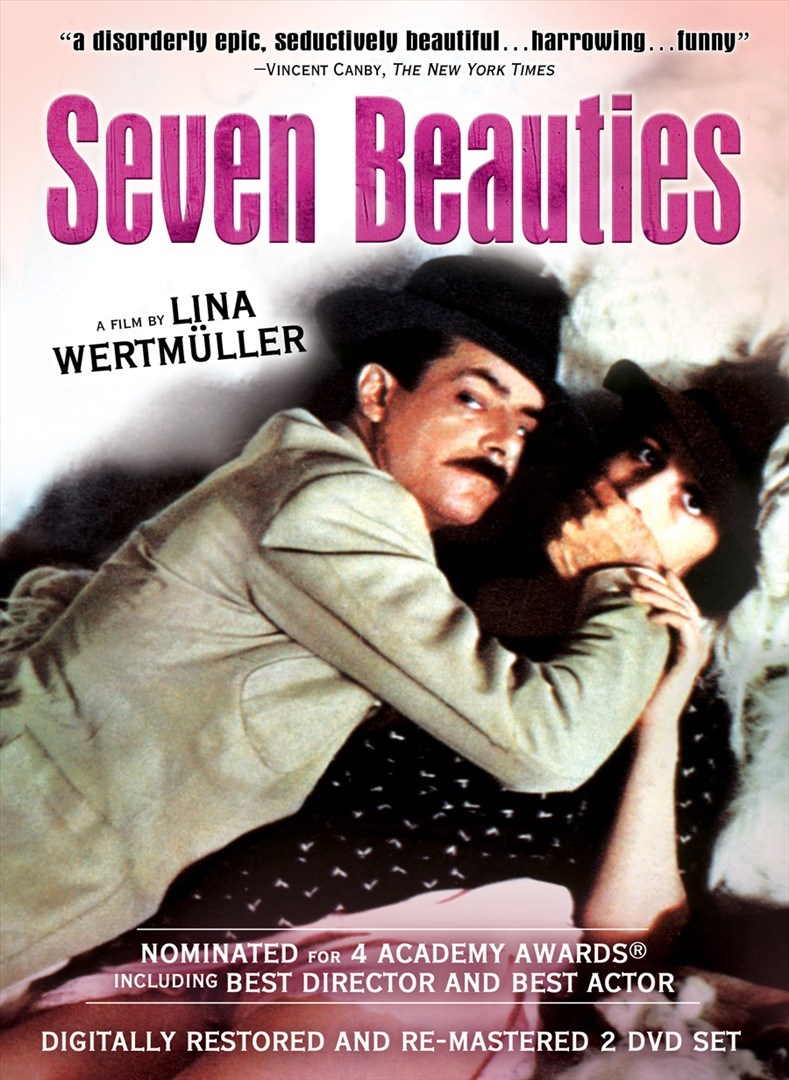
 In the history of cinema, there has never been someone like Lina Wertmüller. Not only did she make history numerous times, but she has also left an indelible impression on the industry, not only paving a path for several female filmmakers to have their voices heard but also becoming one of the greatest directors of her generation. One of her most brilliant works is Seven Beauties (Italian: Pasqualino Settebellezze), a darkly comical film that spans decades and continents, looking at the life of one man as he does anything to survive. A film that has become famous for its history (Wertmüller became the first woman to be nominated for the Academy Award for Best Director) and for its underlying messages, as well as several more grounded properties like its strange story and brilliant leading performance, this is undeniably one of the great works of Italian cinema, a film that oscillates between being hilariously perverse and hopelessly harrowing as it presents us with a picaresque story that is extracted directly from the mind of one of the great social commentators and anthropological artists of our time, who gives us this bewilderingly brilliant film that will leave you mesmerized, and unable to choose between laughter or tears by the end of it.
Pasqualino Settebellezze (Giancarlo Gianni) is a small-time gangster operating out of Naples. He may not be particularly high-ranking in the Mafia, but he is already becoming well-known and has a stranglehold on the community, which he uses positively, helping those who need some support and getting vengeance on those that dare to cause harm to others. He lives with his mother and seven sisters (hence the name he has come to be known by), and he does everything to defend their honour. Unfortunately, when one of his sisters enters into prostitution as a way of making an income for the family, Pasqualino is enraged, and in a fit of anger murders the pimp who forced her into that life. His methods of disposing of the body are less than ideal, and very soon our protagonist is on his way to jail, destined to be sentenced to death for his cold-blooded murder. A plea bargain of insanity brings him to a mental hospital, which only further motivates him to try and get out, which he does through volunteering for the army, fighting for Italy in the Second World War – and when he gets caught deserting his compatriots for his own gain, he is captured and sent to an extermination camp, where he finally realizes that he may not be able to escape at all, at least not unless he changes his modus operandi and assumes a new mindset in order to ensure that he is no longer ensnared by the forces that seek to bind him, and to make sure that he after his escape, he isn’t caught again, by anyone.
Seven Beauties certainly is a strange film – while watching it, I couldn’t help be reminded of how this seems like a precursor to so many subsequent films that received far more attention, yet executing their stories just as well. It did the history-spanning picaresque story better than Forrest Gump, the harrowing Holocaust horror better than Son of Saul, and the irreverent, controversial wartime humour better than Life is Beautiful. It is doubtful this film was an influence on any of them directly, precisely because Seven Beauties is such an unconventional film – it defies all categorization, and opts for a more layered approach to what could’ve very easily been a film that remained loyal to one particular genre. Wertmüller is a maestro, so it’s undeniable that if anyone was going to undertake the daunting task of juggling so many genres and turning them into something extraordinarily special, it would be her. I am still not entirely sure how one would classify this film – it is equal parts quirky comedy, character-driven drama and wartime tragedy. It leaps from genre to genre, never lingering on one long enough for the audience to properly grasp what its central motivation is, which may sound like inconsistent and indecisive filmmaking, but is quite the contrary – Wertmüller has crafted something so arbitrary and uncomfortably odd, the audience is not supposed to know where it is heading. There’s absolutely no way Seven Beauties could be considered predictable – the director dismantles every piece of conventional story structure, and takes us a journey that is not only non-linear in how it presents the plot, but also carefully guards its numerous twists and turns, which ultimately keeps the audience absolutely enthralled throughout, leading to a conclusion that will strike the audience like no other film possibly can. It’s all the genius of a director so firmly in control of her craft, with Wertmüller’s vision being almost unprecedented, and both as a writer and director, she displays her unquestionably iconoclastic talents with such refined grace.
Giancarlo Gianni takes on the main role of Pasqualino Settebellezze and he is nothing short of astonishing. There is very little doubt that this is one of the finest male performances of the 1970s, an intricate and measured character study of a man who goes from ruling over the community of his hometown with an iron fist, to a subservient prisoners begging for mercy from people who hold his lives in their hands the same way he did to those when he was part of the Mafia, taking advantage of anyone he chose to based purely on his status. If there was ever a film about someone truly being cut down to size, Seven Beauties is that very film. Gianni’s performance is almost otherworldly – he finds an incredible balance between the comedy and the tragedy of the film, allowing it to reflect deeply through his performance, which becomes a beautiful, intricate example of reinventing a character through understanding the depths of the role, and evoking every bit of possible narrative potential from it. Gianni is absolutely astounding, playing the role in a way that, much like Pasqualino Settebellezze, he holds us firmly in his grasps – when he intends for us to laugh, we laugh. When he tries to make us cry, we certainly do cry. The final shot of the film, where he looks solemnly into the mirror as the credits pass by is amongst the most powerful endings out of any film I’ve seen in a while – its truly poignant, and even with just a simple glance, Gianni manages to pervade the soul of the viewer and demonstrate considerable ability to move us even from the other side of the screen. It is an intimate, beautiful performance from an actor who runs the gamut of emotions in this role, finding a delicate balance between the tonal shifts that define the film, which put him firmly at the helm of the most emotional moments throughout Seven Beauties.
Wertmüller sets out to do something a lot of filmmakers tried to do, but very few managed to accomplish with much success. She presents us with a story about a man who finds himself in increasingly bleak positions, and she endeavours to find the humour in the most unexpected places, deriving the levity from uncomfortable or difficult situations in a way that is almost unheard of. Seven Beauties doesn’t necessarily use humour to distract from the atrocities occurring around it – the director never dares to make light of of the horrible situations. Nor does Wertmüller seem to want to soften the blow of the horrific imagery – quite the contrary, with some of the juxtaposition in this film being truly unsettling, with the irony only further creating a sense of unease and discomfort. Just consider the use of Wagner’s “Ride of the Valkyries”, a song normally associated with triumph and towering victory (not to mention Adolf Hitler was enamoured with the composer’s work), playing over scenes set in the extermination camp, where we see horrifying footage of the prisoners and their plight. The humour in Seven Beauties serves to remind us of the absurdity of life, and the sometimes ironic hilarity that comes with luck. Wertmüller possesses an extremely dark sense of humour, yet she never fashions her film to be anything close to offensive. The way she executes these audacious and risky concepts is done in a way that is very much tongue-in-cheek, with the clear sardonic sarcasm of the story allowing it to deftly avoid any allegations of insensitivity, and no one could accuse Wertmüller of ever making light of very serious manners. Some have referred to this film as a Holocaust comedy (which isn’t true, because the scenes in the prison camp are amongst the most disturbing and bleak ever committed on film), but considering this is, at least to date, one of the only great films that dares to approach the atrocities of the Second World War with some semblance of intelligence to its humour, it could be said that it does successfully utilize its almost perilous premise in a way that is not only effective but utterly brilliant.
Beneath its often darkly comical exterior, Seven Beauties has a very serious core, one that looks at an important issue that extends beyond the sometimes controversial humour. This is a film primarily about survival, but any means necessary. Pasqualino is a hypocrite – when he was on top of the world, an influential figure amongst his community, he derided those he saw as inferior to him for their apparently dishonourable attempts to make a living. Yet, when put in the same position, he has no choice but to embrace subservience. In his own efforts to survive, the protagonist is shown to be perfectly willing to go to any lengths and to sink to any depths to ensure his own survival. There’s a popular, if not slightly vulgar, adage that boldly states “you can’t save your face and your ass at the same time”, which seems to be the central principle here – we see a man who prides his dignity above all else, doing absolutely anything, even sacrificing his own sacrosanct morals and ethics, just to make sure he sees another day. Wertmüller never tries to persuade is to feel one way or the other on this matter, rather opting to demonstrate the plight of one man, neither a hero nor a villain, and his quest to make it out of the difficult situations he finds himself in, overcoming the challenges, some of which were through his own fault and others purely accidental. Yet, somehow he uses his own resourceful nature to make it out. The final shot of Seven Beauties, whereby he quietly remarks “I’m free” while looking at his aged, ragged reflection is far from a triumphant moment of hard-earned victory against the odds, but rather the end of a harrowing story that saw a man leave the very home he has just returned to years later, coming back a very different person who has seen the world in all its hideosity and despair, having survived its various hardships. Certainly heavy-handed, but nonetheless stunningly beautiful in its own way.
Seven Beauties is an astounding film. It is frequently very funny, featuring a memorable leading turn from Giancarlo Gianni, who gives a terrific performance as the world-weary picaro who traverses from one tragedy to another, always managing to scrape himself out of even the most uncomfortable binds. Lina Wertmüller makes use of many of her most ardent talents – her dark and twisted sense of humour that allows her to present these situations through a more comical perspective, as well as a profound understanding of the human condition, with her empathetic portrayal of the characters in this film being quite moving – even the Nazi commandment, who is constructed to be the embodiment of evil, is shown to be a woman with the same insecurities and desires, and the need to be loved, as everyone else. The director is not necessarily sympathetic to any of the characters – many of them, including the protagonist, are shown to be quite morally and ethically questionable, yet she goes to great lengths to assure that they are portrayed as inherently human. This film is a fascinating work – extremely well-constructed, as well as being deeply intelligent and meaningful, it makes some profound statements and ventures into a level of humanity and history that is hardly explored with such overt honesty. This alone is more than enough to qualify it as a roaring success. Sometimes it is hilariously funny, other times hopelessly depressing – but one thing is certainly very true: Seven Beauties is never dull, and remains truly and earnestly unforgettable in every conceivable way.
 The Postmodern Pelican
For many, the Oscar nominations for Best Director, Best Original Screenplay and Best Actor would indicate a Best Picture nomination. The fourth and final nomination for Seven Beauties was Best Foreign Film. In 1975, AMPAS rules denied contenders for Best Foreign Film the opportunity to complete for Best Picture. Italy sponsored Seven Beauties for the Foreign Film prize which was awarded to Black and White in Color from the Ivory Coast. Had Italy selected the wildly popular David di Donatello winner Amici Miei, it seems likely that Seven Beauties would have landed a Best Picture nod, replacing Hal Ashby’s Bound for Glory, a biography of Woody Guthrie, most noteworthy as the first studio film to use the Steadicam.