 Assault on Precinct 13 reaffirmed something that I’ve slowly started to believe is less of an opinion and more of an unquestionable fact – John Carpenter is one of the most visionary filmmakers of his generation. While his cinematic career will deservedly be defined mainly through the lens of his two horror masterpieces Halloween and The Thing, its sometimes his more unconventional projects that demonstrate that he was a maestro fully in control of his craft right from the beginning of his career. In his sophomore feature film, Assault on Precinct 13, the director found himself making a multilayered thriller that borrowed generously from other genres, and in the process being one of the finest action films of the 1970s, and a brilliant precursor to Carpenter’s future work, especially the iconic action films he made that helped define the 1980s as a watershed moment for these kinds of films. Assault on Precinct 13 is a terrific film – it is proof that just because a certain genre may prioritize certain less-subtle modes of conveying a particular message doesn’t mean it isn’t worthy of acclaim. This film specifically demonstrates that a film can still be highly action-packed and filled to the brim with tension and adrenaline, and still find space for a compelling story, exceptional performances and more than anything else, a particular cinematic dignity that only comes from a filmmaker who is profoundly passionate about what he’s doing.
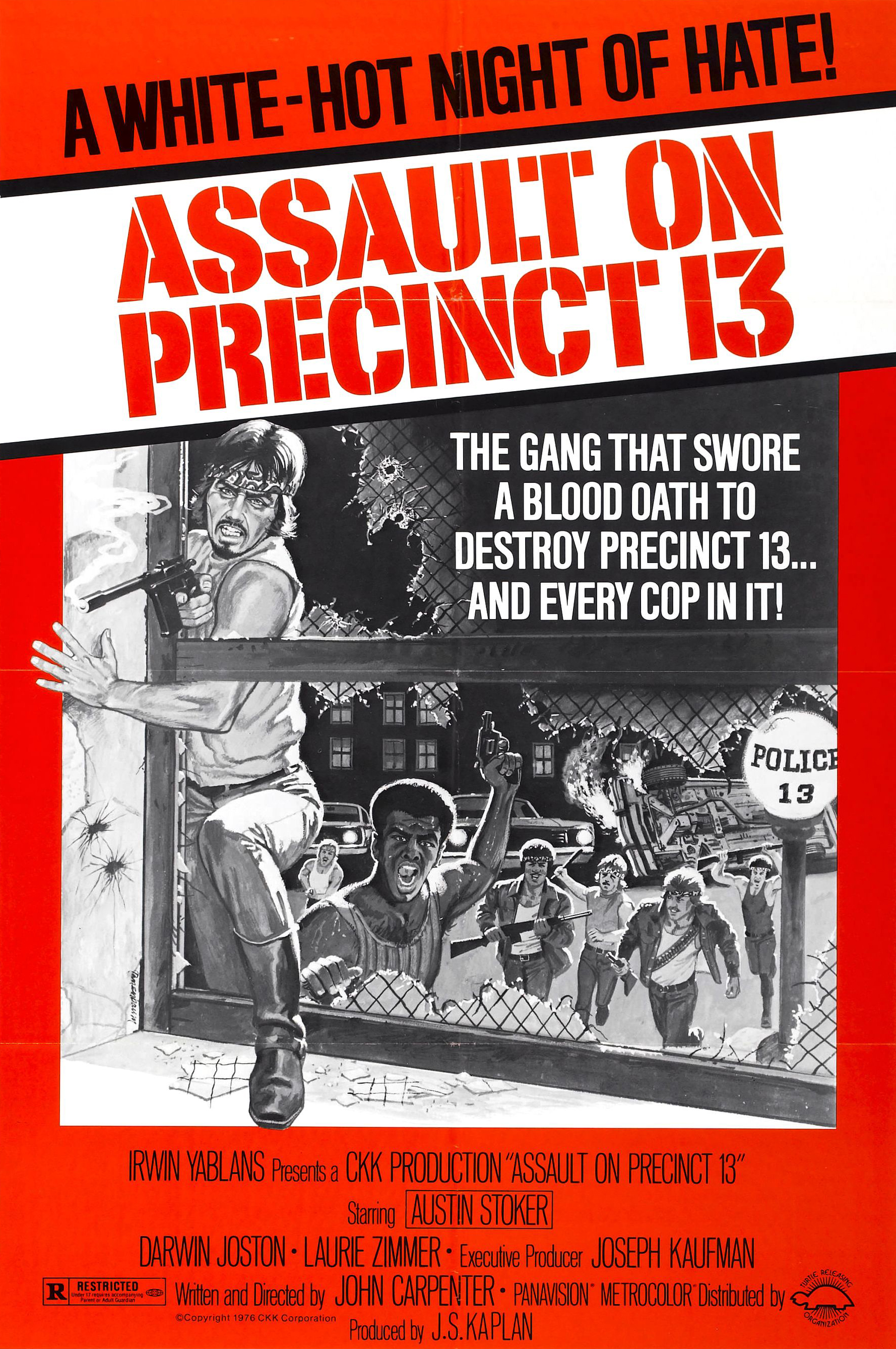
In the most simple terms, Assault on Precinct 13 concerns a motley crew of individuals on both sides of the law, quite literally. Lieutenant Ethan Bishop (Austin Stoker) is a dignified police officer with strong morals and a clear understanding of the division between right and wrong. He is sent to supervise the transition of a now-defunct police station – the titular Precinct 13 – which is moving to a new location but needs an authority to make sure everyone who needs help is directed towards the right place. The problem comes with a variety of visitors to the precinct, which is now suffering from their phone lines being cut, as well as their electricity supply. The first is Lawson (Martin West), an ordinary man who saw his daughter gunned down by ruthless gangsters who are now in full pursuit to get their retribution for his attempt to avenge his daughter’s death. Naturally, he seeks asylum in the defunct precinct, and unintentionally brings the gang along with him. Now without any electricity, no way to call the outside world and diminishing ammunition, Bishop and the feisty secretary Leigh (Laurie Zimmer), and a few others, have to fend off the ruthless criminals surrounding them. The salvation eventually arrives in the form of a prison bus, which is transporting a few prisoners across the country, one of them being the oddly-named Napoleon Wilson (Darwin Joston), an infamous mass murderer on his way to death row. Faced with no other choice, the policeman and the criminal have to team up for the greater good, to protect the lives of everyone in the precinct, and make sure no one else is harmed by these bloodthirsty thugs.
When looking at Assault on Precinct 13, the first thing that we need to focus on is the filmmaking, which is a discussion I normally save for towards the end, but considering how this film thrives the most with the extraordinary technical and creative prowess happening behind the camera, it is the key to the success of the film (Assault on Precinct 13 is certainly not best known for its attention to narrative detail in terms of the script, even though it is quite remarkable on that front as well). Carpenter creates a certain elegance in how he presents the film as not necessarily a straightforward action film – the story itself is already slightly derivative and not exactly the most audacious of ideas in terms of the concept, but rather succeeds mostly on the execution of the story. There is so much going on in this film, which is a result of Carpenter not setting out to make a direct action film, but something a bit deeper, which we’ll consider later on. The first element of this film the audience notices is naturally the score – there are few horror filmmakers that focus on music as much as Carpenter, whose chilling score to Halloween is amongst the most iconic film scores of all time. Assault on Precinct 13 is not different in any way. Carpenter’s electronic score is still impressive by today’s standard, thus in 1976, it was beyond groundbreaking. It sets the tone and informs us that we are not going to be witness to a traditional action film with a predictable structure and taut conventions. It’s calm but unsettling, and it contributes to the general unease and tension present throughout the film without ever drawing attention away from what’s on the screen.
In fact, what’s on the screen is perhaps the most interesting part of Assault on Precinct 13 overall. The visuals in this film are beyond remarkable, with some sequences in this film being amongst the finest in the genre’s history. There are so many scenes where we see utterly awe-inspiring visual work, but one that stands out more than any of the others occurs midway through the film, where all our protagonists have decided to work together, and have just acquired their own weapons, and team up to launch a cataclysmic bombardment of bullets on their terrorizers. The way Carpenter and cinematographer Douglas Knapp depict this scene, cutting between the various protagonists, is so simple, but also deeply original and utterly spellbinding to witness. This is less of a gunfight and more of an unconventionally beautiful display of unhinged violence, choreographed with the broad convictions of a classic Hollywood musical, and edited with exceptional precision. From time to time, you’ll find people mentioning their experiences in being aware of the camera and its purpose when watching a film, and not just seeing it as an objective tool to record a film, but also as a means to portray broader concepts. Assault on Precinct 13 was one of the first times I have positively been aware of the editing present in the film. Carpenter, working under the pseudonym John T. Chance, edits this film with almost unprecedented precision, and being one of the few films that make the audience fully attentive to the artistry that goes into editing films like this. Perhaps it may not be the most enthralling concept, but when you witness the organized chaos that went into taking an outrageous film like Assault on Precinct 13, and asserting a masterful control over how these scenes come together, you’ll understand precisely how, despite its more intangible merits such as the thematic content and the storyline, this film is a technical wonder, and without this attention to the visual presentation of the film, and ensuring it is as cohesive as it can be, Assault on Precinct 13 would not have been nearly as effective.
We certainly can’t neglect the character work that went into this film, because despite being mainly an action film, Carpenter’s approach to the characters was also quite remarkable. The director takes tropes and openly subverts them, giving us a cast of characters that are each distinct and unique, both in comparison to the other characters, but also in the broader scheme of the genre(s) Carpenter uses to construct this film. Considering the subject matter and the nature of the story, it is notable that Assault on Precinct 13 is an oddly character-driven film, and a great deal of the tension doesn’t necessarily come from the action sequences, but from the relationships between these characters. The idea of two individuals like Bishop and Wilson, who essentially represent good and evil, working side by side against a more malicious enemy, is a fascinating concept, and it works extremely well in proving that there doesn’t necessarily have to be a binary of heroes and villains and that there can be a range of conflicting traits exhibited in both archetypes. In terms of the performances, the cast was small but impactful – naturally, Austin Stoker is central to the film and brings a certain morality to an otherwise bleak film. If Carpenter was really inspired by Rio Bravo, its hardly surprising that Stoker takes on the John Wayne surrogate, the calm and resourceful hero that binds everyone together and becomes the de facto leader of the whole operation. However, the most interesting performance comes from Darwin Joston, who plays the sinister but still strangely charming Napoleon Wilson, who is shown, despite his crimes, to still have some semblance of decency. Carpenter does extremely well in leaving the ending of the film vague, because whichever way his story ended, if we were given a definitive answer to what happens to Wilson afterwards, it would betray the complexities of the character – making him a free man would be unrealistic, sending him back to prison would be unsatisfying, and killing him off outright would just be cruel. Carpenter creates unique characters in Assault on Precinct 13, and the actors are magnificent in their approach to interpreting them as both subversions of familiar archetypes, and believable individuals in their own right.
Assault on Precinct 13 is almost entirely uncategorizable, mainly because Carpenter blends genres and conventions in a very unorthodox but still extremely simple way. As alluded to previously, this film is often compared to Rio Bravo in terms of the story, and how it takes the form of an urban, contemporary western with its use of an ensemble of unique characters. However, another film that has been cited as an inspiration on this one is also slightly more fascinating – George A. Romero’s Night of the Living Dead. Throughout the duration of Assault on Precinct 13, I kept realizing that this was was a slasher horror film masquerading as a pulpy exploitation film. Despite the action at the core, the film appears very similar to horror precisely because of its central focus being on a group of individuals gradually falling victim to these mysterious entities that seek out to destroy them without any real motivation. Trapped against their will, and forced to fend off the encroaching forces of malice, they have no choice but to take matters into their own hand – to them, it’s not about winning, it’s about surviving, which is the cornerstone of the slasher genre, which Carpenter would help define two years later. Moreover, another concept that relates to the broader genre debate is that much like Romero’s Dead films, Assault on Precinct 13 has a group of villains that are almost animalistic – none of them talks at any point in the film, and they seem to lack any coherent conscience, killing on sight and seemingly without any remorse of even real, palpable motivation. Assault on Precinct 13 is often considered a really great action film, but to look deeper at the way in which Carpenter borrows liberally from other genres proves that this is far more complex than it initially appears.
Ultimately, Assault on Precinct 13 is a tremendous film. On a purely surface level, it is an entertaining, pulpy exploitation film with some artistic merit and a really exceptional execution. When we look slightly deeper, however, we discover how this is one of the most intelligent action films ever made, being a marvel in both the story it tells (featuring some of the most compelling protagonists in the genre’s history) and how it is made by someone with such a firm grasp on his craft, with Carpenter using his passion not only for groundbreaking, innovative cinema but also for his own love of movies, to make something that is, even by today’s standards, an astonishing visual and creative achievement. Whether it be the director’s nerve-inducing electronic score, or the cinematography and editing that present the viewer with innumerable moments of relentless, awe-inspiring brilliance, or the performances from a cast that elevate characters that could’ve very easily been one-dimensional tropes, and turning them into some of the most captivating performances of the year. Assault on Precinct 13 is a terrific film, and despite the inelegance of subsequent films of the genre, manages to be a smart, gripping cinematic experience that isn’t only fascinating, but just so enthralling to witness as well.
 The Postmodern Pelican
Carpenter is a god. What a thorough review. I’m going to put this in my queue. It’s been a while since I’ve seen it…
Carpenter is a god, and this movie is overlooked. I need to revisit it again.