 There are two types of memorable films – the first is one that attempts to revolutionize the cinematic form, being intellectual, thought-provoking works that thrive on their originality, their narrative idiosyncracies and their technical prowess to create otherwise unforgettable experiences that would be difficult to replicate, and go on to inspire countless other artists to continue honing their craft and creating audacious works. The second type is films that have one specific aim: to entertain their audiences, and despite often being predictable and usually not particularly original, they can leave the viewer with a familiar sensation, a certain comforting warmth that isn’t always available when it comes to the more artistically-charged works. Green Book is a film that most certainly occupies the latter category – it isn’t a film I’d necessarily call the most stimulating, and it does feature many of the same irksome conventions as similar films, but it would be wrong to not see Green Book as a charming, diverting exercise in harmless social commentary, a well-meaning dosage of good-humoured escapism, one that has two notable leading performances, and a unique approach to a sensitive issue that may not make too much of an impactful statement, but it is lovable enough to possibly change just a few hearts and minds, and make us realize that whatever inconsequential matters divide us, we are all united under the common experience of being human. It may not be particularly good, and its reputation may continue to falter due to it’s over-simplicity and reliance on outdated themes, but it has a good heart – but is that enough? The message is there, but can the film actually convey it in a way that makes a real impact. The answer is unfortunately not, and Green Book, while very popular, is just not very good.
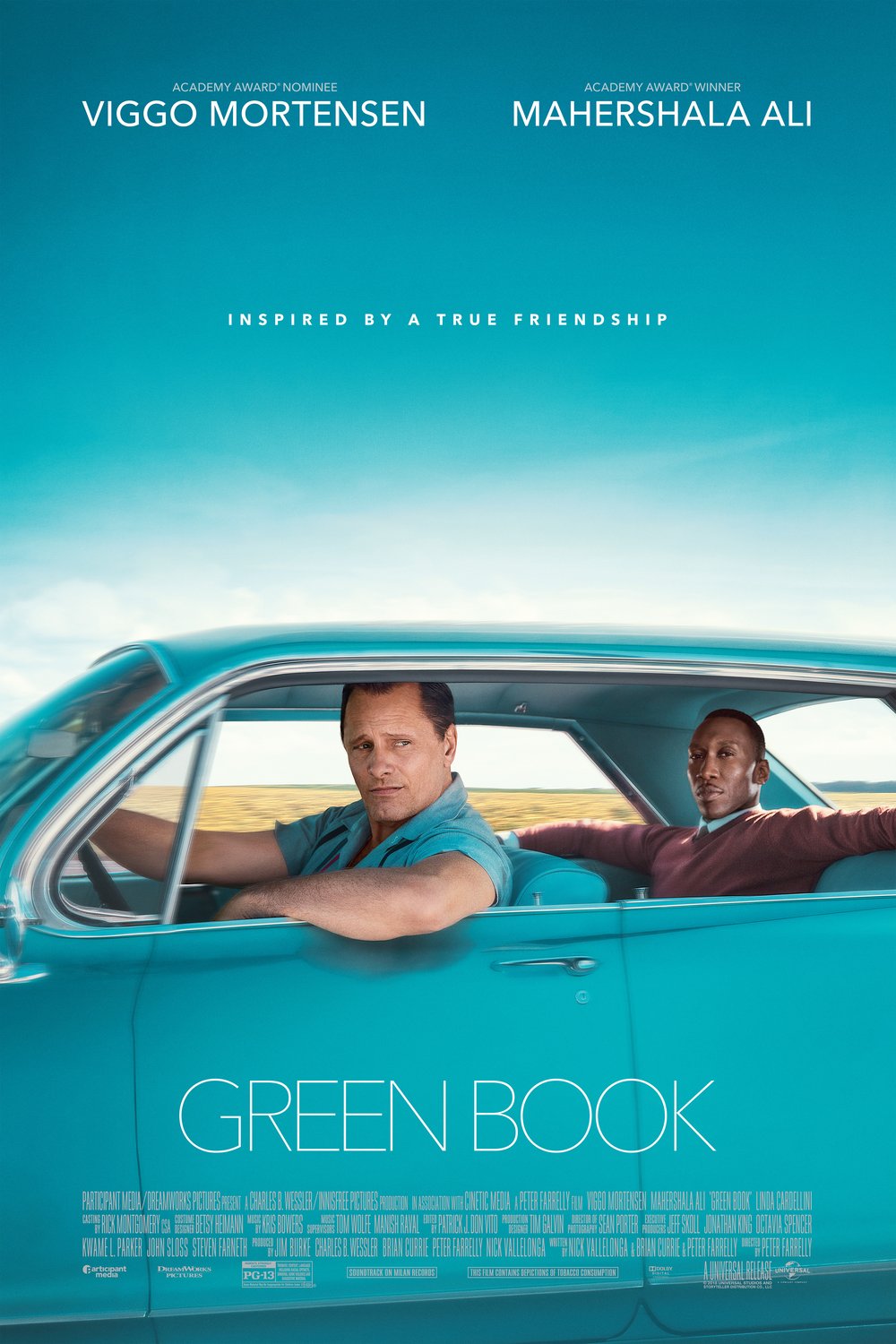
Tony Vallelonga (Viggo Mortensen), who goes by the nickname “Tony Lip” is an Italian-American man living and working in New York in the 1960s. A former sanitation man, he is currently a bouncer at the swanky Copacabana, which sees him interacting with a variety of characters, and taking care of the more rowdy visitors to the prestigious establishment. When the club is closed temporarily for renovations, Tony is out of a job for a while – and his salvation comes in the form of a call from someone representing Dr Don Shirley (Mahershala Ali), a piano virtuoso who is well-regarded in the cultured circles of America, which manage to temporarily look past the fact that he is a black man performing “white” music. Tony is to be Shirley’s chauffeur, bodyguard, valet and most importantly, his companion, as he undergoes an eight-week tour of the Deep South, where someone like Shirley, as intelligent and influential as he is, will be bound to encounter trouble at the hands of some severely bigoted individuals who don’t quite take the same shine to him as his more progressive colleagues do. Over the course of their journey, both men grow exponentially – Tony is able to let go of his prejudices as he gets to know Shirley, who in turn lets go of his own inhibitions, becomes less uptight and starts to realize that there is a world outside of his high-society life, and that some of the most empathetic, fascinating people are those who seem the most ordinary and unassuming. Who would’ve thought all it took to unite two very different people was an eight-week trip across the most prejudiced parts of the country? All the hard work of other people who suffered, all the violence, hatred and bigotry that pervaded the country – all that needed to repair it was a road trip.
Here is a belief I’ve held for the longest time – if a film stars Viggo Mortensen, we should expect something worthwhile, even if the film he’s in doesn’t necessarily warrant the same expectations. He is an actor who can elevate the most mundane, banal material into something worth watching, and there have been many instances where he has lent his talents to films that would not have been nearly as good had it not been for Mortensen’s quiet intensity and effortless ability to play any character with a remarkable dedication very often missing from his peers, with Mortensen always disappearing into his roles, but without the fanfare of some of his contemporaries. His performance as Tony Lip here is one of the more interesting moments in his career – I definitely wouldn’t qualify this as being amongst his best, because not only does he have a career of some truly extraordinary performances, what he does in Green Book isn’t entirely without flaws, and often veers off into the territory of being beneath what we’ve seen from Mortensen (becoming one of his most excessive, overly-melodramatic performances). Needless to say, Mortensen has been able to take forgettable characters and turn them into something quite impactful, and regardless of how he lacks restraint and subtlety in the role, he does put in the effort to humanize Tony, taking him from being a bigoted brute and making him appear to be someone who undergoes a significant change – and the fact that Mortensen took on such an unexpected role and turned it into something unique is testament not only to his remarkable talents but also to his ability to portray any character, even a glorified cartoon such as Tony Lip. I wouldn’t say Green Book is a film too concerned with the anthropological mechanics of a character – and with the exception of the two leads and perhaps one or two auxiliary characters, everyone is slotted into preordained categories of being tolerant or bigoted (one of the films most significant flaws – there is such an overt lack of characterization, everyone being quite binary in regards to race relations) – but at least Mortensen tries to create the illusion that this character actually manages to undergo a significant change of heart – and perhaps he did, and we should praise him for his unique interpretation of a stock character, one that is usually an inconsequential minor character as opposed to the lead. In that regard, Green Book is a noteworthy film, as is Mortensen’s performance, which may be dire in its imperfections and may often be unintentionally funny, but still has its charms. They may be few and far between, and most of Green Book will require the viewer to suspend disbelief that this is the same performer behind extraordinary turns such as Captain Fantastic, A History of Violence and Eastern Promises. But I suppose a man has to eat, and at least Green Book exposed Mortensen to a wider audience, especially those who aren’t particularly enamoured with The Lord of the Rings.
The heart of Green Book is on the two leads, and the other half of the duo is perhaps the reason this film is worth one’s time (and believe me, you’ll need a reason to sit through this film) – Mahershala Ali is rapidly becoming one of his generation’s greatest actors – a performer who has been in a range of films, grappling various genres and conventions, always demonstrating his elegance that goes seemingly unmatched. Green Book is also not his defining performance, but it certainly is a fascinating addition to his steadily-growing career, which is only increasing in diversity and quality as his incredible skills as an actor get noticed by mainstream filmmakers and arthouse auteurs alike. Playing the legendary Don Shirley would be a challenge for any performer – he needs to appear dignified and have clearly-defined pretentions that portray him as a connoisseur of the good life, but not be too aloof to not accept change, because that would prevent the audience from connecting with him – just like how most of Green Book follows Tony Vallelonga as he grows more tolerant, a similar process occurs for Shirley – he is taught to be more open to new experiences, to look at life not as something he has mastered in his own way, but as a journey, filled with obstacles and diversions, and rather than hiding in his luxurious apartment above Carnegie Hall, perhaps going out and experiencing life, with all of its difficulties and pratfalls. Ali is masterful in Green Book – it is an honest, raw and brutally moving performance, filled with heartbreak and humour, dignity and despair and a bevvy of complexities rarely seen in these kinds of films. It would almost appear that Ali’s performance belongs in a much better film – but when we consider how Green Book finds its success in the central duo, and how it soars when both leads are at their best, we understand Ali isn’t great in a middling film – he is the reason why this film isn’t dreadful, but rather just plainly mediocre, with the actor elevating the material massively, portraying Shirley, not as a stereotype, but as a real person, someone with flaws, exposed fully through Ali’s incredible performance, filled with vulnerability and charm, making this one of the year’s most unexpectedly great turns from an actor well on his way to being one of his generation’s most consistently great performers. Considering Mortensen’s performance, as entertaining as it was, seems to be constructed from some fragmented Italian-American tough guy stereotypes, it is odd that Ali, in what is mostly a subtle performance, can manage to have such terrific chemistry with him.
Green Book is a film that makes its central theme very apparent, and rather than skirting around the issue, it addresses it directly (or as much as a film that proposes to solve racism through friendship can be direct). The theme of racism is approached in a way that is disconcerting but not entirely heavy-handed, and the way it was constructed, for better or for worse, was done to be more palatable to audiences. I am sure I’m not the only person who thought the best person to make a film focused on race relations was certainly not the co-director of Dumb and Dumber and There’s Something About Mary – and to realize the fact that Peter Farrelly somehow found it within himself to make his first serious foray into meaningful cinema be Green Book, a sweetly melancholic and often very funny, albeit extremely sensitive, film about racial differences in the Civil Rights Era makes me believe anything is possible (not that everything should be possible, and this film would’ve been just as good had it been left unmade). Green Book is a film concerned with a few central questions, both in the more internal aspects of the characters and their relationship, and through the more external aspects of social perception, whether it be directly through the events of the film, or by how these issues are approached in the artistic form – can social issues be repaired through good-natured storytelling that may not be too inciting but certainly do strike a chord with audiences? Can differences between individuals on different ends of the social spectrum be resolved through as simple a concept as friendship? How do we reconcile our own prejudices in the pursuit of some deeper connection with our fellow human being? These are broad questions, and perhaps are far too difficult to properly answer, even with the most intricate and nuanced of films – but as much as Green Book may not be particularly groundbreaking, its underlying message is certainly very potent – the key to changing hearts and minds is as simple as realizing how understanding your fellow man and having empathy for their own individual situation, their lifetime of different experiences and current circumstances that separate us into unnecessary groups, is pivotal to bridging the gap that continues to make it appear like we are different, when in actuality, we are all the same, in our own individual way…but is it enough? Green Book is a film with an admirable message, but its execution is just severely flawed – one can only wonder what this film could’ve been had the idea of friendship bridging the gap been the starting point, rather than the eventual destination. In 2018, we know racism is bad – and in that same year, there were dozens of films about race that took new and unique approaches to addressing the problems. Green Book may be a crowd-pleaser and be something audiences can enjoy – but do we really need to be entertained by films about racism, even if they are against it? It just doesn’t seem appropriate and feels like something that would’ve found a better place a few decades ago, rather than being made today.
Audiences have certainly been divided on Green Book, with the general public seem to be overly enamoured with this film, while it has often been derided by those with a penchant for high-brow art – but what I feel the detractors of this film do neglect (even though their criticisms are relevant, and I agree with many of them, especially in how they criticize this film’s juvenile approach to telling a very important story) is that Green Book masterfully uses its social message in a way that gets through to audiences without preaching, or coming across as being unnecessarily grave or overbearing. With the exception of a few scattered moments, this film is relatively modest in how it portrays its message – it is hardly too heavy-handed in its approach to its very serious themes, and it looks at race relations through the central dynamic of the two leads, imbuing their relationship with good-natured humour and placing them in situations of conflict that test their individual virtues and how they perceive the other, but ones that are not necessarily overloaded with emotional manipulation, and are more intent on representing them through simple and honest human interactions. Perhaps the most reductive way to describe Green Book is as a racially-charged version of the taut “Odd Couple” trope, and while this perhaps isn’t the most appropriate way to represent this kind of story, Farrelly and his coterie of writers behind Green Book do manage to pull it off effectively, and while this film could’ve been much better, the fact that it managed to be inoffensive to the point where it isn’t a travesty is a masterful achievement on its own.
However, not everything about Green Book is necessarily good, and it does fail in many regards. Firstly, this is not a particularly original film, and it feels like we’ve seen the same message repeated in various iterations throughout the years – perhaps most directly in the seminal classic of false sentimentality, Driving Miss Daisy. Just because these issues have been repeated throughout the years to the point where they are so predictable and taut doesn’t mean these issues don’t exist – it just means that Green Book is just another one of the countless films that approach the same subject through the same means, taking on a sensitive issue but in a way that that is extremely safe and often dismissively expected, because Green Book is not trying to make anyone uncomfortable, nor does it intend to challenge the audience – it is an attempt to unite viewers, regardless of their background, under the common categorization of humanity, and to stir any controversy would be fatal for this film, and we all know the creative team behind this film was not equipped to handle anything more subtle or intelligent. Green Book, to its credit, isn’t ever trying to be the definitive statement on race relations in the era of Civil Rights, nor does it attempt to be an honest representation of the relationship between the two men. Green Book is a harmless film, and it would be wrong to suggest it should’ve tried to be more provocative, but as a result of its overly innocuous approach, it does devolve into something extremely simple and without much artistic merit, other than being a well-meaning and wholesome, but otherwise simplistic, experience. The mantra of this film is that while it is quite insignificant and often extremely negligent of some aspects of history, it could’ve been worse.
Overall, Green Book is a film that doesn’t require much from the audience, as long as we don’t expect too much either, and whoever goes into this film expecting much is bound to be disappointed. It is an entertaining film to an extent and one that does have some meaning beneath its often saccharine execution, albeit one that often feels quite forced. It is a uniting force of a film, not necessarily because it makes any bold statements about politics or society, but rather shows the unimpeachable beauty of humanity – underneath all the hatred, bigotry and suffering in the world, there is an underlying sense of unity, one that brings individuals from all backgrounds together through the simple but pivotal act of understanding one another and changing our own perception of others. Green Book is a very warm and endearing film and audiences have responded to it with a lot of adoration, but not much else can be said about this film. It may look at the concept of friendship as a way to overcome differences, and that certainly is a good way to start a discussion – but it just does not bother to take that conversation anywhere, opting for the more toothless route, where nothing uncomfortable dare be found within this film. Ultimately, Green Book is not an abomination – I do think some detractors are unnecessarily cruel towards this film because it does have a peaceful message at its core. But that’s simply just not enough. The best Green Book can hope for is to be viewed, enjoyed and subsequently forgotten, replaced by something with artistic merit, some semblance of intelligence and respect for the audience, because as sweet and endearing as Green Book may be, the viewer is force-fed artificial sentimentality, told what to feel and left with a giddy warmth, but one that is entirely constructed. Ultimately, Green Book is troubling at worst, mediocre at best. It may not offend, but its certainly far from being as good as it thinks it is – and it seems to be so blissfully unaware of its shortcomings to the point where it thinks itself to be much better than it actually is. The message in Green Book matters and should be remembered. The same cannot be said about the film.
 The Postmodern Pelican
As a white man raising two young men of color, I had to wrestle with my feelings after seeing Green Book. Frankly that occurs for me with many stories of race. While all are thought provoking, this film feels more challenging.
I have read some who feel that Green Book is similar to Driving Miss Daisy. I disagree. That is a knee jerk response. Putting people of different races in the closed confines of a car for a two hour story is a similar plot device. The films, to my mind, explore very different issues. Driving Miss Daisy uses the themes of racial equality and religious tolerance to provide a deeper dialogue about how the indignities of aging and the deterioration of the body and mind levels the playing field for class, race and religion. As I grow older and begin to see that destination to my journey, I have an appreciation for what writer Alfred Uhry was hoping to explore in his story which ultimately earned him an Oscar and a Pulitzer Prize.
I do agree that Green Book has the feel of a populist film of the 1980s. However, I see greater similarities with the road trip comedy of two half-brothers in Rain Man. In the 1988 Best Picture winner, Charlie and Raymond are driving across the US. Raymond is a savant who has been institutionalized for most of Charlie’s life. Further, Charlie’s father never revealed to him that he had a half brother. The two men, who don’t really know one another, take a road trip that builds a strong emotional bond. Doesn’t that sound more like Green Book? Well, it does to me.
Tony Vallelonga, a smooth talking, lower class Italian bouncer (read: thug) is employed for two months prior to Christmas in the early 1960s to chauffeur Dr. Donald Shirley, an African American pianist who holds three doctorates and speaks eight languages, on a two month performance tour of the Deep South. Surprisingly, the achievements of Shirley are not embellished. Actually, little is. The actual length of employment for Vallelonga was 18 months, certainly a longer time to develop a meaningful friendship. The other noted discrepancy is in the portrayal of hotel accommodations for African Americans that were referenced in the Green Book are depicted as less inviting than they actually were.
Having lived as a child in the Deep South during the infancy of the Civil Rights Movement and then returning three decades later to the Deep South to attend graduate school, I found much of Green Book consistent with my memory. In neither time period did I have funds to attend those luxurious country club events, but I was aware of them. I thought the cinematography of Sean Porter to be particularly skilled in capturing not only the beauty of the South but the oppressive nature of the land. I could feel the humidity rise from the asphalt road. There Is one moment that resonated for me. In a rural area, car trouble stops the drive. Dr. Shirley (Mahershala Ali in a finely modulated performance) gets out of the back seat. Dressed in a fine, grey linen suit, the New York resident stands and looks across the road. Behind a ramshackle fence are a group of sharecroppers working the land. Dressed in sweat stained layers, they pause in their labors to study this visitor. Nothing is said. As eyes meet, a wealth of subtext is present but left unspoken. For me, it was a highlight of the film. I was placed in a circumstance that my race prevents me from truly understanding the unspoken thoughts shared and left to think about what I’ve seen. And I still am. It’s terrific filmmaking.
Yet, there lies a moment that does not qualify as terrific filmmaking. Shirley’s mother died in his youth. He was trained at conservatory. His intellect has left him a lonely man. He lives in an ostentatious apartment in the floors above Carnegie Hall. He is divorced. He is estranged from his brother. Though not discussed, each incident of familial discord is probably a result of his closeted sexuality. Vallelonga enjoys listening to popular black musicians and eating fried chicken. He is astonished that Shirley doesn’t know these artists nor has ever tasted friend chicken. Vallelonga suggests that he is more black than Shirley.
The stupidity of such an assumption is not properly addressed in the film. It just lies there. The failure is the filmmakers to explore the ramifications of such a statement is offensive. In a political era where the President of the United States can defend the attendees of white power rallies, the ramifications of such a statement is inexcusable.
Green Book tells an interesting road trip story. The performances of Viggo Mortensen as Tony and Ali are strong. They are terrific actors. Production vaues are top notch. And yet . . .
When you watch Rain Man, it’s Raymond, the isolated savant who lives an interior life, who you want to get to know and understand. I forgot about Charlie and his shiny suits and reflective eyewear five minutes after the movie. Green Book is like the filmmakers focused the story on Charlie and ignored the fascinating man in the back seat that we really want to know and understand. It’s a disappointment.