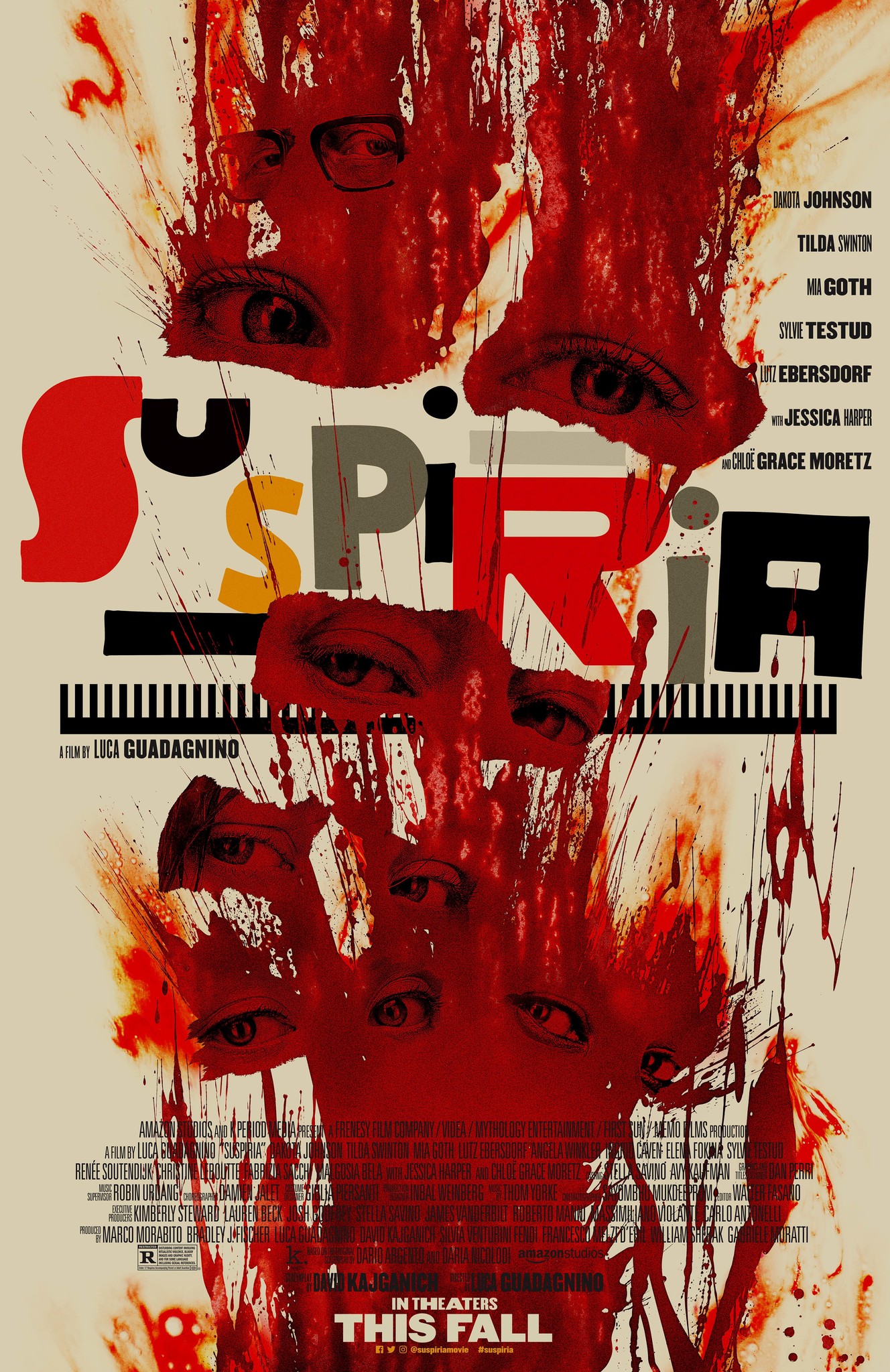
 There has been a recent trend in cinema that is both horrifying and absolutely riveting – horror films are becoming more psychologically-scarring, and feature sequences of unhinged, anarchic insanity, normally devoting the entire third act to reckless terror. Recent examples include Darren Aronofksy’s mother! and Ari Aster’s Hereditary, two extremely audacious and utterly terrifying works. However, they are nothing compared to another film, one that makes them look almost insignificant in comparison. In adapting Dario Argento’s seminal 1977 horror masterpiece Suspiria, Luca Guadagnino has made something extraordinary – chilling, complex and extremely beautiful, albeit in ways that are sometimes entirely unexpected. It is a film that isn’t fully impactful immediately but settles within your consciousness and burrows into your mind, leaving an indelible impression and remaining with you long after the film has ended, inciting terror-fueled ponderings and perhaps a minor existential crisis. In short, Suspiria is a modern horror masterwork, and while it is suitably divisive – there wasn’t much possibility that this would be universally-adored, and in a way it is more appropriate for a film like Suspiria to have both its ardent admirers and vicious detractors – its has its undeniable merits that makes this memorable filmmaking in every sense of the word.
Guadagnino had mentioned during the making of Suspiria that this was not intended to be a remake or reboot of Argento’s iconic film, but rather a homage, a film built around the skeletal structure of the story, and featuring some of the same themes, while introducing further concepts along the way to create a similar but still starkly different work – we will discuss some of the differences between this film and the original momentarily. Set in Berlin (as opposed to the city of Freiburg im Breisgau, as in the original) and in the year 1977 – making this a period piece, unlike the original – and focusing on Susie Bannion (Dakota Johnson), a precocious young American dancer who successfully applies to attend the prestigious Markos Tanz Akademie, a world-renowned dance school run by the tough but loving Madame Veva Blanc (Tilda Swinton), and a host of other women who offer their support, guidance and (when necessary) discipline. Meanwhile, a local psychotherapist named Professor Josef Klemperer (Tilda Swinton, credited as Lutz Ebersdorf) investigates the disappearance of another young dancer from the academy, uncovering the possibility that the school is run by a coven of witches, controlled by the malicious and decrepit centuries-old witch, Helena Markos (Tilda Swinton, who goes uncredited for this part), who claims to be Mother Suspiriorum, one of a trio of ancient witches who have roamed the earth for centuries. At the core of this story is Susie, who just simply wants to dance, but slowly starts to notice the underlying malice lurking within the hallowed halls of the school – but is there something more to Susie as well?
In an act of full disclosure, I need to admit that it has been a very long time since I saw the original, having first seen it when I was a neophyte of a cinephile, and thus while I do remember parts of the original (and most certainly need to revisit it), it has allowed me to view the 2018 film on its own. I considered revisiting Argento’s original in preparation for this one but opted against it in an effort to allow Guadagnino’s to stand on its own terms. One of the most fundamental differences that many have noted is that the 2018 film is far more bleak and visually-barren. The lush, rich colours of the original (which almost entirely define it) are missing, for the sake of buttressing the cold, arid atmosphere of the film. There are brief splashes of colour throughout the film that only become more apparent as the film progresses, normally being saturated red, evoking both warmth and danger. Another primary difference is that this version of Suspiria is more historically-resonant, being set in divided Berlin during the peak of the Cold War. This isn’t of primary importance, as the story around the film is not particularly focused on exploring the underlying socio-political themes of its era, but rather using it to add emphasis to the story. The young American woman from Ohio travelling to divided Berlin has some significance – I’m not entirely sure what the total reasoning behind this was, but there was certainly something there. The dark and sinister tone of the film that is often briefly broken by moments of cathartic beauty creates the illusion that this was a difficult time in European history, but one that could be overcome in some way. Suspiria stands as a powerful statement, and it is admirable that Guadagnino avoided making this a direct remake – and the final act is quite extraordinary and deviates from the original ways not even the most alert of viewers could imagine. It is fruitless to compare the two films because they are certainly extremely different works, just sharing the same title and basic story – other than that, they could not be more different. It has been mentioned innumerable times by all involved in this version that it is merely inspired by Argento’s film, and the viewer should view it as such.
Suspiria has a magnificent ensemble, but it is built mostly around three central performances, two of which are given by Dakota Johnson (collaborating with Guadagnino again after her wonderful work with him on A Bigger Splash) and Mia Goth, who is already an arthouse regular. As the two young dancers who slowly start to unravel the hidden secrets of the Markos Tanz Akademie, they have a difficult task in being the audience surrogates – they are our guides into this dark, sinister world, and we watch as they experience the supernatural evils that pervade the dance school, knowing that if they try and escape, they will be subjected to the same fates as some other students who tried to leave, but found themselves disappearing mysteriously. Goth is explosively good as Sara, playing her with a blend of innocent curiosity and unhinged fearfulness. The film is centred mainly on Johnson’s character, but Goth is equally as good, not being particularly prominent at the start, but having her importance increase as the film goes on. Johnson is a supremely talented actress, and while some of her choices in films have been less than ideal, it is clear that in spite of the poor quality of some of her work, she is certainly very gifted, and it is auteurs like Guadagnino that bring out her true brilliance. For the first two acts, Johnson is masterful at playing Susie as a talented but naive young woman who moves from rural Ohio to the urbanity of Berlin, adjusting to the life in a big city at the centre of a worldwide socio-political conflict. Then in the third act, when the film truly descends into unhinged madness, so does her performance, and the major change in Susie’s character is deftly conveyed by Johnson, who exceeds every expectation the viewer has. This is a magnificent performance from an actress whose profile is steadily rising and will continue to ascend to marvellous new heights as long as she perseveres with such brilliant work.
Now here is some brand new information – Tilda Swinton is probably the greatest actress working today. No other performer has ever been able to be as chameleonic as Swinton, and her career is populated with a range of performances in a variety of films that show her as someone capable of doing nearly everything, shattering the well-built boundaries of performance. In Suspiria, Swinton takes on three different roles (at least that we know of – I would not be surprised to discover that Swinton played other characters as well) – and it wasn’t purely for the novelty of taking the finest performer of her generation and putting her in a range of roles, but rather because there was no one who could play these roles quite as well as her. We first meet Professor Josef Klemperer, the elderly widowed psychologist who is unwillingly thrust into the world of the Markos Tanz Akademie after the mysterious disappearance of one of his patients. Then we encounter Madame Blanc, the overbearing but loving head of the school, and the matriarch to the girls, someone who will greet every one of her dancers with a sympathetic kiss, before relentlessly scolding them for their weaknesses. Finally, towards the end, Helena Markos enters the story, with Swinton transforming into a grotesque, horrifying and almost reptilian individual who may only appear in the film for a very brief period, but already becomes one of horror cinema’s most malicious villains. Swinton never fails to impress me, and Suspiria was not an exception – she disappears into these roles, and that isn’t only a result of the astonishing prosthetic work that physically transformed her, but also how she conveys the differences in these characters with such clarity and utter brilliance. There must be some underlying metaphysical reason as to why Swinton played these three characters – perhaps as they occupy different roles: the protagonist (Klemperer), mentor to the protagonist (Blanc) and antagonist (Markos), showing how we are all connected, how individuality exists, but singularity does not. Swinton is just such an extraordinary actress, and every time she stuns me with something like Suspiria, I always refuse to believe that she can ever top it, yet she always does.
Suspiria deftly avoids the same mistake many horror films tend to make, even the most intelligent of them. Unlike mother! or Hereditary which did have an underlying meaning, concealing it through unhinged terror, Suspiria is much more tranquil, and it reveals its intentions in a way that is far more paced and elegant. This is a film that is primarily about motherhood, as many pieces written on this film and the original have noted. To my memory, there is only one significant male character in the film (portrayed by a woman), and the only other male characters are minor police officers. This is a female-driven film, and it is impossible to not look at this as a subversion on maternal themes. Helena Markos is the omnipotent mother of an entire group of women who take the maternal role for another group of women, who in turn take the position of mentors to even another group of women – it is a cyclical structure, and the malice incited by Markos at the very top slowly pervades to the very bottom of the chain, slowly eroding at the naivete of the innocents. This is a tale of motherhood, but it is far from warm or comforting – rather, it looks at the despair and corruption that can come with negative influence. Throughout Suspiria, the theme of family is constantly repeated – Susie moves from Ohio, leaving behind a manipulative mother, to enter into another family, albeit a constructed one, headed by Madame Blanc, who is far more of a matriarch than she is a dance instructor. Yet, as the character who initially appears to be the most sinister, she is eventually revealed to be almost valiant in her willful determination to bring success to her students, who she genuinely seems to care about. There is so much that can be said about Suspiria from the perspective of these familial themes, and much like his previous work, Guadagnino incites the audience to ruminate on the thematic content, not being heavy-handed in how he tells the story, but allowing us to come to our own conclusions, which is the definition of an artist who inherently respects his audience.
Suspiria is an incredible film – and whether we look at the visual elements (with the film being photographed by Sayombhu Mukdeeprom, who previously worked with Guadagnino on his incredible magnum opus Call Me By Your Name), or the astonishing score by Thom Yorke, who trades in the visceral orchestrations of Goblin for more ethereal, heavenly compositions (“Suspirium” is one of the most beautiful songs written for a film, so delicate yet so powerful), or simply the performances from a large cast, each of which give committed, complex performances, with Dakota Johnson, Mia Goth and especially Tilda Swinton being of particular significance. Suspiria is a film that will certainly be polarizing, and reactions to this film have ranged from extreme contempt to puzzled to utter adoration. This is an extraordinary film, and I count myself in the group of people that adore it – it has its flaws, and it may be very different from what we’d expect, but in a film that is audacious enough to descend into such relentless anarchy, to take this story to such shocking dimensions and subject the audience to the most carnal, haunting storytelling, both visually and narratively, confirms that Suspiria is a masterwork. It certainly will have its detractors, but whether someone abhors or adores this film, I’m sure we can all agree on one thing: this film is never boring, and it is entirely memorable, for better or for worse.
 The Postmodern Pelican