 2018 has been an exceptional year for documentary filmmaking, and any lover of non-fiction filmmaking has been spoiled with a panoply of diverse and audacious works on a variety of subjects this year. From the warmth of Won’t You Be My Neighbor?, to the enigmatic love letter to cinema in Shirkers to the thrilling mystery at the core of Three Identical Strangers, we’ve been witness to some incredible filmmaking (and this is only a few of the many tremendous films we’ve been given access to this year). Another fantastic documentary released this year is Bing Liu’s Minding the Gap, an incredible story that tackles a multitude of resonant themes, from the concept of growing up and reaching maturity, overcoming adversity as well as dealing with some very grim issues that challenge far too many people than we realize. A masterful work of precise storytelling and beautiful imagery, Minding the Gap firmly stands as a towering piece of non-fiction filmmaking and is one of the year’s most astonishing achievements.
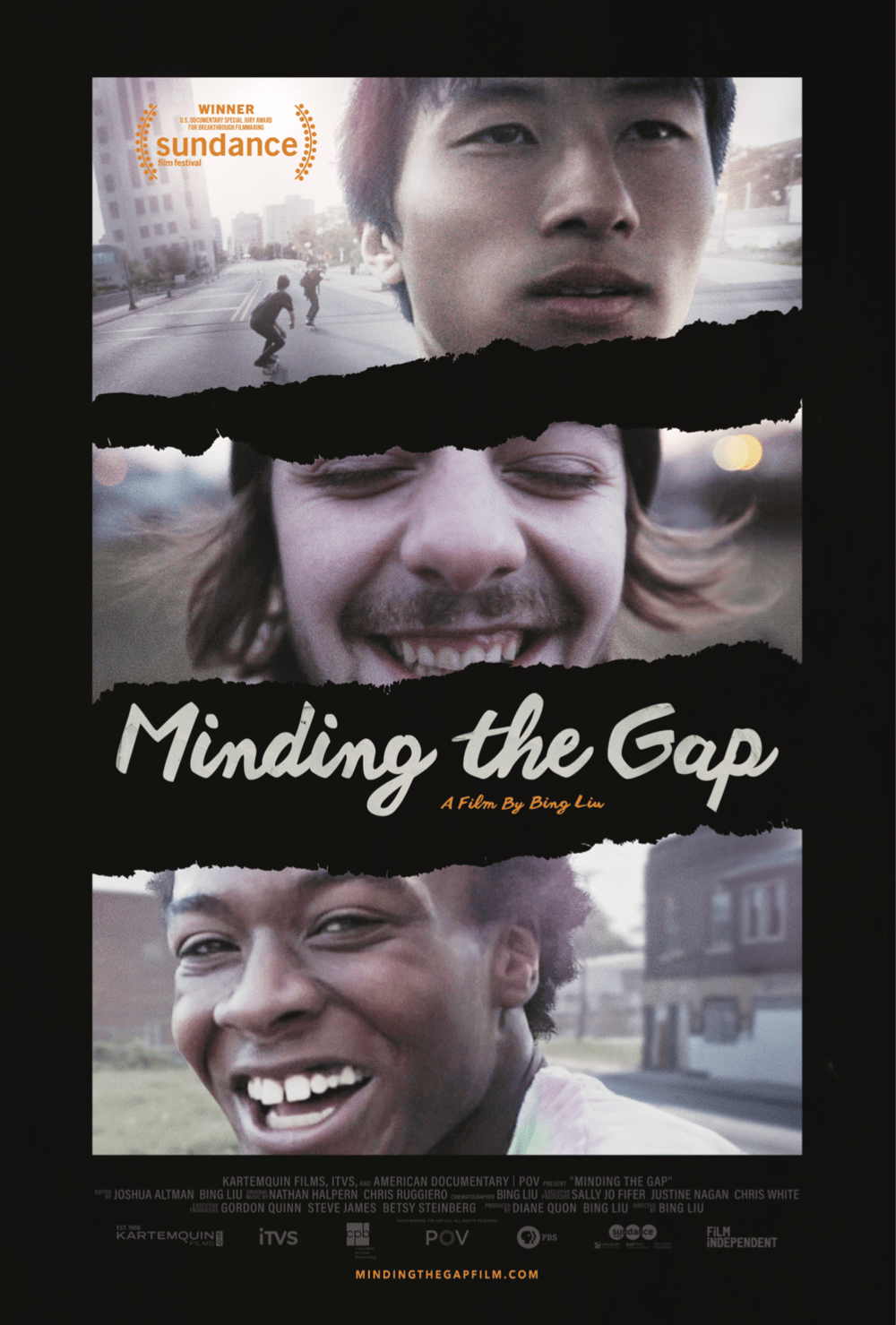
The documentary is focused on three friends – Kiere, Zack and Bing, who is the film’s director. For a number of years, he begins filming his friends as they grow up in Rockford, a working-class city in Illinois ravaged by poverty and crime. The film follows them from their teenage years right into adulthood. It chronicles their growth – physically, mentally and emotionally – as they deal with a variety of challenges – earning a living, raising a family and being functioning adults, in the midst of childhoods plagued with poverty and domestic abuse, which shows that the past continues to haunt us, lingering on in our lives even if we don’t entirely realize it. Liu’s camera follows their gradual transformation from boys to men, separated by different backgrounds, united by their shared love of skateboarding, and more than anything else, their intense desire to escape their small town and the struggles of the past.
Minding the Gap is not a conventional documentary – it doesn’t have much of a traditional narrative structure, lacking the progression to a specific point than most documentaries portray. It is also not a conventional documentary in the sense that it has some over-arching concept that it wishes to explore. Bing Liu, in making Minding the Gap, clearly did not set out to make something specific when he first picked up that camera years ago and began recording the trials and tribulations of his friends from his small town. It is clear that his intention was just to record their lives through as neutral a lens as possible. But as the film progressed, he began to question some bigger issues, gradually challenging the subjects of his film (including himself) to look critically at their individual pasts and determine how it shaped them as individuals. It is a very subtle film, and one that goes against the concept of a grand narrative, rather showing the lives of the three central individuals through a series of episodic moments, carefully arranged to create a fascinating mosaic of life in a working-class town, showing us the experiences of regular people that we would never be able to see otherwise, because they are ordinary individuals, but their stories become touching through the relentlessly sensitive but quietly provocative methods of the director.
What makes Minding the Gap such a unique film, other than its intention to just portray thing as they are, is the fact that it is a working-class manifesto not made by an outsider, but by someone fully-involved in the story. Bing Liu is as much a part of this story as the other two are, and his experiences, while not foregrounded most of the time, are portrayed effectively, and with the same discernment as those of Kiere and Zack. He probes beneath the surface and finds something far deeper than just life in Rockford, Illinois. Minding the Gap potentially started out as a way of recording everyday life – but as the director looked deeper into his life, and the lives of his friends, he discovered stark similarities even in their private lives. Child abuse, emotional neglect and domestic violence are undeniably very difficult subjects – and Liu makes sure to never once trivialize the experiences of the interviewees – this is a profoundly personal film, and rather than just being a novelty representation of a lost generation in a town many of us have never even heard of, its a powerful portrayal of a group of people bound by a variety of experiences.
Minding the Gap is a film about a whole lot more than just three people growing up – if we wanted to see something overly-simplistic focused entirely on the ravages of time on both the physical and emotional state of individuals, we might as well watch Richard Linklater’s audacious but otherwise hollow Boyhood. Minding the Gap takes a much more potent approach, and it is built on two concepts – joy and pain, and Liu makes the bold assertion to not only explore the fact that the one cannot exist without the other, but that it can make for some truly riveting cinema – something endlessly joyful and heartbreakingly unsettling at the exact same time. Minding the Gap looks at the wounds of the past, and how these characters deal with it, looking back at the past and exploring how it still influences us to this day, whether we are cognizant of this fact or not. The emotional core of Minding the Gap is extremely strong – we can see every iota of pain demonstrated in these individuals, and they break our hearts through their testimonies, many of which are reflecting on their childhoods and the experiences that shaped me, often masking the more disturbing undercurrents that would go unspoken had Liu not taken the risk of directly persuading his participants to engage with these uncomfortable memories, which they do with some reluctance, but understand this isn’t an exploitation of their misery, nor a sorrowful journey into their past sufferings – it is an attempt to show that even out of the harshest concrete, a beautiful rose can bloom.
What specifically makes Minding the Gap such a great film is that it never approaches its subject matter as being inherently urgent or necessarily even focusing on the more unsettling aspects of the lives of its participants. Instead, Liu has made a film that subverts the traditional expectations of such a documentary (not like there was much to go by already in terms of this being conventional by any means). For the most part, it is an easy-going and tranquil film, one filled to the brim with a multitude of memorable moments – some heartachingly beautiful, others outrageously hilarious – this is certainly not a miserable film, despite the downbeat territory it eventually begins to explore. The central trio’s love of skating is central to the film – there are many sequences when we see characters skating – it even bookends the film, creating a certain poignant circularity that ties this years-long odyssey into one coherent quilt of existential beauty. It also helps that Minding the Gap is beautifully-shot and edited. Liu was truly intent on portraying this story with a certain experimental overture, with the cinematography of the film suggesting that he wasn’t only recording life – he was also finding the inherent beauty hidden in every moment. Minding the Gap is far more visually-striking than many documentaries, and a large part of this film’s audacity comes from the very simple fact that not only is it very clearly a film without much of a coherent thread, rather opting for episodic moments, it also refuses to abide by the conventions of the genre. In this film, the images are just as important as the story they accompany, and even if the story doesn’t resonate with the viewer, the aesthetic beauty will be undeniably moving.
Minding the Gap is an essential film for a number of reasons. It is a film that many can relate to – it doesn’t show the lives of the rich and famous, nor does it chronicle the lives of people that are extraordinary by the more traditional sense of the word. It is a film about real people, made by real people. It is a portrait of the lives of individuals that is filled with genuine warmth and devastating heartbreak, and it relies very much on the most admirable of all artistic virtues – relentless honesty. It is a raw work of gritty realism, portrayed with effortless beauty and remarkable sincerity. It allows us an intimate look into a group of people who have bonded over shared joys and similar hardships, and it explores their attempts to overcome the various challenges that they come across in their metaphysical journey towards maturity, focused entirely on the resonant concept of finding your way despite the various obstacles we face. Bing Liu has made a slow-burner of a film – it may not appear to be much at the outset, but it captivates you fully, and by the time it has ended, you realize how it has all amounted to something quite extraordinary. Minding the Gap is an earnest and powerful debut for a director who is clearly proficient in both narrative skill and visual prowess, and the result is something that is absolutely remarkable and truly one of the year’s greatest discoveries, a delicate but impactful portrayal of society, presented in a way that is beautiful and wholly unforgettable.
 The Postmodern Pelican