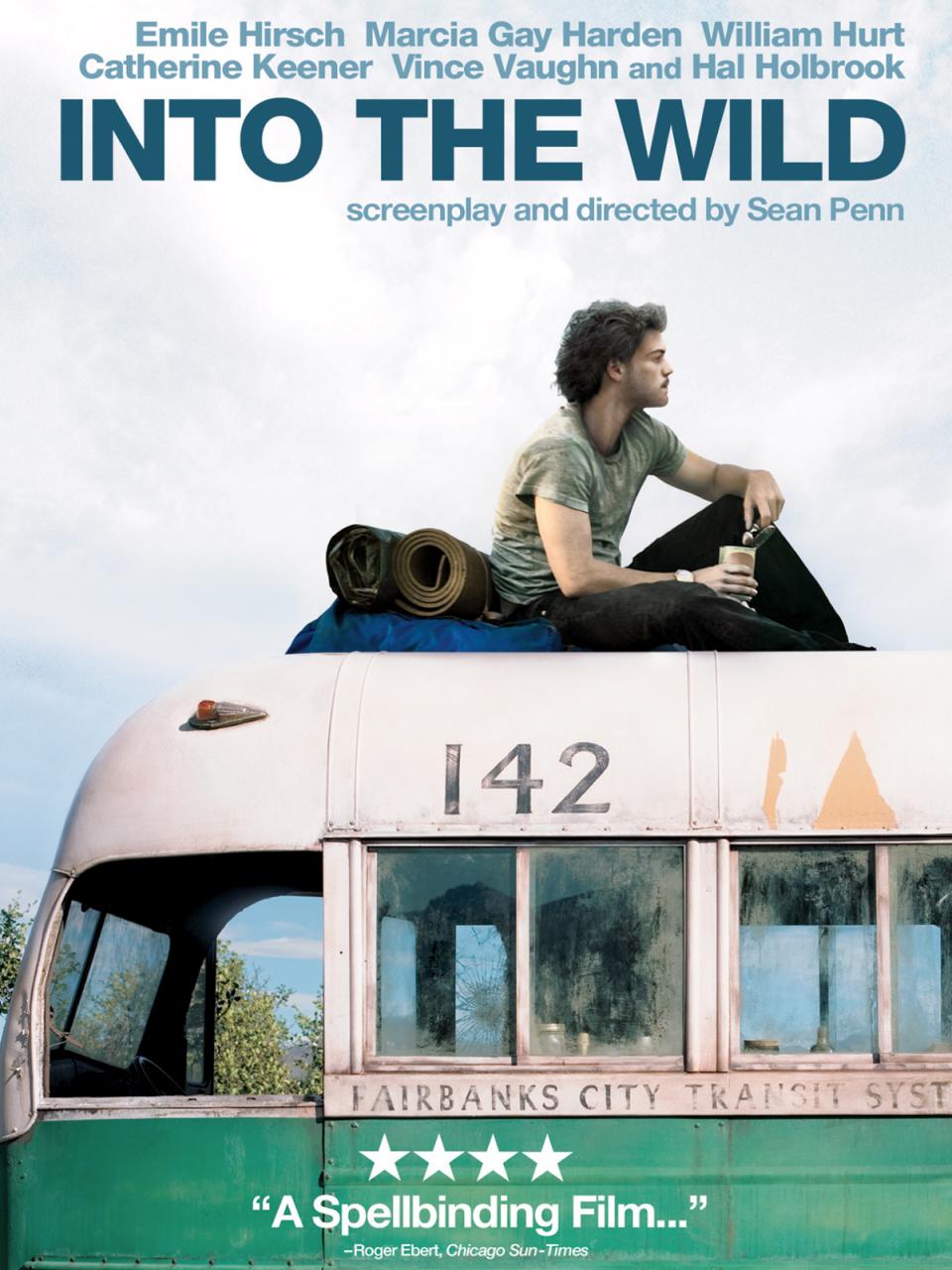
 “It is not about the destination, it is about the journey” – we’ve all heard this old adage, or something similar, at some point. It may be taut and often used to justify self-important metaphysical meanderings, but it does hold some portion of truthfulness. It is also very relevant to the subject of this review, Sean Penn’s feature adaptation of Jon Krakauer’s Into the Wild. From the outset, let me note that I am almost entirely ambivalent towards this film – it was a bundle of neurotic directorial tics and frequently attempts to be profound and moving without being consistent in this endeavour, and more disconcerting was that this is one of the most miserable films I’ve seen recently, just a purely unsettling tale that strives to be inspiring and motivational, but just devolves into something entirely depressing and downbeat. However, this isn’t to suggest Into the Wild is a wholly bad film – there are some great moments peppered throughout the film, and it comes close in many instances to being quite a good film. It is a film that I admire more than I actually enjoyed, and putting aside the filmmaking issues present throughout it, Into the Wild is a fascinating beast, something not very pleasant, but almost entirely essential, if only for the true story at its core.
The book by Krakauer chronicles a few years in the life of Christopher McCandless (played here by Emile Hirsch), who, after graduating from college, decides to disappear and “walk into the wild”, setting his sights on the Alaskan wilderness. Adopting the pseudonym “Alexander Supertramp”, our protagonist ventures across North America, encountering a wealth of different people – amongst them some earnest Swedish tourists, a pair of aging but caring hippies, a teenage girl that could be the successor to Joni Mitchell and a caring, lonely old man – all of which take a shine to the rugged and charming “Alex”, whose happy disposition and spirit for adventure makes him an enduring figure, especially to those who realize their own personal entrapment within society after meeting this postmodern, literary-adept nomad. Yet, as his adventure goes on, he starts to realize that nature is both beautiful and dangerous, and there may be no escape from his decision to disappear from society, and that the place that he had hoped would be where he would find life is the exact place that would bring an end to it. Yet, was there some higher purpose to the voyages of Alexander Supertramp, some meaning that transcends physical life, and suggests at something far deeper and more celestial than simply what we see around us? Not likely, but Into the Wild seems intent on questioning the possibility.
Emile Hirsch is given the central role in Into the Wild, and he was, for the most part, excellent. It is a film focused almost entirely on him, and he leads the film admirably. In fact, his performance was the only consistently great part of the film – he is a character constantly in flux – physically, mentally and emotionally, and Hirsch pulls the role off with great precision, conveying the internal and external transformation of McCandless with such sincerity and authentic resonance. It may not be a definitive performance (and the contrarian in me much prefers his performance in the criminally underappreciated Speed Racer), but it is a strong one, and it is bolstered exceptionally well by the rest of the cast. Highlights include the consistently great Catherine Keener as an empathetic hippie looking to find meaning in a world she realizes she doesn’t understand and Kristen Stewart in one of her pre-breakthrough performances as a delicate young folk musician who makes the mistake of falling for a man who will leave her life faster than he entered it. Unquestionably, the best performance outside of Hirsch comes from Hal Holbrook, whose portrayal of Ron Franz is extraordinary – he may only make his first appearance in the final act of the film, but what Holbrook does with such a limited role in Into the Wild is absolutely astonishing. Quietly heartbreaking and deeply moving, there is so much to this performance – it is in these moments where Into the Wild feels so deeply authentic, and if only every actor had been treated with enough respect to allow them to develop a meaningful character (one just needs to recall how wasted established actors like Marcia Gay Harden and William Hurt were throughout the film), Into the Wild would have been so much better.
Understandably, Into the Wild into necessarily a film that relies too heavily on the performances outside of the central character, because it is essentially a one-man journey, with the characters our protagonist meets being auxiliary to his ultimate quest, being influenced by McCandless and his unique brand of death-defying adventure. The problem with Into the Wild is that it is not a particularly pleasant experience – and there is no reason it should’ve been, and it would’ve been far worse had the story taken the approach to changing the events and making it more pleasing. The issue is, however, that McCandless is made to be empathetic, almost a heroic figure, who were are meant to be attached to, despite the fact that his actions are without motivation, and are frankly not entirely worthy of much sympathy. Its an inspirational tale about someone who puts himself in a situation where he needs to survive the dangers he has fully inflicted on himself. It is dangerous to present this story in such a way because it glamourizes McCandless’ struggles (even his death scene is made out to appear beautiful) and almost condones such recklessness. Obviously, this is a very narrow mentality to have, because the intention of Into the Wild isn’t to show McCandless as a hero, but to be an odyssey into the wilderness, where urban life is dismissed for something a bit more meaningful. Yet, I can’t help shake the feeling that Into the Wild kept trying to justify McCandless’ journey rather than accurately portraying it in a way that was meaningful but objective. The message is certainly there, but the way it is delivered is just hopelessly miserable because we are expecting a deeply moving story when all we get is one that climaxes in nothing but woeful despair.
However, narratively Into the Wild may not be particularly pleasant, but it didn’t need to be, and even the way it was portrayed did have its charms (including some truly beautiful moments throughout, including towards the end when, after realizing that he may not have much time left, McCandless writes in his journal “lonely, scared”). Into the Wild was an effective film in capturing emotions and constructing something with underlying meaning, managing to convey some sense of resonance. The fatal flaw is in the fact that this is so obviously directed by an actor – and it fits with my theory that in many instances when an actor makes the decision to direct a film, they almost over-direct. So much effort was put into the making of the film, it loses the mystique of portraying reality, and it starts to make it evident that we are watching some manufactured – and considering the entire premise of Into the Wild is focused on abandoning modern, urban life for a more simple existence in the natural world, it is disappointing how artificial this film seems – frequent montages (to the point of utter exhaustion), alternations between rapid fast-motion and unbearably redundant slow-motion, and some directorial choices that would be effective had they not been so gaudy (like some instances of a character subtly breaking the fourth wall, which would have worked had it not been handled with such heavy-handed earnestness). Into the Wild could’ve easily benefitted from a touch of sincerity and some subtletly, which would have elevated it considerably into something much better, and while it could be easy to chalk this up to amateur direction, Penn had directed three films prior to this, so it wasn’t entirely a symptom of his lack of talents (The Pledge was excellent), but rather him being woefully out of his depths with something as intricately grandiose as Into the Wild.
As a whole, I found myself hopelessly disappointed by Into the Wild. What could’ve been a masterful and poignant drama about one man’s journey of self-realization just become a muddled, overlong chore of a film. The performances were, for the most part, effective, with Hirsch and Holbrook being the standouts, and there are some moments of sincere emotional resonance. Unfortunately, the film just doesn’t ever live up to its potential, and makes for a generally dull experience. It doesn’t help that Penn, in his capacity as the director, is not particularly adept at translating this fascinating story into the visual medium, reducing McCandless’ journey into a series of episodic moments that are defined by their clear artificiality, and the fact that they don’t come together nearly as well as it thinks it does. Into the Wild takes itself far too seriously, and while the story is definitely serious, the way it was executed here seems almost inappropriately dour. There are fading sequences that actually do manage to convey the underlying message, but these are all lost to the apathetic effort put into creating something entirely great. It isn’t necessarily a bad film, but it is one that could’ve been much better, and with such a great cast, a powerful true story and endless possibilities, the fact that we got something that doesn’t elicit much passion is, to say the least, dreadfully disappointing.