 Sequels to popular films can be hit-or-miss. They have the capacity to be incredible, but more often than not, they could be seen as lesser versions of their predecessor, failed attempts to capture what made the original so successful the first time, this time without the same charm and effort of the original. In recent years, we’ve seen sequels coming out to some iconic films, specifically those in the Pixar-Disney repertoire. Some have been excellent (the two sequels to Toy Story), others not so much (Finding Dory, Cars 2). This year, Disney has released its first sequel in nearly twenty years, and it is a doozy – not only did they manage to capture the spirit of one of their best latter-period films, Wreck-It Ralph, they make a film that could even overtake the first in its imagination and originality – and this is one of the few recent Disney-Pixar films that hasn’t left me cold or disappointed. Wreck-It Ralph was a great film, and Ralph Breaks the Internet honours the original in a way that truly matters. In a year that has been pretty dismal for mainstream animation, Ralph Breaks the Internet is an exemplary moment of both narrative prowess and creative skill, resulting in undoubtedly one of the year’s best films.
There was something about Wreck-It Ralph that worked – it appeared just before the advent of the nostalgia frenzy the world has been in recently. It predates the endless reboots, the attempts to capture styles from the past to invoke fond memories in contemporary audiences that may or may not have been around for those events, but still hold them in high esteem – in many ways, Wreck-It Ralph may have been one of the pioneering works in this field that has become horribly misguided. There is a certain social astuteness that really mattered when it came to making the film, because it wasn’t just a bundle of empty references intended to amuse the audience – there was a fully-realized story that took fond memories and combined it with some of the best world-building in contemporary literature – and unlike the panoply of animated films that give sentience to inanimate objects, the Ralph films are filled to the brim with lovable warmth and a strong story extending beyond its entertaining concept. Ralph Breaks the Internet is a fascinating case – it has a healthy combination of the original’s heart and humour, as well as the audacious narrative integrity, but just enough originality to convince us that this is not simply an attempt to profit off the laurels of the previous film – it is a terrific film that stands wonderfully on its own terms, and makes for some truly wonderful viewing, captivating the audience at every turn.
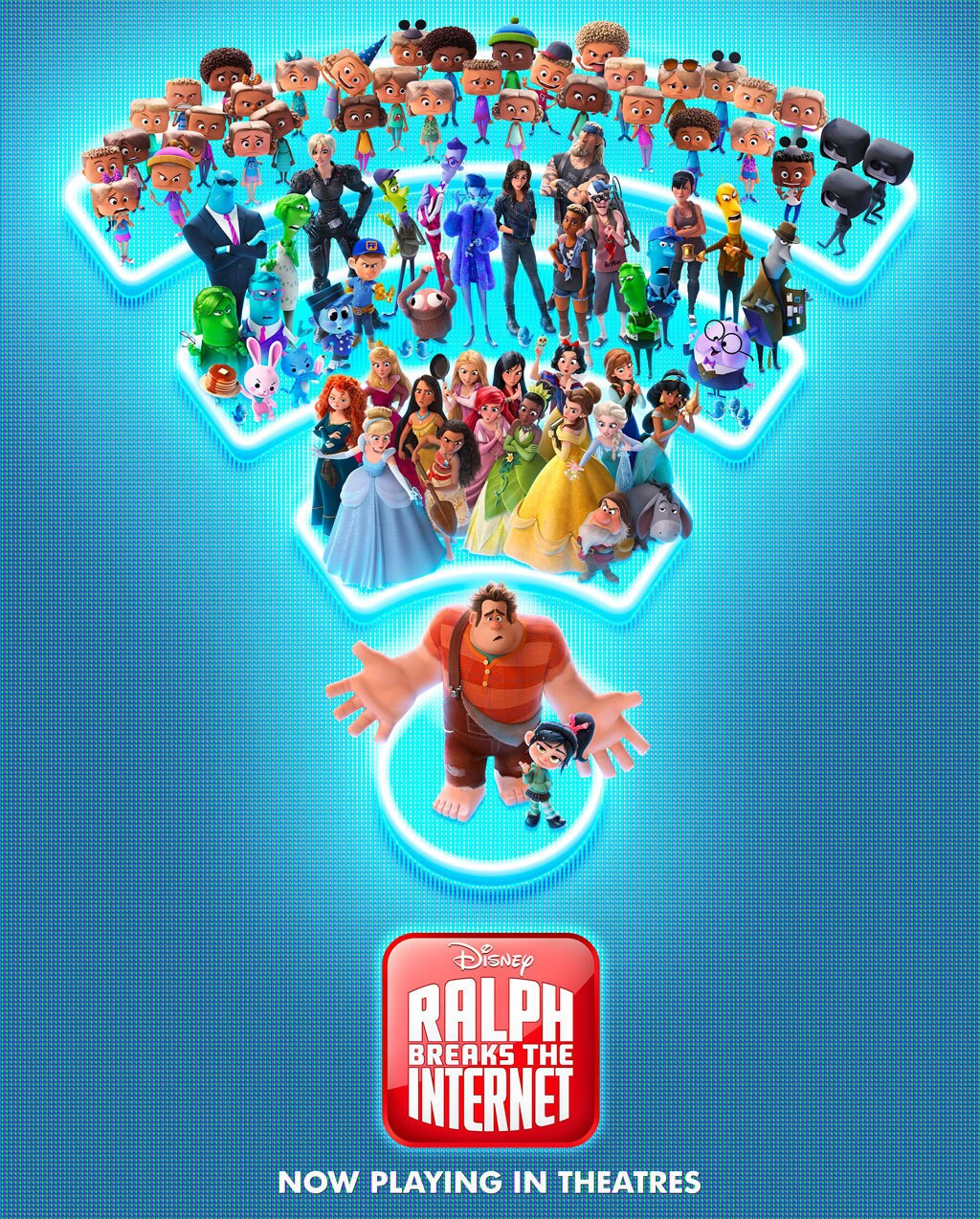
There are a number of reasons behind the success of Ralph Breaks the Internet – firstly, let’s talk about the performances. One area of that Disney-Pixar has consistently excelled at is their performances – these are not just actors, whether major stars or dedicated voice actors – that lend their talents to these characters by way of a recording studio. They’re actors well-chosen for their talents in bringing out the emotional gravitas of the role, lending their character significant nuance, creating a more fully-realized individual through their performances. John C. Reilly has such an infectious warmth, and his work as the titular Wreck-It Ralph is some of the best work of his career, with his lovable charms being evident even through the veneer of an animated character. Yet, despite the film being entitled Ralph Breaks the Internet, focusing on the name of the main villainous character, this film belongs almost entirely to Sarah Silverman in her soon-to-be-iconic voice performance of Vanellope von Schweetz – if we are talking about performers that just manage to be utterly astonishing at every turn, regardless of platform, genre or medium, it is Silverman. She steals Ralph Breaks the Internet away from the titular character, bringing such an undeniable joy to her role that trickles down into the audience, captivating us and making us truly adore this character, who is most certainly amongst the very best of Disney’s Princesses – and as one of this film’s most publicized moments sees her character interact with all of Disney’s other princesses, I’d say they knew exactly what they were doing with this character. Ralph Breaks the Internet is also worth it for the great number of cameos from other established stars – some already being a part of the Disney family, others being welcome newcomers – all of which give some tremendous performances in their own right, despite the brevity of their roles.
On the subject of nostalgia, Ralph Breaks the Internet just gets it right. Earlier this year, Steven Spielberg released Ready Player One that I’d describe as subpar on a good day (and on a bad day, words such as “disaster” would be thrown around quite liberally) – and where that film went wrong and Ralph Breaks the Internet and its predecessor went right is in the approach to referencing past works – a myriad of references do not make a good film if the story isn’t there, and that’s something Ralph Breaks the Internet makes sure to emphasize, because while there are surprises at every turn – references that will doubtlessly bring a face to every viewer as they spot something so familiar – they are not without the necessary narrative underpinnings. Everything in Ralph Breaks the Internet is necessary, whether it is immediately clear or not. It extends far beyond simply being an attempt to stuff several references into a confined space in the hopes that the audience can play off their heightened nostalgia, and while we are certainly charmed by the nods to things that are very familiar, it never feels forced. It is all so natural and effortless, and it never fails to back every choice up with the sheer might of the story itself. Ralph Breaks the Internet is perhaps the best example of nostalgia done right – it is never heavy-handed, and frequently funny, finding its charms within the liberal but controlled use of the past and its multitude of motifs that bring a smile to the audience without bombarding us.
The most effective part of Ralph Breaks the Internet is that it sees the interactions between three intertwining concepts – smartness, sincerity and simplicity. Firstly, this is an exceptionally intelligent film – it is one of the most shrewd commentaries on internet culture made in recent years – the way the online world is presented is endlessly clever – portraying the internet as a sprawling metropolis, populated by a variety of individuals that embody the online world in some very acute ways, bringing together concepts that would be otherwise irreconcilable if they hadn’t been so masterfully drawn together here. In terms of the sincerity, it never feels false nor forced – everything feels like it belongs in this film – the story is authentic and entirely natural, with every moment flowing into the next with masterful precision and genuine care. As mentioned before, this isn’t an excuse to ring out the resonant sounds of relatable nostalgia – it is a love-letter to the internet generation, showing it with bitingly direct wit, but without even an iota of contempt, which means a lot, especially considering other representations of the internet normally tend to portray it as a place of unequivocal danger (which is true, to an extent), and miss out the childlike wonder when we realize that the virtual world has no limits. Finally, the simplicity is what brings everything together so beautifully – Ralph Breaks the Internet takes something as omnipotent and awe-inspiring as the internet and builds a story that is both highly-unique and deniably straightforward. There are no tricks or unexpected turns that distract from the story, and it does meander quite considerably, but in a way that allows it to explore the massive world, it is situated in without sacrificing the story itself. It was astonishing to see how Ralph Breaks the Internet managed to keep everything so contained, controlling the intimidating subject matter it chose to approach. It is almost unwaveringly great in how it retains focus, and I admired the limitless imagination that exceeded the scope of the story itself, which is a difficult feat for any film.
Ralph Breaks the Internet is simply a brilliant film – it is the best portrayal of the internet in recent years, and not only does it excel at some truly extraordinary world-building skills, and a potent story that never feels forced, it has a sincere heart and a truly impactful message – like the majority of Disney and Pixar’s films, Ralph Breaks the Internet is quite predictable, but not in a way that detracts from the narrative, but rather proves that this is firmly within the wheelhouse of the studio’s very best films. This is certainly a frontrunner for finest Disney sequel, because it captures the heart of the original but takes it in new directions instead of just relying on the same formula that made the initial one so successful. Between Coco and Ralph Breaks the Internet, Disney-Pixar is slowly regaining their footing, and we can only hope such audacious, well-made and fascinating projects continue to be made because it proves that even the most broadly entertaining of films can be emotionally-resonant, beautifully-constructed and deeply meaningful. Absolutely terrific work, and amongst the year’s best films, without any doubt.
 The Postmodern Pelican