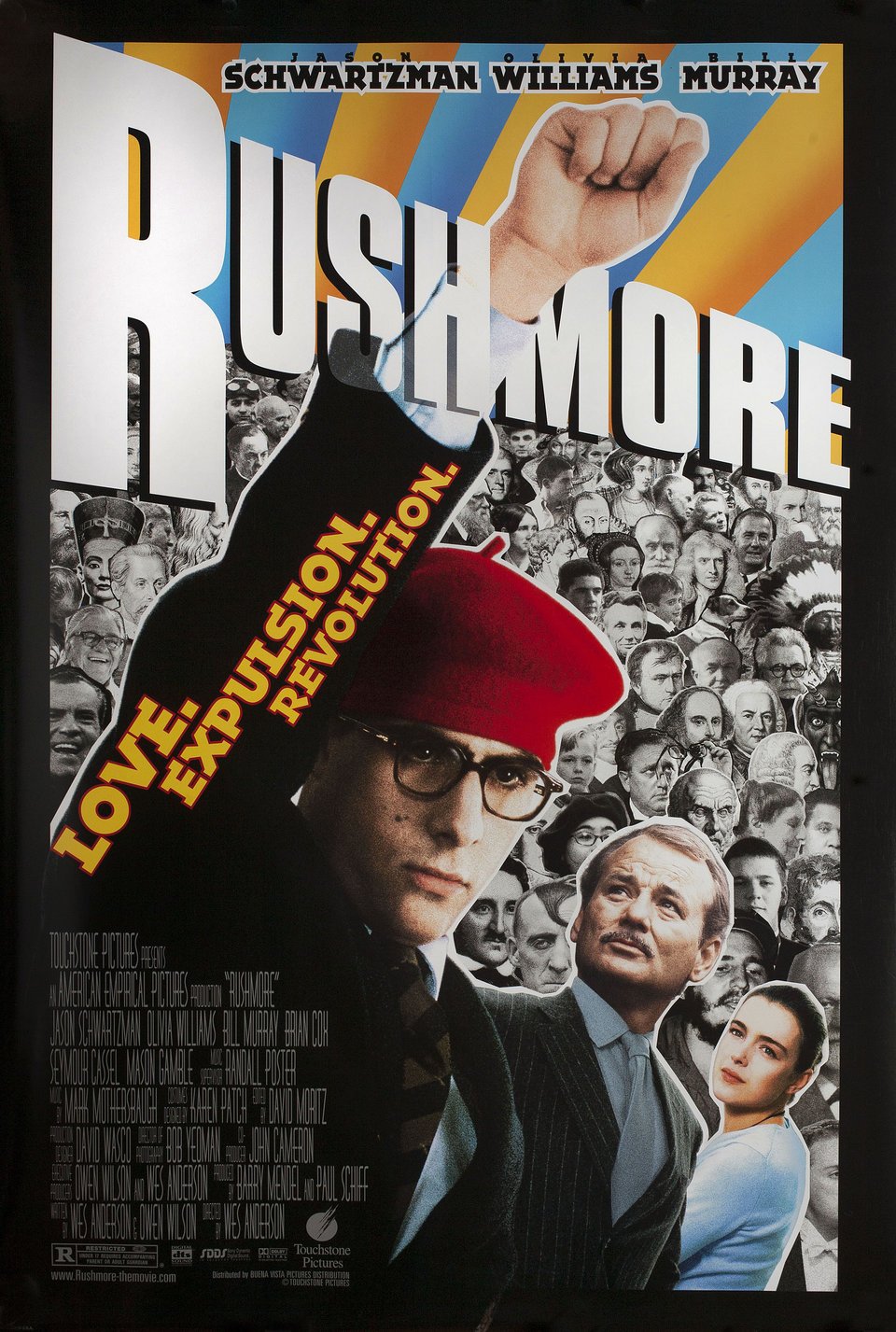
 There was a time when Wes Anderson was not the overly-stylistic auteur who was known for his films that could be reduced to nothing more than just a bundle of quirks set to a retro soundtrack and an abundance of bright colours. I understand that I have often come across as being extremely critical of Anderson, especially with his latter-period works, but it does come from a place of genuine affection, because there is something I realized a long time ago – when Anderson puts in the effort, both aesthetically and narratively, it is impossible to find someone who can make a more entertaining and heartfelt film working today. I’ve been revisiting his work over the past few months, and my most recent venture into his career takes me to the earlier stages, with his sophomore effort, the high school comedy, Rushmore. This is a film I saw a while ago and did enjoy tremendously, even if I did view it as being a tad slight. This viewing, however, changed my perception and helped me see Rushmore (and its audacious creator) in a slightly newer light, and while this is undeniably a Wes Anderson film, it is still more profoundly moving and impactful than most of what he has done recently. Understandably, writing a review for an auteur’s more ambitious early work in comparison with his or her later work is not only bad writing, but it is also misguided and callous and would not take his more brilliant work into account. Therefore, I’m going to be talking about Rushmore from the general perspective, avoiding the less-than-ideal qualities Anderson has taken on in the past few years and rather focusing on precisely what makes him such an enduring and iconic modern filmmaker. This is a film that deserves to be seen on its own merits, and even without the ambitious filmmaker behind the camera, this would still be a towering work of contemporary comedy and a really fantastic film in general.
Max Fischer (Jason Schwartzman) is the embodiment of someone familiar in all of our childhoods- in high school, we all knew someone like Max Fischer, or we were someone like Max Fischer – and I certainly fall into the latter category. An ambitious, over-achieving young man who is wiser behind his years, and perhaps far too self-obsessed to have any sense of awareness of his own idiosyncratic behaviour and its effects on those around him, Max tries to achieve everything he believes he deserves, rather than what others think that he needs (such as schoolwork, a field in which he is deliberately slacking). His ambitions are facilitated by the prestigious private school, Rushmore, with the staff being less encouraging and more tolerant of the wild adventures of Max. However, when he encounters a young teacher, Miss Cross (Olivia Williams), Max is immediately smitten, almost as much as he is with the sardonic but well-meaning Herman Blume (Bill Murray), a rich industrialist with whom Max strikes an immediate friendship, seeing him as both a good friend and a useful resource for more of his outlandish plans. Yet, when his two newest obsessions fall for each other and force Max to the wayside, how will our protagonist recover? He undergoes a journey of self-discovery, with a series of both physical and emotional pratfalls coming his way until he finally realizes his shortcomings and gains some sense of self-awareness – but not without losing the lovable arrogance that is oddly endearing.
This was the first film performance from Jason Schwartzman, who has been a mainstay in Anderson films ever since – and while this performance is most certainly cut from the same cloth as Reese Witherspoon’s similarly-unlikable but still unconventionally-charming Tracy Flick in Election, we cannot help but adore Max Fischer in the hands of Jason Schwartzman – there is something about how he personifies Max and his many quirks that would be been extremely bothersome with most other actors in the role, but rather grow to be endearing when depicted by Schwartzman. There are a number of reasons for this: firstly, Schwartzman plays Max Fischer with unbreakable intensity, putting himself squarely in the role and never wavering from his feverish commitment to the role, playing him with as much serious conviction as Max Fischer himself would. Secondly, Max Fischer is not supposed to be a likeable character, but rather the embodiment of teenage angst and the fear of mediocrity – Max is not particularly special. He’s not extremely smart, nor has he been bestowed with an impressive set of natural talents that set him apart from his colleagues. In fact, the only admirable thing about Fischer is that he is so intent to overcome his mediocrity, he channels it into literally dozens of other interests, becoming a jack-of-all-trades, perhaps to hide the fact that he can never be a master of any of them. Why is this impressive in the context of Rushmore? Simply because this is a character that is realistic, perhaps painfully so. Too many high school films have been intent on showing certain archetypes – the jock, the nerd, the goth, the prom queen and the drop-out (why hasn’t anyone made a film where all five interact?) – but very few ever look at a character like Max Fischer, who wants to be popular, who wants to be smart and who wants to stand out in any way possible – but just fails to do so on every level.
There are certain layers to Schwartzman’s performance that really impressed me in Rushmore – and I consider myself to be an enormous fan of his work (he still gives one of the greatest performances in a Wes Anderson film with his impressive turn in The Darjeeling Limited, a film that needs a re-evaluation, because I truly consider it Anderson’s masterpiece), and while I wouldn’t dare call Rushmore one of his most likeable performances, it certainly is one of his very best – armed with a sincere pretentiousness and a set of precious skills that make his characterization one that is profoundly authentic, subtle without being inconsequential, and charming without being flawless. Rushmore is a film that centres on Max growing from arrogant innocence to meaningful maturity, both mental and physical. Schwartzman is extraordinarily talented, and while he hasn’t been utilized to the full extent of his clear capabilities, he has certainly found a home in the independent scene, which seems equipped to provide him with the platform to play these offbeat but captivating characters that are unconventional and often a lot more complex than traditional heroes, but just as enthralling as any other cinematic hero. Rushmore belongs primarily to Schwartzman, who takes the leading role and conveys every nuance of Max with such tremendous nuance, crafting a wholly unforgettable portrayal of a young man who is only certain about one thing: he needs to be great, whatever the cost may be.
Rushmore also features some stellar supporting performances, most notably from Bill Murray, who began the first of his several collaborations with Anderson. Murray is (to my knowledge) the only person to have worked with Anderson on every one of his films, with the exception of one, Bottle Rocket. There is something about Murray that makes him such a remarkable fit for the sensibilities of Anderson – perhaps it is his sardonic, wry wit that works alongside the more optimistic tone of Anderson’s films, complementing it with just enough contradictory vitriol, it only elevates the loveable core. Rushmore was a formative moment in Murray’s career because it demonstrated that he was not merely someone capable of broad performances in mainstream comedies, but also a reliable presence in independent cinema, where he has unquestionably given his very best performances. His performance in Rushmore is a powerhouse of deadpan sincerity, and while on the surface this may appear to be another wise-cracking performance from the maestro of lovable bitterness, there is something much deeper here. Anderson and Murray bring out an entirely new dynamic in each other, and I’d argue that they have both been extremely important to the subsequent career of the other.
Olivia William is absolutely lovely as Miss Cross, the elementary school teacher who proves herself to be a worthy opponent for both of the men who see her as some kind of prize, showing that beneath her beguiling beauty there is a woman who is not going to dare be underestimated by a pair of egotistical, self-obsessed men. I’m surprised this was the only collaboration between Anderson and Williams, who is still woefully underrated, and fits perfectly into the wonderful world Anderson has created over the course of his career. Rushmore also has smaller but distinctive performances from the likes of Brian Cox and Seymour Cassel, who is at his most sympathetic as Max’s father who loves his son despite his outlandish schemes.
There is just something about Rushmore that just works and appeals to me. Putting aside the aforementioned dedication this film has to the trials and tribulations of being an outsider in the angst-ridden teenage years. In many ways, Rushmore seems to be inspired somewhat by the work of Hal Ashby – throughout the film, I found some similarities between this and Ashby’s magnum opus, Harold and Maude – both films concern a young man who is very much an outsider who doesn’t fit in (nor does he necessarily want to), falling in love with an older woman in between his very unconventional hobbies, as well as striking up a friendship with an older man who seems to be just as juvenile as he is. Moreover, Anderson seems to be drawing upon the relentless warmth of Ashby’s films, portraying the delicately beautiful human relationships that are possible between individuals. It is heartfelt and hilarious, but also profoundly meaningful – which is a great strength of Anderson’s, who never fails to imbue his films with heart and hilarity, never ignoring the deeply human side of these stories. This film is not particularly groundbreaking, and it hits all the familiar beats that we’d expect – Anderson is not a filmmaker who attempts to conceal his style in any way (not that he should, as I said before, his stylistic flair makes him one of his generation’s most exciting filmmakers) – but there is a meaningful undercurrent that flows throughout Rushmore, and makes this quite an extraordinary film – philosophical without being dense, lighthearted without being mocking. This is Wes Anderson distilled to his purest form, and considering how Rushmore was only his second film, to see such introspection from a relative novice is incredible. Taken on its own individual merits, Rushmore is really an impressive achievement.
There is a lot more depth in Rushmore than we normally see in Anderson’s films, and while it may not hit the towering heights of his more ambitious projects, Rushmore is nonetheless a truly extraordinary film with an abundance of meaning and a clear heartfulness. Jason Schwartzman is an astonishing lead, and along with Bill Murray and Olivia Williams, he forms one of Anderson’s most fascinating casts, one that is small in size, but immense in dedication. Anderson would certainly go on to do bigger, more audacious work in the future, and while I may have some small quibbles with some of his more recent choices, looking at Rushmore, it is impossible to not be utterly enamoured with his singular vision. He made a wonderful comedy with Rushmore, a traditional but impactful comedy about high school, romance and family, and the importance of individuality and how we define ourselves as unique in an enormous, intimidating world, all of which are common themes in the director’s work. Rushmore is a terrific film, one that is incredibly resonant and quite possibly relatable to many of us. It may not be the boldest of Anderson’s works, but a great soundtrack, tremendous performances and a brilliant story make for a truly compelling experience that proves Anderson to be a true cinematic iconoclast because anyone who can make something as enthralling as Rushmore deserves a great deal of acclaim. It may not overtake The Darjeeling Limited and The Royal Tenenbaums as Anderson’s best, but it certainly does come close. An astonishing achievement in every sense of the word, and a very special film.