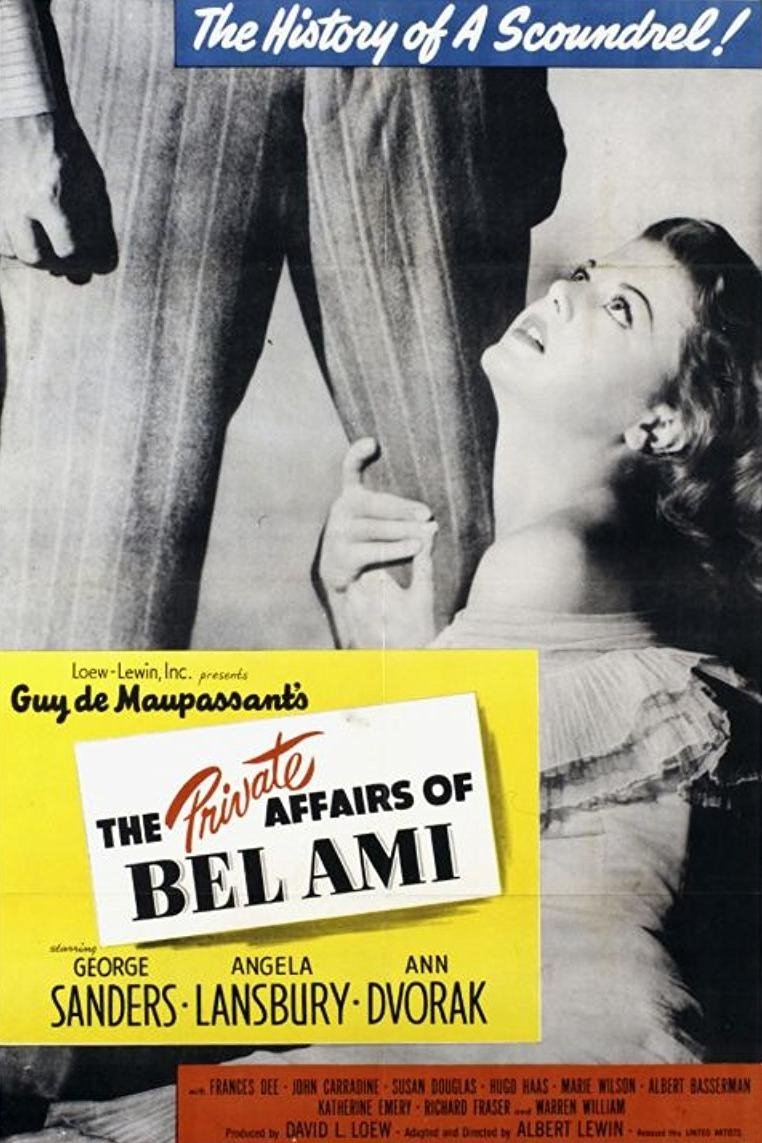
 With what is undeniably one of his masterworks, The Private Affairs of Bel Ami, Albert Lewin did something quite astonishing – he took a very formal premise garnered from a classic French text and morphed it into a remarkable achievement, a positively riveting affair that is scandalous without being cheap, and exhilarating without losing its elegance. A film I have been intent on watching for a number of years, I found The Private Affairs of Bel Ami to be an entirely thrilling film, one that takes its famous text and creates one of the finest romantic dramas of its age, one that doesn’t find itself bound by the irreconcilable constraints of the genre, being a film independent on conventions, but not being too far from the structural guidance of these kinds of films, creating something wonderfully subversive without being needlessly innovative, because while The Private Affairs of Bel Ami is a tremendous film, it truly soars when it directly confronts the nature of its genre, which it does with unflinching gusto and extraordinary gracefulness, making this a film with an abundance of romance, but very little palpable sentimentality that would make it appear to be inauthentic. In short, The Private Affairs of Bel Ami is a marvellous film, and a representative of a bygone era, where such simple but effective films could be made without a hint of self-congratulatory awareness or disingenuous pretensions.
The Private Affairs of Bel Ami is concerned with Georges Duroy (George Sanders), a penniless ex-soldier living out the post-war dream in nineteenth-century Paris. A chance encounter with an old colleague brings him into the journalistic world, which occurs concurrently which his entrance into the high society, where he is able to earn friends by virtue on his name alone, as he is apparently a descendant of one of the country’s most esteemed (but sadly, near-extinct) noble families. Georges, someone who thrives in his sardonic disposition and clear disdain for his fellow human (especially those of the opposite sex), realizes that while the noblemen of Paris may have the influence, it is their wives that have the power, and our anti-hero polishes his dormant charms and begins to seduce the high society women, fooling them into thinking that he is truly in love with them, when in actuality, he is deeply enamoured with something else of theirs entirely: their fortune, their influence and their positions within the upper-echelons of Parisian society, which is extremely seductive to Georges, who lusts for power in the same way he relentlessly chases his desires for these women that wield it. However, the situation becomes slightly more complex (as these stories often do), and we begin to question, just like the characters, the real nature of George Duroy, or perhaps his very existence overall.
George Sanders is an actor I knew (much like many people) mostly from his performance as the prickly theatre critic Addison DeWitt in the landmark showbusiness satire All About Eve, and while I adored him and his sardonic depiction of an all too familiar archetype in that film, I was woefully under-educated in most of his work. The Private Affairs of Bel Ami offered the opportunity to see Sanders at his very best, in the leading role of a distinctive drama, where he plays a complex character in constant, perpetual conflict. His portrayal of the titular “Bel Ami”, Georges Duroy was masterful, and he imbues the character with such distinctive grace, we almost forget that we are supposed to despise him – a true cad in every sense of the word, we find ourselves unexpectedly hoping to see him succeed – and I don’t think I’d be dishonest if I said the final climactic moments of this film are as chilling and heart-stopping today as they were seven decades ago. Sanders takes a character that could have very easily been played for laughs (how often have we seen this archetype of the dashing rogue who gets away with far more than he or she should on virtue of their appearance and deceptive charms?), and rather constructs a nuanced and multi-faceted character that never feels unnecessarily false or pretentious in a way that isn’t entirely believable. It is a masterful performance from an extraordinary performer, and while I still need to delve deeply into his career, I can already sense that Sanders is bound to be an actor whose work I admire greatly if The Private Affairs of Bel Ami is anything to go by.
The Private Affairs of Bel Ami also has an impressive supporting ensemble, with one of the central roles being played by someone who is nothing short of the very definition of a legend, Dame Angela Lansbury. However, while she is now known and adored as a paragon of brilliance, an elder stateswoman of stage and screen, The Private Affairs of Bel Ami sees Lansbury playing a young ingenue, albeit one that is far from ignorant or one-dimensional. Her performance as Clotilde is extraordinary, and she finds the complex humanity in a character who would otherwise be entirely inconsequential had attention not been given to her more than what we’d normally see. Ann Dvorak, John Carradine and Susan Douglas Rubeš are also equally as tremendous in performances that may not be as present as those of Sanders or Lansbury but are still nonetheless extremely important to the storyline. The Private Affairs of Bel Ami really has an exceptional cast, and they deliver brilliant performances, none of them opting to cheapen this film by playing their characters with anything less than determined sensitivity and dedicated simplicity, which shows in the powerful but subtle performances from this extraordinary cast.
I was struck by the intelligence of The Private Affairs of Bel Ami. This is not a film that attempts to cheapen its source text by playing anything for laughs – and considering such stories are often misrepresented as broad comedies (usually the only platform for such despicable characters in the central role). In many ways, Lewin (a director with his roots in the silent era, as evident throughout The Private Affairs of Bel Ami, with the studio, sets looking endearingly artificial) has made a fascinating ode to the period in which it takes place, and while it may not be the most historically accurate of films (it is, after all, an American production of a French novel portrayed by Anglo-American actors), it does resonate as a captivating piece of cinema, a film intimate in its narrative, theatrical in its execution. This is a film that distances itself from the more convenient genres of farce or the comedy-of-manners, rather opting to be a delicate but impactful social drama that leaves a lasting impression, especially in the final act, which sees a bevvy of characters undergo unexpected introspection, which makes The Private Affairs of Bel Ami quite an achievement.
The Private Affairs of Bel Ami is, more than anything else, a scathing critique of the intersections between common human morality and its relationship with the material world. This is a film primarily concerned with lust and desire, with these concepts taking different forms, mainly those of romance and wealth, which are shown to not be necessarily mutually-exclusive, but also not particularly compatible, especially with a scoundrel such as Duroy at the core. The Private Affairs of Bel Ami can be reduced to the relationship between Duroy and Clotilde, as this is the perfect indication of their relationship – he is cold, cynical and lustful for wealth and influence, whereas she is warmer and more enamoured with the world as a whole, hoping to find some semblance of true love, especially after her previous husband dies and leaves her both a widow and single mother. These two would naturally not be a fit, as their desires are quite distant – yet, they soon find themselves to be the only person the other can truly love, which naturally pushes them further apart, as even the most ardent of romantic feelings are not good enough for Georges to abandon his seductive obsession with the riches of Parisian society. The Private Affairs of Bel Ami is a film that looks directly at concepts such as wealth and status in a way that has rarely been the focus of such films, and while this is a film with a heavy sense of romance, it is far more dour and serious than one would have expected. This is certainly not a shortcoming, but an observation – and in many ways, this attention to the simple human drama is precisely what elevates The Private Affairs of Bel Ami above its contemporaries.
I found The Private Affairs of Bel Ami to be a terrific film – a simple and elegant social drama with extraordinary performances, most notably on behalf of George Sanders and Angela Lansbury, both of which are exceptional here and demonstrate precisely why they are regarded as some of the finest performers to work across any medium. The Private Affairs of Bel Ami is a deceptively charming film, but not one that ever feels inauthentic, and rather approaches its landmark source with a great deal of respect and delicacy, and frequently challenges the audience to reconsider our own desires, and how we balance the metaphysical with the material, and while George Duroy is almost irredeemable (despite the unnecessary coda to this film), he does represent a vast portion of society who put themselves above others. In this regard, The Private Affairs of Bel Ami is a profoundly relevant film, one that resonates with contemporary concerns and becomes something quite extraordinary. Quietly compelling and explosively captivating, The Private Affairs of Bel Ami is a truly tremendous film.
 The Postmodern Pelican