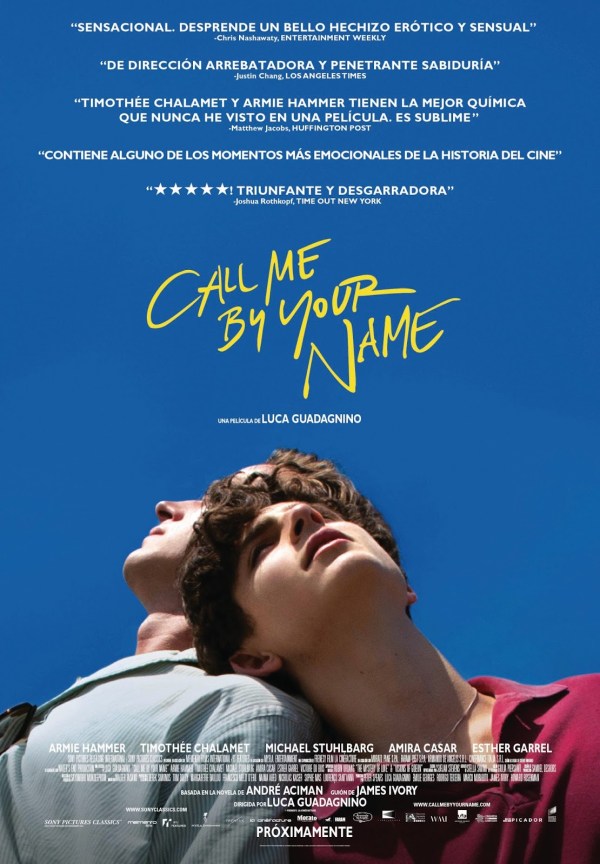
 Call Me by Your Name left me completely speechless. Sometimes when talking about a film I adored, like the best of people, I can exaggerate slightly and use figures of speech that are not entirely accurate or representative of what I feel or my actual response to an artistic work, and just serve to overhype the excitement I feel towards the film. However, this is certainly not the case here, because the beautiful and complex romantic coming-of-age story Call Me by Your Name physically left me at a loss for words, and the ability to articulate what I actually felt in response to this film was completely lost, leaving me with an undeniable sense of melancholy and wonder for this utterly incredible film, the likes of which I cannot ever recall seeing. Call Me by Your Name struck me so hard emotionally, and I cannot coherently comprehend the sheer grandiosity of this film. I am still trying to register my thoughts and come to terms with what this film so beautifully says through its poignant and heartbreaking story, and through my discussions with others, I am clearly not the only person who has been extraordinarily moved by this unbelievable piece of cinematic art. I am not entirely sure how to describe Call Me by Your Name, or even begin to discuss how it made me feel, but some films are just simply indescribable and the emotions that are evoked by this film are nearly impossible to express. All I can say – and I state this with complete confidence – Call Me by Your Name is one of the most brilliantly moving films I have ever seen, and undeniably the best film of the year. That is not a hyperbole – Call Me by Your Name is a film that is already starting to appear like a new cinematic classic and a film that will endure for decades to come. I know what I am saying here does come off like the ramblings of an overemotional wreck, but trust me when I say that Call Me by Your Name is simply extraordinary in every sense of the word, and a film that is going to become a comfortable part of the canon of historically-significant films. My reaction may seem somewhat hyperbolic, but I am comfortable in the belief that this is a film truly worthy of such acclaim and adoration.
Essentially, Call Me by Your Name is quite a straightforward film in terms of the storyline, taking place “somewhere in Northern Italy” in the year 1983. It focuses on Elio Perlman (Timothée Chalamet), a precocious 17-year-old intellectual, bibliophile and musical devotee, who (by his own admission) has Jewish, American, Italian and French roots, and thus a bit of a global citizen who is extremely confident and willful, and this shows through his comfortable interactions with those in the small Italian town where he and his parents, his university professor father (Michael Stuhlbarg), a prominent archaeologist on the verge of a great discovery, and his caring and empathetic mother, Annella (Amira Casar), spend their summers every year. In addition to his parents, we also see Elio’s budding relationship with the lovely Marzia (Esther Garrel), the young local woman with whom he is developing an attraction, and who is something close to being his girlfriend, even if he does not say it in so many words, with the buds of romance still being relatively new. However, his tranquil existence in the Italian village is disrupted by the arrival of Oliver (Armie Hammer), a fellow Jewish-American and a university graduate who has been invited to stay with the Perlman family for six weeks while working alongside Elio’s esteemed and respected father as a research assistant and intern of sorts, and naturally, Elio has to endure Oliver’s impingement of his family and personal space, and like any young man who has to receive unwelcome visitors into his life, Elio feels resentment. What initially begins as feelings of disrespect and disdain for Oliver on the part of Elio, who finds his careless arrogance contradictory to the honest and simplistic values of his family, eventually grows into a meaningful friendship, and inevitably blossoms into a beautiful love affair between the two individuals, both of which find the growing attraction beautifully unconventional, with their respective inexperience in this facet of love only amplifying the powerful bond between the two young men. One of the central elements of Call Me by Your Name is that the romance between Elio and Oliver is both beautiful and tragic, because in spite of all the fiery passion and abundance of feelings of requited love and seeming acceptance from those around them, it is destined to end in heartbreak, as Oliver’s time in Elio’s life is only temporary, and it is only a matter of time before he has to return home, leaving Elio and their gorgeously seductive and passionate romance in the past, where they will always look towards their brief romance over that memorable summer with heartbreaking nostalgia and bittersweet melancholy.
Call Me by Your Name has one of the most unexpectedly perfect pairings behind the camera, with a screenplay written by the legendary filmmaker James Ivory (based on the novel by André Aciman, who also has a small role in the film), and directed by the audacious and innovative Luca Guadagnino, who has proven himself to be one of the most consistently brilliant filmmakers working today, who has finally started to receive the recognition he deserves. I am in admiration of both of these artists through their iconoclastic creative careers, and their collaboration on this film was almost fateful in how fitting it was for the source material, despite how I did not ever consider the possibility that their careers (despite sharing some very clear qualities) would ever cross paths in such a way, allowing them to collaborate on such a beautiful film. Ivory, who does not need much of an introduction as his enduring legacy as one of the key figures in the Merchant/Ivory production company known for their impeccably-crafted period dramas speaks volumes towards his talents, was extremely suitable for Call Me by Your Name, precisely because of his background in creating these kinds of sweeping and beautiful period dramas that are character-driven stories about desire and the complex relationship between individuals, not only romantic affairs, but also that of friends and family. It does not matter that Call Me by Your Name takes place in relatively recent history, as opposed to Victorian or Edwardian society, as the same attention to capturing the zeitgeist and mentalities of the period is as present here as it was in all of Ivory’s notable works. I honestly did not think we would ever receive another major work from James Ivory, and while his involvement in this film was limited to writing the screenplay and serving as a producer, the same audacious and highly-romantic spirit that persists throughout his work is still clearly evident in Call Me by Your Name.
Luca Guadagnino, on the other hand, proves himself to be a modern cinematic maestro who is only growing in status as he continues to progress as a filmmaker. He is not a newcomer by any means, but he has remained relatively low-profile up until recently. I Am Love could be considered his first relatively major success in terms of making a name for himself as a modern filmmaker, but one should not neglect his earlier efforts, such as the sublime Melissa P. and his directorial debut, the crime thriller The Protagonists, both of which showed a director with an extremely promising career, which he has most certainly proved to be glowingly accurate throughout his career. Guadagnino made, at the time, perhaps his most widely-embraced film last year, A Bigger Splash, which I absolutely adored. I expect that film, while being relatively divisive (but still considered a masterpiece by many, albeit one that has inspired its fair share of controversy as well as passionate detractors and ardent supporters), helped Guadagnino gain further status and allowed him to venture off into making films of a higher pedigree that would be seen by a wider audience, such as Call Me by Your Name, which is quite simply another proverbial feather in the impressive cap of his career. Taking over from Ivory as director (after a brief period where they almost co-directed the film) is a major progression in Guadagnino’s creative career, and he proves that his involvement was nothing but a perfectly fitting decision, because Call Me by Your Name contains the loving passion Guadagnino frequently imbues into his films, as well as being far more tranquil and serene in tone and execution than his previous films, allowing him to retain his unique talents but also to experiment with a tone that he had not ventured into displaying throughout his career.
The collaboration between Ivory and Guadagnino on Call Me by Your Name resulted in an undeniably moving and emotionally-destructive film that allows the two cinematic artists to bring out the best in each other in their endeavour to convey this extraordinary cinematic love story in a way that is brutally honest, incredibly memorable and soaringly beautiful. Call Me by Your Name is an sensational film in so many ways, and through the serendipitous inter-mingling of the talents of the screenwriter and the director, the film retains the delicate, beautiful character-driven spirit of Ivory’s films, as well as being allowed to soar to extremely staggering and gorgeous heights through Guadagnino’s relentlessly beautiful direction and hypnotic attention to developing characters towards a certain intangible metanarrative (in this case, love) that he has managed to consistently perfect as he career has progressed. To consider Call Me by Your Name anything less than an astonishing work of creative genius seems inadequate and utterly inappropriate. Call Me by Your Name displays Ivory and Guadagnino doing possibly their greatest work (a contentious opinion, especially in regards to Ivory and his legacy of iconic films throughout his long and storied career, but I stand by such a belief), and they craft nothing short of a mesmerizing, alluring coming-of-age story that stands as one of the greatest cinematic love stories of recent years.
It would be wrong to consider a film to be made up of anything other than several different elements all working together in harmony, each being of imperative importance to the eventual success or failure of the film. One of the most undeniably vital aspects of a film are the performances, and I have grown to appreciate and sometimes even utterly adore certain performances from actors who are just wonderful in certain films. However, I don’t think I have ever seen a performance quite as shockingly brilliant as that of Timothée Chalamet in Call Me by Your Name. This is, without any exaggeration at all, one of the most impressive cinematic performances I have ever seen. This is a star-making performance akin to the greatest ever committed to the screen. If this sounds far too hyperbolic, believe me when I say that what Chalamet does in this film is utterly extraordinary and left me completely dumbstruck. It is a struggle to remember the last time a performance left me so utterly devastated, not to mention from a relative newcomer. This is not Chalamet’s debut performance, but it certainly is the performance that is going to define his career and allow him to flourish into the truly extraordinary actor that he is obviously going to become as a result of his astonishing performance in Call Me by Your Name. This year, he has appeared in both Call Me by Your Name and Lady Bird, and these roles could not be more different, but Chalamet is tremendous in both of them. I was beyond impressed with Chalamet here and found him to be exquisite in the nuances of the character, and the way in which he expresses the inner-turmoil of the character is absolutely staggering. The final scene of this film solidifies Chalamet’s performance as one of the greatest of the year, with the raw pain and longing he expresses without saying a single word being truly unbelievable and heartbreakingly convincing. History is going to be extremely kind to this performance (and the film as a whole, as it is carried almost entirely on Chalamet’s performance), and it will doubtlessly become a definitive piece of acting, to be appreciated for decades to come. Chalamet is just that astonishing.
As good as Chalamet was, his performance was only possible through his chemistry with the other half of the duo that forms the focal point of Call Me by Your Name, the character of Oliver, played so masterfully by Armie Hammer, who has already proven himself to be one of the most effortlessly enduring leading men working today, even when the material he is given is not particularly good. Playing Oliver, a cocky, arrogant and irresistibly charming graduate student who finds himself falling deeply in love with the teenage son of the academic who will be mentoring him that summer. Hammer, while not reaching the same seemingly-impossible heights that Chalamet does, is also wonderful, and he is entirely convincing as the man who appears to be self-assured and confident, but is soon revealed to be the same as Elio in his insecurities, his vulnerabilities and the terror he feels towards the flourishing romantic urges he starts to develop towards Elio, while still being unable to not act on those urges. The chemistry between Chalamet and Hammer is unbelievably palpable and poignant, and it just feels so raw and naturalistic, without a single false moment of insincerity shared between the actors. Both Hammer and Chalamet absolutely commit to the roles, and while Call Me by Your Name is most definitely Elio’s story, therefore making Oliver something of just a device of Elio’s development, Hammer has some extraordinary moments that allow us to explore his own complexities, such as Oliver’s final physical moment, where he avoids making eye contact with Elio while the train departs, but fails, with this moment being absolutely devastating and one of the several poignant moments that occur consistently throughout this gorgeous film.
While the growing romance between Elio and Oliver is the central focus of the film, Call Me by Your Name is not restricted to being about their budding love affair. As I alluded to previously, there are a plethora of themes present throughout Call Me by Your Name, which is, more than anything else, a coming-of-age story, and the relationship between Elio and his parents is vital to the emotional impact of the film, and through looking at the interactions between Elio and his mother and father, we can come to an understanding towards the kind of person Elio is. Amira Casar is luminous as Elio’s loving mother, who adores her son and helps him develop into the caring, emotionally-open individual he is shown to be. Casar may not be distinctive and notable on first glance, but as the events of the film unfold, the audience begins to realize that Casar is an imperative emotional presence, and some of the most beautifully tender moments of the film occur between her and Chalamet. However, having said this, the most moving moment in the entire film comes from Michael Stuhlbarg. I have never hid my admiration for Stuhlbarg, considering him one of the greatest character actors working today, and he is an amazing presence in the film. He is nothing but a supportive, loving father throughout the film, having some delightfully touching moments scattered throughout that supporting the melancholic tranquillity of the film. It is easy to see Stuhlbarg’s performance as a typical supportive father character who is not a major presence, but it all changes in one of the film’s final moments, where Stuhlbarg delivers a moving, heartbreaking monologue about the virtues of love that solidifies his presence in this film as being essential to the emotional core of the story. One can easily become distracted by the central romance that drives the story, but it is important to note that the relationship between Elio and his parents is of equal importance in representing the events of Call Me by Your Name as a truly extraordinary coming-of-age story, with this theme being as equally as strong (if not even stronger) than the romantic overtures present throughout this film.
It was absolutely astonishing the extent to which this film was able to move me to literal tears, which I am not ashamed to admit. The sheer emotional impact of this film is nothing short of incredible, and I cannot recall a film so emotionally-profound and meaningful. Call Me by Your Name is not a prototypical saccharine love story that relishes in the manipulation of the emotions of the audience through false sentimentality and obvious clichés, nor is it a film that is anything less than honest and beautifully-constructed. Call Me by Your Name is a film that is clearly in complete control of its emotional-resonance, being able to tell a story that is heartbreaking and stirring without being artificial or dishonest. It is because of this dedication to conveying the central themes of the story, such as love, friendship and family, that Call Me by Your Name is one of the frankest and honest depictions of life and its inevitable challenges that are poignant and beautiful in their own way. The tone set by the story, which is constructed out of a series of episodic moments of self-reflection, encounters with strangers and interactions between familiar individuals that work towards the grander narrative of the central romance between Elio and Oliver, allows for this film to be a calm, serene commentary on the nature of life and love, one that is unpredictable, filled with moments of heartfelt humor and genuine sadness and experiences that help the characters grow as individuals. Call Me by Your Name conveys the idea that very often, our most vulnerable moments tend to be exploited and our insecurities exposed, which forces us to experience things that we could never have been able to if we hadn’t bared our souls for a brief period of time, allowing change of some sort to happen to us, which is not always the most pleasant sensation, but it is vital for personal growth and progress, and aids in forging our perspective of the world around us, particularly in the case of someone as young and naive as Elio. This idea persists throughout the film, and is clearly evident in all of the characters, even those that seemingly are more well-composed and wise. As Elio’s father states in his passionate testimony of the nature of life and existence, “nature has a cunning way of finding our weakest spots”, which perfectly describes the vulnerable spirit this film lovingly conveys, and the ways in which individuals can only go in the pursuit of their heart’s desires to overcome these moments of heartbreaking vulnerability, where what we desire seems all too elusive.
Call Me by Your Name is not simply a love story, and as previously mentioned, there is an abundance of themes scattered throughout. If I had to describe Call Me by Your Name as being only one thing, in particular, I’d probably use the same words Evelyne Politanoff used in describing the work of Diane Arbus: a steadfast celebration of things as they are. Call Me by Your Name is a meditation on life and what we experience in the various trials and tribulations that come with being alive – to love, to lose and to grow as a person from both experiences. It is a celebration of the joys in life, and an account of the inherent sadness that co-exists with our happiest moments. Call Me by Your Name is a film that will strike a chord with absolutely anyone who has felt unrequited love or found themselves being a victim to the deceptive logic of the brain rather than the pure desires of the heart. The final scene of Call Me by Your Name is devastatingly resonant because it is likely that each and every one of us has been in the exact same position as Elio, forced to confront the loss of someone who he truly loved, and coming to the harsh realization that the love was only temporary. To have felt such pure love is beyond beautiful, and to lose that love is indescribably tragic. In a way, the core message of Call Me by Your Name is that life is constantly about the interactions between joyful experiences and tragic moments and the way in which the individual experiences these moments shapes them and forges their perception of the world and of others. Once again, this may seem like incoherent, quasi-philosophical ramblings, but I believe that Call Me by Your Name is nothing short of a modern masterpiece, not only as a film but also a statement on the nature of life itself.
As much as I want to convey the idea that the romance storyline is not the only driving factor of the film, I have to concede that it is the unabashed romance of Call Me by Your Name that makes it an utter masterpiece, and the concept of love, while not the only theme, is the most important and the reason why Call Me by Your Name soars. The romance between Elio and Oliver is utterly beautiful, and their journey towards love is paced, gradual and very often tense. This is a film pulsing with raw sexuality, and Guadagnino has proven himself to be a maestro of erotic suggestion without overt representation of sexual desire in a way that is explicit. Call Me by Your Name is a film that is certainly unconventionally erotic, finding the sensuality in seductive suggestiveness rather than in outright salacious imagery. Guadagnino, through all of his films, clearly intends to arouse the viewer cerebrally and mentally rather than physically, and this intent has never been clearer than here. Call Me by Your Name is undeniably, as I have mentioned several times before, a coming-of-age story, that focuses on the growth of our protagonist, and like many similar films (which can be considered part of the literary genre known as the bildungsroman), this involves some sort of sexual awakening of the protagonist, an education towards maturity and adulthood. Call Me by Your Name is tasteful but still shows the steady stream of desire present in these characters, and while it is certainly not void of sexual suggestion, it is done in a way that satisfies the grandiose beauty of love rather than simply being an erotic, prurient display of sexual desire and lustful hunger, being able to show considerable restraint in representations of passion. Call Me by Your Name is one of the most romantic films I have ever seen, a film brimming with vivid passion and blossoming adoration, dedicated to representing the process of becoming infatuated with someone, and quite possibly falling deeply in love with that person. The film does not conceal anything about the complex and chaotic feeling of falling in love, showing both the most beautiful, celestial moments, as well as the bitter, shattering heartbreak in the realistic circumstance that the love was only temporary, or simply just not meant to be. For such a gorgeous, delicate film, it is also brutal in conveying the truthfulness of the experiences contained within, and it never hides the painful truth, which only emphasizes the crushing pulchritude of this story.
I have happily spent an enormous portion of this review rambling on about the themes and virtues of this film, but like any great film, there are technical elements that perhaps do not contribute to the message of the film, but certainly amplifies it. Call Me by Your Name is a beautiful film (which I have said countless times already, but it is honestly the truth, as reductive as it may be), but not only in terms of the storyline, but also visually. Guadagnino is an extraordinary director, not only because of his masterful control of the narrative but also the way in which he conveys the story visually. Call Me by Your Name has some utterly gorgeous cinematography, which is shot through the brilliantly meticulous eye of Sayombhu Mukdeeprom, who is most notable for his cinematography of another towering arthouse masterpiece, Apichatpong Weerasethakul’s Uncle Boonmee Who Can Recall His Past Lives (another brilliant meditation on life and loss, but I digress). The sheer beauty of Call Me by Your Name is not to be underestimated, with the exquisite camera work contributing to the passionate tranquillity of the film, lingering on the most seemingly inconsequential moments, focusing on the minutiae of the everyday lives of these characters as they experience the various events of the film. The production design creates a serene and beguiling world that the audience is able to become happily lost within, so simple and delicate, being beautiful without being gaudy or over-excessive, as period pieces often tend to be. Call Me by Your Name has a supremely strong story, so there was not any real need to make this film so magnificent in terms of aesthetic- but the fact that it managed to be one of the most visually marvelous films of the year confirms my belief that Call Me by Your Name is something akin to a perfect film, one that finds the perfect balance between narrative and aesthetic, with the interactions between them only supporting the sheer brilliance of this film.
Finally, I want to speak about the music. Considering the towering narrative, as well as the abundantly beautiful visual aesthetic, dominates most of this film, the small details such as the score can easily be forgotten. However, Call Me by Your Name features an astonishing score that only proves to further perfect this incredible film. Most notably, the two songs by modern troubadour and musical genius Sufjan Stevens stand out – “Mystery of Love” and “Visions of Gideon” are truly exceptional songs, and the context in which they are used in this film is tremendous and only elevates the film, emotionally. They are both hauntingly beautiful songs and are deeply meaningful when considering how they occur in the film, being pivotal tools used to bring out the inherent emotion in the moments they are utilized in. Listening to them after watching Call Me by Your Name is a daunting exercise, simply because these songs evoke the painful melancholy of the film, while still managing to be gorgeous, engaging pieces of music. Other than the songs by Stevens, the rest of the score (consisting of pre-existing music) contributes massively to the film. The film opens with an overture of “Hallelujah Junction”, which is a quaint but meaningful piece of music, and a poignant way to start the beautiful journey of the film. Various 1980s European pop songs occur throughout, such as Bandolero’s “Paris Latino” and “J’adore Venise” by Ivano Fossati, not to mention the recurring “Love My Way” by The Psychedelic Furs, which lingers on the mind of the viewer for a very long while afterwards after its use in a particularly poignant scene. The reason to mention these songs is not arbitrary – it is a way to display the wide and diverse array of music present in this film, how they are complex choices that buttress the central themes of the film, being upbeat and endearing at some points, and bleak and heartbreaking at others. The music in Call Me by Your Name is beautifully selected because it proves to amplify the gorgeous, diverse nature of the film, and allow the inherent heartbreak of this film to make even more of an indelible impression.
It is clear throughout this review that I adored Call Me by Your Name. It is one of the most singularly beautiful cinematic experiences I have ever had, and it was truly a blissful, albeit heartbreaking, film. The panoply of themes all worked together in perfect harmony to construct something utterly extraordinary, and the committed performances from the cast, such as the definitive star-making turn from Timothée Chalamet as our conflicted protagonist, the beautifully vulnerable performance from Armie Hammer and the poignant and lovely supporting performances from Amira Cassar and Michael Stuhlbarg position Call Me by Your Name as a new classic, a film that says so much in a way that is undeniably meaningful, complex and nuanced, and most importantly, deeply profound and utterly gorgeous. It is one of the greatest films I have ever experienced, a film that was seemingly without flaws (although I did not actively make an effort to find fault in this film, because it was far too mesmerizing, and to find small and petty grievances with such a remarkable film just seemed contradictory to the beautifully soulful spirit of this film), which manages to be something that I consider to be a perfect piece of art. I absolutely adored this film, and I don’t think I would be mistaken in calling this quite possibly the best film of the year. I have used too many words to describe this film, and I am still trying to register my emotions, attempting to convey my thoughts coherently. But there is only one way to describe it in a way that is as simple, honest and straightforward as the film itself: Call Me by Your Name is quite simply a masterpiece, and I do not use that term lightly. There will never be enough words to describe the endless beauty of this story and its pursuit to represent life and love in a way that is as flawless and honest as possible. For that reason, Call Me by Your Name is quite simply unlike anything I have seen before, and I adored it so much. Call Me by Your Name is a work of outstanding grandeur and celestial grace, and simply astonishing in every conceivable way.
In spite of everything I have said here, I am still at a complete loss for words.
 The Postmodern Pelican
A favorite movie topic for folks to share is their favorite love story. I love listening to the answers, because it gives insight into the viewer. I have four films that rank as my favorite love stories. I have thought about what my marked affection for Casablanca, The Way We Were, Dirty Dancing, and Call Me By Your Name say about me.
Each relationship ends rather irrevocably at the end of the film. The great love is felt too intensely. I feel drawn to stories of passion that is unsustainable. Is there a better cry in the movies than Katie and Hubble standing outside the Plaza Hotel in New York City and attempting casual conversation when both characters and the audience want them to go into the building and get a room? That single gesture of Streisand’s long fingers and perfectly manicured nails brushing the wisp of Redford’s hair from his brow is sweet agony. We all want love that fills our being with an all consuming physical desire.
Each relationship ends with a defiant act of nobility that demonstrates ardor. I love that thrill of a public declaration of love when Johnny defies the edict from Kellerman’s resort management, strides into the audience of the final show, and scolds everyone, “No one puts Baby in a corner.” The ensuing dance of precision and abandon in equal measure is movie magic. We all want our lover to proclaim that we are loved. And then we want to . . . dance. There is no feeling of being more alive than when you and your lover are pressed together and the physical pulsing of your hearts are shared.
Each relationship ends with nostalgia. Casablanca’s last frames are long after the Rick and Ilsa’s affair has ended. The two lovers are clearly still in the throes of deep passion, but societal pressures prevent a lasting happiness. We all have lovers who are remembered with great tenderness. We all want to be eloquent enough to turn to our former paramour and say, “Inside of us, we both know you belong with Victor. You’re part of his work, the thing that keeps him going. If that plane leaves the ground and you’re not with him, you’ll regret it. Maybe not today. Maybe not tomorrow, but soon and for the rest of your life. … We’ll always have Paris. We didn’t have, we, we lost it until you came to Casablanca. We got it back last night. … But I’ve got a job to do, too. Where I’m going, you can’t follow. What I’ve got to do, you can’t be any part of. Ilsa, I’m no good at being noble, but it doesn’t take much to see that the problems of three little people don’t amount to a hill of beans in this crazy world. Someday you’ll understand that. …Now, now… Here’s looking at you, kid.“ I think we all reflect on the end of love affairs and regret our remarks, wish for a redo, and yearn for Rick’s eloquence.
Each relationship is marked with a moment of honesty that gives the audience pause. In Call Me By Your Name, my favorite moment is not the father’s eloquence at a particularly pained period or the extended tearful pause looking into the fire. I was stopped dead during the scene when Oliver discovers Elio in the attic napping. He fellates Elio and teases him. In a remarkable acting choice, Timothée Chalamet becomes overwhelmed with emotion from the intensity of his first sexual experience that is driven by love for Oliver. The truth in that scene as Elio heaves with sobbing and a startled Oliver holds Elio and comforts him is profound. We all desire an opportunity to reveal our deepest fears and insecurities and be held in loving arms that will console and heal us.
This is an exceptionally beautiful and well-written response. Thank you so much for sharing with such honesty and openess. This was a wonderful piece to read 🙂