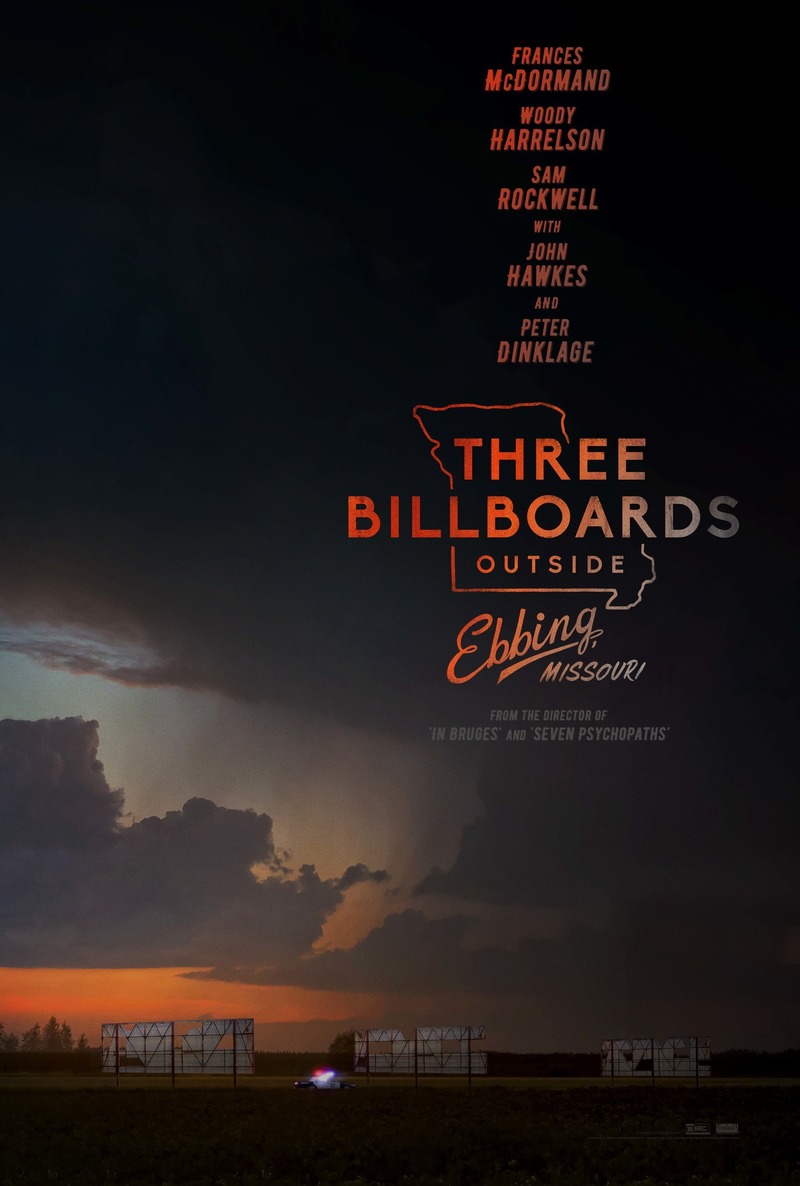
 It goes without saying that it takes a masterful artist to reflect the dark nuances of humanity in a way that is endearing, hilarious and entertaining, but not dismissive of the subject at hand. Martin McDonagh, through both his extraordinary theatre work as well as his wonderful films, is one such artist, and with his latest film, Three Billboards Outside Ebbing, Missouri, he makes his most profoundly complex film to date, a film with a powerful statement concealed within its darkly comical morality tale. A film that covers topics such as racism, police brutality, murder and sexual violence in a way that does not make light of the subject matter, but rather looks at it from McDonagh’s notably acidic perspective. This all goes towards making Three Billboards Outside Ebbing, Missouri one of the most audacious and brilliant films of the year, and one that never shies away from the uncanny truths that it presents to the audience. Without any doubt, Three Billboards Outside Ebbing, Missouri is one of the most complex explorations of the problems that plague our society, and the inherent good and evil that human beings are capable of, as well the possibility of finding redemption. While it may not match McDonagh’s incredible feature film debut In Bruges, there is no way to deny that Three Billboards Outside Ebbing, Missouri represents a considerably excellent move towards scathing social commentary on the part of the writer/director, who manages to construct a beautifully poignant and often darkly hilarious morality tale about human nature and how a community can come together after a certain event, and be torn apart by the ramifications of a single action.
Mildred Hayes (Frances McDormand) is a working-class woman in Ebbing, Missouri (proving that the film’s title is anything but arbitrary) who has recently had to endure a heartbreaking tragedy when her daughter is raped and murdered by an unknown assailant who has yet to be apprehended. Dissatisfied by the lack of results on the part of the Ebbing Police Department, Mildred pays for three billboards outside the city to be put up, targeting the head of the police, Sherriff Bill Willoughby (Woody Harrelson), naming him the main culprit in terms of failing to find her daughter’s killer. The community is torn apart by Mildred’s shocking action, but she stands her ground firmly, believing that justice (in whatever form) must be served, and whoever raped and murdered her daughter needs to be found so that he may atone for his sins and receive the relevant punishment for what he did. The tightly-knit community starts to turn against Mildred, with many empathizing with her tragic loss but refusing to support her decision to attack the very people (as well as their hard-working and sympathetic leader) who did their best to bring justice, but unfortunately were only able to do so much. The film tracks Mildred as she searches for justice in the face of the belligerence of the people who had previously supported her through the grieving process. Meanwhile, racist, trigger-happy buffoon Officer Jason Dixon (Sam Rockwell) has to undergo his own introspection in the face of his own loss, being forced to consider his own violent actions and bigotry towards others, and showing how his own struggles do eventually overlap with those of Mildred. Their paths meet in the most unexpected way, leading to a surprising climax that shows McDonagh’s fierce control over representing the nuances of the human spirit.
Cutting straight to the chase here (because Three Billboards Outside Ebbing, Missouri is a film that does not beat around the bush, and rather serves to be an incredibly straightforward, brutally honest film that does not hold a single punch, and rather bombards the audience with a plethora of complex but poignant themes), this film thrives almost entirely on the cast, and nearly everyone – regardless of the size of their roles, whether leading star, meaningful supporting player or welcome cameo – is giving the opportunity to shine, and are the beneficiaries of an extraordinary script which clearly does care deeply for its characters in the telling of this story (which is suprisingly becoming increasingly rare in modern filmmaking, where characters are secondary to story, rather than having strong connections to each other). It becomes extremely clear that McDonagh perfected his craft through his notable career background in the theatre, as his films always have well-written, wonderfully-developed characters that are original and do not fall victim to cliche or taut cinematic conventions, similar to the subversive characters he has created over the years in his highly-acclaimed theatrical productions. Undeniably, Three Billboards Outside Ebbing, Missouri has one of the best ensembles of the year, with absolutely everyone giving wonderful performances and making the best out of the characters they have been given. There are very few films in recent history in which the roles are so perfectly occupied by the actors who play them, and the astounding performances, as well as the astonishing chemistry between the actors, was a major merit in regards to this fantastically subversive piece of social satire.
Frances McDormand is one of the most consistently wonderful actresses working today, and over the course of her career has been responsible for some fascinating character work – whether it is through her multiple collaborations with her husband and his brother (the iconic Joel and Ethan Coen) in films such as Fargo, Blood Simple and Burn After Reading, or her tremendous work in films such as Almost Famous, North Country or the brilliant television miniseries Olive Kitteridge or essentially any of the countless projects to which McDormand has so graciously and gracefully lent her remarkable talents as an actress. Three Billboards Outside Ebbing, Missouri is definitely one of her most exceptional performances, and the way she is able to convey the unspeakable suffering her character has to go through after losing her daughter to a horrific crime while still commanding the screen and demanding attention is truly astonishing. At first glance, the character of Mildred Hayes in Three Billboards Outside Ebbing, Missouri seems like something McDormand is effortlessly capable of doing – a brassy, straightforward and slightly vulgar (but still unbelievably endearing and perhaps even ruggedly lovable) woman just seems like something McDormand can accomplish so easily. Yet, there is something so palpably profound about her performance as the grieving mother who just wants justice. In anticipation for this film, I found out that McDormand had based her performance as Mildred on John Wayne, and this is abundantly clear in her performance here as someone who has suffered tremendously, and wants justice to be served, whether it is through legal means or through her own relentless vigilante vengeance. Much like Wayne, McDormand’s gruff and standoffish demeanour hides a very tender heart and a simple desire to right the unspeakable wrongs that befell her loved one. McDormand is an incredible actress, and what she does with this role is truly staggering. It is one of her strongest performances, and proof that McDormand is capable of commanding the screen in a truly spectacular fashion.
I have never hidden my utter admiration for Sam Rockwell, an actor capable of strong leading performances as well as being a consistently wonderful supporting presence. Rockwell has built his career out of playing relatively smarmy, arrogant and slightly idiotic characters that are used for comedic relief or to play off Rockwell’s unique talents to create an endearingly strange character (such as his great work in Matchstick Men as well as his leading role in Confessions of a Dangerous Mind, a mediocre film but one in which Rockwell gave a solid performance). Rockwell worked with McDonagh previously on Seven Psychopaths (in which he was excellent, as expected), and based on promotional material, Three Billboards Outside Ebbing, Missouri would see Rockwell playing a similar kind of character – a scene-stealing, endearing individual used as comedic relief. The first impression of Rockwell’s character in Three Billboards Outside Ebbing, Missouri is that Jason Dixon is just an extraordinarily idiotic character that is a foil to Sherriff Willoughby and the other residents of Ebbing, used as a comedic presence to lighten the seriousness of the story. Considering what we have seen Rockwell do before, particularly in Seven Psychopaths, it was a fair assumption. However, I have never been more wrong in regards to a performance, and Rockwell gives a performance that will doubtlessly be a defining role in his career. As the film progresses, we see that there is a certain sinister side to Dixon which results in the revelation that there is something far deeper to this character than what appears on first glance. Bigoted, violent and utterly malicious in his relentlessly aggressive rage, Dixon is a complex character, and Rockwell brings him to life brilliantly. Rockwell is a great actor, but he has never been quite as great as he was in Three Billboards Outside Ebbing, Missouri, a film that plays on Rockwell’s obvious capabilities while still subverting them. McDonagh truly astounded me with his ability to take a popular archetypal character in unique and unexpected directions, and the result is one of the most staggering performances of the year and the exact kind of role that shows exactly what Rockwell can do when he is given the opportunity.
Beyond McDormand and Rockwell’s magnificent performances, Three Billboards Outside Ebbing, Missouri is positively overflowing with remarkable performances from incredible actors. Woody Harrelson, one of the most effortlessly charming and talented actors working today, gives one of the most endearing performances as the police chief who has to deal with his own personal demons while struggling with the added wave of attention directed towards him by Mildred’s billboards. Harrelson is consistently great, and he is a continuous presence in this film, contributing (directly or indirectly) to the events of the story. Peter Dinklage and John Hawkes have small but memorable roles, with Dinklage in particular showing that he is an actor that can be detached from his iconic role in Game of Thrones (and if anyone doubted this, please remember that Thomas McCarthy’s The Station Agent exists, and it is marvelous, and Dinklage even more so). Lucas Hedges, whose impressive growth as an actor continues to astonish me, has a considerably smaller role as compared to his two other recent notable efforts, namely Manchester by the Sea and Lady Bird, but he is doubtlessly as good here as he was there. I am anxiously awaiting to see what the future holds for Hedges, but he is a tremendously talented actor, and I expect only magnificent things for him in the future. 2017 has also been the year that Caleb Landry Jones has risen (somewhat) in status after his great work in Heaven Knows What, with a polarizing but effective performance in Get Out, a small role in The Florida Project and Three Billboards Outside Ebbing, Missouri, where he is given a character that may seem disposable, but he actually plays an important emotional role in the story, and one of his scenes across from Rockwell was heartbreaking. It may be bold, but I truly believe that Jones has an incredible career ahead of him. Even Samara Weaving and Željko Ivanek, in roles that are merely pure comedic relief, are able to contribute to the splendid ensemble of Three Billboards Outside Ebbing, Missouri.
Of all the themes in Three Billboards Outside Ebbing, Missouri, the one I found the most intriguing was how McDonagh was able to convey the All-American, Midwestern small-town mentality that pulsates throughout this film. McDonagh has an uncanny ability to get under the skin of the subjects that he approaches in all of his work, and is able to convincingly convey the nuances of the storyline in a way that conceals the fact that Three Billboards Outside Ebbing, Missouri is essentially an outsider attempting to comment on issues that are not exclusively American, but are undeniably integral to the current social and political strife that pervades the country at the present moment, and has for decades. McDonagh’s approach to Three Billboards Outside Ebbing, Missouri is two-fold, as he clearly wants to convey the aforementioned social turmoil that lurks everywhere from the biggest cities to the smallest towns, as well as showing the quaint and charming nature of towns like Ebbing. The reason for the latter is far more unsettling than simply to be an entertaining statement on small-town mentalities, but rather a way to filter the shocking and brutal narrative through something so endearing, to amplify the disturbing and distressing nature of the statement McDonagh wants to make. I was taken aback by how serious Three Billboards Outside Ebbing, Missouri actually is – there are some remarkably funny moments, and it has the same scathing wit of In Bruges and Seven Psychopaths, but it lacks the juvenile hilarity that defined those films. It isn’t necessarily a bad thing, as it shows some considerably more mature filmmaking from McDonagh, who abandons the outrageously hilarious and absurd nature of his previous films and rather makes a meaningful meditation on an issue that is far too startling in how relevant it is. Do not misunderstand what I am saying here – Three Billboards Outside Ebbing, Missouri has much of the scalding dark comedy that has defined McDonagh’s career but shown through a very distressing lens, and there are moments of considerable seriousness that forces the audience to pay attention to the meaningful core of this film.
Three Billboards Outside Ebbing, Missouri is a fantastic film. It is funny, heartbreaking and beautifully-composed. It has a remarkable ensemble, with each and every actor giving performances that were astonishing, and profoundly meaningful to the grander narrative. Frances McDormand and Sam Rockwell, in particular, are worth noting for their courageous, brilliant approaches to their characters, and their performances reached far deeper than the first impressions towards this film would suggest. Three Billboards Outside Ebbing, Missouri is not overly shocking, and it is a relatively crowd-pleasing film, but not one that flinches away from gravely serious subject matter. Martin McDonagh is one of our greatest living satirists, and Three Billboards Outside Ebbing, Missouri is just another fantastic addition to his acclaimed collection of works. It is a tremendously moving and deeply profound exploration of human nature, more than anything else, and I found it positively wonderful, and certainly one of the most fascinating films of the year.
 The Postmodern Pelican
Anger begets anger. In his screenplay for Three Billboards outside Ebbing, Missouri, Martin McDonagh takes a long, hard look at anger. It is a hot topic. The media informs us of a growing inability to deal with anger. Children shoot other children in schools. Reported incidents of extreme road rage make us hesitant to blow a horn in traffic. World leaders make irresponsible pronouncements that come from a place of hostility. I saw the film a second time after several weeks of mulling over my first viewing.
Major characters in the film are faced with incidents that prompt rage. Certainly, the most controversial of these characters is police officer Jason Dixon (Sam Rockwell). Dixon is a middle aged man who still resides with his mother, a vehement woman who verbally abuses her only child. Prejudice must be taught to children. Dixon has been taught well. Much of his abhorrent behavior, including physical assault, appears to be done to impress his mother. Each time Mildred Hayes (Frances McDormand) encounters Dixon, she taunts him with remarks about his mother. Ebbing is a small town. There are no secrets in small towns. Everyone knows how Dixon was raised.
Dixon’s unnamed mother is unapproachable. She ridicules her son. It is quickly evident that Jason Dixon is not bright. He was held back in the police academy and struggles with making simple decisions. Rather, he accepts his mother’s barbed slights without protest and drinks heavily to self-medicate his depression. Anger begets anger. There is a telling scene in the latter part of the film. Dixon’s mother is napping in the living room. We can see Dixon sitting on her bed cleaning his gun. For those of us who have seen McDonagh’s landmark play, The Beauty Queen of Leeanne, we anticipate Dixon’s next action. Even without that background, we can see the idea of matricide wash across Dixon’s face. When he chooses not to act, we see a change in Dixon. He now seeks to choose who will be the recipient of his wrath.
We know Dixon held a career goal of police detective. After being fired following yet another violent altercation when his emotions got the best of him, Dixon becomes contemplative. He overhears a barroom conversation which he concludes is a confession of Angela Hayes’s rapist/murderer. He drunkenly determines the best course of action to gather the suspect’s DNA in a manner that injures Dixon severely. When he is proven to be mistaken, he decides to become a vigilante and murder the man anyway. Dixon is damaged goods. He is simply unable to break the cycle of abuse.
The other character who captures our attention with her anger is Mildred Hayes, the mother of a teenage girl who was raped, murdered and immolated within view of their family home. There is a blackened piece of earth beneath one of the three billboards on the road leading to the Hayes residence that serves as a visual reminder of what Mildred cannot forget.
Mildred is incensed that those responsible for the crime have not been apprehended. She rents the three billboards at the site of Angela’s death to call attention to the failure of the police to solve the crime. It is an effective ploy. Mildred remarks that she had actually seen new interest sparked to solve the crime. Grief can be a powerful burden. The rage that struck down the doomed teenage girl fuels Mildred’s virulent anger.
Fire becomes a symbol in the film of how anger is a consuming passion. We learn that Angela was raped while she was on fire. In response to Mildred’s protest, the billboards are set aflame. Mildred lights up the police station with Molotov cocktails in response to Dixon assaulting local businessman Red Welby for renting Mildred the billboards.
Mildred’s ex-husband, Charlie, appears at the family home she now shares only with her teenage son, Robbie. Charlie becomes angry with Mildred and physically shoves her into a wall. Like Jason Dixon, Mildred doesn’t fight back but accepts the threat. Only Robbie intercedes, holding a butcher knife to his father’s throat. Rage dissipates and conversation resumes. McDonagh well documents the politics of abuse. The immediate threat and the subsequent denial of the act are commonplace in such situations. Based on McDonagh’s oeuvre of texts addressing the trauma and aftermath of domestic abuse, the author may well be writing from a personal truth.
I think what makes Three Billboards outside Ebbing, Missouri a powerful emotional catharsis for me is the subtle but pointed way that McDonagh reveals how Mildred Hayes begins to release her anger and seeks to move forward in her life. The first indication is at a rare meal in a restaurant. Mildred learns that Charlie burned the billboards that prompted her to set fire to the police station. We see her rise from her table. The camera focuses on a close up of Mildred’s fingers slowly encircle and grasp the neck of a wine bottle. We anticipate the violence that will occur. Rather, Mildred sets the wine on her ex-husband’s table and encourages him to treat his 19 year old girlfriend well.
Later, Dixon and Mildred plan to become vigilantes together. Mildred expresses hesitancy. As the two head down the road to murder the man from the bar that Dixon is convinced is guilty of an unknown crime, Mildred states she will decide what to do on the road. The story ends with this possibility of Mildred moving toward acceptance.
Anger begets anger. I think I responded so positively to the film, because I recognize anger overwhelming me at different points in my life. McDonagh prompts us to see ourselves in the rage-impeded lives of Jason Dixon and Mildred Hayes. And, perhaps, we too can reflect for a healthier way to address the rage that percolates inside of each of us.