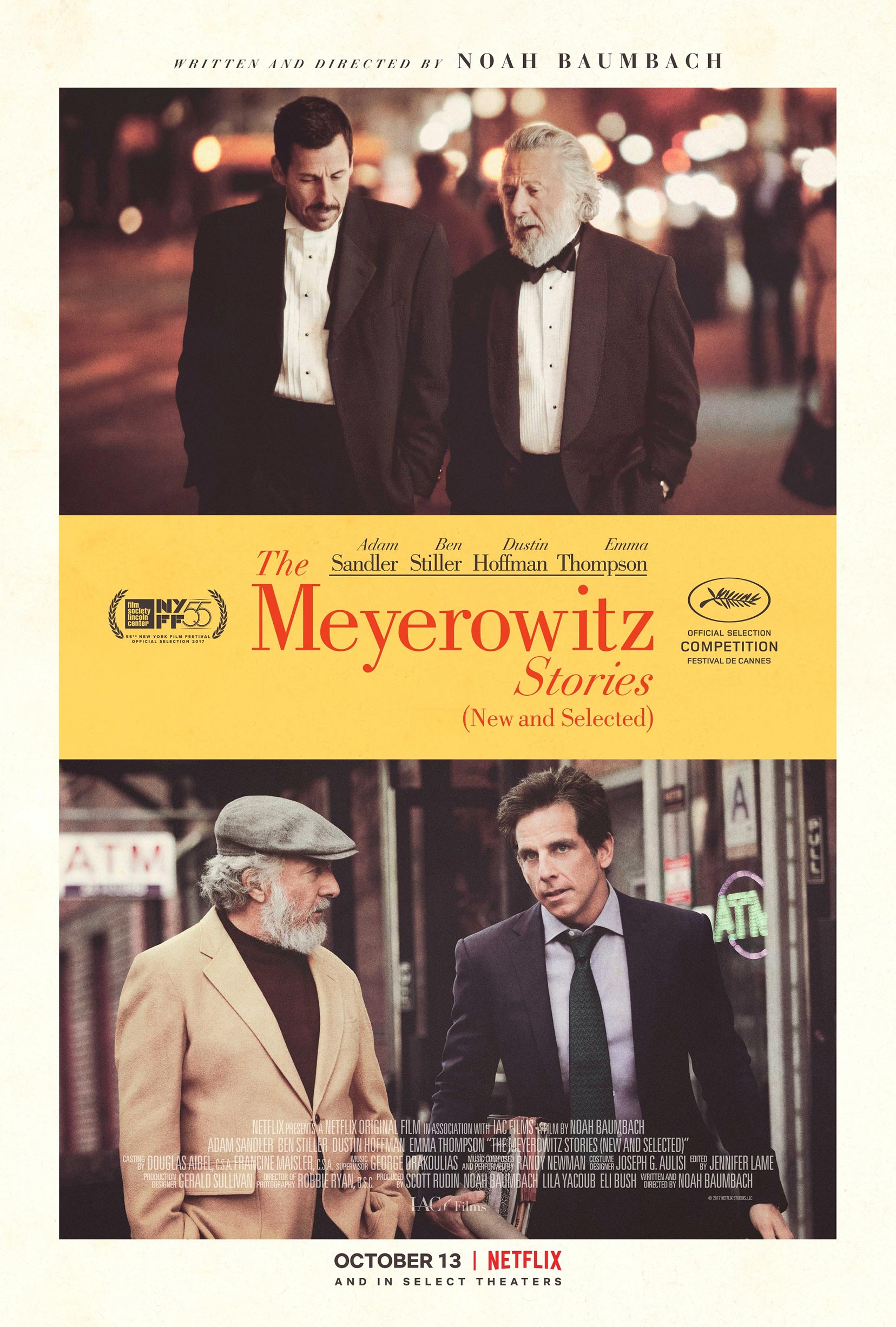
 There is something so delightful and satisfying of seeing a film go through its stages of development, and then finally watching the film after having followed its production so closely, albeit from a distance. I have been a fan of Noah Baumbach since I saw his incredible The Squid and the Whale over a decade ago, and since then I have followed his career closely as I watched him go from strength to strength each and every time he produced something. It also helps that he has been a shining beacon of independent cinema, because even after forays into mainstream acclaim, he has never once sacrificed his artistic integrity, and has always been faithful to his independent roots. Therefore, it was such a pure pleasure to finally watch The Meyerowitz Stories (New and Selected) recently, a film that I have relentlessly followed the production of, and found to be better than my expectations could have possibly imagined.
The central character in this film is Harold Meyerowitz (Dustin Hoffman), an aging sculptor who occupies that awkward position many artists find themselves in – he has been hardworking and acclaimed enough to have a bit of a following, but not enough to allow him to be famous or to be notable outside of a small social bubble of students and contemporaries. It is through Harold that we encounter the rest of his family who all enter into Harold’s life at this particular moment for various reasons. His oldest son Danny (Adam Sandler) has just split up from his wife, and with his daughter Eliza (Grace van Patten) moving off to college, he needs a place to stay, but more importantly he needs a companion in some form – and it just so happens his only choice is his aging father who we see does not necessarily see his oldest son or his daughter Jean (Elizabeth Marvel) as anything notable, rather focusing on his younger son Matthew (Ben Stiller), who Harold sees as his masterpiece. Matthew is a serious, dour accountant who arrives in New York to try and convince his father to sell his home and his lifetime of art for the simple reason that drives every decision to do such things in our modern age – convenience. In addition to this, the family has to deal with a variety of other factors, such as Harold’s alcoholic and volatile third wife Maureen (Emma Thompson) and Danny’s fear that his daughter, the only person who ever made him feel like he was somewhat useful, is growing apart from him.
Baumbach has always been someone who has one central theme in his films – that of family, showing the different dynamics that exist within traditional and unconventional families. In an essence, The Meyerowitz Stories (New and Selected) is his ultimate ode to the concept of family. There are some profound reflections on the meaning of family as well explore the underlying tensions that exist within this multi-generational modern Jewish family who clearly have different expectations on what the other people in the family should be, and their own judgments on who they actually have become. It is often a very difficult film to watch, mainly because beneath its often hilarious and heartwarming nature, there are moments of genuine heartbreak and despair as we see this family struggle to come to terms with the fact that everyone is different, and that sometimes families are far from perfect, and that everyone has flaws. It is a film that chronicles this family over the course of a few months as we see their interactions unearth and promptly cover all the underlying problems that exist, which results in a breaking point where there is absolutely no other choice than to face the problems, even if it means confronting those who you hold most dear to you, your family. If there was a message in this film (and there certainly was), it was this relentlessly brutal portrayal of the nuances of a modern family.
Just a warning – do not avoid this film because Adam Sandler is in it. I implore you to actually watch this film, especially because of Sandler. Now a bit of an admission – I am someone who criticizes (although the term “constantly and relentlessly trashes” is more accurate) Adam Sandler, because very often I find many of his films, especially those of late, to be messy, unfunny and deeply disturbing to my sensibilities as someone who enjoys actually watching something where some effort was put in. But I am also someone who believes anyone is possibly redeemable, and there has been no one who defends Sandler’s performance in films such as Punch-Drunk-Love and Reign Over Me quite like me. However, there is something else entirely about Sandler’s performance in The Meyerowitz Stories (New and Selected) – it isn’t a case of “Adam Sandler can actually be dramatic!” like we’ve seen previously, where the entire point of the performance was to show that Sandler can shed his broad comedic persona and deliver something dramatic. There wasn’t that sense of self-congratulatory artificiality in his performance here – rather, he was unrecognizable in his performance as Danny (obviously not physically but in the nuances in his performance). This was a heartbreaking, hilarious and deeply unique performance from an actor, and I really did not ever think Sandler was capable of such a performance. It isn’t the fact that Sandler actually gave a decent performance, it is the fact that this was a great performance overall. In fact, and I saw this with any sense of irony, it is one of the best performances of the year so far. I cannot rave Sandler enough – if you’re a fan, you’ll love him here. If you despise him, you’ll have your perception of what he is capable of doing completely changed. Honestly, Sandler is so great here, he is forgiven for the last decade of mediocre work. Let’s hope he can continue to choose challenging and interesting roles like The Meyerowitz Stories (New and Selected), and there should be enough goodwill from this film to qualify him to be considered for better roles.
Now forgive me for doing the pretty stereotypical act of conflating Adam Sandler and Ben Stiller – but if we are perfectly honest, the two men have had similar (but not identical) career trajectories, so it astounded me that it was only with Meyerowitz Stories (New and Selected) that they properly worked together for the first time, not counting Stiller’s very small cameo in Happy Gilmore. Now even if Meyerowitz Stories (New and Selected) is a film that is notable for Sandler’s incredible performance, Stiller holds his own, and unlike Sandler, I always expect Stiller to be great, especially considering this is his third collaboration with Baumbach. I am a notable defender of Stiller, both as an actor and as a director, and Meyerowitz Stories (New and Selected) was a film that allowed him to play a character that isn’t new territory for him, but rather a comfortably safe but ultimately well-performed role. He only makes his first appearance towards the beginning of the second act, but from his first moment, he fits well into the world this film creates. Sandler is the emotional core of the film, but Stiller has several resonant moments, especially being the contrast to Sandler’s character, playing the favorite son who has to live in his father’s shadow. It is a twist on the popular odd couple sibling trope, with one being laid-back and relaxed, and the other being persnickety and uptight, but their performances go far beyond simple tropes such as these, and they deliver knockout performances and play off each other well, with Stiller himself having some beautiful moments of complex development throughout.
A major draw towards this film was obviously Dustin Hoffman, clearly the very definition of a Hollywood legend. Playing the patriarch of the family, he is a blunt and often obtuse artist who appears to be absent-minded and distant, but actually is fully-aware of the scope of his actions and understands exactly what his family is feeling, yet he is unable to shed the proud and arrogant nature that he has developed as an artist who has received only middling claim and very little fame, even if he believes himself to be someone worthy of entire exhibits dedicated to his work. Hoffman’s character is odd – he is not the archetypal senile comic relief, nor is he the all-knowing, wise patriarch. The fact that his character is older does not necessarily make him any wiser, and he is shown to be as naive and stubborn as his sons. It is Hoffman’s best performance in over a decade, and whereas much of his recent work has been focused on playing characters that are very comfortably within his wheelhouse, The Meyerowitz Stories (New and Selected) presented him with a challenge to play a character that goes through the same motions as one would expect, but actually is shown to be so much more complex than one would imagine. It is a popular and very lazy tend for filmmakers to hire these legendary veterans to play supporting roles in their films simply to play off their legacies and their status as cinematic icons, but Baumbach avoids that completely by giving Hoffman’s character genuine personality and moments of strong development. Hoffman has not been this good in years.
One criticism I have seen thrown against The Meyerowitz Stories (New and Selected) is that it doesn’t care too much about its female characters – which I find entirely wrong (even if I am contributing to perpetuating such an idea by grouping the female performances together). However, despite this being a film about family, its focus is really on the male characters, which isn’t that bad when you consider that even if the female characters are somewhat secondary, they are still well-developed. Elizabeth Marvel is really fantastic as Jean, with her droll but hilarious delivery being responsible for some of the best moments in the film. Her character could’ve benefitted from a little more focus, but her third-act monologue was heartbreaking. With the exception of Sandler, she gave my favorite performance in the film. Grace van Patten is absolutely wonderful as well, and she is a revelation as Danny’s daughter who is becoming a woman, even if her father is trying to hold onto the image of his little girl (which makes her experimental and very explicit college student films even more awkward). Here is an interesting fact – in a film that has Emma Thompson playing an eccentric, alcoholic middle-aged women, she is only the fourth best performance. Thompson was as wonderful as she always is, but she just suffered from the fact that the other performances were just so much more interesting.
The Meyerowitz Stories (New and Selected) is a film that succeeds on the strengths of its capable and very talented ensemble, each one a valuable piece of this tremendous film, and it is through them that we are able to look at the major dominant themes of the film. Like I said previously, this is a film about family and the underlying tensions – and through the combining narratives of the various characters, we can piece together the history of this family. It is a very funny film, but also one that doesn’t neglect to show how serious it actually can be. It isn’t a tragedy at all, and it is relatively amusing, but the core of this film is very brutal in how it shows the breakdown of family dynamics. It is far more than just the quirky independent comedy you’d expect it to be – it is a poignant and utterly moving portrait of a family still (and likely permanently) under construction.
Beyond the ensemble, The Meyerowitz Stories (New and Selected) is a film that may not be particularly showy, but it does have some visual flair. It feels very much like a classic 1970s Hal Ashby comedy (with similarly innovative editing such as in Landlord), with the sensibilities of looking at serious issues through a very warm but not overly sentimental lens. It is a film that has its own unique look of New York City, and Baumbach is fast joining the likes of Woody Allen, Spike Lee and others in being a filmmaker who presents a certain idyllic but realistic image of the city with which cinema has been having a passionate love affair for nearly a century. Baumbach shows a unique side to the city through his films and focuses on the smallest details in order to drive his characters forward. While Baumbach’s films are not necessarily technical achievements that tower above all others, they are certainly very warm and endearing films that thrust you into the world of these characters beautifully.
The Meyerowitz Stories (New and Selected) is such a great film. I was expecting to love it, but even if I put my own unabashed adoration for Baumbach aside, this is a really wonderful film. Warm and funny, but also poignant and filled with moments of sheer beauty in how it handles the topic of family – it is not a typical independent comedy where humorous situations mask serious subject matter – this is a film that shows the trials and tribulations that come with being in a family and how each individual needs to achieve their own potential while still trying to satisfy the expectations of the people who we supposedly care the most about. The Meyerowitz Stories (New and Selected) is such a great film, and it serves to be a career-best for nearly everyone involved. Watch it, it is absolutely incredible, and certainly one of the best films of the year.
 The Postmodern Pelican
The examination of the dysfunctional family has become a tired cliché.
Here the self-absorbed artist who has ignored his children is flirting with his mortality. All three wounded children come bounding home for one more attempt to win daddy’s heart and discover that they are worthy of love.
Sigh.
I don’t see this much in life. Perhaps it occurs in affluent families where children with poor career choices appear to be seeking a non-existent bond but really want to insure their cut of the inheritance. More often than not, the disinterested parent who has money has married someone younger who gets the cash.
Why do we head to the movies to see this story yet again? Are we so hungry for that fantasy of reconciliation a movie provides to ease the harsh reality of the painful absence of parental love?
The star studded cast is stellar. So many are rare to see now on the big screen we can be almost be excused for double takes.
Look there’s Candace Bergen. Doesn’t she still look lovey?
It’s Judd Hirsch and Rebecca Miller. Wow. They still have got it!
Wait, was that Adam Driver? Probably. He was gone too quickly. Yeah. Same with Sigourney Weaver, but I remember her. Her bit was pretty funny.
Who’s the drunk under the wig? I think, yes it is Emma Thompson. She’s so funny.
The leads are Ben Stiller and Adam Sandler. Both do solid work here. Though Sandler is doing yet another performance as the man boy in his standard uniform of rumpled cargo shorts, I refuse to get all worked up because he doesn’t suck. It’s about time Sandler actually uses his talent. Just because he shows that still can employ his acting chops after years of coasting doesn’t persuade me that solid work is a revelation.
Rather, supporting players Elizabeth Marvel and Dustin Hoffman deserve the praise. Marvel is a wonder as the only daughter of the indifferent father. We see how the lack of parental love is physically exhibited in her lifeless hair, her purposefulless shuffle, and her broken spirit. The film is more interested in boys so the actress must make every moment count in her limited screen time. She is devastating when surprised by the arrival of an elderly family friend who once sexually harassed her. Marvel’s monologue recounting the event is riveting.
The great Dustin Hoffman returns to the screen with a roar. A gerontologist once wrote that our true selves are no longer masked in old age. Hoffman spares us nothing in the truth of this retired Bard professor and sculptor. He is vain, cruel, self-absorbed, and dismissive. Hoffman plays each of these characteristics without vanity. And yet, he is utterly hilarious. An extended sequence in an upscale urban restaurant where the elderly father creates escalating drama thinking another patron has taken his blazer is a sheer delight of cringe worthy humor. In Hoffman’s hands, the ludicrous premise seems completely believable. Even when he has been proven to be mistaken, we still question if Hoffman is right. The movie suffers mightily during his long term absence mid story.
And, of course, the ending provides that glimmer of hope the dysfunction of this family might find respite. Isn’t that sweet?