At least once a year, I have been doing these features under a series I’ve called The Long Take, in which the premise is simple: choose a filmmaker I admire and gradually explore their work from beginning to end and then ultimately come forward with a definitive ranking of their films. This has mostly been done with filmmakers who have either passed on or have essentially retired from directing, which includes a couple that are ongoing projects (the next one of which is due to be published in the coming months), which gives us a limited body of works to analyse, making it possible to be more conclusive. However, the conundrum comes when dealing with filmmakers who have either come out of retirement or simply never stopped working – how do we manage to be thorough when they are putting out new films? This brings us to the inaugural entry into this series, in the form of Paul Thomas Anderson – he was the first person covered for the series when it first came about in early 2017. In the time since, he has given us a few additional films, some of which are probably the best of his career. Now that he has reached his tenth film and seems poised to receive long-overdue awards attention, what better opportunity to discuss Anderson than now?
Therefore, I’d like to introduce a spin-off on the original series, which I am calling “The Long(er) Take”, in which the same principle will be implemented, but for filmmakers who have previously been the subject of an entry into the series, but after a certain amount of time are given an update. It is going to be somewhat more sporadic, and some might even say it could be a bit redundant – but it is also an opportunity to experiment with how taste changes and evolves. Some of these films – all of which I have rewatched in preparation for this update – have risen in estimation since the last time, whereas others have not aged quite as well. The idea that the ranking will remain the same is unlikely, since there are many variables, and the overall approach was to blend my previous perceptions with those that have emerged in the years since, an intriguing experiment in looking at how my feelings towards both the director and his individual works have been altered over time, through re-interpreting the films or simply viewing them with fresh eyes. For the most part, the sentiments remain the same – but in many ways, there have been new insights, which are ultimately what I am so interested in exploring here. It’s not just a matter of ranking, but also engaging with the text in a way that updates the original thoughts and brings new insights into the conversation, blending past and present.
What is it about Anderson we love and admire so much? My original thoughts have not changed too much over the years – he’s someone who wears his heart on his sleeve, making both his admiration for certain filmmakers like Jonathan Demme, Stanley Kubrick and Martin Scorsese known, as well as his affection for his origins, which infiltrate so much of his work. Anderson is, at heart, a Californian filmmaker. Except for a couple of films, his work has remained rooted in his native California, tracing the state’s shifting identity across time, which is a subject that we oddly find isn’t discussed as extensively in terms of finding a connective tissue between his films. His work weaves together an unconventional history of the region: from the oil fields and mining expeditions of the early 20th century in There Will Be Blood, through the postwar tensions of the 1950s in The Master, the fading counterculture of the 1970s in Inherent Vice and Licorice Pizza, and into the contemporary landscape with films like Punch-Drunk Love and One Battle After Another, which is clearly rooted in a version of the state that is both recognisable and uncanny. Rather than presenting California as it is so often mythologised on screen, Anderson captures it through deeply human stories, creating a textured portrait of place and time.
What also makes his body of work resonate so strongly is not scale but sincerity. Anderson has never chased the spectacle of bigger, more commercial films; instead devoting himself to projects that carry heart and intimacy at every step. He may have made fewer films than many of his contemporaries and takes longer breaks in between each one, but they all feel essential, events that are infused with emotional depth and a profound interest in the human condition, getting to the very root of society and culture as a whole. His characters are strikingly well-developed, and his casting choices so precise that actors seem to inhabit their roles completely. Across his films, Anderson examines what drives individuals, what binds communities, and what allows societies to endure, making him one of the most distinctive and genuinely thoughtful filmmakers working today. This piece is designed to be a tribute to not only his work, but the multitude of ideas that inform them, making each one a masterful piece of pure artistry in itself.
On that note, let’s start:
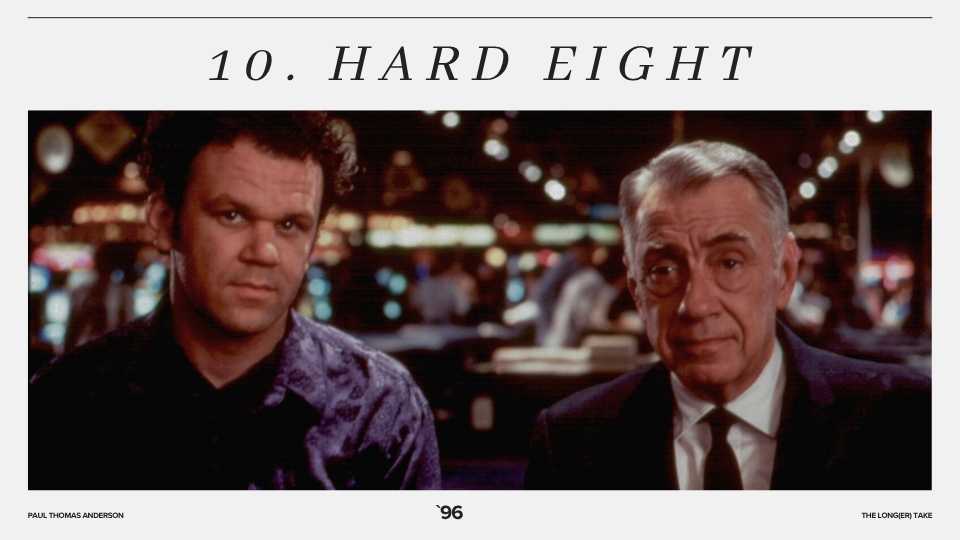
While ranking Hard Eight at the bottom of this ranking feels unfair, it’s still a film I admire a great deal, but ultimately something has to be placed here. Anderson’s debut is a lean, atmospheric noir that demonstrates his command of mood and character interaction from the very beginning. Phillip Baker Hall (one of the great unheralded actors of his generation) anchors the film with a performance of quiet authority, while John C. Reilly, Gwyneth Paltrow, and Samuel L. Jackson round out a cast that hints at the strong ensembles the director would later become known for. The film builds a fascinating tension around mentorship, deception, and loyalty, and it works as a stylishly low-key crime drama. Yet, compared to the rich characterisation and hypnotic scope of Anderson’s later films, Hard Eight feels comparatively slight. It is a very good film, but in a career defined by greatness, being merely very good inevitably ends up at the bottom. A solid debut, only just missing the spark of what was to come.
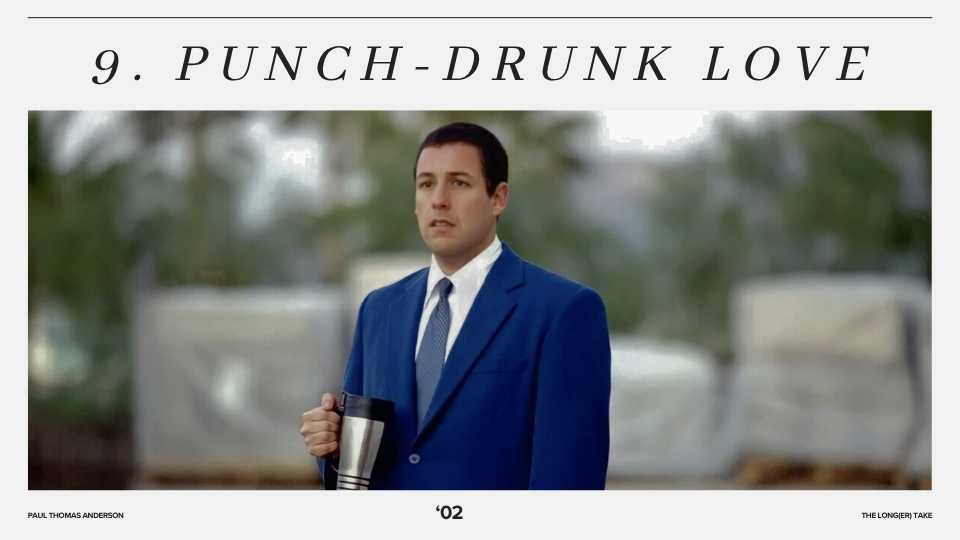
Punch-Drunk Love marks Anderson’s most overtly experimental effort, a strange and often beautiful attempt to reimagine the Adam Sandler comedy as an arthouse romance. I’ve often found Sandler unbearable in projects where he can be slightly too excessive, but Anderson forces a reassessment, and his performance as Barry Egan, a lonely man prone to volcanic outbursts, proves he does possess real dramatic talent when guided by a strong director and forced to challenge himself as an actor, something he has been willing to do more lately. The film surrounds Barry with a heightened, almost surreal world, punctuated by bursts of colour, music, and awkward tenderness, resulting in something both funny and unexpectedly moving. Emily Watson provides a quiet, grounding counterpoint, and the film’s quirky rhythms have a charm all their own. Still, despite its originality and undeniable sweetness, Punch-Drunk Love lands in the lower half of Anderson’s filmography. Like Hard Eight, it’s a very good film, but compared to the towering ambition and richness of his other work, it feels like a lighter sketch of greater things that were on the horizon for the director.
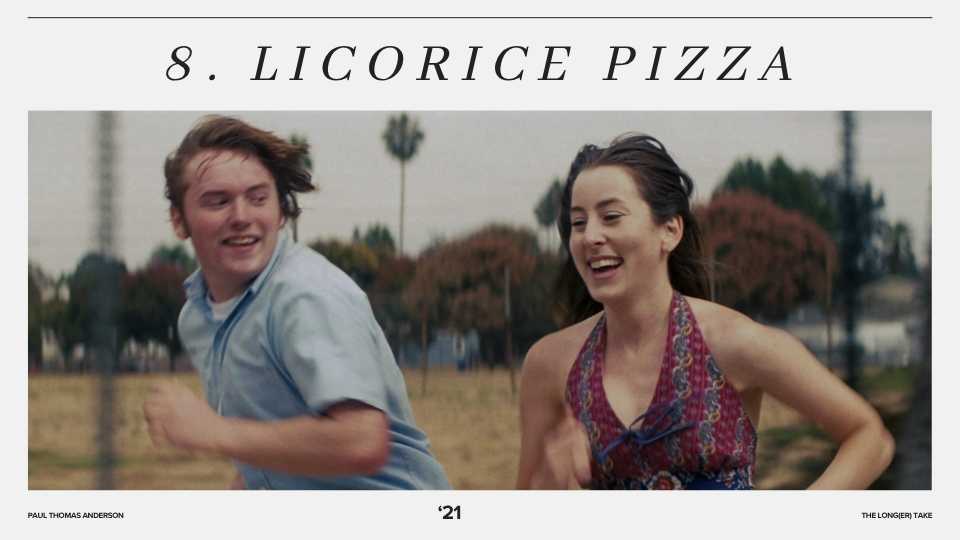
A slightly more controversial choice, but this is the point where we have to kill some darlings in favour of honouring a process of ranking his work. Licorice Pizza feels like Anderson returning home, not just geographically, but also emotionally. Set in the San Fernando Valley of the early 1970s, it’s less about tight plot mechanics than about mood, nostalgia and the awkward pulse of reckless youth. Anderson steps back from the ambition of some of his previous work and leans instead into atmosphere, focusing on themes surrounding growing friendships, awkward flirtation, and messy in-between moments between two kindred spirits, which are drawn with warmth and authenticity. First-time actors Cooper Hoffman and Alana Haim shine with a kind of ease that elevates the whole film and makes a case for themselves as major stars of the future. There’s humour, tenderness, and a real affection for the little details, with cultural quirks, suburban textures, and the hum of ordinary lives becoming something more. However, Licorice Pizza still doesn’t quite reach the heights of Anderson’s very best, despite having some genuine merits. Its lack of a strong driving narrative and its gentler tone mean it’s wonderfully charming, but not quite as hypnotic or profound as his towering masterpieces.
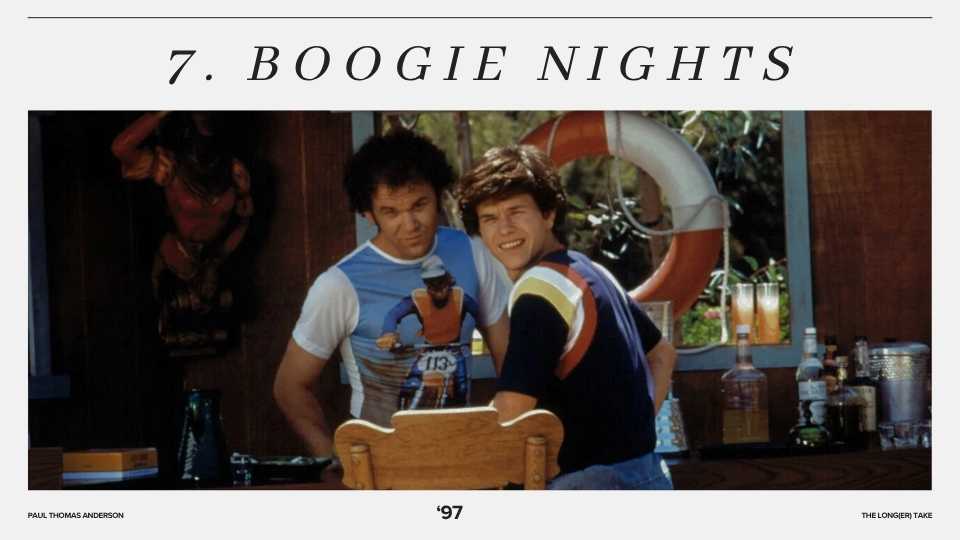
Placing Boogie Nights at #7 may seem sacrilegious, given its reputation as Anderson’s magnum opus, but in a ranking of masterpieces, it’s another sacrifice that needed to be made as we move through his body of work. Like many, I consider it one of the defining films of the 1990s, a sweeping, audacious portrait of the adult film industry that doubles as a sprawling family saga, perhaps even overtaking the more scandalous subject matter to become the beating heart of the film. Anderson’s direction is electric: fluid long takes, dazzling set-pieces, and a knack for balancing comedy with tragedy. We see the roots of the director he was set to become. The ensemble cast, consisting of the likes of Mark Wahlberg, Julianne Moore, Burt Reynolds, Philip Seymour Hoffman and many others, delivers career-best work, and the film captures both the exhilaration and devastation of its world with unflinching honesty. Yet, despite its brilliance, I find Boogie Nights slightly overlong, and it doesn’t have the same element of surprise or layers of detail as we find in some of Anderson’s other major films, having the audacity but lacking the maturity we’d see later in his career. For almost any other director, this would be the crown jewel. For Anderson, it occupies a place towards the centre.
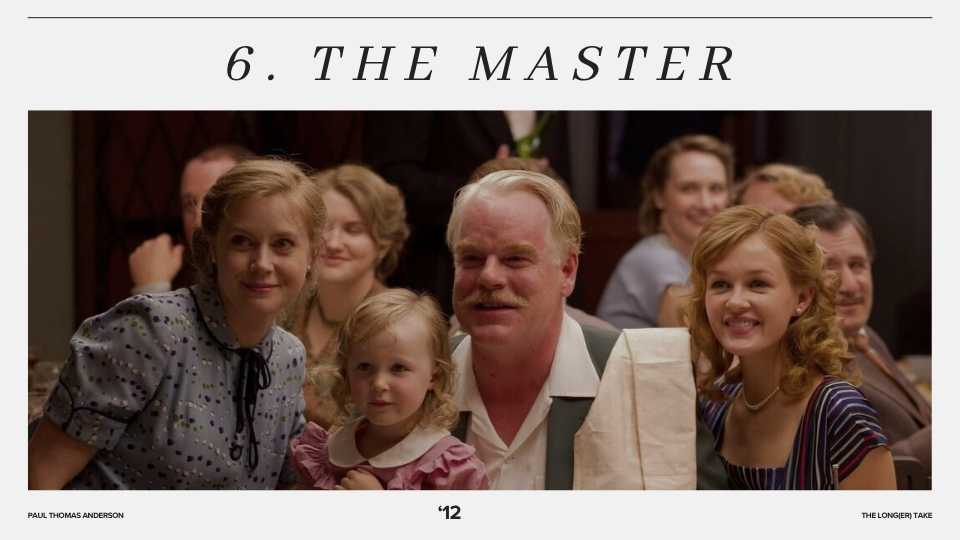
Few director–actor collaborations have been as rewarding as that between Paul Thomas Anderson and Philip Seymour Hoffman. Across five films together, Anderson consistently drew out some of Hoffman’s finest work, but nowhere more so than in The Master, one of his most sombre and chilling works. Here, Hoffman delivers the performance of his career (an ambitious statement, but one made all the more clear as we start to assess his work from a distance), matched by Joaquin Phoenix, another actor operating at his peak during this time. The result is a towering achievement: a searing, unsettling portrait of post-war America and a chilling exploration of faith, power, and the allure of cults. The Master is a film of immense ambition, tackling subject matter that could easily have collapsed under its own weight. Instead, Anderson, slightly out of his usual element, channels that challenge into something extraordinary. Both leads give performances of astonishing intensity (perhaps among the greatest ever put to film in the 21st century) while Anderson’s direction transforms potentially treacherous material into an unflinching, hypnotic achievement that only becomes more complex and layered the more we revisit it, despite its cold and challenging nature.
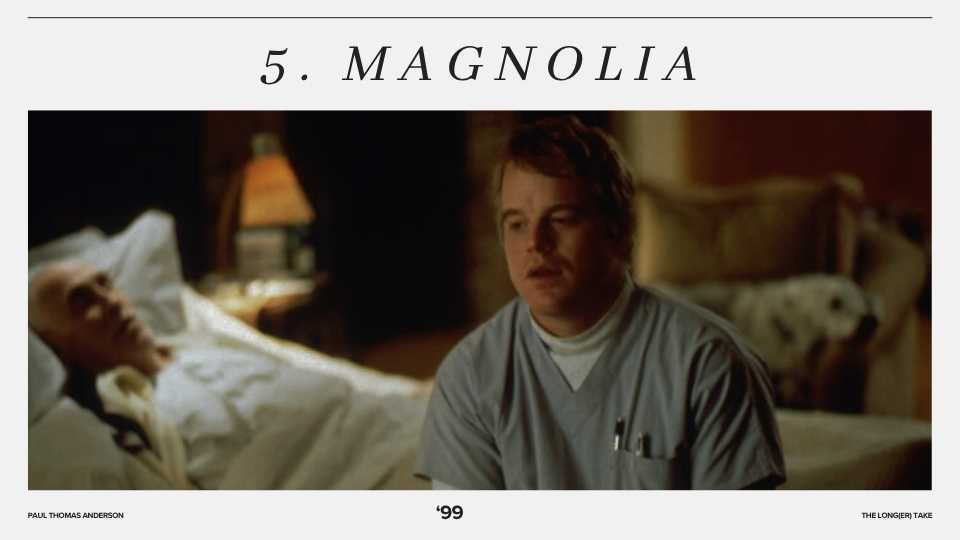
This is where it becomes truly challenging, since every one of these films in the upper half of the list are masterpieces in their own right and could have easily been at the first position. Magnolia was the film that made me fall in love with Paul Thomas Anderson’s work. It is an intricate, profoundly moving existential odyssey that threads together multiple narratives to reveal the ways in which lives intersect, touching on love, loss, regret, and the fragile hope that binds people together. Shot with breathtaking confidence and scope, it remains Anderson’s most emotionally resonant film, one that is both intimate and epic in equal measure. The ensemble cast (arguably the greatest Anderson has ever assembled) delivers uniformly powerful performances, further grounding the film’s sprawling ambition in raw humanity. On some days, I consider Magnolia to be his most complex and daring film, and I remain convinced it is one of the greatest films of the 1990s, coming in one of the most extraordinary years in film history. Yet, as much as I adore it, there are a few other works in his filmography that, for me, capture his essence even more perfectly, particularly with the addition of layers of maturity that only time can provide. Even so, Magnolia is an exquisite masterpiece and perhaps the one that contains the most meaning.
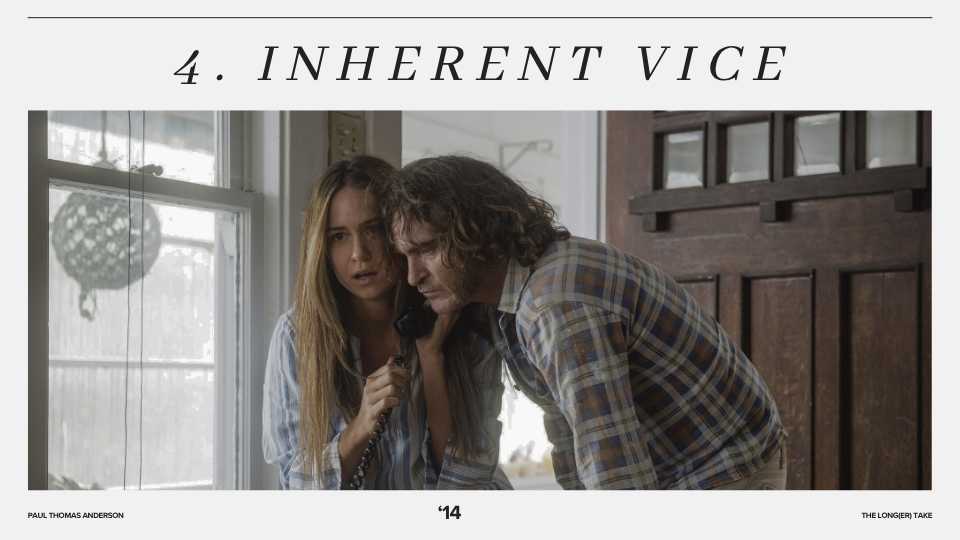
Perhaps the most controversial placement based on how many people place this at the bottom of their personal lists, I consider Inherent Vice to be one of Anderson’s most astounding achievements, for reasons that we only begin to realise after revisiting the film. While its divisiveness is well-documented, my admiration for it runs deep and has only become richer in the years since its release. Much of that stems from my love of Thomas Pynchon, my favourite author and a creative hero whose writing first opened my mind to new possibilities. It took more than fifty years for one of his novels to reach the screen, and it feels fitting that Anderson had the daring to make the leap. Adapting Pynchon’s intricate, anarchic prose was an immense challenge, yet Anderson captures its humour, eccentricity, and melancholy with precision. Joaquin Phoenix anchors the film with a magnetic performance, surrounded by a remarkable ensemble. The result is a work that is strange, funny, moving, and endlessly rewarding. Inherent Vice is often dismissed as incoherent or overlong, but to me it is Anderson at his boldest, an underappreciated masterpiece that grows richer with every viewing.
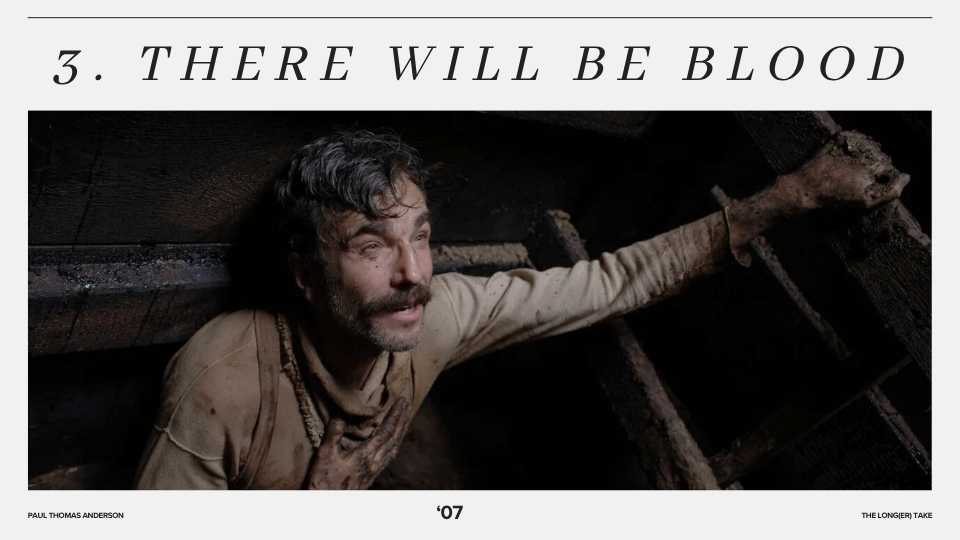
For a long time, There Will Be Blood stood as my clear choice for Anderson’s greatest achievement—and I still consider it one of the finest films of the 21st century. It is dark and unrelenting, yet also astonishingly beautiful, a film that transcends expectations to become nothing less than the defining cinematic work of the present century. Daniel Day-Lewis delivers a barn-burning performance as Daniel Plainview, embodying both ambition and ruin, while Paul Dano proves a formidable counterpart, both actors creating characters etched into modern film history. Beyond the acting, this is one of Anderson’s most accomplished works as a director in terms of how he pieces it together from a range of bespoke components: Robert Elswit’s meticulous cinematography, Jonny Greenwood’s haunting score, and the impeccable production design combine to create a work of staggering power and artistry. It is a nearly flawless film, both terrifying and sublime, and though it has now settled at a slightly lower position on my list, it remains the most persuasive proof that Paul Thomas Anderson is a master filmmaker.
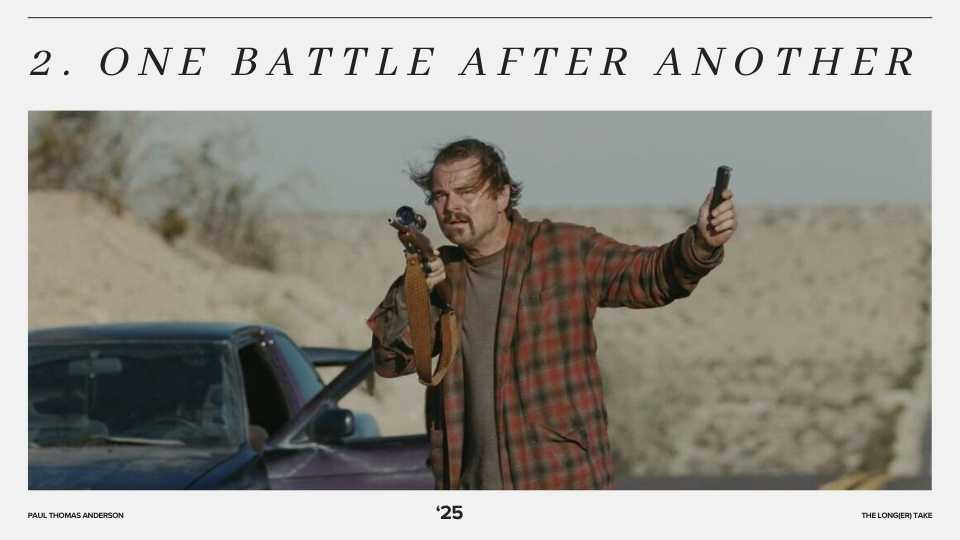
One Battle After Another is a remarkable achievement in Paul Thomas Anderson’s filmography, earning its place as my second favourite of his works, despite it being his most recent offering. This audacious adaptation of Thomas Pynchon’s Vineland (or rather, a free-form collage inspired by it) captures the chaos and contradictions of contemporary America with striking originality and an interminable sense of sincerity. Leonardo DiCaprio delivers a compelling performance as Bob Ferguson, a former revolutionary drawn back into conflict to protect his daughter, played by newcomer Chase Infiniti, who has a bright future ahead of her. The film’s bold satire, dynamic action sequences, and poignant father-daughter narrative are underscored by Jonny Greenwood’s electrifying score and the unforgettable cinematography. While some dissenters have noted its sprawling structure and tonal shifts, I find that these elements contribute to its unique energy and relevance, being a truly exemplary achievement in both form and content. One Battle After Another is a daring, politically charged film that challenges and entertains, solidifying Anderson’s status as one of the most inventive filmmakers working today, and proof that he’s only getting better with each new project.
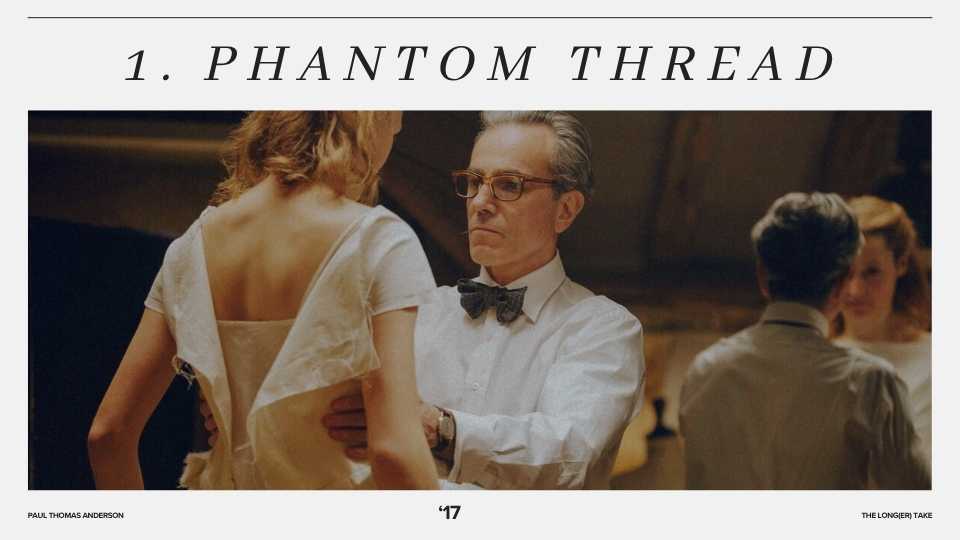
Phantom Thread represents Paul Thomas Anderson at his most audacious and masterful, and it claims the top spot on my ranking. Departing from his familiar Californian settings, Anderson sets the film in 1950s London, immersing viewers in the meticulous and obsessive world of Reynolds Woodcock (in a stunning reunion with Daniel Day-Lewis, who delivers his best work to date here), a dressmaker whose life revolves around precision, routine, and control. When Alma enters his world by chance, she disrupts his rigid order, leading to a darkly provocative exploration of love, obsession, and power. Lesley Manville as Cyril provides a quietly commanding presence, grounding the narrative with subtle intensity. The film is a triumph in performance, design, and score, with Mark Bridges’ costumes and Jonny Greenwood’s music enhancing its exquisite period detail. Phantom Thread is simultaneously beautiful, subversive, and deeply moving, a twisted yet romantic study of human desire and societal constraints. It is Anderson’s most unconventional, meticulously realised, and unquestionably greatest achievement to date, and while he is certainly becoming more ambitious, I can’t fathom anything being a more thrilling, complex accomplishment than this utter masterpiece.
On that note, the ranking is now complete. This did intentionally exclude his short films, which are wonderful in their own right but obviously cannot be included on a ranking of his best works, both for the obvious reason that their length precludes them from holding the same impact, and also because they pale in comparison to his feature-length work. Anderson is a director who has a few films that could be considered definitive masterpieces, and it seems like (with the exception of perhaps one or two titles), each and every one of these films is found at the top of the lists of other viewers, who are more than willing to make arguments as to why they feel like a particular film best encompasses everything that Anderson represents as an artist. Bold, daring and extremely smart in how he approaches his subjects, it’s hardly a surprise that Anderson’s name has become synonymous with ambition and quality, each of his films feeling like major artistic events.
How would you rank Anderson’s films? Let us know in the comments below!
 The Postmodern Pelican
At the inevitable Paul Thomas Anderson retrospectives in 50 years, it’s the screenings of Boogie Nights and One Battle After Another that will sell out. The Phantom Thread will make do with the overflow who failed to buy their tickets in advance.