A couple of years ago, I chose a slightly ambitious project – I would take a cinematic road trip through the United States, choosing a single film from each of the fifty states (as well as Washington D.C.) that was either entirely or prominently set within that particular part of the country, to get a broader glimpse into the entire country and how humour emerges in different regions. There wasn’t much discernible difference between them for the most part, but there was certainly more than enough unique cultural detail to make it quite an intriguing endeavour. Considering how enjoyable the experience was, it wasn’t going to take long to do a follow-up to that project – but rather than redoing comedy (even if my initial project was far from exhaustive or definitive), I thought I’d venture into another genre, and one that is just as definitive of American culture as comedy. Horror is a fascinating subject, and as one of the oldest genres in literature, it holds a special place in any culture. American horror (or more specifically, horror films set in the United States) has its unique history, which has spanned decades since the inception of the genre, and played a fundamental role in the development of how people look at various subjects. It seemed like a logical step to replicate this project using the same constraints, just from a different angle. There were a few comedic horrors covered in the first version of this project, so it’s not entirely untrodden territory, but now rather than focusing on the elements that make us laugh, we’ll shift our focus to those that terrify us, which is an equally as interesting approach that will likely reveal as much about the global culture as it does the genre itself.
Horror is quite a difficult subject to define since it isn’t always as clear-cut as comedy, which may take on many different forms, but it is clear to see when something is tinged with humour, even those slightly more ambiguous works. There are so many different kinds of horror scattered over the last century, existing in far too many sub-genres to even begin to count. This is made even more difficult by the fact that everyone has a very different interpretation of what horror should be – some qualify those films that aim to be terrifying more than anything else, while others look at any film that focuses on unsettling subjects as being the core for any work of horror. Personally, my approach will be based on what I find to qualify under the broader umbrella – I tend to be quite liberal as far as categorization goes, and some works are not considered scary by any traditional metric, but still qualify as horror, whether based on the thematic subject matter or the presence of certain tropes that align with the overall understanding of what defines a horror film. Throughout the project, I will choose several different films from across the decades which feature as many different styles as possible, with some veering towards the more comedic, others being more gruesome, and there will very likely be quite a substantial amount of oscillation between thrillers and horrors since the boundary between them tends to be razor-thin and sometimes even slightly ambiguous to the point where each individual could fall on very different sides of the debate. Ultimately, what qualifies as horror is far too difficult to define using a clear-cut set of criteria, so it will solely depend on what I feel best fits the themes, as well as providing a more diverse range of options, rather than depending on the same style of horror throughout.
Much like the previous iteration of this project, we’ll be using a very specific map on our journey, borrowed from FlyTrippers. This curated route is appealing since it doesn’t have a definitive starting or finishing point but rather is designed so that anyone can choose the state of their choice (regardless of where they want to start), and still be able to venture through all 48 continental states and Washington D.C., which creates a sense of circularity that can feel very valuable. The choice I made with the state to start the project was ultimately based on the film that could be seen as a good transition point between the two genres, functioning as both one of the greatest comedies ever made, but also a genuinely terrific work of horror, meaning that it has a logical place in this project as the one to kick the entire endeavour off. The rest of the journey will follow the map below:
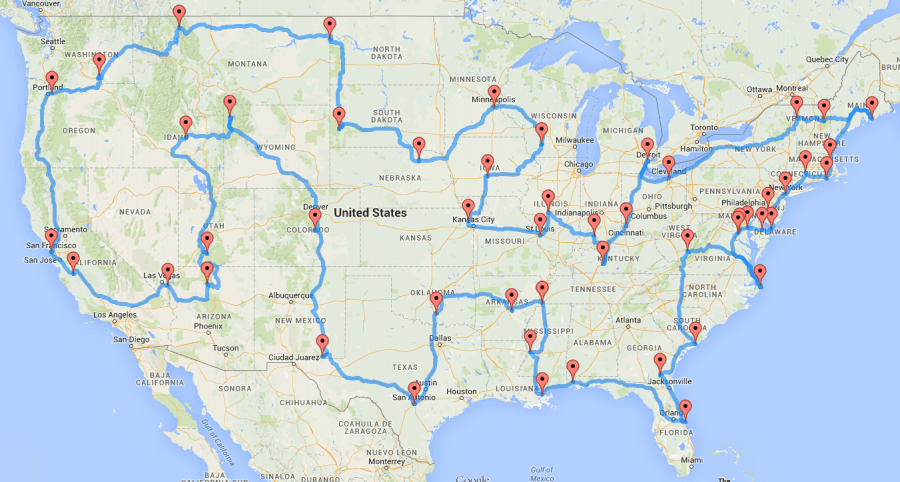
The table below outlines the order in which we will be moving, and will be populated as we voyage throughout the country:
| State/Region | Film |
| Florida | TBA |
| Georgia | TBA |
| South Carolina | TBA |
| West Virginia | TBA |
| North Carolina | TBA |
| Virginia | TBA |
| Washington, D.C. | TBA |
| Maryland | TBA |
| Delaware | TBA |
| New Jersey | TBA |
| Pennsylvania | TBA |
| New York | TBA |
| Connecticut | TBA |
| Rhode Island | TBA |
| Massachusetts | TBA |
| Maine | TBA |
| New Hampshire | TBA |
| Vermont | TBA |
| Michigan | TBA |
| Ohio | TBA |
| Kentucky | TBA |
| Indiana | TBA |
| Illinois | TBA |
| Missouri | TBA |
| Kansas | TBA |
| Iowa | TBA |
| Wisconsin | TBA |
| Minnesota | TBA |
| Nebraska | TBA |
| South Dakota | TBA |
| North Dakota | TBA |
| Montana | TBA |
| Washington | TBA |
| Oregon | TBA |
| California | TBA |
| Nevada | TBA |
| Arizona | TBA |
| Utah | TBA |
| Idaho | TBA |
| Wyoming | TBA |
| Colorado | TBA |
| New Mexico | TBA |
| Texas | TBA |
| Oklahoma | TBA |
| Arkansas | TBA |
| Tennessee | TBA |
| Mississippi | TBA |
| Louisiana | TBA |
| Alabama | TBA |
| Hawaii | TBA |
| Alaska | TBA |
Without any further ado – since this doesn’t require too much explanation since we’ve done it already and the majority of what I will have to say about horror will be revealed through the reviews over the coming year – let us begin.
A final note – I highly recommend the book Nightmare USA by film historian Stephen Thrower, a fantastic text dedicated to the changing nature of horror and how it reflected the history of the United States over the years, often existing in dialogue with major events. This project is not designed to replace that incredible book, nor tackle the same ground. If anything, it can be viewed as a companion that exists in vague dialogue with the author’s ideas, so if this project is appealing to you, do not hesitate to seek out that exceptional book.
 The Postmodern Pelican